Have you ever looked at a clothing label and noticed a small triangle, then wondered whether it was a warning, a brand symbol, or some kind of washing instruction?
You are not alone. Clothing-care symbols can look like a secret visual language, especially when several symbols appear together on a tiny label.
The triangle symbol on clothes usually relates to bleaching. It tells you whether bleach can safely be used on the garment and, in some versions, what type of bleach is appropriate.
The details matter. An empty triangle, a triangle with diagonal lines, and a crossed-out triangle do not mean the same thing. Using the wrong bleach can fade colors, weaken fibers, or permanently damage a favorite shirt.
This guide explains exactly what the triangle means, how to read its variations, what it looks like in different countries, and what you should do before putting bleach anywhere near your clothes.
What Does the Triangle Symbol Mean on Clothes? – Quick Meaning
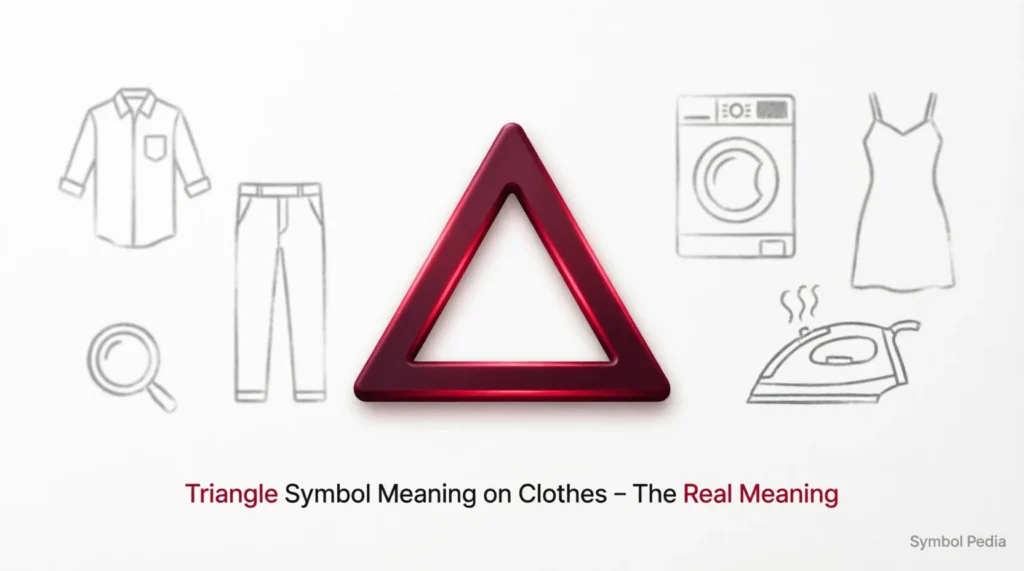
On a standard textile care label, the triangle symbol represents bleaching instructions.
Here is the simple version:
- Empty triangle: Bleaching is allowed.
- Triangle with two diagonal lines: Only non-chlorine/color-safe bleach should be used.
- Triangle crossed out with an X: Do not bleach the garment.
- Triangle by itself as part of a decorative design: It may have nothing to do with laundry care.
For example:
“△” = Bleaching is permitted.
“△ with two diagonal lines” = Use only non-chlorine bleach.
“△ with an X” = Do not use bleach.
The most important point is that the triangle does not tell you how to wash the clothing overall. It specifically addresses bleaching.
A washing tub symbol gives washing instructions, a square normally relates to drying, an iron represents ironing, and a circle generally represents professional dry cleaning.
So if you see a triangle, think bleach.
Origin & Background of the Triangle Clothing Symbol
The triangle is part of the broader international language of textile care symbols. Instead of printing lengthy instructions such as “Do not use chlorine bleach,” manufacturers can communicate the same basic information with a small, recognizable icon.
Standardized care labeling became especially useful as clothing became increasingly international. A garment manufactured in one country might be sold in another where consumers speak a completely different language.
Symbols help bridge that language gap.
International textile-care standards, including ISO 3758, provide a framework for using care symbols. In many markets, organizations and labeling systems also work with standardized textile-care marks so consumers can understand instructions without relying entirely on written language.
The triangle became associated with bleaching because it provides a distinct visual category within the care-label system.
Over time, the symbol became familiar enough that many shoppers recognize its general purpose even if they do not know every variation.
Why Does the Symbol Have Different Versions?
Because “bleach” is not one single thing.
Traditional chlorine-based bleach is powerful and can damage or discolor some fabrics and dyes. Oxygen-based or other non-chlorine bleaches may be more suitable for certain colored garments.
That is why the triangle can contain additional markings.
A plain triangle gives one instruction, while internal lines or an X add restrictions.
This is a good example of how clothing labels use simple graphics to communicate increasingly specific information.
How Social Media Changed the Conversation
People now photograph confusing care labels and ask about them on TikTok, Instagram, Reddit, Facebook, and messaging apps.
A tiny symbol that once went unnoticed can suddenly become the subject of a viral laundry question.
This has also created some confusion because decorative triangles, recycling symbols, fabric symbols, and laundry symbols can look surprisingly similar when viewed quickly.
The safest approach is always to consider where the triangle appears and what other symbols surround it.
Real-Life Conversations About the Triangle Symbol
WhatsApp Conversation
Person A:
“There’s a triangle on my new shirt. Does that mean I can bleach it?”
Person B:
“If it’s an empty triangle on the care label, yes. Check whether there are lines or an X inside it first.”
Person A:
“Oh, mine has an X.”
Person B:
“Then definitely don’t bleach it. That’s the ‘do not bleach’ symbol.”
Person A:
“Glad I checked before washing it!”
Instagram DM
Person A:
“Quick question 😂 What does this little triangle mean on clothes?”
Person B:
“It’s usually the bleach symbol.”
Person A:
“So it means bleach is okay?”
Person B:
“Not always. A plain triangle allows bleaching, but an X through it means no bleach. Diagonal lines mean non-chlorine bleach only.”
Person A:
“Okay, that tiny label suddenly makes sense.”
TikTok Comments
Person A:
“I always thought the triangle meant dry clean 😭”
Person B:
“Not that one. The triangle is for bleach.”
Person A:
“What does the circle mean then?”
Person B:
“Usually dry cleaning instructions.”
Person A:
“Why do clothing labels have their own language?”
Person B:
“Honestly, once you learn the symbols, they’re pretty easy.”
Text Message
Person A:
“Can I use bleach on these white trousers?”
Person B:
“Check the care label.”
Person A:
“It has a triangle with two lines.”
Person B:
“That means non-chlorine bleach only. Don’t use regular chlorine bleach unless the manufacturer specifically says it’s safe.”
Person A:
“Perfect. You may have just saved my trousers.”
Emotional & Psychological Meaning of the Triangle Symbol
Unlike a heart, smiley face, or emoji, the triangle on a clothing label usually has no emotional or psychological meaning.
It is functional.
That distinction is important because people sometimes search for the “meaning” of a symbol assuming it has a hidden message. In the context of a care label, the triangle is simply there to help you protect your clothing.
Still, there is an interesting psychological reason these symbols matter.
Most people do not think about laundry instructions until something goes wrong. A favorite black shirt turns orange, a colorful sweater becomes faded, or a delicate fabric develops an unusual texture.
At that moment, a tiny care symbol suddenly becomes extremely important.
A common real-world situation is this: someone buys an expensive garment, assumes that “white clothing equals bleach,” and reaches for a strong whitening product. Then they notice the crossed triangle only after the damage has already happened.
The lesson is simple: the label is there before the mistake, not after it.
Usage in Different Contexts
Social Media
On social media, people often use the phrase “triangle symbol on clothes” when trying to identify a care-label icon.
The symbol itself does not usually carry slang meaning. If someone posts a picture asking what the triangle means, they are almost certainly talking about laundry care.
Friends & Relationships
Friends may use the symbol while discussing laundry, stain removal, shopping, or clothing care.
For example:
“Check the triangle before you use bleach.”
Here, the triangle is shorthand for the garment’s bleaching instructions.
Work & Professional Settings
The symbol can be especially relevant in workplaces involving uniforms, hospitality, healthcare garments, textile production, cleaning services, and laundry operations.
Professional laundry environments may follow detailed procedures based on fiber type, dyes, chemicals, temperature, and manufacturer instructions.
Casual vs. Serious Tone
The symbol itself has a neutral tone.
Whether the conversation is casual or serious depends on the situation:
“What does this triangle mean?” — casual.
“Follow the garment-care instructions before applying chemical treatments.” — professional.
The meaning of the symbol does not change simply because the conversation becomes more formal.
When NOT to Use or Interpret the Triangle This Way
There are several situations where you should not automatically assume a triangle means bleaching.
1. When It Is a Decorative Design
A triangle printed on a shirt, jacket, or pair of shoes may simply be artwork, branding, or decoration.
Look for the symbol on the care label, usually alongside other laundry symbols.
2. When It Is Part of Another Symbol
Some clothing labels contain additional markings, letters, numbers, or graphics.
Do not interpret one isolated shape without considering the entire symbol.
3. When the Label Is Damaged
A faded or torn triangle can be difficult to interpret correctly.
If you cannot distinguish whether it contains diagonal lines or an X, avoid guessing before using bleach.
4. When the Manufacturer Gives Specific Instructions
A care label may contain written instructions that provide more detail than the symbol alone.
When there is uncertainty, follow the manufacturer’s instructions.
5. When You Are Assuming All Bleach Is the Same
This is one of the most important mistakes to avoid.
“Bleach allowed” does not necessarily mean that every bleaching product is appropriate for every fabric.
Common Misunderstandings About the Triangle Symbol
“The triangle means washing.”
Not exactly.
The washing tub symbol generally deals with washing. The triangle is specifically associated with bleaching.
“An empty triangle means chlorine bleach is always safe.”
Not necessarily.
An empty triangle traditionally indicates that bleaching is permitted, but you should still consider the manufacturer’s instructions and the product you are using.
“All triangles mean the same thing.”
They do not.
Internal lines and crossing marks can significantly change the instruction.
“The triangle is a warning symbol.”
It can look like a warning sign because triangles are commonly associated with caution, but on a clothing care label its standardized purpose is different.
“The triangle means dry cleaning.”
Usually not.
A circle is the main symbol associated with professional dry-cleaning instructions.
“If the clothing is white, bleach must be safe.”
This is a particularly risky assumption.
White fabric can still contain fibers, finishes, dyes, or treatments that are unsuitable for certain bleaching products.
Triangle Clothing Symbols Compared
| Symbol / Marking | Main Meaning | What You Should Do |
|---|---|---|
| Empty triangle | Bleaching permitted | Bleach may be used according to the garment instructions |
| Triangle with two diagonal lines | Non-chlorine bleach only | Choose a suitable color-safe/non-chlorine bleach |
| Crossed-out triangle | Do not bleach | Avoid bleach products |
| Washing tub | Washing instructions | Check temperature and washing method |
| Square | Drying instructions | Check tumble-drying or other drying guidance |
| Iron | Ironing instructions | Follow the recommended heat level |
| Circle | Professional dry cleaning | Check the letters/markings for details |
| Crossed-out care symbol | Action prohibited | Do not perform that treatment |
Key Insight
The shape alone is not always enough. For the triangle, the extra markings are what tell you whether bleaching is allowed, restricted to non-chlorine products, or prohibited altogether.
How to Respond When Someone Asks What the Triangle Means
If someone sends you a picture of a clothing label and asks what the triangle means, you can respond in several ways.
Casual Replies
- “That triangle is the bleach symbol.”
- “It tells you whether bleach is safe.”
- “Check the lines or X inside it too.”
Funny Replies
- “Tiny triangle, surprisingly serious laundry business 😂”
- “That little triangle might save your shirt.”
- “Laundry labels really do have their own secret language 😂”
Mature Replies
- “The triangle refers to bleaching. The exact instruction depends on whether it is plain, marked with lines, or crossed out.”
- “Check the full care label before using any bleaching product.”
Respectful Replies
- “It usually indicates the garment’s bleaching instructions. If you send me the full symbol, I can help you interpret the variation.”
- “The triangle is associated with bleach care. The markings inside it determine what type of treatment is permitted.”
Regional & Cultural Usage
The triangle’s basic laundry meaning is relatively universal, but clothing labels can vary somewhat between markets and labeling systems.
Western Culture
In North America and Europe, consumers commonly encounter standardized textile-care symbols on mass-produced clothing.
The triangle is generally recognized as the bleach-care symbol, although not everyone knows the difference between its variations.
Asian Culture
Clothing sold throughout Asian markets may use international care symbols because garments are frequently manufactured and distributed across borders.
Written instructions may appear in local languages alongside familiar symbols.
Middle Eastern Culture
Clothing labels in Middle Eastern markets can also use internationally recognized care symbols, sometimes alongside Arabic or English instructions.
The practical meaning of the triangle remains focused on bleaching rather than cultural symbolism.
Global Internet Usage
Online, the phrase “triangle symbol on clothes” usually refers to a person’s attempt to identify a laundry-care icon.
Searches often happen when someone is standing in front of a washing machine or holding a new garment and does not want to risk damaging it.
Gen Z vs. Millennials
Younger consumers may be more likely to search the symbol online immediately, especially when buying unfamiliar fabrics or secondhand clothing.
Millennials and older generations may have encountered these symbols repeatedly through years of doing laundry, although familiarity varies greatly from person to person.
In reality, age does not determine whether someone understands the triangle. Clothing-care experience does.
Is the Triangle Symbol Safe for Kids?
Yes. The triangle clothing symbol itself is simply a care instruction and is not dangerous.
However, children should not be encouraged to experiment with bleach or other laundry chemicals.
If a child is helping with laundry, an adult should handle chemical products and explain that a crossed-out triangle means the garment should not be bleached.
The symbol is useful as an educational way to teach children that clothing requires different types of care.
FAQs About the Triangle Symbol on Clothes
What does a triangle symbol mean on clothes?
A triangle on a clothing care label generally indicates bleaching instructions. Its markings show whether bleaching is allowed, restricted, or prohibited.
What does an empty triangle mean on a clothing label?
An empty triangle generally means bleaching is permitted according to the garment’s care instructions.
What does a triangle with an X mean?
A triangle crossed out with an X means do not bleach the garment.
What does a triangle with two lines mean on clothes?
A triangle containing two diagonal lines indicates that non-chlorine bleach should be used, rather than chlorine bleach.
Does a triangle mean I can use any bleach?
Not necessarily. The exact symbol matters, and you should follow the garment manufacturer’s instructions and the directions on the bleaching product.
Is the triangle symbol the same in every country?
Its basic meaning is widely standardized, but care-label systems and labeling requirements can differ between countries and markets.
What clothing symbol means dry cleaning?
A circle is generally used for dry-cleaning instructions. Additional letters or markings inside the circle can provide further information.
Conclusion
The next time you see a tiny triangle on a clothing label, you do not have to wonder what mysterious message it is hiding.
In most care-label contexts, the triangle means bleaching. An empty triangle generally permits bleaching, a triangle with diagonal lines indicates non-chlorine bleach, and a crossed-out triangle means you should not bleach the garment.
The most useful habit is to slow down for a few seconds before reaching for a laundry chemical. Read the complete care label, look carefully at the markings inside the triangle, and follow the manufacturer’s instructions.
A tiny symbol can seem insignificant, but it can make the difference between preserving a favorite piece of clothing and accidentally ruining it.
Once you learn the triangle, the rest of the clothing-care symbols become much easier to understand. What initially looks like a confusing collection of shapes starts to feel like a simple visual language designed to help you take better care of what you wear.
descover more post
What Does the Lock Symbol Mean on Snapchat Everything …
Ohm Symbol and Meaning Understanding Ω Its History and …
What Does the Clover Symbol Mean Luck Love Culture More …

Orvian is a passionate researcher and dedicated content creator focused on exploring the deeper meanings behind symbols, signs, and cultural interpretations. With a strong interest in symbolism and human psychology, Orvian simplifies complex ideas into clear, engaging, and easy-to-understand content for readers around the world.
Through consistent research and thoughtful writing, Orvian aims to provide accurate, insightful, and meaningful information that helps users connect with symbols on a deeper level—whether for personal growth, curiosity, or knowledge.
Known for a hardworking mindset and attention to detail, Orvian believes that every symbol carries a story, and every story deserves to be understood.