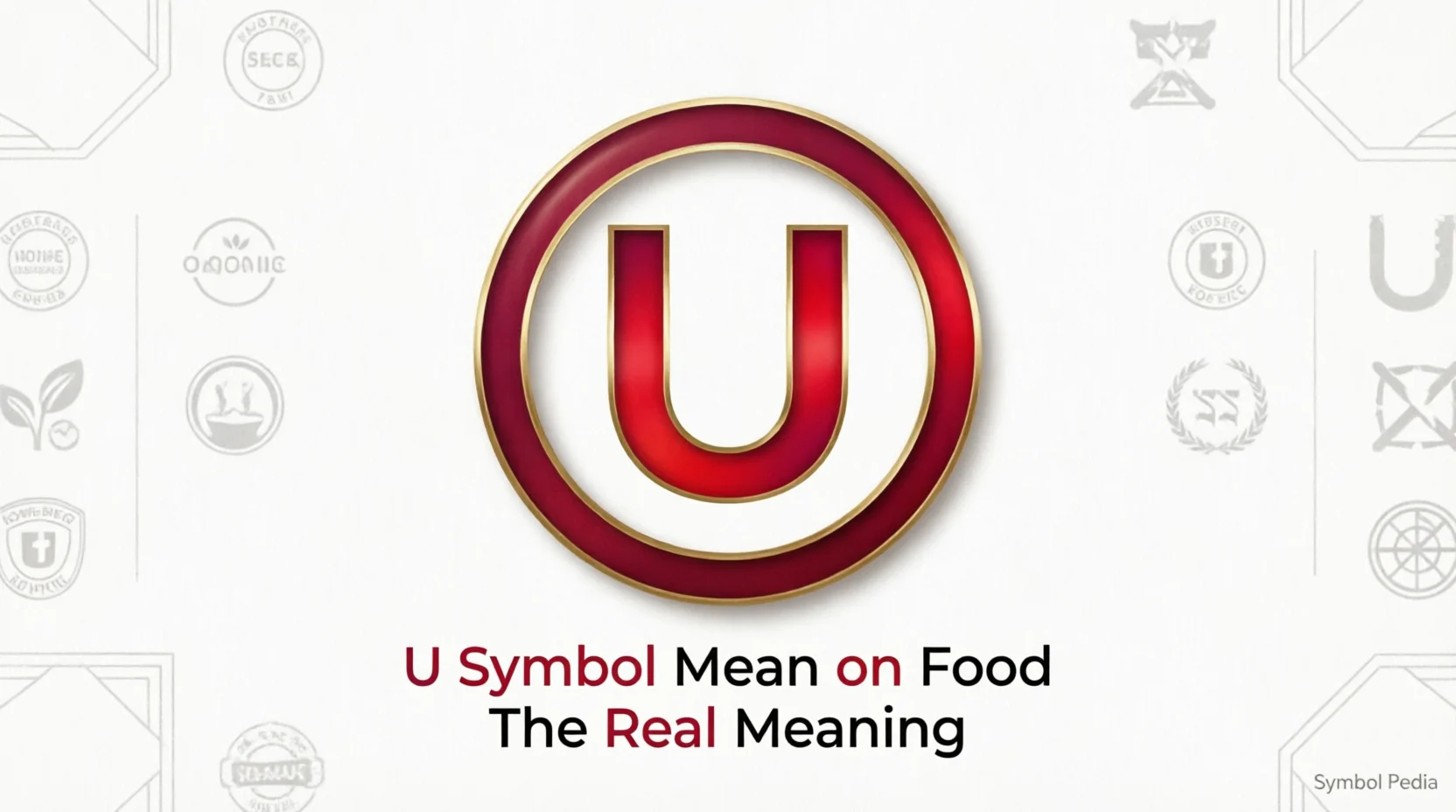
Have you ever noticed a U inside a circle on a food package and wondered what it actually means?
The symbol can look like a simple letter or a quality mark, but on food packaging, it has a specific purpose. The familiar Ⓤ symbol is the kosher certification mark of the Orthodox Union (OU). It tells consumers that the product has been certified as kosher under OU standards.
For someone unfamiliar with kosher labeling, the symbol can be confusing. Does it mean the food is vegetarian? Is it a health certification? Does it mean the food contains no animal ingredients?
Not exactly.
The details become especially important when the U appears with another letter, such as D, P, M, or F. Those small additions can change what the certification tells you about the food.
This guide explains what the U symbol means on food, where it came from, how to read its variations, and what it means in everyday situations.
What Does the U Symbol Mean on Food? – Quick Meaning
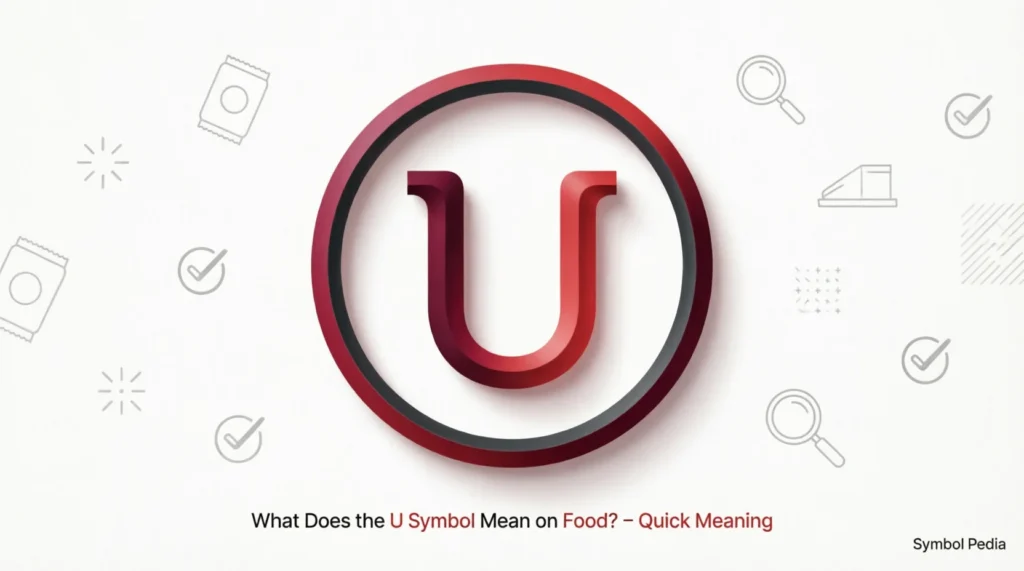
The Ⓤ symbol on food generally means the product is certified kosher by OU Kosher, the kosher certification program of the Orthodox Union. The standard OU symbol without an additional letter generally indicates a kosher pareve product—meaning it contains neither dairy nor meat or their derivatives and was not produced on dairy or meat equipment.
In simple terms:
- Ⓤ / OU = Kosher, generally pareve
- ⓊD / OU-D = Kosher dairy or made on dairy equipment
- ⓊP / OU-P = Kosher for Passover
- ⓊM / OU-M = Kosher meat
- ⓊF / OU-F = Contains a significant fish ingredient
So, if you see a plain circled U on a snack, cereal, sauce, or another packaged food, it is not simply a decorative logo.
It is a certification mark connected to Jewish dietary laws, known as kashrut.
For example:
“This cereal has an OU symbol, so it has kosher certification.”
“Check whether the product says OU-D before serving it with meat.”
“OU-P means this product has specific Passover certification.”
One important point: the plain OU symbol does not automatically mean the food is certified for Passover. Passover certification is specifically identified with OU-P.
Origin & Background of the U Food Symbol
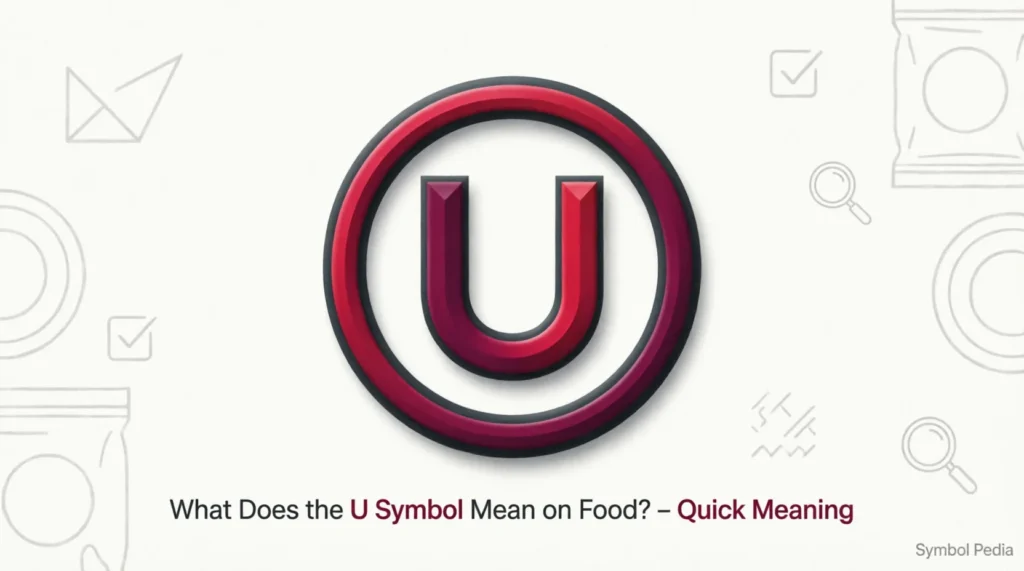
The story behind the U symbol goes back more than a century and is closely connected to the growth of kosher food production in the United States.
The Orthodox Union developed kosher certification as food manufacturing became increasingly industrialized. Consumers needed a dependable way to know whether packaged foods met kosher requirements.
The familiar U inside a circle became associated with OU kosher supervision in the 1920s. According to OU’s historical account, the symbol was created in connection with Heinz products and was designed in 1923.
That was an important development.
Before modern packaged-food labeling, consumers often had to rely on personal knowledge, trusted suppliers, or community guidance. As ingredients became more complex and manufacturing moved into large factories, identifying kosher status became much harder.
A recognizable certification mark offered a practical solution.
Over time, the OU symbol became widely recognized far beyond Jewish communities. Today, OU Kosher describes itself as one of the world’s largest kosher certification agencies, with certification covering products made across numerous countries.
Why did the symbol become so recognizable?
Part of the reason is simple: it is easy to spot.
A consumer does not need to read an entire ingredient list to recognize the certification mark. The symbol provides a quick visual signal that the product has undergone kosher certification.
Kosher labeling also became part of mainstream food culture in the United States. Manufacturers discovered that kosher certification could appeal to consumers beyond those who specifically follow Jewish dietary laws.
Today, people may notice the symbol on everything from crackers and chocolate to beverages, sauces, cereals, and processed foods.
Real-Life Conversations About the U Symbol
Sometimes the easiest way to understand a food label is to see how people actually talk about it.
1. WhatsApp Conversation
Person A:
I bought these cookies. Do you know what the U in the circle means?
Person B:
That’s the OU kosher symbol.
Person A:
Oh, so they’re vegetarian?
Person B:
Not necessarily. The plain OU usually means kosher and pareve, but kosher and vegetarian aren’t exactly the same thing.
Person A:
Got it. I thought it was another nutrition symbol.
2. Instagram DM
Person A:
Why does this chocolate have OU-D on it?
Person B:
The D means dairy.
Person A:
So the U alone would be different?
Person B:
Yes. A plain OU generally indicates pareve certification, while OU-D indicates dairy or dairy equipment.
Person A:
That little D makes a bigger difference than I expected.
3. TikTok Comments
Commenter 1:
What does that U symbol mean on the cereal box?
Commenter 2:
It’s an OU kosher certification.
Commenter 3:
Does that mean it’s healthy?
Commenter 2:
Nope. Kosher certification and nutrition are different things.
Commenter 4:
That explains why I keep seeing it on completely different foods.
4. Text Message
Person A:
Is this snack okay for Passover?
Person B:
Look for OU-P.
Person A:
It has a regular OU.
Person B:
Regular OU means kosher, but don’t assume it’s kosher for Passover. OU-P specifically indicates Passover certification.
Emotional & Psychological Meaning of the U Symbol
A food certification symbol might look purely technical, but for people who rely on it, it can carry a much deeper meaning.
For someone who follows kosher dietary laws, the symbol can provide confidence, reassurance, and a sense of trust when buying food.
Imagine standing in a supermarket with dozens of products in front of you. Ingredient lists may contain unfamiliar names, processing information can be complicated, and manufacturing methods are not always visible.
A trusted certification mark simplifies that decision.
It essentially answers one important question: Has this product been examined and certified according to a recognized kosher standard?
That can make shopping feel much less stressful.
A simple personal-style scenario
Imagine visiting a supermarket with a friend who keeps kosher.
You pick up a snack and casually say, “This looks fine.”
Your friend checks the package first.
They are not being overly cautious. They are looking for information that matters to their religious practice. When they find a trusted kosher symbol, the decision becomes easier.
That small printed mark can therefore represent something much larger than a logo: trust between the consumer, the certification organization, and the food manufacturer.
Usage in Different Contexts
On Social Media
The U symbol occasionally appears in food videos, grocery hauls, recipe discussions, and product reviews.
Someone might ask:
“Does anyone know what the OU means?”
In online conversations, people sometimes incorrectly describe it as a general “quality” or “health” symbol.
It is better to be precise: it is primarily a kosher certification mark, not a nutrition or health certification.
Among Friends and Relationships
Friends may discuss the symbol when sharing meals or buying food for someone who keeps kosher.
For example:
“I’m bringing snacks tonight. Is OU-certified food okay?”
The answer may depend on the specific dietary requirements of the person.
A plain OU, OU-D, OU-P, and other designations are not interchangeable.
Work and Professional Settings
In workplaces, restaurants, catering, schools, or events, the symbol can become particularly relevant when food is being provided for people with religious dietary requirements.
Rather than guessing what someone can eat, checking the certification can show consideration.
Still, it is wise to ask the person about their own requirements because different people may follow different standards.
Casual vs. Serious Tone
There is no special “slang” meaning attached to the U symbol.
In casual conversation, someone might simply say:
“Look for the OU.”
In a more serious context, such as food preparation or religious observance, people may want to distinguish carefully between kosher categories.
When NOT to Assume What the U Symbol Means
The biggest mistake is assuming that every U-shaped logo on every package means the same thing.
The recognizable kosher symbol is specifically the OU mark: a U inside a circle.
Also, don’t assume that the symbol means:
- Healthy
- Organic
- Vegan
- Vegetarian
- Gluten-free
- Halal
- Non-GMO
- Low-calorie
- Allergy-free
These are separate claims and certifications.
Another important caution is that not every product made by a particular brand is automatically OU-certified. Certification applies to the specific products and manufacturing arrangements covered by the certification.
So if one flavor carries an OU mark, don’t automatically assume every flavor from the same brand does.
Common Misunderstandings About the U Symbol
“It means vegetarian.”
Not necessarily.
A plain OU symbol generally indicates kosher pareve status, which means no dairy or meat components under the certification conditions. But kosher and vegetarian are different concepts.
“It means the food is healthier.”
No.
Kosher certification concerns compliance with Jewish dietary laws and production requirements. It does not mean a product is nutritionally superior.
“OU always means Passover-safe.”
No.
For Passover certification, look specifically for OU-P or the appropriate Passover designation.
“OU-D just means the product contains milk.”
Not always in the simplest sense.
OU-D indicates that the product is dairy or was processed using dairy equipment.
“The symbol is just a brand logo.”
No.
The OU mark represents kosher certification and supervision.
U Symbol vs. Other Food Designations
| Symbol / Term | Meaning | Main Difference |
|---|---|---|
| OU / Ⓤ | Kosher, generally pareve | No dairy or meat under OU’s certification |
| OU-D | Kosher dairy | Contains dairy or uses dairy equipment |
| OU-P | Kosher for Passover | Meets additional Passover requirements |
| OU-M | Kosher meat | Contains meat or meat ingredients |
| OU-F | Kosher fish | Contains a significant fish ingredient |
| Vegan | No animal-derived ingredients | Not the same as kosher |
| Vegetarian | Generally excludes meat | Does not automatically indicate kosher status |
| Halal | Meets Islamic dietary requirements | A different religious food standard |
| Gluten-free | Meets gluten-related labeling requirements | Concerns gluten, not kosher status |
Key Insight
The easiest way to remember the difference is this: OU tells you about kosher certification, while labels such as vegan, halal, organic, and gluten-free describe different aspects of a food. One certification does not automatically guarantee another.
How to Respond When Someone Asks About the U Symbol
If someone sends you a picture of a food package and asks what the symbol means, your response can match the situation.
Casual Replies
- “That’s the OU kosher symbol.”
- “It means the food has kosher certification.”
- “The U in the circle is an OU certification mark.”
Funny Replies
- “That tiny U is doing more work than it looks like.”
- “It’s not a nutrition badge—it’s a kosher certification.”
- “Welcome to the surprisingly complicated world of food labels.”
Mature Replies
- “The circled U indicates OU kosher certification. The exact status depends on whether there are additional letters.”
- “A plain OU generally indicates pareve kosher status, while OU-D and OU-P have additional meanings.”
Respectful Replies
- “It’s the Orthodox Union kosher certification symbol. If you’re checking whether a product fits someone’s specific dietary practice, it’s best to look at the exact designation or ask them.”
That last response is particularly useful because religious observance can vary from person to person.
Regional & Cultural Usage
Western Culture
In the United States and Canada, the OU symbol is especially familiar because kosher certification has become a common part of packaged-food labeling.
Many non-Jewish consumers recognize the symbol even if they do not personally follow kosher dietary laws. OU describes its certification as widely recognized internationally.
Asian Culture
In Asian markets, awareness of kosher symbols varies considerably by country and community.
Some consumers encounter the OU symbol when buying imported American foods or products marketed toward international consumers.
It may be less immediately familiar than local food certifications.
Middle Eastern Culture
In Middle Eastern countries, consumers may be more accustomed to discussing halal food certification.
That can create confusion for people who encounter an OU symbol on imported products.
Kosher and halal share some broad concerns about permissible foods, but they are different religious dietary systems and should not automatically be treated as identical.
Global Internet Usage
The internet has made food-label symbols much easier to research.
Someone can photograph an unfamiliar symbol in a supermarket and search for its meaning within seconds.
That convenience is useful, but it also creates misinformation. Social media posts sometimes label food symbols as “healthy,” “vegan,” or “safe for everyone” without understanding what the certification actually means.
Gen Z vs. Millennials
Younger consumers often discover food certifications through TikTok, Instagram, Reddit, and short-form educational videos.
Millennials may be more accustomed to traditional ingredient-label research and brand websites.
Neither generation automatically understands kosher certification, however. The difference is often where they look for the explanation, rather than whether they know the symbol.
Is the U Symbol Safe for Kids?
Yes, the symbol itself is simply a food certification mark and is not dangerous or age-restricted.
The important point for children is understanding what it does—and does not—tell them.
A child should not assume that an OU symbol means a food is healthy, allergy-free, or suitable for every diet.
Parents and caregivers should still check ingredients, allergen information, nutrition facts, and any dietary requirements that apply to the child.
FAQs About the U Symbol on Food
1. What does the U symbol mean on food?
The circled U, or OU symbol, generally means the product has been certified kosher by OU Kosher, the Orthodox Union’s kosher certification program.
2. Does the U symbol mean the food is vegetarian?
No. A plain OU generally indicates kosher pareve status, but kosher and vegetarian are different dietary classifications.
3. What does OU-D mean?
OU-D means the product is kosher dairy or was made using dairy equipment.
4. What does OU-P mean?
OU-P means the product is certified kosher for Passover. A regular OU symbol should not automatically be interpreted as Passover certification.
5. Is OU the same as halal?
No. OU kosher certification follows Jewish dietary requirements, while halal certification follows Islamic dietary requirements.
6. Does OU mean the food is healthy?
No. The OU symbol is about kosher certification, not calories, nutrition, organic status, or general healthfulness.
7. Can I assume every product from a brand with an OU symbol is kosher?
No. Check the specific product and package. Certification can apply to particular products, sizes, facilities, or production arrangements rather than automatically covering everything a brand sells.
Conclusion
So, what does the U symbol mean on food?
If you’re referring to the familiar U inside a circle, it is the OU kosher certification symbol associated with the Orthodox Union. A plain OU generally indicates kosher pareve status, while additional letters such as D, P, M, and F provide more specific information about the product’s kosher classification.
The most important lesson is not to judge the symbol by its appearance alone.
It isn’t a health rating, a vegan label, or a guarantee that the food fits every dietary preference. It is a certification connected to Jewish dietary law and food-production standards.
Once you know what you’re looking at, that little U becomes much easier to understand. And the next time you spot it on a cereal box, cookie packet, or bottle, you’ll know that there is a real history—and a meaningful system—behind that simple circle and letter.
descover more post
What Does the Car Sliding Symbol Mean Warning Light …
What Does the Swirl Symbol Mean A Complete Guide to Its …
Japanese Symbol Meaning What Popular … – Symbl Pedia

Kavon is a passionate content creator and digital researcher who specializes in decoding symbols, meanings, and modern internet language. With a strong focus on clarity and authenticity, Kavon writes in a way that makes complex ideas simple, relatable, and useful for everyday readers.
Known for a hardworking mindset and attention to detail, Kavon is dedicated to creating content that genuinely helps people understand the deeper meanings behind words, signs, and online expressions. Every article is crafted with care, combining research, real-life insight, and a reader-first approach.
Through Symblpedia, Kavon aims to build a trusted space where curiosity meets clarity—helping users find answers that are not only accurate but also meaningful and easy to understa