
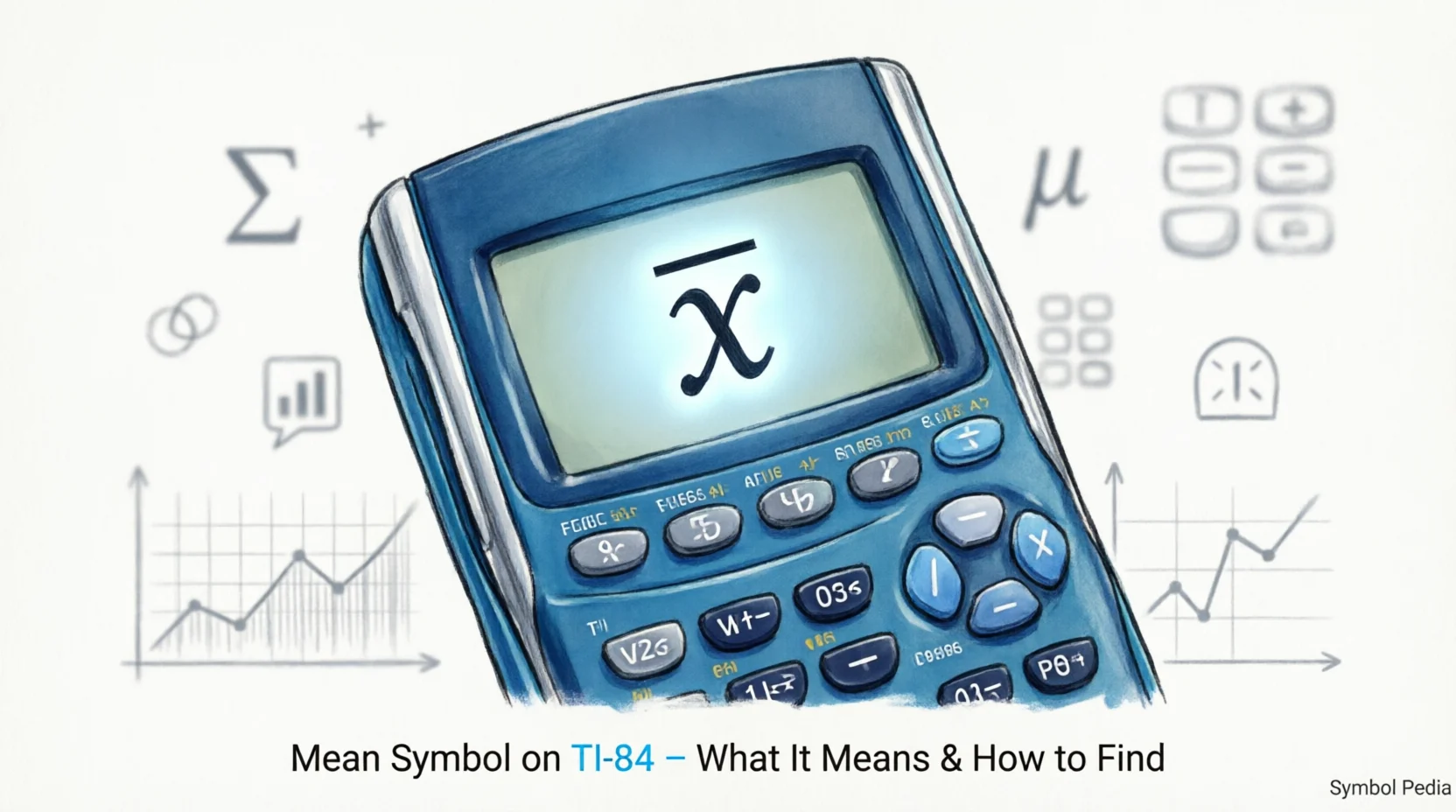
If you are using a TI-84 calculator for statistics, you may come across a symbol that looks like an x with a small bar over it: x̄. If you are wondering what the mean symbol on a TI-84 actually means, you are not alone.
The symbol x̄ (x-bar) represents the sample mean, or average, of a set of numbers. It is one of the most common symbols you will encounter when working with statistics, especially when using the TI-84 to calculate descriptive statistics.
The confusion usually starts when students see x̄ = 72.5 on the calculator screen and wonder whether x-bar is a special calculator function, a variable they need to type, or simply another name for the average.
The answer is simpler than it looks: x̄ is the statistical symbol for the mean of a sample.
Your TI-84 can calculate this value for you through its statistical functions. You generally do not need to manually enter the x̄ symbol. Instead, you enter your data, run 1-Variable Statistics, and the calculator displays the mean as x̄.
Understanding this small symbol can make statistics feel much less intimidating. Once you know what it represents, many calculator outputs become easier to read and interpret.
Mean Symbol on TI-84 – Quick Meaning
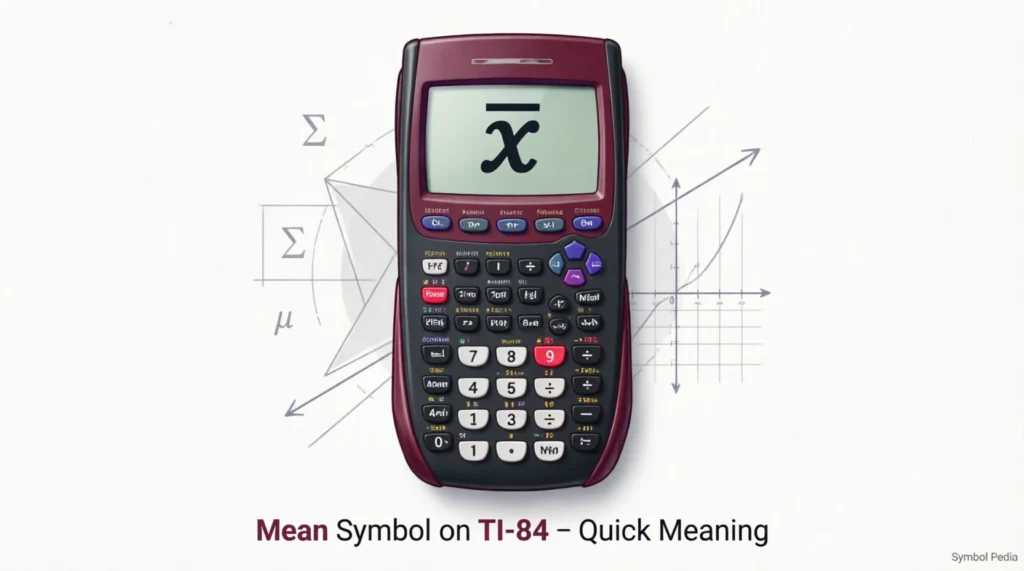
The mean symbol on the TI-84 is x̄ (x-bar).
It means the arithmetic average of a sample.
- x̄ = sample mean
- Σ = sum
- n = sample size
- μ = population mean
- Sx = sample standard deviation
- σx = population standard deviation
The basic formula is:
x̄ = Σx / n
In simple terms, add all the values together and divide the result by how many values you have.
For example:
10, 20, 30, 40, 50
The total is 150, and there are 5 numbers.
x̄ = 150 ÷ 5 = 30
So the mean is 30.
Another example:
Test scores: 72, 81, 85, 92
Their mean is:
(72 + 81 + 85 + 92) ÷ 4 = 82.5
Therefore:
x̄ = 82.5
That is the value your TI-84 reports when you calculate one-variable statistics.
What Does x̄ Mean in Statistics?
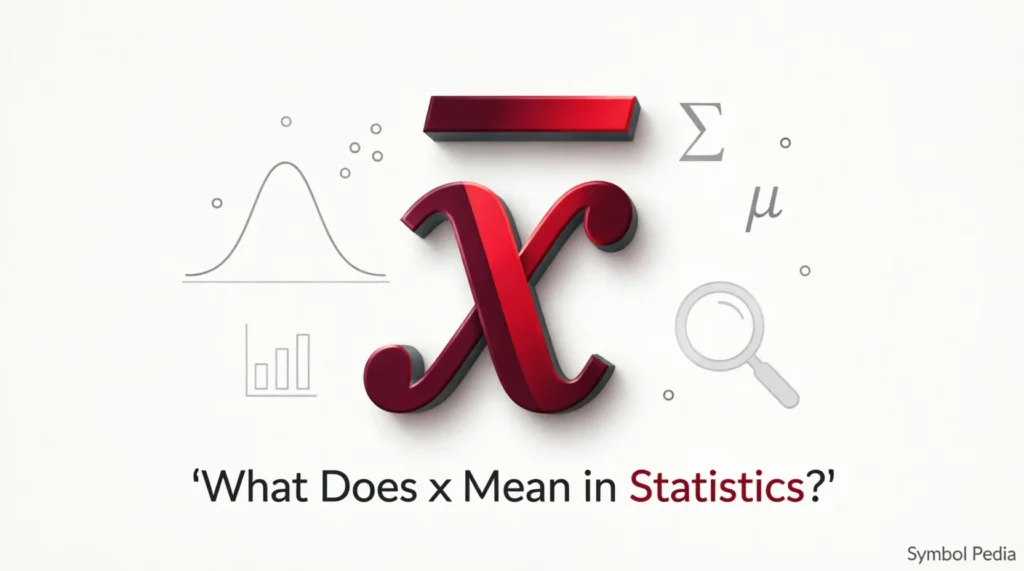
The letter x generally represents an individual observation or data value.
When a horizontal line is placed above it, producing x̄, the meaning changes. It represents the average of all observations in a sample.
For example, imagine five students receive these scores:
68, 74, 80, 86, 92
The individual scores are represented by x values.
Their average is represented by x̄.
So:
x̄ = 80
This distinction matters because statistics often deals with many numbers at once.
The symbol x represents one data point, while x̄ summarizes the entire sample with one number.
How to Find the Mean on a TI-84
The easiest way to find the mean is through the calculator’s 1-Variable Statistics function.
Suppose you have the following data:
12, 15, 18, 21, 24
Step 1: Enter the data
Press:
STAT
Then choose:
1:Edit
Enter your numbers into L1.
Your screen should contain something similar to:
- L1: 12
- L1: 15
- L1: 18
- L1: 21
- L1: 24
Step 2: Open the statistics calculation
Press:
STAT
Then move to the CALC menu.
Choose:
1: 1-Var Stats
Depending on your calculator settings, you may need to enter the list containing your data.
For example:
1-Var Stats L1
Then press ENTER.
Step 3: Find x̄
The calculator will display several statistical values.
Look for:
x̄
That number is your sample mean.
For the example above:
x̄ = 18
The TI-84 has done the addition and division for you.
Why Does the TI-84 Use x̄ Instead of Saying “Mean”?
The symbol x̄ comes from traditional statistical notation rather than being something unique to Texas Instruments.
Statisticians use symbols because mathematical notation needs to communicate information quickly and consistently.
Instead of writing:
“the average of the sample”
every time, they can simply write:
x̄
This is particularly useful in formulas.
For example:
x̄ = Σx/n
is much shorter and easier to use mathematically than writing the entire phrase.
The TI-84 follows this established notation, which is why you see x̄ rather than a word such as “average.”
Origin & Background of the Mean Symbol
The concept of an arithmetic mean is centuries old. People have used averages to compare quantities long before modern calculators existed.
The notation x̄ developed as part of modern mathematical and statistical writing. The bar over a variable is commonly used to indicate an average.
The idea is intuitive.
If x represents individual observations, putting a bar over x signals that you are talking about the average of those observations.
Modern calculators such as the TI-84 simply display the established statistical notation electronically.
There is also an important cultural shift behind why students frequently search for terms such as “mean symbol on TI-84.”
Today, students often learn statistics through a mixture of textbooks, classroom instruction, online videos, homework platforms, and calculator screens. A symbol that might once have been explained by a teacher can suddenly appear on a screen without much context.
That makes searching for the symbol’s meaning completely understandable.
Social media and online homework communities have also made calculator terminology more visible. Students commonly ask questions such as “What does x-bar mean?” or “Where is mean on a TI-84?” because they recognize the calculation but not necessarily the notation.
Real-Life Conversations About the Mean Symbol on TI-84
WhatsApp Conversation
Person A:
I got x-bar on my TI-84. Is that the mean?
Person B:
Yep. x-bar is the sample mean.
Person A:
So if it says x-bar = 76.4, I write 76.4 as the average?
Person B:
Exactly. That’s your sample’s mean.
Instagram DM
Person A:
Why does my calculator say x̄ instead of mean?
Person B:
That’s just the statistics symbol for the average.
Person A:
Ohhh. I thought I had to find another button.
Person B:
Nope. Run 1-Var Stats and the TI-84 calculates it automatically.
TikTok Comments
Person A:
What does the x with the line over it mean on the TI-84?
Person B:
x-bar. It means sample mean.
Person A:
So basically average?
Person B:
Yes, basically the statistical word for average.
Text Message
Person A:
My homework asks for x-bar and I’m confused.
Person B:
Enter the data into L1, then use STAT > CALC > 1-Var Stats.
Person A:
And x-bar is the answer?
Person B:
If they’re asking for the sample mean, yes.
Emotional & Psychological Meaning
There is no special emotional meaning behind x̄ itself. It is a mathematical symbol.
However, the confusion surrounding it can have a psychological side.
For many beginners, unfamiliar notation creates the impression that a problem is harder than it really is. A student may understand “average” perfectly well but become uncertain when a textbook suddenly calls it x̄.
That is a common experience in mathematics: sometimes the difficult part is not the calculation but understanding the language used to describe it.
I have seen this kind of confusion repeatedly in basic statistics. Once students realize that x̄ simply means “the sample average,” the rest of the calculation often becomes much less intimidating.
The larger lesson is useful beyond statistics: never assume a new symbol represents a new mathematical idea. Sometimes it is simply a shorter way of naming something you already understand.
Using the Mean Symbol in Different Contexts
Social Media
On social media, x̄ usually appears in educational posts, statistics discussions, homework help, and calculator tutorials.
Someone might write:
“My x̄ is 84.2.”
They are simply saying that their sample average is 84.2.
Online, people may also use the phrase “x-bar” instead of writing the actual symbol.
Friends and Relationships
In casual conversation, people rarely use x̄ unless they are discussing school, research, grades, sports statistics, or data.
A student might text:
“My x-bar was higher than I expected.”
This usually means:
“My average was higher than I expected.”
There is no hidden slang meaning.
Work and Professional Settings
In professional statistics, research, education, economics, engineering, and data analysis, x̄ can have a much more formal role.
For example, a researcher might compare the mean of one sample with another.
A report could state that:
Sample A: x̄ = 42.7
This means the observations in Sample A have an average of 42.7.
Casual vs. Serious Tone
The symbol itself is neutral.
The context determines how formal the communication feels.
- “The average is 50.” — everyday language
- “x̄ = 50.” — mathematical/statistical notation
- “The sample mean is 50.” — formal statistical language
All three communicate essentially the same central idea.
When NOT to Use the Mean Symbol
Don’t Use x̄ When You Mean the Population Mean
This is one of the most important distinctions.
x̄ generally represents a sample mean.
The population mean is usually represented by:
μ (mu)
So if a statistics problem specifically asks for the population mean, you should not automatically label your answer x̄.
Don’t Assume x̄ Is a Calculator Variable
The x̄ displayed by the TI-84 is statistical output.
You normally do not need to create a variable called x-bar or type the symbol manually just to calculate the mean.
Let the calculator’s statistics functions calculate it.
Don’t Confuse It With x
An individual observation can be represented by x, while the mean is represented by x̄.
For example:
x = 25
could represent one score.
But:
x̄ = 25
means the average of the sample is 25.
Those statements are not necessarily saying the same thing.
Common Misunderstandings About x̄ on TI-84
1. “x̄ is a special button.”
Not exactly.
The TI-84 displays x̄ as part of its statistical output. You usually access it by running 1-Var Stats.
2. “x̄ means the biggest number.”
No.
The mean is an average. It is not automatically the maximum value.
3. “x̄ means the middle number.”
Not necessarily.
The median is the middle value when data are arranged in order. The mean is calculated by adding the values and dividing by the number of observations.
4. “x̄ and μ always mean the same thing.”
No.
They can both describe averages, but x̄ usually refers to a sample mean, while μ refers to a population mean.
5. “I have to type x̄ into the TI-84.”
Usually, no.
If your goal is to calculate the mean, enter your data and use 1-Var Stats.
6. “The mean is always one of the original data values.”
Not necessarily.
For example:
10, 20, 30
has a mean of 20, which happens to be one of the values.
But:
10, 20
has a mean of 15, which is not in the original data.
Mean Symbol vs. Similar Statistical Terms
| Symbol or Term | Meaning | Common Use |
|---|---|---|
| x̄ | Sample mean | Average of sample data |
| μ | Population mean | Average of an entire population |
| x | Individual observation | One data value |
| Median | Middle value | Describing the center of ordered data |
| Mode | Most frequent value | Finding the most common observation |
| Σx | Sum of observations | Adding all data values |
| n | Sample size | Number of observations in a sample |
| Sx | Sample standard deviation | Measuring sample variability |
| σx | Population standard deviation | Measuring population variability |
Key Insight
The most important distinction is simple: x̄ means sample average, while μ generally means population average. If you remember that difference, much of the statistical notation on your TI-84 becomes easier to understand.
How to Respond When Someone Asks About x̄
Casual Reply
“x-bar just means the sample average.”
Funny Reply
“It’s basically your calculator’s fancy way of saying ‘average.’”
Mature Reply
“x̄ represents the arithmetic mean of the sample. You can find it through 1-Var Stats on the TI-84.”
Respectful Reply
“x̄ means sample mean. If you enter your data into a list and run 1-Var Stats, the TI-84 will calculate it for you.”
Helpful Reply
“Enter the values in L1, go to STAT → CALC → 1-Var Stats, and look for x̄ in the results.”
Regional & Cultural Usage
Mathematical notation is more internationally consistent than everyday slang, but teaching styles can still differ.
Western Culture
In the United States, Canada, the United Kingdom, and other Western educational systems, students commonly encounter x̄ in introductory statistics courses.
American textbooks often use “x-bar” when teaching sample means.
The TI-84 is particularly familiar in American high schools and colleges, so students may encounter x̄ directly on the calculator.
Asian Culture
Across many Asian education systems, students may learn the same statistical notation but encounter different terminology or textbook conventions.
Some teachers emphasize the formula first, while others focus on calculator procedures.
Regardless of teaching style, x̄ generally retains its statistical meaning as the sample mean.
Middle Eastern Culture
Statistics courses in Middle Eastern educational institutions also commonly use internationally recognized mathematical notation.
The language of instruction may vary, but symbols such as x̄, μ, and σ are often retained because they are standard mathematical notation.
Global Internet Usage
Online education has made statistical terminology increasingly universal.
A student in one country may watch a calculator tutorial created in another country and immediately encounter x-bar.
That is one reason phrases such as “mean symbol on TI-84” are useful search queries: students may understand the calculation but need help translating the notation.
Gen Z vs. Millennials
Younger students who regularly use calculators, online homework systems, and educational videos may encounter x̄ in several different formats.
Gen Z students are especially likely to ask about the symbol directly through search engines, video comments, or messaging platforms.
Millennials may remember learning the same notation through traditional classroom instruction, printed textbooks, or earlier calculator models.
The mathematics has not changed. The way people learn and ask about it has.
Is the Mean Symbol on TI-84 Safe for Kids?
Yes. x̄ is a standard educational statistics symbol and is completely safe for children and teenagers.
It is commonly taught in middle school, high school, college-preparatory, and introductory statistics courses.
The main issue is not safety but understanding the difference between sample mean, population mean, median, and mode.
For younger learners, explaining x̄ as “the average of the sample” is usually the clearest starting point.
FAQs About the Mean Symbol on TI-84
What does x̄ mean on a TI-84?
x̄ means the sample mean, or average, of the data you entered. It is normally displayed when you use the calculator’s 1-Variable Statistics function.
How do I find the mean on a TI-84?
Enter your data into a list, then select STAT → CALC → 1-Var Stats. The result labeled x̄ is the sample mean.
Is x̄ the same as average?
Yes. In basic statistics, x̄ is the arithmetic average of a sample.
What is the difference between x̄ and μ?
x̄ generally represents a sample mean, while μ represents a population mean.
What is the difference between x and x̄?
x can represent an individual data value, while x̄ represents the average of the sample’s values.
Is x-bar the median?
No. x̄ is the mean, while the median is the middle value when the data are arranged from smallest to largest.
Do I need to type the x̄ symbol into my TI-84?
Usually not. The calculator produces x̄ automatically as statistical output when you run 1-Var Stats on your dataset.
Conclusion
The mean symbol on a TI-84, x̄, is simply the statistical notation for the sample mean. In everyday language, that means the average of the values in your sample.
Once you recognize x̄, the TI-84’s statistics screen becomes much easier to read. Instead of seeing a strange letter with a line above it, you can immediately understand what the calculator is telling you.
Remember the essentials:
x̄ = sample mean
μ = population mean
x = individual observation
And when you need the mean on your TI-84, you generally do not need to hunt for an “average” button. Enter your data, run 1-Var Stats, and look for x̄ in the results.
A small symbol can look complicated when you first meet it. But once you know what it stands for, it becomes one of the simplest pieces of statistical notation you’ll use.
descover more post
Statistical Symbol for Mean What It Means How to Use It and …
What Does the Infinity Symbol Mean in Apple Music Complete …
What Does the Car Sliding Symbol Mean Warning Light …