If you have ever looked at an electrical diagram, electronics project, physics textbook, or even the specifications of a household device, chances are you have seen the symbol Ω. Many people recognize it but are not entirely sure what it means.
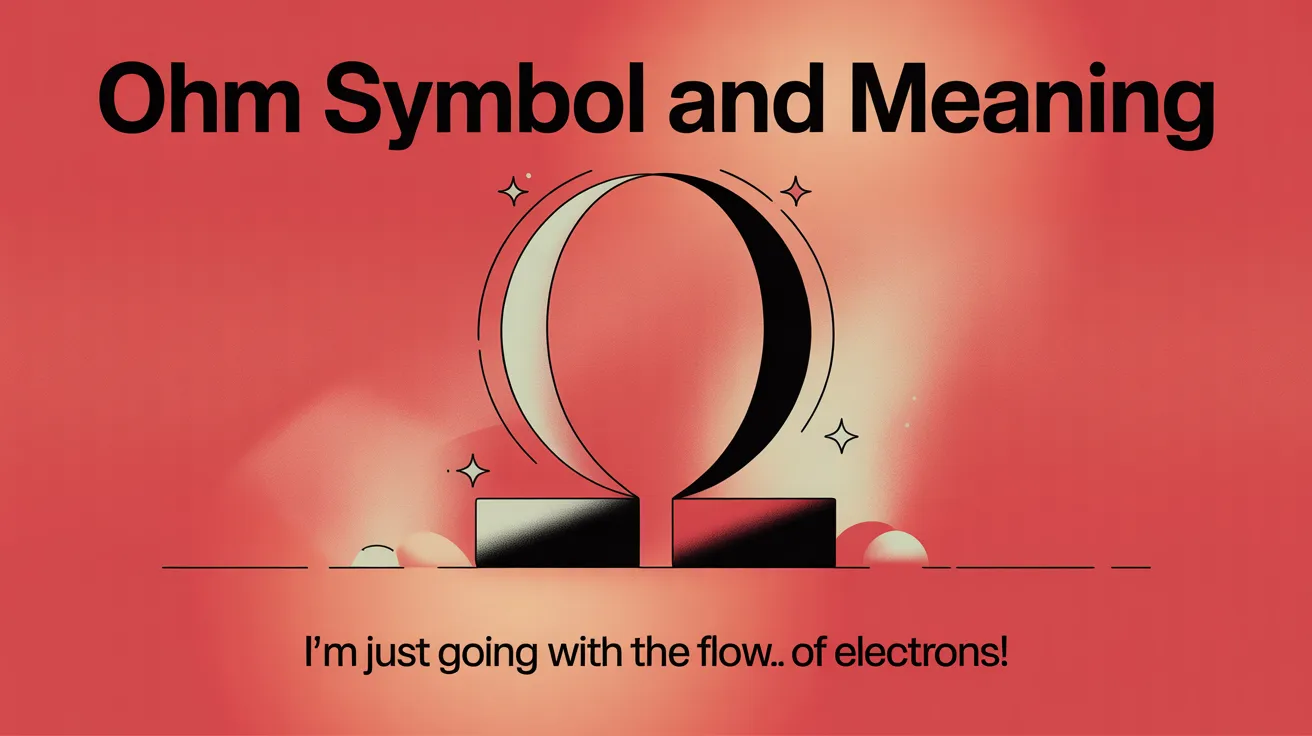
The ohm symbol (Ω) is one of the most important symbols in electricity and electronics. It represents resistance—the property that controls how easily electric current flows through a circuit.
People search for “ohm symbol and meaning” for different reasons. Some encounter it while studying science, others see it on electrical equipment, and many simply want to understand what the strange Greek letter actually represents.
Understanding the ohm symbol helps make sense of how electricity works in everyday life. Whether you’re a student, hobbyist, technician, or simply curious, knowing the meaning behind Ω can make electrical concepts much easier to understand.
Ohm Symbol and Meaning – Quick Meaning
The ohm symbol (Ω) is the official symbol for the unit of electrical resistance.
Quick Definition
- Symbol: Ω
- Name: Ohm
- Measures: Electrical resistance
- Named after: Georg Simon Ohm
- Used in: Electronics, electrical engineering, physics, and technology
In simple terms, resistance is the opposition to electric current.
Think of electricity like water flowing through a pipe:
- More resistance = harder flow
- Less resistance = easier flow
Examples
“This resistor has a value of 100 Ω.”
“The speaker has an impedance of 8 Ω.”
“The circuit resistance measures 500 Ω.”
Origin & Background

The story of the ohm symbol begins with the work of German physicist Georg Simon Ohm.
During the early 1800s, scientists were trying to understand how electricity moved through materials. Ohm conducted extensive experiments and discovered a relationship between voltage, current, and resistance.
His findings eventually became known as Ohm’s Law, one of the most fundamental principles in electrical science.
The unit of resistance was later named the ohm in his honor.
The symbol Ω comes from the Greek alphabet. It is the uppercase form of the Greek letter omega.
Scientists adopted omega because it was visually distinct and easy to recognize in technical writing.
As technology evolved—from telegraphs to radios, computers, smartphones, and modern electronics—the Ω symbol became a universal language understood by engineers and technicians worldwide.
Today, the symbol appears everywhere from circuit diagrams and electrical manuals to product packaging and educational content.
Real-Life Conversations
WhatsApp Chat
Person A: My phone charger stopped working.
Person B: Did you test the cable?
Person A: Yeah, the technician said the resistance was too high.
Person B: Makes sense. He probably measured it in ohms.
Instagram DMs
Person A: I’m learning electronics.
Person B: Nice! Do you know what Ω means?
Person A: Isn’t it resistance?
Person B: Exactly. You’ll see it everywhere in circuit diagrams.
TikTok Comments
Creator: Here’s how a resistor works.
User 1: What does the Ω symbol mean?
Creator: It stands for ohms, the unit of resistance.
User 2: Finally! I’ve been wondering that for months.
Text Message
Person A: Which speaker should I buy?
Person B: Check the impedance rating.
Person A: It says 4 Ω.
Person B: Then make sure your amplifier supports 4-ohm speakers.
Emotional & Psychological Meaning
Unlike internet slang or emojis, the ohm symbol does not directly express emotion.
However, it carries a deeper psychological significance in how people understand technology.
Symbols simplify complex information.
When engineers see Ω, they instantly understand resistance without needing lengthy explanations.
This creates efficiency, clarity, and shared understanding.
In modern communication, symbols help bridge language barriers. An engineer in Japan, Germany, Pakistan, or the United States will recognize Ω immediately.
I remember helping a beginner understand electronics for the first time. Once they learned what Ω represented, many confusing circuit diagrams suddenly started making sense. A single symbol unlocked an entire area of knowledge.
That demonstrates the power of standardized communication.
Usage in Different Contexts
Social Media
Educational creators frequently use Ω while explaining:
- Electronics projects
- DIY circuits
- Science experiments
- Engineering concepts
The symbol acts as a shorthand for resistance.
Friends and Relationships
Unless someone is interested in technology, the symbol rarely appears in everyday personal conversations.
However, hobbyists and electronics enthusiasts often discuss resistance values casually.
Example:
“Use a 220 Ω resistor for that LED.”
Work and Professional Settings
The symbol is extremely common in:
- Electrical engineering
- Electronics manufacturing
- Telecommunications
- Automotive repair
- Renewable energy industries
Professionals use it daily.
Casual vs Serious Tone
Casual Use
- Hobby projects
- Learning electronics
- Online discussions
Serious Use
- Engineering specifications
- Safety documentation
- Industrial design
- Technical calculations
The meaning remains consistent regardless of context.
When NOT to Use It
There are situations where using the Ω symbol may create confusion.
With Non-Technical Audiences
Many people do not recognize the symbol.
Instead of writing:
“Measure the resistance in Ω.”
You may need to explain:
“Measure the resistance in ohms.”
Educational Contexts
When teaching beginners, introducing the full term before the symbol improves understanding.
Informal Communication
Using technical symbols in unrelated conversations may confuse readers.
Cross-Disciplinary Discussions
Not everyone works with electrical concepts, so context is important.
Common Misunderstandings
Mistaking Ω for a Decoration
Some people assume the symbol is purely decorative or a logo.
In reality, it has a precise scientific meaning.
Confusing It With the Greek Alphabet
While Ω is a Greek letter, in electrical contexts it specifically represents ohms.
Assuming Higher Ohms Are Always Better
Higher resistance is not automatically better.
The correct resistance depends on the application.
Mixing Resistance and Voltage
Beginners often confuse:
- Ohms (Ω)
- Volts (V)
- Amperes (A)
Each measures something different.
Thinking It Only Applies to Resistors
The concept of resistance appears in many electrical components and systems.
Comparison Table
| Term | Meaning | Relationship to Ohm |
|---|---|---|
| Ω (Ohm) | Unit of resistance | Main term |
| Volt (V) | Electrical pressure | Works with resistance |
| Ampere (A) | Electrical current | Affected by resistance |
| Impedance | Opposition in AC circuits | Related concept |
| Conductance | Ease of current flow | Opposite idea |
| Resistance | Property measured in ohms | Direct connection |
| Short Circuit | Very low resistance | Opposing condition |
| Insulator | Extremely high resistance | Related concept |
Key Insight
The ohm is not an isolated measurement. It works together with voltage and current to explain how electrical systems behave. Understanding Ω provides a foundation for understanding virtually all electronics.
How to Respond When Someone Uses It
Casual Replies
- “That’s the resistance value.”
- “Looks like it’s measured in ohms.”
- “Check the resistor rating.”
Funny Replies
- “My electronics knowledge just increased by 100 Ω!”
- “Resistance is not futile—it’s measurable.”
Mature Replies
- “The resistance value will affect current flow.”
- “Let’s verify the circuit requirements first.”
Respectful Replies
- “Good observation. The Ω symbol represents resistance.”
- “That measurement is expressed in ohms.”
Regional & Cultural Usage
Western Culture
The symbol is widely taught in schools and technical institutions.
Most electricians and engineers recognize it immediately.
Asian Culture
Countries with strong manufacturing and technology sectors use Ω extensively in technical education and industry.
Middle Eastern Culture
Engineering, telecommunications, and energy sectors rely heavily on the symbol in professional documentation.
Global Internet Usage
The symbol appears frequently in:
- Electronics forums
- Educational websites
- Technical communities
- DIY maker groups
It functions as a universal technical language.
Generational Differences
Gen Z
Often encounters Ω through STEM education, coding projects, robotics, and online tutorials.
Millennials
More likely to have seen the symbol through formal education, electronics repair, gaming hardware, and workplace technology.
Despite generational differences, the meaning remains the same.
Is It Safe for Kids?
Yes.
The ohm symbol itself is completely safe and educational.
It represents a scientific unit used in physics and electronics.
Children learning science, engineering, or technology may encounter Ω in textbooks, experiments, and educational projects.
The only consideration is ensuring explanations are age-appropriate and easy to understand.
FAQs
What does the Ω symbol mean?
The Ω symbol represents the ohm, the standard unit of electrical resistance.
Why is resistance measured in ohms?
The unit was named after Georg Simon Ohm, who discovered the relationship between voltage, current, and resistance.
Is Ω a Greek letter?
Yes. It is the uppercase Greek letter omega.
What is a good example of an ohm value?
A resistor labeled 220 Ω has a resistance of 220 ohms.
Is resistance the same as voltage?
No. Resistance, voltage, and current are different electrical measurements.
Where is the ohm symbol commonly used?
It appears in electronics, engineering, physics, appliances, speakers, circuit diagrams, and technical manuals.
Can I type the ohm symbol on a keyboard?
Yes. Most devices allow special character insertion, and many operating systems include Ω in their symbol menus.
Conclusion
The ohm symbol (Ω) may look simple, but it represents one of the most important ideas in electricity. It serves as the universal symbol for resistance, helping engineers, students, technicians, and hobbyists communicate complex electrical concepts with clarity and precision.
From its origins in the groundbreaking work of Georg Simon Ohm to its presence in modern technology, the symbol has become an essential part of scientific communication around the world.
Whether you’re reading a circuit diagram, studying physics, troubleshooting electronics, or simply satisfying your curiosity, understanding the meaning of Ω gives you a stronger grasp of how electricity behaves.
The next time you see the ohm symbol, you’ll know it is more than just a Greek letter—it’s a key that unlocks the language of electronics and modern technology.
descover more post
Volkswagen Symbol Meaning The Hidden Story Behind the …
Double Infinity Symbol Meaning The Hidden Message Behind …
Horus Symbol Meaning The Powerful Ancient Sign of Protection …