Have you ever sent a text and stared at the little check marks underneath it, wondering whether the other person actually received your message?
You are not alone. Check marks look simple, but their meaning can change depending on the messaging app, phone, and even the settings of the person you are talking to.
In most messaging apps, check marks are used to show the status of a message. They can tell you whether a message has been sent, delivered to the recipient’s device, or opened and read.
The confusing part is that there is no universal meaning for every check mark across every app.
For example, one check mark might mean your message has successfully left your phone. Two check marks might mean it reached the other person’s device. On some platforms, two colored or filled check marks can indicate that the message has been read.
This is why people often search for phrases such as “what do the check marks mean in a text message” or “what do two check marks mean on messages?”
Understanding these small symbols can save you from unnecessary worry. A single check does not automatically mean someone is ignoring you, and two checks do not necessarily mean the person has read your message.
Let’s break it down clearly.
What Do the Check Marks Mean in a Text Message? – Quick Meaning
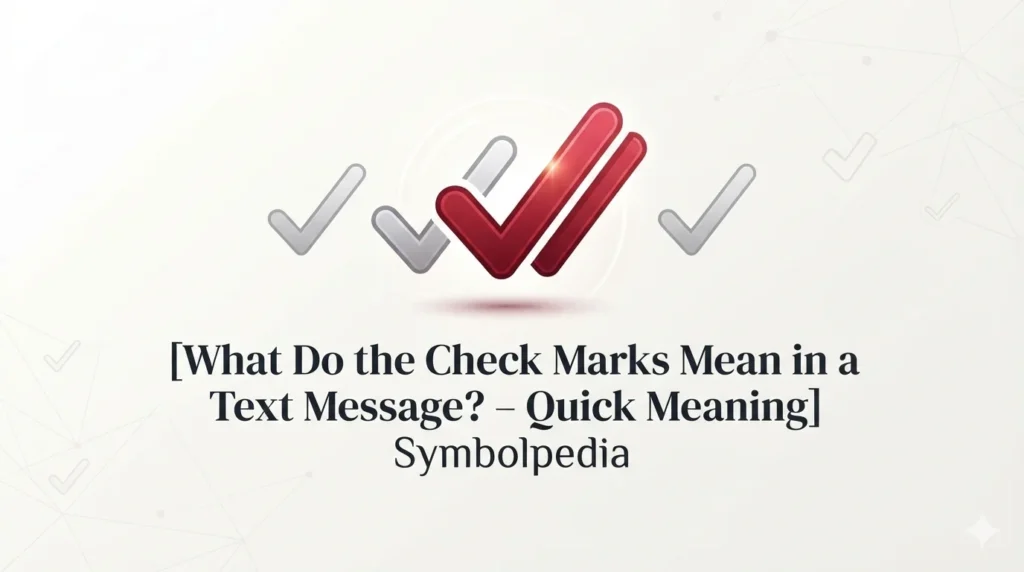
Generally, check marks indicate the delivery or reading status of a message.
Depending on the messaging service, you may see:
- One check mark: The message has been sent successfully.
- Two check marks: The message has usually been delivered to the recipient.
- Two colored or filled check marks: On some apps, the message has been read.
- No check mark: The message may still be sending, or the app may use a different status indicator.
For example:
“I sent the message, but there’s only one check.”
This usually means the message has been sent but has not yet been confirmed as delivered.
“It has two checks, so it reached her phone.”
That generally indicates successful delivery.
“The checks changed color, so he probably read it.”
On apps that use colored check marks for read receipts, this can indicate that the conversation was opened.
The important word here is usually. Messaging platforms do not all use the same system.
Origin & Background of Check Marks in Messaging
The check mark itself is much older than texting.
A check or tick has traditionally been used to communicate ideas such as completion, confirmation, approval, or correctness. As digital communication developed, that familiar visual language became useful for showing the progress of messages.
Early forms of electronic communication did not always provide users with detailed delivery information. Modern messaging apps changed that experience by making message status visible.
Instead of wondering whether a message had disappeared into cyberspace, users could see indicators showing that something had happened.
Messaging platforms gradually introduced different stages such as sent, delivered, and read.
This became especially important as smartphones transformed texting into a constant form of social communication.
Apps such as WhatsApp, Messenger, iMessage, and other chat services developed their own visual systems. Some rely on check marks, while others use labels, timestamps, circles, or other icons.
Social media also changed how people interpret these symbols.
A tiny status indicator can now influence how someone feels about an entire conversation. If a message says “delivered” but receives no response, people may start wondering whether the recipient is busy, upset, uninterested, or deliberately avoiding them.
That emotional interpretation is not actually provided by the check mark.
The symbol tells you about message status, not someone’s feelings.
Real-Life Conversations About Check Marks
The easiest way to understand these symbols is to see how they appear in ordinary conversations.
WhatsApp Conversation
Person A:
Did you get my message?
Person B:
Yeah, I saw it.
Person A:
Okay, because I only saw two checks and wasn’t sure.
Person B:
Two checks mean it was delivered. Once I opened the chat, the read indicator showed that I had seen it.
Here, the important distinction is between delivery and reading.
A delivered message has reached the recipient, but that does not necessarily mean the person has opened it.
Instagram DM Conversation
Person A:
I sent you that video yesterday 😂
Person B:
I know! I haven’t watched it yet.
Person A:
Oh, I thought you had because it showed as seen.
Person B:
No, I opened the chat but didn’t actually watch the whole thing.
This shows why read indicators should not be treated as proof of exactly what someone did with a message.
Text Message Conversation
Person A:
Does your phone show check marks under texts?
Person B:
Sometimes. It depends on whether we’re using the same messaging service.
Person A:
So the checks aren’t universal?
Person B:
No. Different messaging systems use different indicators.
This is an important point because people often assume every messaging app follows the same rules.
TikTok Comment Conversation
Person A:
Why does my message have a check but no reply?
Person B:
A check doesn’t mean they’re ignoring you.
Person A:
So what does it mean?
Person B:
Usually that the message went through. Whether they read it depends on the platform.
The emotional lesson is simple: delivery information is not the same thing as social information.
Emotional & Psychological Meaning of Check Marks
Technically, check marks are just status indicators.
Emotionally, however, people can attach much more meaning to them.
A person may see a message sitting on one check and immediately think:
“Did their phone die?”
“Did they block me?”
“Is their internet off?”
When the message changes to two checks, the thought may become:
“They got it. Why aren’t they answering?”
And when a read indicator appears without a response, the emotional reaction can become even stronger.
“They saw it and chose not to reply.”
But that conclusion is often based on assumption rather than evidence.
Someone may be working, driving, studying, sleeping, talking to another person, emotionally overwhelmed, or simply unsure how to respond.
The check mark cannot tell you which explanation is true.
From a communication perspective, this is one of the interesting effects of modern messaging. Technology gives us more information about communication, but that information can sometimes create more opportunities for overthinking.
A personal-style example is easy to imagine.
You send a friend an important message before an appointment. The message shows as delivered, but there is no response for two hours. It is tempting to keep checking the status.
Later, your friend replies: “Sorry! I was in a meeting.”
Nothing about the check mark changed. Your interpretation did.
That is why healthy digital communication requires separating what the technology confirms from what we assume about another person’s intentions.
Usage in Different Contexts
Social Media
Check marks and read indicators are common in direct messages.
People often use them to determine whether a message reached another person. Influencers, friends, couples, customers, and online communities may all rely on these indicators.
However, social platforms can have different terminology and visual designs.
Always consider the specific app rather than assuming a check has the same meaning everywhere.
Friends and Relationships
Check marks can become surprisingly important in personal relationships.
If someone normally responds quickly, seeing a delivered message without a reply may feel unusual.
Still, the status should not be treated as an emotional thermometer.
Two checks mean the message reached the recipient in systems where that is the function of the indicator. They do not mean the recipient agrees with you, likes the message, or is intentionally refusing to respond.
Work and Professional Settings
Message status indicators can be useful for work.
For example, if you send a colleague an urgent update, knowing that it was delivered can reassure you that the message successfully reached their device.
But professional communication requires extra caution.
A delivered or read indicator does not mean someone is immediately available to respond.
For urgent matters, established workplace procedures are usually more reliable than repeatedly checking a read receipt.
Casual vs. Serious Conversations
In casual conversations, check marks are usually nothing more than a convenient status feature.
In serious conversations, however, people may become highly sensitive to them.
If you have sent an apology, important question, or emotional message, avoid interpreting a check mark as a complete answer.
The content of the conversation matters more than the icon.
When NOT to Use or Rely on Check Marks
Check marks themselves are not something you usually “use” intentionally. They are generated by the messaging system.
However, there are situations where you should not rely on them to interpret someone’s behavior.
Avoid assuming that:
- A delivered message means someone has read every word.
- A read receipt means someone has had time to respond.
- A delayed status automatically means you were blocked.
- A lack of response means someone is angry.
- A read receipt proves someone is deliberately ignoring you.
- A missing check always means there is a problem with the recipient.
Cultural and personal communication styles also matter.
Some people respond immediately. Others prefer to think before replying.
In some cultures and families, rapid replies are considered polite. In others, people may not feel pressure to respond immediately.
The symbol cannot account for those differences.
Common Misunderstandings About Check Marks
“Two Checks Always Mean Read”
Not necessarily.
On many messaging services, two checks indicate delivery, not reading. A separate visual change may indicate that the message was opened.
“One Check Means They Blocked Me”
Not necessarily.
A single check may result from connectivity problems, the recipient’s phone being offline, app behavior, or other technical circumstances.
Some services also change how blocking and delivery information works.
“Read Means They Read Everything”
Not always.
Opening a conversation may trigger a read status even if the recipient only glanced at the message.
“No Reply Means They Are Ignoring Me”
This is a social interpretation, not a technical fact.
People can be busy, distracted, asleep, overwhelmed, or planning a response.
“Every App Uses the Same Check Marks”
They do not.
The exact meaning depends on the platform and its notification system.
Check Marks Compared With Other Message Statuses
| Indicator or Expression | Typical Meaning | What It Does Not Prove |
|---|---|---|
| One check | Message sent or successfully transmitted | That it was read |
| Two checks | Message delivered | That the person wants to reply |
| Colored/filled checks | Often read on some platforms | The person’s emotional reaction |
| “Sent” | Message left your device/app | Successful delivery in every case |
| “Delivered” | Reached the recipient’s device | That they immediately noticed it |
| “Seen” / “Read” | Conversation or message was opened | That the person carefully read everything |
| No response | Nothing has been communicated back | That the person is angry or ignoring you |
Key Insight
A message-status icon tells you what happened technically; it does not tell you what happened emotionally. That distinction is one of the most useful things to remember when communicating online.
How to Respond When Someone Uses or Mentions Check Marks
Sometimes someone will ask about the status of a message directly.
Casual Replies
“Yep, got it!”
“Yeah, it came through.”
“Got your message 👍”
Funny Replies
“The checks have spoken 😂”
“Two checks, zero response from me because I’m still thinking 😂”
“Technology says delivered. My brain says buffering.”
Mature Replies
“Yes, I received it. I’ll get back to you when I have a moment.”
“I saw your message and want to give you a proper response.”
Respectful Replies
“I received your message. Thank you for letting me know.”
“Yes, I got it. I’ll respond as soon as I can.”
These responses are useful because they communicate clearly instead of leaving the other person guessing.
Regional & Cultural Usage
Western Culture
In many Western online conversations, people are familiar with the idea of sent, delivered, and read indicators.
Quick replies may sometimes be expected in close friendships, dating, or workplace chats, but expectations vary significantly between individuals.
Asian Culture
Messaging apps play an especially important role in many Asian communities.
Family groups, school conversations, workplace chats, and social relationships can all take place through messaging platforms.
Because group communication can be frequent, read indicators may be viewed as useful confirmation that important information reached people.
However, expectations differ by country, age, family, and social setting.
Middle Eastern Culture
Messaging platforms are widely used for family, friendship, business, and community communication.
In close relationships, a visible read status can sometimes create pressure to respond quickly.
Still, there is no single “Middle Eastern meaning” for a check mark. Technology determines the technical meaning, while social expectations determine how people interpret it.
Global Internet Usage
Internet communication has made check marks almost universally recognizable as some kind of status indicator.
But users should still check the specific platform’s system.
A symbol that means “delivered” in one app may have a slightly different function in another.
Gen Z vs. Millennials
Younger users often understand message-status indicators intuitively because they have grown up with instant messaging and social media.
Older users may be more likely to ask what individual symbols mean, especially when switching between apps.
Interestingly, both generations can overinterpret read receipts.
The technology may be modern, but the human question remains very old:
“Why haven’t they answered me?”
Is It Safe for Kids?
Yes, check marks themselves are simply communication-status indicators and are not inherently unsafe for children.
The more important issue is helping children understand what these symbols actually mean.
Kids should learn that a delivered or read message does not create an obligation for someone to respond immediately.
They should also understand privacy, respectful messaging, unknown contacts, and healthy boundaries.
Parents and guardians can use these symbols as an opportunity to teach children that online communication does not always reveal someone’s feelings or intentions.
FAQs
What does one check mark mean in a text message?
One check mark commonly means that a message has been successfully sent, although the exact meaning depends on the messaging platform.
What do two check marks mean in a text message?
Two check marks often mean the message has been delivered to the recipient. They do not always mean the message has been read.
Do two check marks mean someone read my message?
Not necessarily. Some apps use two checks for delivery and another indicator, such as a color change, for read status.
What do blue check marks mean?
On platforms that use blue checks for read receipts, blue check marks usually indicate that the recipient has opened or viewed the message.
Does one check mark mean I am blocked?
No. A single check can have several explanations, including connectivity problems or the recipient’s device being unavailable.
Can someone receive a message without reading it?
Yes. A message can be delivered to someone’s device without them opening the conversation or reading it.
Why are check marks different on different phones?
Messaging services use different notification and delivery systems. The meaning depends more on the app or messaging protocol than on the phone itself.
Conclusion
So, what do the check marks mean in a text message?
In simple terms, they usually show the journey of your message: whether it has been sent, delivered, or, in some cases, read.
The tricky part is remembering that the check mark only describes the technical status of the message.
It does not tell you whether someone is happy, annoyed, busy, interested, distracted, or deliberately avoiding you.
That distinction can make digital communication much less stressful.
The next time you see one check, two checks, or a read indicator beneath a message, look at it as information—not a verdict.
Technology can tell you that your message arrived.
Only the other person can tell you what they actually mean.
descover more post
What Does the Christian Fish Symbol Mean History Faith …
What Does the Judaism Symbol Mean Star of David Meaning …
What Does the Arrow Symbol Mean on Instagram Meaning …

Kavon is a passionate content creator and digital researcher who specializes in decoding symbols, meanings, and modern internet language. With a strong focus on clarity and authenticity, Kavon writes in a way that makes complex ideas simple, relatable, and useful for everyday readers.
Known for a hardworking mindset and attention to detail, Kavon is dedicated to creating content that genuinely helps people understand the deeper meanings behind words, signs, and online expressions. Every article is crafted with care, combining research, real-life insight, and a reader-first approach.
Through Symblpedia, Kavon aims to build a trusted space where curiosity meets clarity—helping users find answers that are not only accurate but also meaningful and easy to understa