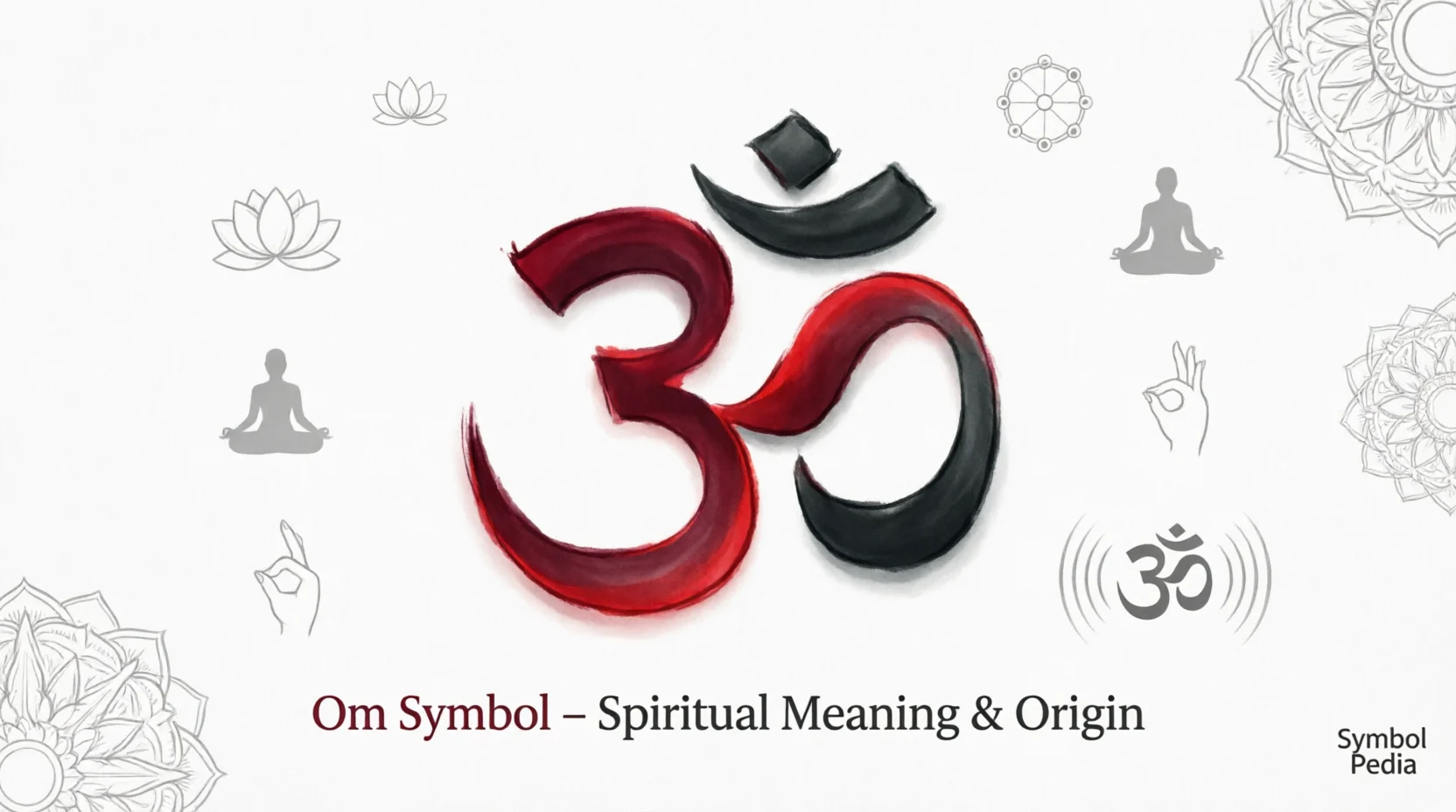
If you have ever seen the ॐ (Om) symbol on a yoga mat, necklace, tattoo, temple wall, meditation space, or social media profile, you may have wondered what it actually means.
At first glance, it can look like an attractive spiritual design. But Om is much more than a decorative symbol. It represents one of the most important sacred sounds and concepts in several Indian religious and philosophical traditions.
So, what does Om symbol mean? In its broadest sense, Om represents a sacred sound associated with ultimate reality, consciousness, spiritual awareness, and the interconnectedness of existence. It is commonly pronounced approximately as “A-U-M,” although its meaning goes far beyond those three sounds.
For many people, Om is connected with meditation, inner peace, mindfulness, prayer, and the search for deeper awareness. In Hindu traditions especially, it has an exceptionally important place in spiritual practice.
The symbol can also be misunderstood when it is treated simply as a universal “peace logo.” Its history and religious significance deserve more respect and context.
Let’s explore what the Om symbol means, where it came from, how people use it today, and why such a simple-looking mark carries so much philosophical depth.
What Does Om Symbol Mean? – Quick Meaning
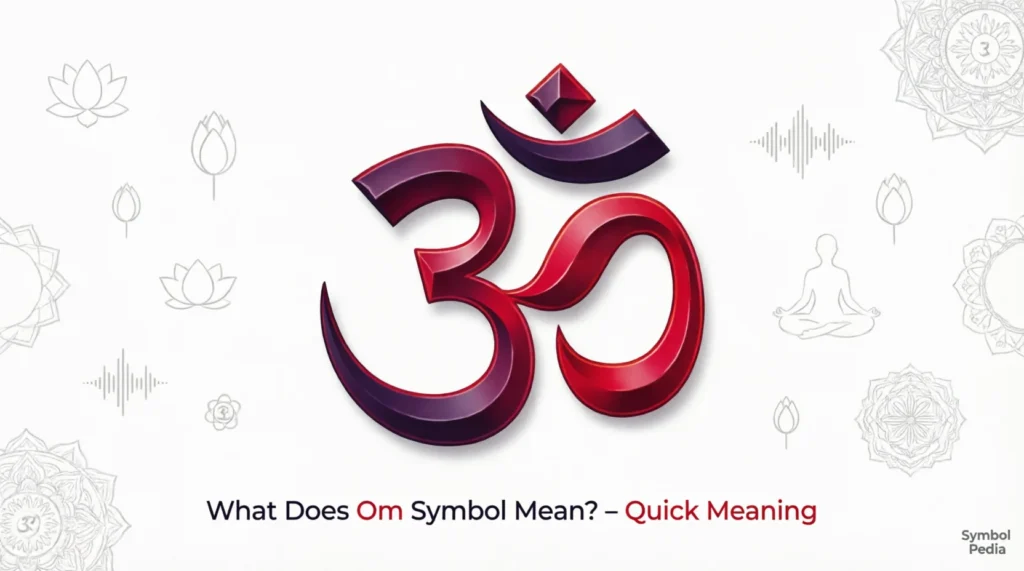
Om (ॐ) is a sacred syllable and symbol deeply associated with Hindu spirituality and philosophy. It is also used in various Buddhist and Jain contexts, although its meaning and importance can differ between traditions.
The simplest explanation is:
- Om represents sacred sound and spiritual reality.
- It is strongly associated with Hinduism, meditation, prayer, and consciousness.
- It is often pronounced as A-U-M.
- The three sounds are traditionally given philosophical interpretations connected with different states or aspects of consciousness.
- The silence following the sound can symbolize a state beyond ordinary mental experience.
- The written ॐ is the visual representation commonly associated with the sacred syllable.
You might hear someone say:
“I start my meditation with Om.”
Or:
“The Om symbol reminds me to slow down.”
Another person might wear it as a spiritual reminder:
“ॐ helps me stay connected to my inner peace.”
The exact interpretation depends on the religious or philosophical tradition and the person’s own practice.
Origin and Background of the Om Symbol
The story of Om reaches deep into the history of Indian religious thought.
The syllable appears in ancient Sanskrit texts, including the Upanishads, where it is discussed as a profound symbol and sound connected with ultimate reality. The Mandukya Upanishad, in particular, is famously devoted to explaining Om and its relationship to consciousness.
The Sanskrit syllable is generally written as ॐ, although the visual form has developed through historical writing traditions. It should not be assumed that the modern printed shape has existed unchanged since ancient times.
The Meaning of A-U-M
Om is frequently explained through three phonetic components:
A + U + M = Om
These sounds have been given different layers of philosophical meaning.
One influential interpretation connects them with three ordinary states of consciousness:
- A — waking consciousness
- U — dreaming consciousness
- M — deep sleep
The silence that follows the sound is associated in the Mandukya Upanishad with turiya, a fourth state beyond the three familiar states.
This is one reason Om is so much more complex than a simple religious logo. It can function as a compact philosophical teaching about consciousness itself.
Om in Hindu Tradition
Within Hindu traditions, Om is frequently found at the beginning of prayers, mantras, sacred recitations, and spiritual practices.
It can be used before a mantra or as a mantra on its own. Its importance is connected with ideas such as Brahman, the ultimate reality described in several Hindu philosophical traditions.
Different schools and practitioners may explain Om differently, so there is no single sentence that captures every interpretation.
Influence on Modern Yoga and Meditation
In the modern world, Om became increasingly visible outside South Asian religious settings through the spread of yoga, meditation, Indian philosophy, and spiritual practices.
Today, you may encounter it on:
- Yoga studio signs
- Meditation apps and books
- Jewelry
- Clothing
- Home décor
- Tattoos
- Wellness products
- Social media profiles
This wider popularity has made the symbol recognizable around the world.
However, popularity can sometimes remove symbols from their original context. For people who regard Om as sacred, using it merely as an aesthetic decoration may feel inappropriate or disrespectful.
Real-Life Conversations About the Om Symbol
1. WhatsApp Conversation
Person A:
I keep seeing this ॐ symbol everywhere. What does Om symbol mean?
Person B:
It’s a sacred symbol and syllable, especially important in Hindu traditions. It’s connected with spiritual awareness and meditation.
Person A:
So it basically means peace?
Person B:
Peace is part of how people may personally experience it, but its meaning is much deeper than just “peace.” It’s connected with consciousness and ultimate reality too.
2. Instagram DM
Person A:
Your new necklace has an Om symbol. Is there a special meaning behind it?
Person B:
Yeah. I wear it as a reminder to stay grounded and mindful.
Person A:
Is Om religious?
Person B:
It has deep religious and philosophical significance, particularly in Hindu traditions. I use it respectfully as part of my meditation practice.
3. TikTok Comments
Person A:
What does this ॐ tattoo mean?
Person B:
Om is a sacred syllable associated with spirituality, consciousness, and ultimate reality.
Person A:
I thought it was just a yoga symbol.
Person B:
Yoga helped make it popular globally, but its roots go much deeper than modern yoga culture.
4. Text Message
Person A:
Thinking about getting an Om tattoo. What does it actually represent?
Person B:
It can represent sacred sound, spiritual awareness, and the connection between different states of consciousness.
Person A:
Would you get it?
Person B:
Only after learning about its religious significance. If you choose it, I’d treat it as a sacred symbol rather than just a design.
Emotional and Psychological Meaning
Symbols can carry emotional meaning that goes beyond dictionary definitions, and Om is a particularly good example.
For many practitioners, chanting Om creates a deliberate pause from everyday noise. The repeated sound can become part of a meditation routine, giving the mind something simple and steady to focus on.
Psychologically, people may associate Om with:
- Calmness
- Reflection
- Presence
- Spiritual connection
- Inner balance
- Mindfulness
- Self-awareness
The important distinction is that these are personal experiences and associations, not necessarily the complete traditional meaning of Om.
Someone might see the symbol after a stressful day and immediately associate it with taking a breath and slowing down.
I have seen this kind of symbolic association in everyday communication: a person may not be able to explain an entire philosophy behind a symbol, but the symbol can still remind them of a meaningful practice or period in their life.
That emotional connection is one reason symbols survive across generations.
How Om Is Used in Different Contexts
On Social Media
On Instagram, TikTok, Facebook, and other platforms, people may use ॐ in usernames, captions, bios, or posts related to meditation, yoga, spirituality, Indian culture, or mindfulness.
For example:
“Starting the morning with meditation ॐ”
Here, the symbol may communicate a spiritual or reflective mood.
However, a social-media use does not automatically mean the person follows a particular religion.
Among Friends and in Relationships
Friends may use Om when discussing yoga, meditation, spirituality, travel in India, or personal growth.
Someone might text:
“I really need a quiet weekend and some meditation ॐ”
In this setting, it can communicate peacefulness or spiritual reflection.
In Work and Professional Settings
Om generally isn’t necessary in ordinary professional communication.
A yoga instructor, meditation teacher, spiritual organization, or cultural institution may appropriately use it in branding or educational material.
In a conventional business email, however, adding the symbol simply to appear spiritual could feel unusual or out of place.
Casual vs. Serious Tone
The same symbol can appear in both casual and serious settings, but the surrounding context matters.
Using it while discussing meditation is very different from using it as a random decorative emoji-like character.
Because Om is sacred to many people, respectful use is generally the safest approach.
When NOT to Use the Om Symbol
Understanding a symbol also means knowing when to leave it alone.
Don’t Treat It Merely as Decoration
Although Om can look visually appealing, its religious significance should not be ignored.
Putting it randomly on shoes, floors, bathroom décor, or objects that may be treated disrespectfully can offend people who regard it as sacred.
Don’t Assume Everyone Interprets It the Same Way
Hinduism contains many philosophical and devotional traditions, and Buddhist and Jain traditions may also use Om-related symbolism in different ways.
Avoid saying there is one universal interpretation.
Think Carefully Before Getting an Om Tattoo
A tattoo is permanent, while your understanding of a symbol can change.
Before choosing Om as body art, learn about its religious and cultural meaning rather than selecting it solely because it looks “spiritual.”
Avoid Using It to Mock Religious Practice
Using sacred imagery sarcastically or as part of a joke about someone’s beliefs can easily become disrespectful.
Context and intention matter, but impact matters too.
Common Misunderstandings About Om
“Om Just Means Peace”
Not exactly.
Peace is one modern association, particularly in wellness and meditation culture, but Om has a much broader philosophical and religious significance.
“Om Is Just a Yoga Logo”
Yoga helped popularize the symbol internationally, but Om predates modern global yoga culture by many centuries.
Its roots are found in ancient Indian religious and philosophical traditions.
“Everyone Uses Om the Same Way”
No.
Its significance varies across Hindu schools and also across Buddhist and Jain contexts.
“The Symbol and the Sound Are Exactly the Same Thing”
They are closely connected but aren’t identical.
Om refers to the sacred syllable or sound, while ॐ is a written representation associated with that syllable.
“Om Has Only One Meaning”
This is perhaps the biggest misunderstanding.
Om has layers of interpretation involving sound, consciousness, sacred knowledge, meditation, and ultimate reality.
Om Compared With Similar Spiritual Expressions
| Symbol or Expression | Main Association | How It Differs From Om |
|---|---|---|
| ॐ Om | Sacred sound, consciousness, ultimate reality | A sacred syllable with deep philosophical significance |
| Namaste | Respectful greeting | Primarily a greeting or expression of respect, not the same sacred syllable |
| Shanti | Peace | A Sanskrit word associated with peace |
| Aum | Sacred syllable | Alternative English transliteration emphasizing A-U-M |
| Mantra | Sacred phrase or sound | A broader category that can include Om |
| Meditation | Mental/spiritual practice | A practice rather than a specific sacred symbol |
| Turiya | “Fourth” state of consciousness | A philosophical concept associated with interpretations of Om |
| Brahman | Ultimate reality in Hindu philosophy | A profound philosophical concept, not simply a visual symbol |
Key Insight
Om isn’t simply another word for peace, yoga, or meditation. It is a sacred syllable with a particularly rich philosophical history, and its meaning becomes clearer when its religious and cultural context is understood.
How to Respond When Someone Uses the Om Symbol
If someone sends you ॐ, your response should depend on why they used it.
Casual Replies
- “That’s a beautiful symbol.”
- “Om! Hope you’re having a peaceful day.”
- “I’ve always wondered about its meaning.”
Funny Replies
If you already know the person is comfortable joking:
- “Okay, bringing peaceful energy into the chat!”
- “Meditation mode activated.”
- “I think I need some of that calm energy today.”
Be careful with humor if you don’t know the person’s relationship with the symbol.
Mature Replies
- “I know Om has a deep spiritual meaning. What does it mean to you?”
- “I’d love to understand the symbolism behind it.”
- “Is it part of your meditation practice?”
Respectful Replies
If the context is religious or spiritual:
- “Thank you for sharing that.”
- “I respect the meaning it has for you.”
- “I’d be interested in learning more about its significance.”
A thoughtful question is often better than pretending to understand something you don’t.
Regional and Cultural Usage
Western Culture
In Western countries, Om is often encountered through yoga studios, meditation communities, wellness culture, spiritual books, and alternative health spaces.
It may be understood primarily as a symbol of mindfulness or inner peace.
That interpretation is common, but it can simplify a much deeper religious and philosophical tradition.
Asian Culture
Across South Asia and other parts of Asia, Om can have stronger cultural and religious associations.
In India especially, its presence can be closely connected with Hindu religious practice, Sanskrit traditions, temples, prayer, philosophy, and spiritual education.
Its use in Buddhist traditions in countries such as Tibet and surrounding Himalayan regions can carry additional meanings depending on the mantra or lineage.
Middle Eastern Culture
In Middle Eastern settings, Om may be less familiar as a religious symbol than it is in South Asian contexts.
People encountering it for the first time may associate it with yoga or meditation without knowing its historical background.
Respectful explanation is usually more useful than assuming everyone recognizes it.
Global Internet Usage
The internet has transformed Om into a globally recognizable spiritual symbol.
A person in one country may use it as part of a formal religious practice, while someone elsewhere may use it simply to communicate “peace,” “mindfulness,” or “spirituality.”
That difference is worth remembering.
Gen Z vs. Millennials
Younger internet users may encounter Om through wellness content, yoga videos, tattoos, fashion, or aesthetic social-media posts.
Millennials may be more likely to have encountered it through the growth of modern yoga and meditation culture.
Neither generation has a single interpretation. Personal background and cultural knowledge matter more than age alone.
Is the Om Symbol Safe for Kids?
Yes, Om itself is not inherently unsafe for children.
It is a religious and cultural symbol rather than something dangerous or inappropriate. Children can learn about it as part of education about world religions, Indian culture, Sanskrit traditions, meditation, or symbolism.
The most important point is context.
If a child sees the symbol online, parents or teachers can explain that different people attach different religious and cultural meanings to it. Teaching respect is more useful than presenting it as merely a decorative mark.
Frequently Asked Questions
What does Om symbol mean?
The Om symbol represents a sacred syllable associated with spiritual reality, consciousness, meditation, and ultimate reality, especially in Hindu traditions.
Is Om a Hindu symbol?
Om has especially deep significance in Hinduism, where it is used in sacred texts, prayers, mantras, and philosophical traditions. It also appears in some Buddhist and Jain contexts.
What does ॐ mean spiritually?
Spiritually, Om can represent sacred sound, consciousness, interconnectedness, and ultimate reality. Its precise interpretation varies between traditions.
Is Om the same as Aum?
Yes, Om and Aum generally refer to the same sacred syllable. “Aum” emphasizes the three phonetic components A-U-M.
Why do people chant Om?
People chant Om as part of various spiritual and meditative practices. The sound can provide a focused object for attention and may be experienced as calming or centering.
What do A, U, and M mean in Om?
One important traditional interpretation associates A, U, and M with waking, dreaming, and deep sleep. The silence following the sound is associated with a fourth state of consciousness known as turiya.
Is it disrespectful to wear an Om necklace?
Not necessarily, but wearing Om respectfully is important because it is sacred to many people. Understanding its religious and cultural significance before wearing it is a thoughtful choice.
Conclusion
So, what does Om symbol mean?
At its heart, Om is a sacred syllable and symbol connected with profound ideas about sound, consciousness, spirituality, and ultimate reality. Its significance reaches far beyond the modern image of a peaceful yoga studio or meditation session.
For some people, Om is part of prayer. For others, it is a focus for meditation or a reminder of spiritual awareness. For still others, it represents a connection with Indian philosophy and cultural heritage.
The most meaningful way to understand ॐ is not to reduce it to one simple definition.
It is better understood as a symbol with layers—religious, philosophical, cultural, and personal. That depth is precisely what has allowed it to remain meaningful across centuries while also becoming recognizable around the world.
If you encounter Om in a conversation, tattoo, piece of jewelry, or social-media post, context is your best guide. Ask what it means to the person using it, learn about its tradition, and approach it with respect.
That small symbol carries a surprisingly large idea: the invitation to pause, listen, become aware, and look beyond the surface.
descover more post
What Does the Swirl Symbol Mean A Complete Guide to Its …
Japanese Symbol Meaning What Popular … – Symbl Pedia
What Does the Lock Symbol Mean on Snapchat Everything …

Kavon is a passionate content creator and digital researcher who specializes in decoding symbols, meanings, and modern internet language. With a strong focus on clarity and authenticity, Kavon writes in a way that makes complex ideas simple, relatable, and useful for everyday readers.
Known for a hardworking mindset and attention to detail, Kavon is dedicated to creating content that genuinely helps people understand the deeper meanings behind words, signs, and online expressions. Every article is crafted with care, combining research, real-life insight, and a reader-first approach.
Through Symblpedia, Kavon aims to build a trusted space where curiosity meets clarity—helping users find answers that are not only accurate but also meaningful and easy to understa