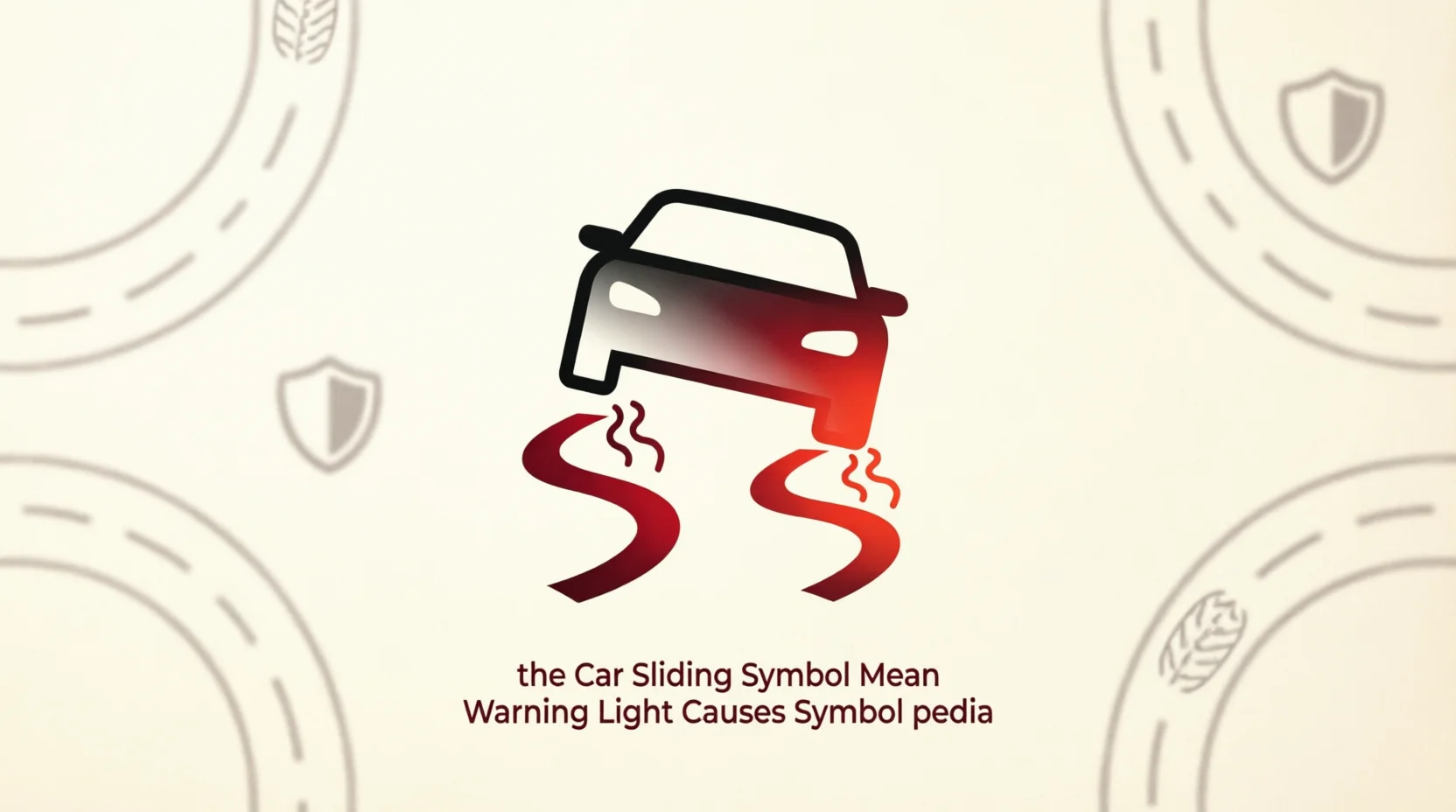
If you have ever seen a little car with wavy lines underneath it appear on your dashboard, you may have wondered whether something is seriously wrong with your vehicle. The symbol can look dramatic, especially when it lights up unexpectedly while you are driving.
So, what does the car sliding symbol mean? In most vehicles, it is the traction control or electronic stability control (ESC) indicator. It tells you that your car’s system is detecting wheel slip or is actively helping the vehicle maintain traction and stability.
Sometimes the symbol appears briefly when the system is working normally. In other situations, it stays illuminated because traction control has been switched off or because the vehicle has detected a fault.
Understanding the difference can prevent unnecessary panic—and help you recognize when your car actually needs attention.
What Does the Car Sliding Symbol Mean? – Quick Meaning
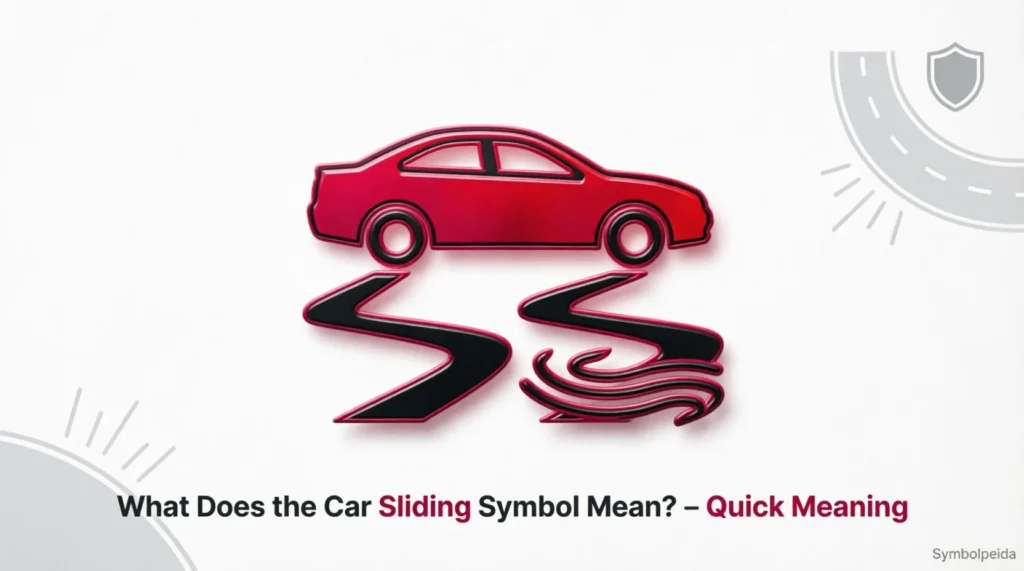
The car sliding symbol usually looks like a vehicle viewed from behind or above, with two wavy lines beneath it.
Its exact appearance varies by manufacturer, but the basic message is similar:
- Flashing symbol: The traction or stability system is actively working.
- Steady symbol: The system may have been turned off or may have detected a problem.
- Symbol showing “OFF”: Traction control or stability control has intentionally been disabled.
- Symbol plus another warning light: The vehicle may need professional inspection.
For example:
“The car sliding light flashed when I accelerated.”
This normally means the system detected wheel slip and intervened.
“The sliding car light stayed on after I started the engine.”
That may indicate that the system is switched off or has detected a fault.
“The light came on during heavy rain.”
That can happen when the tires temporarily lose grip on a wet road.
The important point is that a flashing symbol is not automatically a sign of a mechanical failure.
Origin & Background of the Car Sliding Symbol
The sliding-car icon became common as modern vehicles began using electronic systems to manage traction and stability.
Older cars relied heavily on the driver, tires, brakes, and mechanical components to maintain control. Modern vehicles can continuously monitor wheel speed, steering angle, acceleration, and other information.
Traction control systems help prevent the driven wheels from spinning excessively. Electronic stability control goes a step further by helping the vehicle remain on its intended path when it begins to lose stability.
The familiar wavy-line image is essentially a visual shortcut for slippery conditions and loss of traction.
Why the Symbol Looks Like a Sliding Car
The illustration is intentionally simple.
Instead of requiring drivers to understand a technical abbreviation such as ESC, manufacturers use a picture of a vehicle appearing to slide. The wavy lines underneath suggest reduced grip between the tires and road.
This is part of a broader international approach to dashboard symbols. Drivers may travel between countries or drive unfamiliar vehicles, so standardized visual language can communicate information more quickly than words.
How Its Meaning Has Evolved
At first, many drivers associated the icon only with slippery roads. Today, it represents a much broader group of electronic safety functions.
Depending on the vehicle, the system may be called:
- Traction Control System (TCS)
- Electronic Stability Control (ESC)
- Electronic Stability Program (ESP)
- Dynamic Stability Control (DSC)
- Vehicle Stability Control (VSC)
Different manufacturers use different names, but the purpose is generally related to maintaining traction and vehicle stability.
Social media and driving forums have also changed how people discuss dashboard symbols. A driver who sees the icon for the first time can quickly describe it as “the car sliding light” and ask others what it means.
That informal description has become surprisingly common.
Real-Life Conversations About the Car Sliding Symbol
WhatsApp Conversation
Person A:
My dashboard has a car with squiggly lines underneath it. What does that mean?
Person B:
That’s probably the traction control light.
Person A:
Is my car broken?
Person B:
Not necessarily. If it flashed while you were driving, the system may have just kicked in because the tires slipped.
Person A:
Oh, it happened when I pulled away in the rain.
Person B:
Then that makes sense. Just drive smoothly and keep an eye on it.
Instagram DM
Person A:
Do you know what the sliding car symbol means? 😭
Person B:
The one that looks like the car is drifting?
Person A:
YES 😂
Person B:
That’s usually traction or stability control. If it’s flashing, the car may be helping you regain grip.
Person A:
So I didn’t accidentally turn on drift mode? 😂
Person B:
Definitely not. Please don’t test that theory.
TikTok Comments
Person A:
Why does my car show the sliding symbol every time it rains?
Person B:
Probably because your tires are losing a little traction and the system is correcting it.
Person A:
So I should turn it off?
Person B:
Usually no. Let the system do its job unless you have a specific reason to disable it.
Text Message
Person A:
The car sliding light is still on after I turned the car off and back on.
Person B:
Is it flashing or staying solid?
Person A:
Solid.
Person B:
Check whether traction control was accidentally switched off. If it wasn’t, have the vehicle checked, especially if another warning light is on.
Emotional & Psychological Meaning
Although the symbol has a technical meaning, the driver’s reaction to it is often emotional.
A dashboard warning can instantly create anxiety. Most people do not memorize every symbol in their owner’s manual, so seeing an unfamiliar light can make them wonder whether their car is about to stop working.
The sliding-car symbol is particularly confusing because it looks like a warning of danger even when it is simply showing that the safety system is doing its job.
Imagine driving through heavy rain and suddenly seeing the symbol flash. Your first thought might be, “Something is wrong.”
In reality, the vehicle may be telling you, “I noticed the tires were slipping, so I intervened.”
That difference matters.
Understanding dashboard language gives drivers a greater sense of control. Instead of reacting emotionally to every unfamiliar light, you can observe what the symbol is doing, consider the driving conditions, and decide whether further action is necessary.
Using and Understanding the Symbol in Different Contexts
Social Media
On social platforms, people often call it the sliding car light, skidding car symbol, or traction control light.
These informal descriptions are understandable even though they are not necessarily the official name used by the manufacturer.
Friends and Relationships
When someone asks what the symbol means, a simple explanation is usually better than technical jargon.
You could say, “It usually means your traction or stability system is working or has been switched off.”
That answers the question without overwhelming the person.
Work and Professional Settings
In professional communication, use the technical term when possible.
For example:
“The traction control warning light remains illuminated.”
This is clearer when speaking with a mechanic, fleet manager, dealership, or vehicle technician.
Casual vs. Serious Tone
“The car sliding light came on” works perfectly well in casual conversation.
For a repair appointment, however, describe exactly what happened:
- Was the light flashing or solid?
- When did it appear?
- Was the road wet, icy, or loose?
- Did another warning light appear?
- Did the vehicle feel unstable?
Those details are much more useful than simply saying, “My sliding car light is on.”
When NOT to Ignore the Car Sliding Symbol
Not every appearance of the symbol means you need immediate repairs, but there are situations where you should take it seriously.
Don’t Ignore a Persistent Light
If the symbol remains illuminated after restarting the vehicle and you have not intentionally disabled traction control, check your owner’s manual and consider having the vehicle inspected.
Don’t Assume It Means the Tires Are Fine
The traction system can respond to loss of grip, but it does not replace good tires.
Worn, underinflated, damaged, or poorly matched tires can significantly affect traction.
Don’t Turn the System Off Without Understanding Why
Some vehicles allow drivers to temporarily disable traction control. There can be legitimate reasons for doing this in specific situations, but turning it off simply because the light appeared is not generally a good idea.
Don’t Ignore Additional Warning Signs
If the sliding-car symbol appears alongside other dashboard warnings, unusual braking behavior, steering problems, or changes in vehicle handling, treat the situation more seriously.
Common Misunderstandings About the Sliding Car Symbol
“It Always Means My Car Is Broken.”
Not necessarily.
A flashing symbol can simply mean the traction or stability system is actively responding to wheel slip.
“The Car Is Literally Sliding.”
The image is symbolic.
It does not necessarily mean your vehicle is physically drifting. It represents a situation where the tires may have lost some grip or where the stability system is intervening.
“I Should Turn It Off When It Appears.”
Usually, the opposite is true.
If the system is working because the vehicle has detected wheel slip, disabling it may remove an important electronic aid.
“It Only Appears on Snow.”
No.
Rain, gravel, mud, loose surfaces, rapid acceleration, and other low-traction conditions can cause the system to activate.
“Every Car Uses the Same System.”
Not exactly.
Different manufacturers use different names, software strategies, and dashboard designs. The symbol can therefore behave differently from one vehicle to another.
Car Sliding Symbol vs. Similar Dashboard Warnings
| Symbol or Term | Common Meaning | Typical Situation |
|---|---|---|
| Sliding car symbol | Traction/stability control activity or warning | Wheel slip or stability correction |
| Traction Control OFF | Traction control has been disabled | Driver switched the system off |
| ABS warning | Anti-lock braking system issue | Possible ABS fault |
| Tire pressure warning | Low tire pressure detected | One or more tires need checking |
| Check engine light | Engine/emissions-related fault | Sensor, emissions, or engine issue |
| Brake warning | Brake system warning | Parking brake, fluid, or brake-system issue |
| Slip indicator | Traction or stability intervention | Reduced grip or system activity |
Key Insight
The car sliding symbol is not automatically a “stop driving immediately” warning. The meaning depends on whether it is flashing or steady, whether the system is switched off, the road conditions, and whether other symptoms are present.
How to Respond When Someone Mentions the Symbol
Casual Replies
- “That’s probably your traction control light.”
- “It usually means the car detected some wheel slip.”
- “If it flashed during rain, the system may have been working normally.”
Funny Replies
- “Your car thinks it’s auditioning for a drift movie. 😂”
- “The dashboard says ‘easy there, racer.’”
- “Apparently your tires had a little disagreement with the road.”
Mature Replies
- “Check whether the light is flashing or staying on. That distinction matters.”
- “If it stays illuminated, consult the vehicle manual or have it inspected.”
- “Pay attention to whether the light appears with any other warning indicators.”
Respectful Replies
- “It sounds like the traction or stability-control indicator. I’d check your owner’s manual for the exact meaning.”
- “If you’re unsure, it would be safest to have the vehicle checked by a qualified technician.”
Regional & Cultural Usage
Dashboard terminology is fairly universal, but the way people describe the symbol can vary by culture and generation.
Western Culture
In the United States, Canada, the United Kingdom, and other Western countries, drivers commonly use terms such as traction control light, stability control light, or slip indicator.
Car forums and repair communities often use the technical abbreviations TCS, ESC, and ESP.
Asian Culture
Across Asian countries, drivers may encounter manufacturer-specific terminology depending on the vehicle’s origin.
Japanese and Korean vehicles, for example, can use different names for closely related systems. Drivers may therefore describe the same icon simply as the “slip light” or “skidding light.”
Middle Eastern Culture
In Middle Eastern driving environments, the symbol can be especially relevant because conditions may change dramatically between smooth paved roads, dusty surfaces, gravel, and wet roads during seasonal rain.
Drivers may casually refer to it as the sliding car light even when the technical system is traction or stability control.
Global Internet Usage
Online, “what does the car sliding symbol mean?” is a natural question because people often describe symbols visually rather than using technical terminology.
Someone may never know the abbreviation ESC but immediately recognize the picture of a car with squiggly lines.
Gen Z vs. Millennials
Younger drivers are often comfortable asking about unfamiliar dashboard symbols online using informal language.
Millennial drivers may be more likely to search phrases such as “traction control light” or “ESC warning.”
Neither approach is wrong. The important thing is identifying the symbol accurately.
Is the Car Sliding Symbol Safe for Kids?
The symbol itself is not dangerous or inappropriate for children.
However, if a child asks what it means, the explanation should be age-appropriate. A simple answer is enough:
“It means the car is helping the tires stay in contact with the road when they start to slip.”
Children should also understand that dashboard warning lights are not something to experiment with while driving.
FAQs About the Car Sliding Symbol
What does the car sliding symbol mean?
It usually indicates the vehicle’s traction control or electronic stability system. A flashing symbol often means the system is actively responding to wheel slip.
Is the sliding car light dangerous?
Not necessarily. A flashing light can indicate normal system intervention. A persistent light may mean the system is disabled or has detected a fault.
Why does the sliding car symbol appear in rain?
Wet roads reduce tire grip, so the traction or stability system may detect wheel slip and activate.
Can I drive with the sliding car light on?
It depends on why the light is illuminated. If it remains on unexpectedly, check the owner’s manual and consider having the vehicle inspected.
What does a sliding car symbol with “OFF” mean?
It generally means the traction or stability-control system has been manually switched off.
Should I turn traction control off?
Most drivers should leave it enabled during normal driving. Some vehicles and conditions have specific situations where temporary disabling may be appropriate, but follow the manufacturer’s instructions.
Is the sliding car symbol the same as the ABS light?
No. They are related to vehicle safety but indicate different systems. The sliding-car symbol generally relates to traction or stability control, while ABS refers to the anti-lock braking system.
Conclusion
The next time you see a little car with wavy lines underneath it, don’t immediately assume your vehicle is in serious trouble.
In most cases, the symbol is connected to traction control or electronic stability control. If it flashes briefly while you’re driving on rain, gravel, snow, or another low-grip surface, it may simply be showing that the vehicle is helping maintain traction.
The bigger concern is a symbol that stays illuminated unexpectedly, especially when accompanied by other warnings or unusual vehicle behavior.
Learning what dashboard symbols mean is more than a matter of curiosity. It helps you stay calm, communicate clearly with mechanics, and make better decisions behind the wheel.
So if someone asks, “What does the car sliding symbol mean?”, the simplest answer is: it usually means your vehicle’s traction or stability system is detecting or managing wheel slip.
And sometimes, that little flashing icon isn’t telling you that something has gone wrong—it is telling you that your car noticed the problem before you had to.
descover more post
What Does the Lock Symbol Mean on Snapchat Everything …
Ohm Symbol and Meaning Understanding Ω Its History and …
What Does the Clover Symbol Mean Luck Love Culture More …

Orvian is a passionate researcher and dedicated content creator focused on exploring the deeper meanings behind symbols, signs, and cultural interpretations. With a strong interest in symbolism and human psychology, Orvian simplifies complex ideas into clear, engaging, and easy-to-understand content for readers around the world.
Through consistent research and thoughtful writing, Orvian aims to provide accurate, insightful, and meaningful information that helps users connect with symbols on a deeper level—whether for personal growth, curiosity, or knowledge.
Known for a hardworking mindset and attention to detail, Orvian believes that every symbol carries a story, and every story deserves to be understood.