Have you ever seen ≥ in a math problem, online post, school assignment, or technical document and wondered what it actually means?
The symbol ≥ means “greater than or equal to.” It tells you that one value is either larger than another value or exactly the same as it.
For example:
x ≥ 10
This means x can be 10 or any number greater than 10.
So, 10 works.
11 works.
25 works.
100 works.
But 9 does not work.
At first glance, ≥ can look confusing because it combines two mathematical ideas: greater than (>) and equal to (=). Once you understand that combination, however, the symbol becomes very easy to recognize.
People often search for the meaning of ≥ because they encounter it outside ordinary arithmetic. It appears in algebra, statistics, science, programming, data analysis, schoolwork, graphs, product specifications, age requirements, and even casual online writing.
This guide explains what ≥ means, where it came from, how to read it naturally, how it differs from similar symbols, and what it can communicate in real-life situations.
What Does This Symbol Mean ≥? Quick Meaning
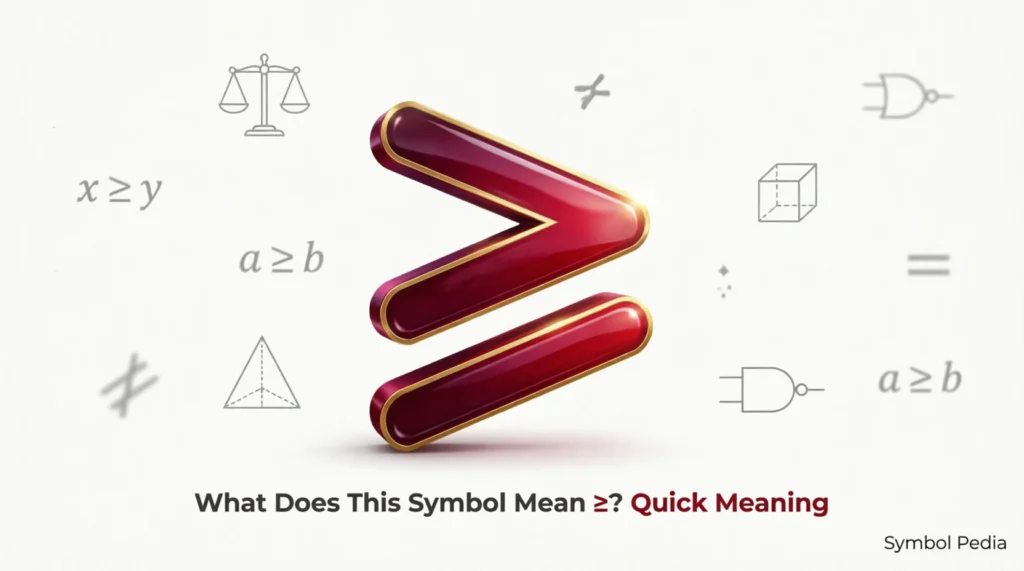
The symbol ≥ means:
- Greater than or equal to
- At least
- No less than
- Equal to or more than
In simple language, it means the number on the left must be the same as or larger than the number on the right.
Simple examples
x ≥ 5
Read this as:
“x is greater than or equal to 5.”
Or more naturally:
“x is at least 5.”
Another example:
Age ≥ 18
This means:
“Age must be 18 or older.”
And:
Score ≥ 80
means:
“The score must be 80 or higher.”
The important detail is that the two values can be equal. That is what separates ≥ from the ordinary greater-than symbol >.
Origin & Background of the ≥ Symbol
The modern greater-than-or-equal-to symbol developed from mathematical notation designed to make comparisons easier to write and understand.
The symbols < and > became established in European mathematics during the seventeenth century. They provided a quick visual way to compare quantities without writing a complete sentence.
Later, mathematicians needed a similarly convenient symbol for comparisons where equality was also allowed.
That led to notation combining the greater-than sign with a horizontal line representing equality:
≥
The idea is straightforward:
> + = → ≥
Although mathematical notation has evolved over centuries, the basic purpose of ≥ has remained remarkably stable.
Today, it is part of standard mathematical language worldwide.
You may see it in textbooks, research papers, spreadsheets, scientific formulas, statistics, economics, engineering, computer-related documentation, and online educational material.
Why the symbol became useful
Imagine having to write:
“x must be greater than or exactly equal to 50.”
every time you solve an equation.
The symbol makes that entire condition much shorter:
x ≥ 50
This is one reason mathematical symbols are so powerful. They remove unnecessary words while preserving a precise meaning.
Real-Life Conversations Using ≥
The ≥ symbol is not usually something people use in ordinary texting as a replacement for words. However, people may use it when discussing numbers, requirements, grades, measurements, or comparisons.
1. WhatsApp conversation
Person A:
What score do I need to pass?
Person B:
The requirement is ≥ 50.
Person A:
So exactly 50 is okay?
Person B:
Yep. 50 or anything higher.
Here, ≥ makes it clear that 50 itself qualifies.
2. Instagram DM
Person A:
Do you know the minimum age for the event?
Person B:
It says age ≥ 18.
Person A:
Oh, so 18-year-olds can attend too?
Person B:
Exactly. It means 18 or older.
The confusion here would come from assuming the requirement means “more than 18.” It does not. The equality portion matters.
3. TikTok comments
Person A:
How much storage do you need for this game?
Person B:
The description says ≥ 20 GB.
Person A:
So 20 GB is enough?
Person B:
Yes, provided the other requirements are met.
This is a common technical use of the symbol. It establishes a minimum threshold.
4. Text message
Person A:
How many people are coming?
Person B:
Probably ≥ 10.
Person A:
So at least ten?
Person B:
Right. Could be more.
In this situation, ≥ is being used as a compact way to say “at least.”
Emotional & Psychological Meaning of ≥
Unlike emojis, slang, or expressive punctuation, ≥ does not normally carry an emotional meaning.
Its meaning is primarily logical and mathematical.
Still, the way someone uses it can influence the tone of a conversation.
For example, writing:
“You need ≥ 90%.”
can feel more formal, precise, or technical than saying:
“You need at least 90%.”
The symbol creates a sense of exactness.
This is particularly noticeable in digital communication. People increasingly mix mathematical notation with ordinary language because symbols can communicate numerical information quickly.
I have seen this kind of notation become especially useful when someone wants to avoid ambiguity. Saying “90 or more” is understandable, but ≥90 immediately establishes a precise boundary.
That boundary is the heart of the symbol.
Usage in Different Contexts
Social Media
On social platforms, ≥ may appear in posts, comments, infographics, captions, or educational content involving numbers.
Examples include:
- Age ≥ 18
- Temperature ≥ 30°C
- Score ≥ 90
- Followers ≥ 10K
It is more common in informational posts than in casual personal conversations.
Friends and Relationships
Friends might use ≥ when discussing numerical comparisons.
For example:
“We need ≥ 6 people for the game.”
A friend familiar with mathematical notation will understand that six is the minimum.
However, writing the phrase “at least 6 people” may be clearer when chatting with someone who is not comfortable with mathematical symbols.
Work and Professional Settings
The symbol is common in professional environments involving measurements, statistics, finance, engineering, research, data, or technical requirements.
For example:
“The system requires a temperature ≥ 70°C.”
or:
“Applicants must have an experience level ≥ 3 years.”
In formal writing, though, clarity matters more than cleverness. If your audience may not understand mathematical notation, writing “at least three years” is often preferable.
Casual vs. Serious Tone
The symbol itself has a neutral tone.
Its surrounding context determines whether the message feels casual or formal.
Casual:
“We need ≥ 4 people for this game 😂”
Formal:
“Participants must be aged ≥ 18 years.”
Both use the same symbol, but the surrounding language changes the impression.
When NOT to Use the ≥ Symbol
Although ≥ is useful, it is not always the clearest choice.
Avoid it when your audience may not understand mathematical notation
If you are writing for young children or a general audience, “at least 10” may be easier than “≥10.”
Avoid unnecessary technical language
A simple sentence does not become better merely because it contains a mathematical symbol.
Instead of:
“Please bring ≥ 3 documents.”
you could simply write:
“Please bring at least three documents.”
The second version may be more natural in ordinary communication.
Be careful in culturally mixed conversations
Mathematical notation is broadly understood internationally, but familiarity varies between educational backgrounds.
If an important instruction depends on understanding ≥, consider spelling it out.
Don’t confuse it with >
This is one of the most important points.
> means strictly greater than.
≥ means greater than or equal to.
So:
x > 5
does not allow 5.
But:
x ≥ 5
does allow 5.
Common Misunderstandings About ≥
Misunderstanding 1: “It means only greater than”
Not quite.
The equal sign underneath is essential.
≥ means the left side can be greater than or exactly equal to the right side.
Misunderstanding 2: “The number must be bigger”
No.
For x ≥ 20, x can be exactly 20.
That is one of the defining features of the symbol.
Misunderstanding 3: “≥ and > are interchangeable”
They are not.
Consider:
x > 10
Possible values include 11, 12, 15, and 100.
But 10 is excluded.
With:
x ≥ 10
10 is included.
Misunderstanding 4: “The symbol always refers to people”
No. It can compare almost any quantities that can meaningfully be ordered.
Examples include:
- Age
- Weight
- Distance
- Temperature
- Scores
- Prices
- Time
- Measurements
- Quantities
- Statistical values
Misunderstanding 5: “The symbol has a special texting meaning”
Usually, no.
Unlike expressions such as LOL, BTW, or IDK, ≥ is not primarily internet slang.
Its core meaning remains mathematical and comparative.
≥ Compared With Similar Symbols
| Symbol | Meaning | Example | Does equality count? |
|---|---|---|---|
| > | Greater than | x > 5 | No |
| ≥ | Greater than or equal to | x ≥ 5 | Yes |
| < | Less than | x < 5 | No |
| ≤ | Less than or equal to | x ≤ 5 | Yes |
| = | Equal to | x = 5 | Only equality |
| ≠ | Not equal to | x ≠ 5 | No |
Key Insight
The easiest way to remember ≥ is to think “at least.”
Whenever you see x ≥ 10, mentally translate it to:
“x is at least 10.”
That simple habit eliminates most confusion.
How to Respond When Someone Uses ≥
Your response depends on the situation.
Casual replies
- “So basically, at least that much?”
- “Got it—equal counts too.”
- “So the minimum is that number?”
Funny replies
- “Translation: don’t go below the line 😂”
- “So 10 is officially invited, but 9 isn’t?”
- “Math really has a symbol for everything.”
Mature replies
- “Understood. The minimum acceptable value is that number.”
- “Thanks, that makes the requirement clear.”
- “So the value can equal or exceed the stated amount.”
Respectful replies
- “Just to confirm, does that include the exact number?”
- “When you say ≥, you mean that value or higher, correct?”
- “Thanks for clarifying the minimum.”
The last group is particularly useful in professional or academic situations because it confirms the meaning without making assumptions.
Regional & Cultural Usage of ≥
The mathematical meaning of ≥ is essentially universal, but familiarity with the symbol can vary.
Western Culture
In countries with strong exposure to algebra and standardized mathematics education, ≥ is generally familiar.
It appears regularly in education, science, statistics, technology, and everyday informational material.
Asian Culture
Across many Asian education systems, mathematical comparison symbols are also widely taught.
Students commonly encounter ≥ in algebra, inequalities, science, and examinations.
However, everyday communication still tends to favor words such as “at least” when the audience is not specifically discussing mathematics.
Middle Eastern Culture
The symbol is also used in mathematics and technical education throughout the Middle East.
Its meaning remains the same regardless of the language surrounding it.
A mathematical inequality does not change meaning simply because the explanatory text is written in Arabic, Persian, Urdu, or another language.
Global Internet Usage
The internet has made mathematical notation increasingly visible to ordinary users.
Someone might encounter ≥ in:
- Fitness targets
- Game requirements
- Age restrictions
- Technical specifications
- Educational videos
- Data charts
- Statistics
- Programming discussions
- Online courses
Still, it remains a comparison symbol, not a universal piece of internet slang.
Gen Z vs. Millennials
Younger internet users may be more comfortable encountering symbols in informal digital communication, especially in educational, gaming, technology, and meme-related contexts.
Millennials and older users who studied traditional mathematics may recognize the symbol immediately as well.
The biggest difference is usually not generation but context and mathematical familiarity.
Someone who frequently works with numbers may naturally write ≥, while another person may prefer “at least.”
Is the ≥ Symbol Safe for Kids?
Yes. ≥ is completely safe for children.
It is a standard mathematical symbol commonly taught in school.
For younger learners, the main challenge is understanding the difference between greater than, greater than or equal to, less than, and less than or equal to.
A useful teaching trick is to explain ≥ as:
“bigger than or the same as.”
For example:
7 ≥ 7 is true.
8 ≥ 7 is also true.
But:
6 ≥ 7 is false.
Once children understand that equality is included, the symbol becomes much easier.
Frequently Asked Questions
What does ≥ mean?
≥ means “greater than or equal to.” It indicates that the value on the left is either larger than or exactly equal to the value on the right.
What does ≥ 10 mean?
≥ 10 means “10 or more” or “at least 10.” The value can be 10, 11, 12, 20, or any larger number.
Is ≥ the same as >?
No. > means greater than, while ≥ means greater than or equal to. The ≥ symbol includes equality.
Does ≥ include the number itself?
Yes. For example, x ≥ 5 includes 5 as a valid value.
What is the opposite of ≥?
The corresponding opposite direction is ≤, meaning “less than or equal to.”
For example:
x ≥ 5 means x is 5 or greater.
x ≤ 5 means x is 5 or smaller.
How do you read ≥ aloud?
You can read it as “greater than or equal to.” In everyday language, “at least” is often a simpler equivalent.
Is ≥ used in texting?
It can be, especially when people are discussing numbers, requirements, statistics, or technical subjects. However, it is not primarily a texting abbreviation or slang term.
Conclusion
The ≥ symbol may look complicated at first, but its meaning is wonderfully simple: greater than or equal to.
Think of it as a mathematical way of saying “at least.”
If you see x ≥ 10, remember that 10 is included. The answer can be 10 or anything greater than 10.
The small horizontal line underneath the greater-than sign is what makes the difference. Without it, > excludes equality. With it, ≥ welcomes equality.
Once you recognize that detail, you can understand the symbol in equations, charts, schoolwork, technical instructions, statistics, social media posts, and everyday numerical comparisons.
So the next time you see ≥, don’t overthink it. Read it as “greater than or equal to”—or, even more naturally, “at least.”
That one simple translation will make the symbol much easier to understand and use correctly.
descover more post
What Does the Infinity Symbol Mean in Apple Music Complete …
Aquarius Zodiac Symbol Meaning The Hidden Power Behind …
What Does the Car Sliding Symbol Mean Warning Light …

Orvian is a passionate researcher and dedicated content creator focused on exploring the deeper meanings behind symbols, signs, and cultural interpretations. With a strong interest in symbolism and human psychology, Orvian simplifies complex ideas into clear, engaging, and easy-to-understand content for readers around the world.
Through consistent research and thoughtful writing, Orvian aims to provide accurate, insightful, and meaningful information that helps users connect with symbols on a deeper level—whether for personal growth, curiosity, or knowledge.
Known for a hardworking mindset and attention to detail, Orvian believes that every symbol carries a story, and every story deserves to be understood.