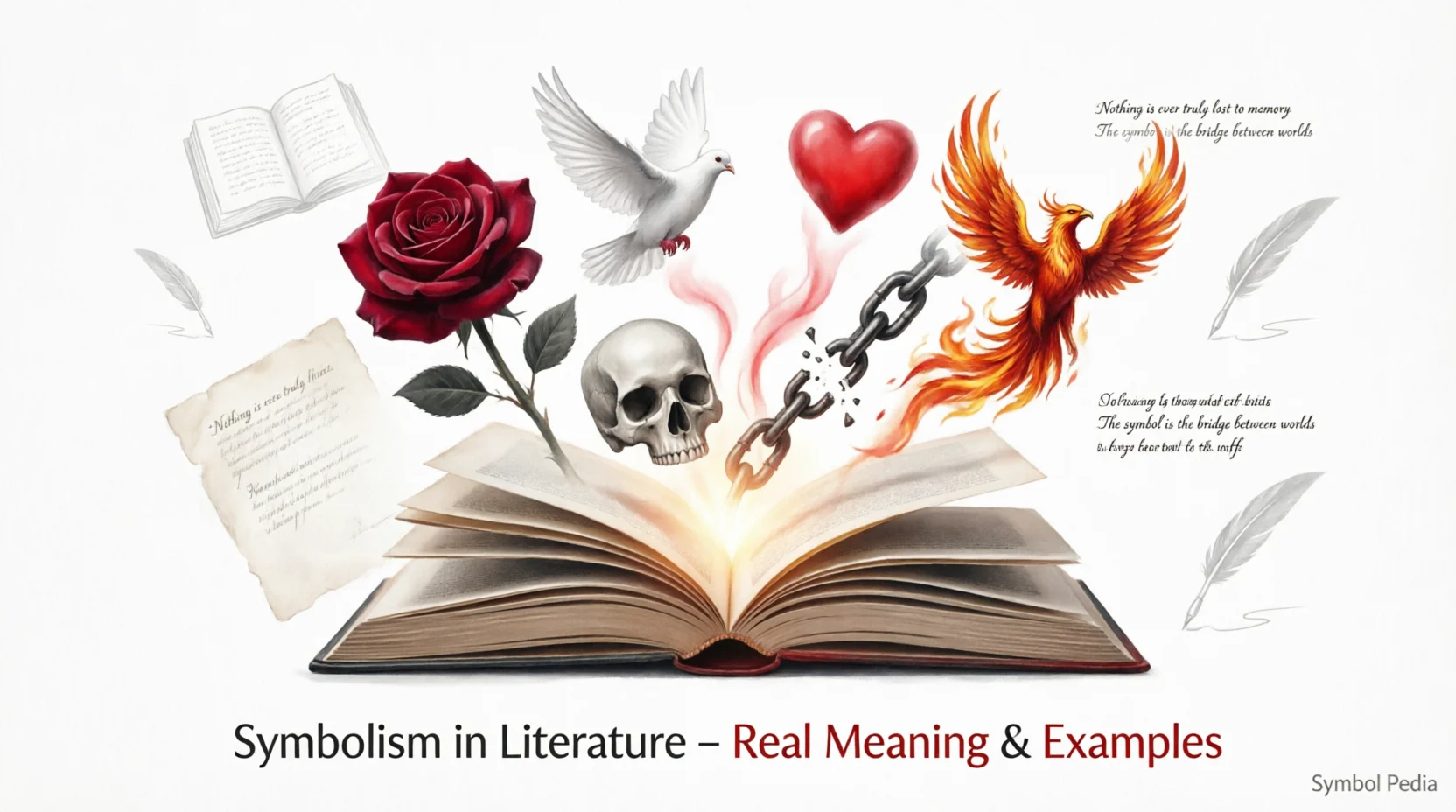
If you have ever read a novel, poem, short story, or play and wondered why an author keeps mentioning the same object, color, animal, place, or action, you have probably encountered a symbol.
So, what does symbol mean in literature? In simple terms, a symbol is something concrete—a person, object, image, setting, action, or even color—that represents a deeper idea beyond its literal meaning.
A rose may simply be a flower, for example. But in a poem, it might suggest love, beauty, passion, secrecy, or even the shortness of life.
This is where literary symbolism becomes fascinating. Writers can communicate complicated emotions and ideas without explaining everything directly. Instead of saying, “The character is grieving,” an author might describe a dying tree outside the character’s window.
People often search for the meaning of symbols in literature because symbolism can feel confusing at first. Is the object actually important, or is it just part of the story? Does the author intend a specific meaning, or can readers interpret it differently?
The answer is usually somewhere in between.
A literary symbol has meaning because of its context, repeated use, cultural associations, and relationship to the characters or themes. Understanding those clues can turn an ordinary reading experience into something much richer.
What Does Symbol Mean in Literature? – Quick Meaning
A symbol in literature is an element that represents an additional idea, emotion, theme, or concept beyond its literal meaning.
A symbol can be:
- An object, such as a ring, mirror, candle, or key
- A color, such as white, black, red, or green
- An animal, such as a bird, snake, or dove
- A place, such as a garden, forest, road, or house
- An action, such as washing hands or opening a door
- A natural element, such as rain, fire, winter, or sunlight
- A character who represents a larger idea
- A recurring image or event
For example:
“The broken clock represented the family’s inability to move forward.”
The clock is literally a clock, but symbolically it may represent time, loss, stagnation, or a life stuck in the past.
Another example:
“The bird finally escaped its cage.”
Literally, a bird leaves a cage. Symbolically, the scene could represent freedom, independence, or escape from control.
And:
“The winter seemed to last forever.”
Winter may describe a season, but it can also symbolize loneliness, emotional emptiness, death, or hardship.
The important point is that a symbol carries meaning beyond what it physically is.
Origin & Background of Literary Symbolism
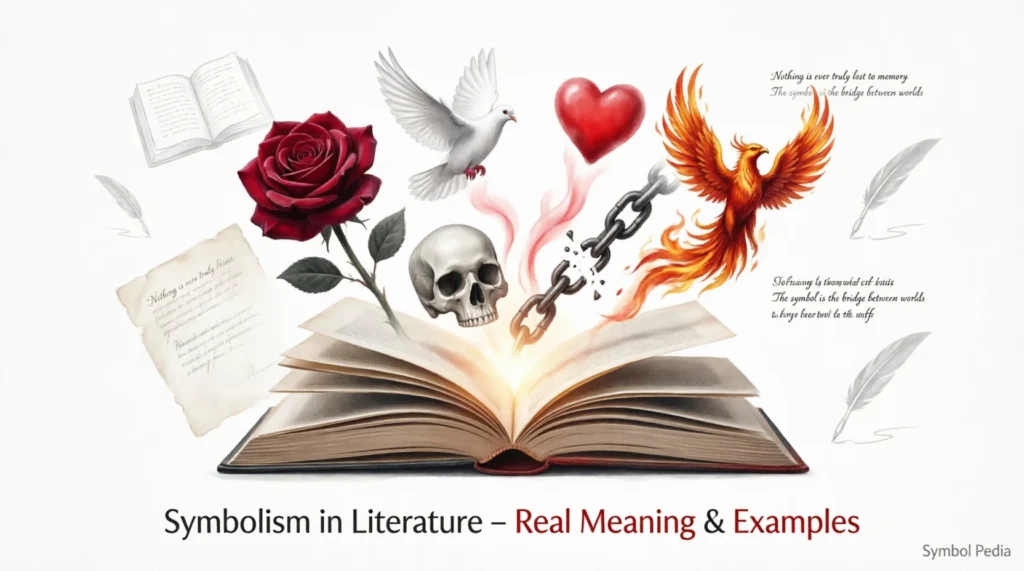
Symbolism is almost as old as storytelling itself.
Long before modern novels existed, humans used objects, animals, colors, natural events, and images to communicate ideas. Ancient myths and religious stories frequently relied on symbolic characters and objects.
A journey, for example, could represent more than traveling from one location to another. It could represent personal growth, spiritual discovery, or a transition from childhood to adulthood.
Flowers, birds, water, fire, darkness, and light have appeared symbolically across countless cultures and literary traditions.
Over time, writers developed increasingly sophisticated ways of using symbols. In poetry especially, symbolism became a powerful method for expressing feelings that are difficult to describe directly.
The nineteenth-century literary movement known as Symbolism placed particularly strong emphasis on suggestion, imagery, and indirect meaning. Symbolist writers often preferred creating an emotional atmosphere rather than explaining an idea plainly.
Modern literature continues this tradition.
Today, symbolism appears not only in books and poems but also in films, television, advertising, music videos, comics, and online storytelling. Social media has also made certain symbols instantly recognizable.
A heart emoji may suggest affection. A broken-heart symbol can suggest emotional pain. A black color may create an impression of grief or mystery.
However, modern communication also reminds us of something important: symbols do not have one universal meaning.
Culture, personal experience, historical background, and context can all change interpretation.
Real-Life Conversations About Symbols in Literature
1. WhatsApp Conversation
Person A: I don’t understand why the author keeps mentioning the rain.
Person B: Did you notice that it appears whenever the character feels depressed?
Person A: Yeah.
Person B: Then the rain probably works as a symbol of sadness or emotional heaviness.
Person A: So it isn’t just describing the weather?
Person B: Exactly. The weather is literal, but it may also reflect what’s happening inside the character.
2. Instagram DM
Person A: Why does the writer keep talking about mirrors?
Person B: Maybe it’s about appearance?
Person A: That’s what I thought, but the character looks into the mirror whenever she questions herself.
Person B: Then the mirror could symbolize identity or self-reflection.
Person A: That actually makes the story make much more sense.
3. TikTok Comments
Person A: Why is everyone saying the bird represents freedom?
Person B: Because the character is trapped in her house, and the bird keeps appearing outside the window.
Person A: Ohhh, so it’s connected to her situation.
Person B: Yep. That’s usually how you identify symbolism—look at what the image is doing in the larger story.
4. Text Messages
Person A: My English teacher says the road in the poem is symbolic.
Person B: Symbolic of what?
Person A: Life choices, apparently.
Person B: That makes sense. A road can literally be a road but also represent the direction someone’s life takes.
Person A: Literature suddenly got complicated 😂
Person B: Or interesting. Depends on your teacher.
Emotional & Psychological Meaning
Symbolism works so well because human beings naturally connect concrete images with abstract emotions.
It is difficult to physically show loneliness, regret, hope, jealousy, freedom, or grief. But writers can give those feelings a visible form.
A lonely character sitting beside an empty chair can communicate absence without the author writing several paragraphs about sadness.
A locked door can create a psychological feeling of restriction.
A growing tree can suggest healing or renewal.
A fading photograph can evoke memory and loss.
This gives symbolism an emotional power that direct explanation sometimes lacks.
There is also a psychological reason readers respond strongly to symbols. We bring our own memories and associations into a story.
Imagine reading about an old family house. One reader may associate it with warmth and childhood. Another may associate an old house with fear or painful memories.
The symbol can therefore become personally meaningful.
I have often found that the most memorable literary symbols are not the ones an author explains. They are the ones readers discover gradually and then suddenly realize have been present all along.
That moment of recognition is part of the pleasure of reading.
Usage in Different Contexts
Social Media and Online Discussions
People frequently discuss literary symbols on platforms such as TikTok, Instagram, Reddit, and online book communities.
A reader might say, “The red dress symbolizes her transformation,” while another reader may disagree.
That disagreement is not necessarily a problem. Literary interpretation often involves evidence and reasonable argument rather than one simple answer.
Friends and Relationships
When discussing books with friends, symbolism can make conversations much deeper.
Instead of saying, “I liked that scene,” you can explain why the repeated image of water made the character’s emotional journey more powerful.
Work and Professional Settings
In academic or professional writing, symbolism should be explained carefully.
Rather than writing, “The bird means freedom,” a stronger interpretation would be:
“The recurring bird imagery suggests freedom because it appears whenever the protagonist begins questioning the restrictions placed upon her.”
This approach connects the interpretation to evidence.
Casual vs. Serious Tone
Casually, you might say:
“I think the rain symbolizes her sadness.”
In an essay, you could write:
“The recurring rain imagery functions as a reflection of the protagonist’s growing emotional isolation.”
Both express the same basic idea, but the second is more analytical.
When NOT to Assume Something Is a Symbol
Not every detail in a story is symbolic.
This is one of the biggest mistakes beginners make.
If a character drinks coffee, the coffee does not automatically symbolize comfort, addiction, routine, capitalism, or anything else.
Sometimes coffee is simply coffee.
Before calling something a symbol, look for evidence such as:
- Repetition
- Unusual emphasis
- Connection to a major theme
- Relationship to a character’s emotions
- Placement at important moments
- Contrast with another image
- Cultural or historical significance
You should also be culturally sensitive.
A particular animal, color, object, or gesture may have different associations in different cultures. Assuming that one Western interpretation applies everywhere can produce a shallow reading.
The same symbol can also change meaning within one story.
Common Misunderstandings About Literary Symbols
“Every detail has a hidden meaning.”
Not necessarily.
Authors include ordinary details to make stories believable. Searching for secret meanings in every sentence can lead to overinterpretation.
“A symbol has only one correct meaning.”
Usually, no.
A strong interpretation should be supported by the text, but multiple interpretations can sometimes coexist.
“The dictionary definition is the symbolic meaning.”
A symbol depends heavily on context.
A snake might suggest danger in one story, transformation in another, and wisdom in a third.
“If the author doesn’t explain it, it isn’t a symbol.”
Authors often deliberately leave symbolism open to interpretation.
“Symbolism and metaphor are exactly the same.”
They are related but not identical.
A metaphor makes a comparison, while a symbol can repeatedly represent an idea throughout a larger work.
Comparison Table
| Literary Device | Basic Meaning | Example | Main Purpose |
|---|---|---|---|
| Symbol | Something represents a deeper idea | A cage representing restriction | Adds deeper meaning |
| Metaphor | One thing is described as another | “Her heart was ice.” | Creates comparison |
| Simile | Comparison using “like” or “as” | “He ran like the wind.” | Creates vivid imagery |
| Allegory | A larger story represents another idea | A fictional journey representing political or moral ideas | Communicates an extended message |
| Motif | A recurring image, idea, or element | Repeated references to water | Reinforces themes |
| Imagery | Descriptive language creating sensory pictures | Describing cold rain on skin | Builds atmosphere |
| Allusion | Reference to another text, person, or event | Mentioning a famous myth | Adds cultural or historical meaning |
| Irony | Contrast between expectation and reality | A fire station catching fire | Creates complexity or surprise |
| Personification | Giving human qualities to nonhuman things | “The wind whispered.” | Makes descriptions expressive |
Key Insight
The most useful way to understand symbolism is not to memorize a list of meanings. Instead, ask what the symbol means in this particular story and why the author chose it. Context is more reliable than a universal symbol dictionary.
How to Respond When Someone Uses a Literary Symbol
If someone is discussing symbolism and you want to respond naturally, your answer can depend on the situation.
Casual Replies
- “I can see that interpretation.”
- “That actually makes sense.”
- “I hadn’t noticed that before.”
- “The repeated imagery definitely supports that.”
Funny Replies
- “So the flower isn’t just a flower? 😂”
- “My English teacher was right after all.”
- “Apparently even the door has a backstory.”
- “I knew that suspiciously repeated rain meant something.”
Mature Replies
- “I think that interpretation fits because the image appears during the character’s emotional changes.”
- “There may be more than one valid reading here.”
- “The surrounding context makes that symbolism convincing.”
Respectful Replies
- “That’s an interesting interpretation.”
- “I hadn’t considered the cultural meaning behind it.”
- “I see your point, although I interpreted the symbol differently.”
The best literary conversations leave room for interpretation instead of treating every disagreement as a mistake.
Regional & Cultural Usage
Western Culture
In many Western literary traditions, symbols such as roses, crosses, journeys, darkness, light, and seasons have accumulated strong historical associations.
However, even familiar symbols can be deliberately reversed by authors.
Asian Culture
Asian literary traditions contain rich symbolic systems involving nature, seasons, animals, colors, landscapes, family objects, and spiritual imagery.
A symbol’s meaning may depend strongly on cultural history and philosophical traditions.
For this reason, readers should avoid assuming that a symbol means exactly what it commonly means in Western literature.
Middle Eastern Culture
Literature from Middle Eastern traditions can draw on religious, historical, poetic, and cultural symbolism.
Objects, landscapes, colors, and natural imagery may carry meanings connected to heritage, spirituality, family, identity, exile, or social experience.
Context is especially important when interpreting culturally significant imagery.
Global Internet Usage
Online readers increasingly discuss symbolism across cultures.
This has made literary interpretation more accessible, but it has also encouraged oversimplified claims such as “this symbol always means X.”
It usually does not.
Gen Z vs. Millennials
Younger readers often encounter literary symbolism through short-form videos, memes, fandom discussions, and visual storytelling.
Gen Z discussions may use casual language such as “coded,” “symbolism,” or “this represents,” while Millennials may be more accustomed to traditional classroom terminology.
Despite differences in vocabulary, the underlying question is the same: What deeper idea is this image communicating?
Is Symbolism in Literature Safe for Kids?
Yes. Learning about literary symbolism is generally safe and beneficial for children when the material itself is age-appropriate.
It can help young readers develop critical thinking, vocabulary, emotional awareness, and interpretation skills.
Parents and teachers should simply consider the age and themes of the book.
A children’s story might use a butterfly to symbolize transformation, while an older novel may use darker or more complex symbols involving death, violence, identity, or trauma.
The skill of recognizing symbolism is valuable at every reading level.
FAQs About Symbols in Literature
What does symbol mean in literature?
A symbol is a person, object, image, action, setting, or other element that represents a deeper idea beyond its literal meaning.
What is an example of symbolism?
A locked door can symbolize restriction, secrecy, isolation, or an opportunity that remains inaccessible, depending on the story.
Why do authors use symbols?
Authors use symbols to communicate themes, emotions, and complex ideas indirectly while giving readers something meaningful to interpret.
Does every symbol have one meaning?
No. Symbolic meaning depends on context, culture, repetition, character development, and the themes of the literary work.
What is the difference between a symbol and a metaphor?
A metaphor creates a comparison between two things, while a symbol represents a deeper idea and may develop meaning throughout a work.
How can I identify a symbol in a story?
Look for objects, images, colors, places, or actions that are repeated, emphasized, connected to important themes, or associated with major character changes.
Can the same symbol mean different things?
Absolutely. A symbol such as water might represent cleansing in one story, danger in another, and emotional change in a third.
Conclusion
So, what does symbol mean in literature? At its heart, a symbol is a doorway between the literal world of a story and the deeper ideas underneath it.
A flower can become a memory. A road can become a life choice. A locked door can become a boundary. Rain can become grief. Light can become hope.
But there is no need to turn every object into a puzzle.
The strongest readers pay attention to patterns, context, character emotions, cultural background, and the author’s larger themes. They ask not only, “What does this object represent?” but also, “Why does it appear here, and what changes when it appears?”
That small shift in thinking can completely change the way you read.
And perhaps that is the real beauty of literary symbolism: the author gives you an image, but the meaning grows through the conversation between the text and your own imagination.
descover more post
Ohm Symbol and Meaning Understanding Ω Its History and …
What Does the Clover Symbol Mean Luck Love Culture More …
Statistical Symbol for Mean What It Means How to Use It and …

Orvian is a passionate researcher and dedicated content creator focused on exploring the deeper meanings behind symbols, signs, and cultural interpretations. With a strong interest in symbolism and human psychology, Orvian simplifies complex ideas into clear, engaging, and easy-to-understand content for readers around the world.
Through consistent research and thoughtful writing, Orvian aims to provide accurate, insightful, and meaningful information that helps users connect with symbols on a deeper level—whether for personal growth, curiosity, or knowledge.
Known for a hardworking mindset and attention to detail, Orvian believes that every symbol carries a story, and every story deserves to be understood.