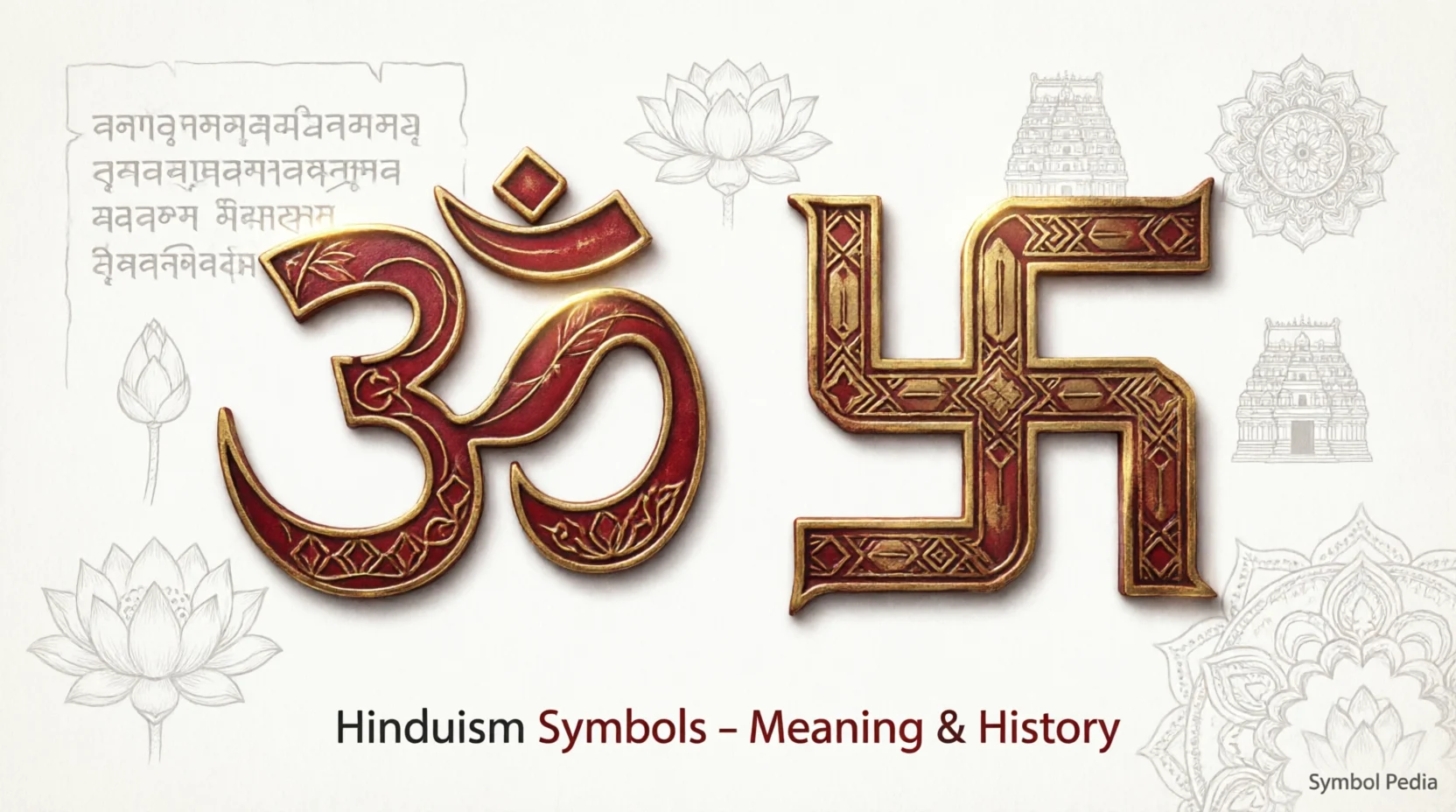
If you have ever seen the familiar ॐ (Om) symbol and wondered, “What does the Hinduism symbol mean?”, you are not alone. It appears in temples, prayer spaces, books, jewelry, tattoos, artwork, yoga studios, and social media posts around the world.
The symbol most commonly associated with Hinduism is ॐ, written in English as Om or Aum. It represents one of the most important spiritual ideas in Hindu thought: the sacred sound and vibration associated with ultimate reality, consciousness, and the divine.
However, there is an important detail that often gets missed. Hinduism does not have only one symbol. Om is probably the most recognizable, but symbols such as the Swastika, Trishula, Lotus, and sacred tilak also have deep religious meanings.
So, when someone asks what the Hinduism symbol means, they are usually asking about ॐ (Om). Understanding it properly requires more than knowing its name. Its meaning is connected to ancient Sanskrit traditions, meditation, consciousness, and the relationship between the individual self and ultimate reality.
This guide explains that meaning in simple English while also looking at how the symbol is used in everyday life today.
What Does the Hinduism Symbol Mean? – Quick Meaning
The ॐ (Om/Aum) symbol is a sacred Hindu symbol representing a profound spiritual reality. It is traditionally associated with the sound of creation, the divine, consciousness, and the ultimate reality known as Brahman.
In simple terms:
- ॐ = Om or Aum
- It is a sacred syllable in Hindu traditions.
- It represents ultimate reality and spiritual consciousness.
- It is commonly used in prayer, chanting, and meditation.
- Its three-part sound, often expressed as A-U-M, has several traditional interpretations.
- It can symbolize different states of consciousness, including waking, dreaming, and deep sleep.
- The silence following the sound is also spiritually significant in some philosophical interpretations.
You may see someone describe it simply by saying:
“Om represents universal consciousness.”
Or:
“It is a sacred sound used in Hindu prayer and meditation.”
Another person might explain it more personally:
“For me, Om represents peace and connection with the divine.”
All three explanations can make sense, but the symbol has a much richer philosophical background.
Origin & Background of the Hinduism Symbol
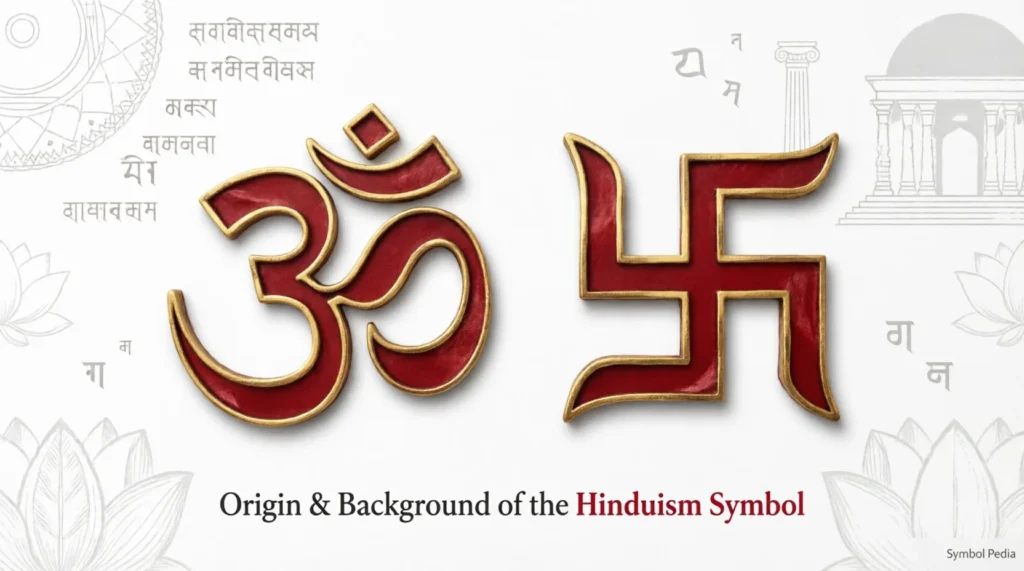
The history of Om reaches back thousands of years into ancient Indian religious and philosophical traditions.
The syllable appears in the Vedic and Upanishadic traditions, where sacred sound and spoken language were considered deeply significant. Rather than functioning merely as a decorative religious mark, Om became associated with profound questions about existence and consciousness.
One of the best-known discussions of Om appears in the Mandukya Upanishad, a short but philosophically influential Hindu text. It explores Om in connection with different dimensions of consciousness and ultimate reality.
The syllable is often represented as A-U-M.
Traditionally, these sounds have been interpreted in different ways. One influential interpretation connects them with waking consciousness, dreaming, and deep sleep, while the silence beyond the three sounds points toward a fourth state of consciousness.
That fourth state is often called Turiya, associated with a state beyond ordinary waking, dreaming, and deep sleep.
This is one reason Om can mean much more than “peace.” It can represent an entire philosophical understanding of consciousness.
Cultural Influence
Om became deeply woven into Hindu religious life. It may appear at the beginning or end of prayers, mantras, scriptures, and devotional practices.
It is also connected with numerous Hindu mantras. For many practitioners, chanting Om is not simply about producing a pleasant sound. It can be a way of focusing the mind and turning attention inward.
Social Media and Modern Culture
Today, Om has moved far beyond traditional religious settings.
You may see it on:
- Yoga clothing
- Meditation posters
- Jewelry
- Home décor
- Tattoos
- Instagram profiles
- Wellness websites
- Spiritual artwork
This worldwide visibility has made the symbol familiar to people who may know little about Hindu philosophy.
That popularity can be positive because it introduces people to Hindu traditions. At the same time, it can create misunderstandings when Om is reduced to a generic symbol for “good vibes” or relaxation.
Its roots are much deeper than modern wellness culture.
Real-Life Conversations
Seeing how people actually ask about religious symbols can make the meaning easier to understand.
WhatsApp Conversation
Person A:
I keep seeing this symbol ॐ in meditation videos. What does the Hinduism symbol mean?
Person B:
That’s Om. It’s a sacred Hindu syllable connected with ultimate reality and consciousness.
Person A:
So it’s basically a meditation symbol?
Person B:
Meditation is one use, but its meaning is much deeper. It’s connected with Hindu philosophy, prayer, and the nature of existence.
Instagram DM
Person A:
I want to buy an Om necklace. Does it just mean peace?
Person B:
Not exactly. Peace is one way people interpret its spiritual feeling, but Om has deeper meanings related to consciousness and the divine.
Person A:
Oh, I didn’t realize there was that much history behind it.
Person B:
Yeah, it’s an ancient sacred symbol, not just a wellness logo.
TikTok Comments
Person A:
What does this Hindu symbol mean? I see it everywhere.
Person B:
It’s Om or Aum. It’s a sacred syllable associated with ultimate reality and spiritual consciousness.
Person A:
Is it pronounced “om”?
Person B:
Yes. It’s commonly pronounced Om, while Aum emphasizes its traditional three-part sound.
Text Message
Person A:
My friend has ॐ in her bio. Is that a religious symbol?
Person B:
Usually, yes. It’s strongly associated with Hinduism, although it’s also important in some other Indian religious traditions.
Person A:
So I shouldn’t assume it just means yoga?
Person B:
Right. Yoga and meditation use it, but its religious and philosophical meaning comes first.
Emotional & Psychological Meaning
Symbols often communicate feelings that are difficult to put into ordinary words. Om is a good example.
For many people, it represents inner stillness, spiritual connection, awareness, and a search for deeper meaning.
When someone uses Om in a personal space, they may be expressing an interest in meditation or spirituality. For someone practicing Hinduism, however, the symbol may carry a much more personal religious significance.
There is also a psychological side to chanting.
Repeating a sound slowly and rhythmically can help a person concentrate on the present moment. The practice can create a feeling of ritual and mental focus. But that psychological experience should not be confused with the complete religious meaning of Om.
A simple personal-style example might be someone sitting quietly before a difficult day, taking several slow breaths, and chanting Om. For that person, the symbol may become a reminder to pause, regain perspective, and reconnect with their spiritual beliefs.
That personal association is meaningful, but it exists alongside—not instead of—the symbol’s traditional Hindu significance.
Usage in Different Contexts
Social Media
On social media, Om commonly appears in usernames, bios, captions, artwork, and meditation content.
Some people use it to express Hindu identity. Others use it because they practice yoga or meditation.
Because the same symbol can have different personal motivations, it is better not to assume exactly what someone believes simply because they use Om.
Friends & Relationships
Among friends, someone might use Om while discussing spirituality, yoga, meditation, or Hindu culture.
A respectful response is usually enough. You do not need to be an expert in Hindu philosophy to appreciate what the symbol means to someone.
Work and Professional Settings
Om may appear in workplaces connected with yoga, meditation, Indian culture, spirituality, or religious organizations.
In a general professional environment, however, it is best to understand the symbol before using it in promotional material or branding.
Casual vs. Serious Tone
Using Om casually can be harmless when someone understands its significance.
The problem begins when a sacred religious symbol is treated as a meaningless decoration or joke. Context and intention matter.
When NOT to Use It
There are situations where using Om deserves extra care.
Don’t Use It as a Joke
Because Om is sacred to many people, using it as part of a joke about Hinduism can come across as disrespectful.
Be Careful With Tattoos
A tattoo is permanent, so anyone considering an Om tattoo should understand its religious significance rather than choosing it solely because it looks attractive.
Some Hindu communities and individuals may have strong feelings about where sacred symbols should be placed on the body.
Avoid Treating It as a Generic “Peace Logo”
Om can be associated with peace and meditation, but reducing it entirely to those concepts removes much of its religious and philosophical depth.
Consider Cultural Context
If you are using Om in a business, educational project, artwork, or public campaign, take time to understand its context.
Good intentions do not automatically prevent cultural misunderstanding.
Common Misunderstandings
“Om only means peace.”
Not quite. Peace may be part of someone’s personal association with Om, but the symbol has broader philosophical meanings involving consciousness, sacred sound, and ultimate reality.
“Om is just a yoga symbol.”
Yoga has popularized Om internationally, but its history is much older and strongly connected to Hindu religious and philosophical traditions.
“The symbol and the sound are exactly the same thing.”
They are closely related, but the written character ॐ is a visual representation of the sacred syllable Om/Aum.
“Everyone who uses Om is Hindu.”
Not necessarily. People from different backgrounds may use the symbol because of yoga, meditation, spirituality, cultural appreciation, or personal practice.
“Om has only one interpretation.”
Hindu traditions contain diverse philosophical schools and interpretations. The symbol has accumulated several layers of meaning over centuries.
Comparison Table
| Symbol or Expression | Main Meaning | Common Context |
|---|---|---|
| ॐ Om/Aum | Sacred sound, consciousness, ultimate reality | Hindu prayer, meditation, philosophy |
| Swastika | Auspiciousness, well-being, good fortune | Hindu ceremonies, homes, religious art |
| Lotus | Purity, spiritual growth, beauty | Hindu religious imagery |
| Trishula | Shiva’s trident; multiple symbolic interpretations | Shaivism, temples, religious art |
| Tilak | Religious or spiritual identity and devotion | Hindu worship and ceremonies |
| Mantra | Sacred phrase or sound used in spiritual practice | Prayer, meditation, ritual |
| Shanti | Peace | Sanskrit prayers and spiritual contexts |
| Namaste | Respectful greeting/salutation | Indian cultural and spiritual contexts |
Key Insight
Om is not simply interchangeable with words such as “peace,” “namaste,” or “meditation.” These concepts can overlap in spiritual contexts, but each has its own meaning and cultural history.
How to Respond When Someone Uses the Hinduism Symbol
If someone sends or displays Om, your response can depend on the situation.
Casual Replies
- “Oh, that’s Om, right?”
- “I recognize that symbol from Hindu traditions.”
- “That’s interesting. What does it mean to you?”
Funny Replies
Keep humor gentle and avoid making the religion itself the joke.
- “Okay, I definitely need a lesson on that one!”
- “I recognize the symbol, but I’m still learning its deeper meaning.”
Mature Replies
- “I know Om has a deeper meaning in Hindu philosophy. I’d love to understand your interpretation.”
- “That symbol has such a long history. What does it represent for you personally?”
Respectful Replies
- “Thank you for explaining its significance.”
- “I appreciate learning about the cultural meaning behind it.”
- “I’ll make sure I understand the tradition before using it.”
The most respectful response is often simple curiosity rather than pretending to know more than you do.
Regional & Cultural Usage
Western Culture
In Western countries, Om is frequently encountered through yoga, meditation, wellness culture, and spirituality.
This has made the symbol widely recognizable, but it can also lead to the mistaken idea that Om is primarily a wellness or relaxation symbol.
Asian Culture
Across South Asia and other parts of Asia, Om can have stronger connections to religious practice, traditional art, temples, family customs, and spiritual life.
Its meaning may therefore feel more immediate and culturally grounded.
Middle Eastern Culture
In Middle Eastern communities, people may encounter Om primarily through global media, yoga, Indian culture, or personal connections with South Asian communities.
Understanding the symbol’s Hindu background helps prevent confusion with symbols from other religious traditions.
Global Internet Usage
The internet has transformed Om into a globally recognized image.
Someone may use ॐ in a profile because they are Hindu, interested in meditation, connected with Indian culture, or simply drawn to its visual symbolism.
Digital use has therefore broadened the symbol’s audience without eliminating its original religious significance.
Gen Z vs. Millennials
Younger internet users may encounter Om through TikTok, Instagram, wellness communities, tattoos, and aesthetic content.
Millennials may be more familiar with it through the growth of global yoga and meditation culture.
Neither generation necessarily understands its traditional philosophical meaning simply because they recognize the symbol.
Is It Safe for Kids?
Yes, Om is not inherently unsafe for children. It is a religious and cultural symbol.
The important issue is context. Children can learn about Om as part of lessons about Hinduism, Indian culture, religion, art, history, or world traditions.
If a child wants to wear or draw the symbol, parents or teachers can use the opportunity to explain that it has sacred significance for many Hindus.
Teaching children the meaning behind a religious symbol is generally more respectful than presenting it as a random decorative image.
FAQs
What does the Hinduism symbol mean?
The symbol most commonly associated with Hinduism is ॐ (Om/Aum). It represents sacred sound, consciousness, ultimate reality, and spiritual awareness in Hindu traditions.
Is Om the symbol for Hinduism?
Om is widely recognized as one of the most important symbols associated with Hinduism, although Hinduism has many other important symbols as well.
What does Om mean spiritually?
Spiritually, Om can represent ultimate reality, consciousness, the divine, and the interconnected nature of existence. Its interpretation varies across Hindu philosophical traditions.
Why do people chant Om?
People chant Om during prayer, meditation, and spiritual practice. For many practitioners, chanting helps focus attention and supports contemplative practice.
Is Om a religious symbol?
Yes. Om has deep religious significance in Hindu traditions and should not be treated merely as decorative artwork.
Is Om the same as Aum?
Om and Aum refer to the same sacred syllable. “Aum” emphasizes the traditional three-part sound, while “Om” is the common English spelling and pronunciation.
Can non-Hindus use the Om symbol?
People from outside Hinduism may use Om in meditation, yoga, art, or personal spiritual practice. However, anyone using it should understand and respect its religious significance.
Conclusion
So, what does the Hinduism symbol mean?
If you mean ॐ (Om), the answer goes far beyond “peace” or “meditation.” Om is a sacred syllable deeply connected with Hindu ideas about ultimate reality, consciousness, existence, and spiritual awareness.
Its history reaches into ancient Indian religious and philosophical traditions, while its modern presence can be found everywhere from temples to yoga studios and social media profiles.
The most important thing is to see the symbol as more than an attractive design. For millions of people, it carries religious meaning, cultural memory, and personal spiritual significance.
If you encounter Om, you do not need to know every detail of Hindu philosophy. Start with respect, recognize its sacred roots, and remain curious about the deeper meaning behind the symbol.
That small shift—from simply recognizing a symbol to understanding the tradition behind it—is what turns cultural familiarity into genuine cultural understanding.
descover more post
What Does the Swirl Symbol Mean A Complete Guide to Its …
Japanese Symbol Meaning What Popular … – Symbl Pedia
What Does the Lock Symbol Mean on Snapchat Everything …

Orvian is a passionate researcher and dedicated content creator focused on exploring the deeper meanings behind symbols, signs, and cultural interpretations. With a strong interest in symbolism and human psychology, Orvian simplifies complex ideas into clear, engaging, and easy-to-understand content for readers around the world.
Through consistent research and thoughtful writing, Orvian aims to provide accurate, insightful, and meaningful information that helps users connect with symbols on a deeper level—whether for personal growth, curiosity, or knowledge.
Known for a hardworking mindset and attention to detail, Orvian believes that every symbol carries a story, and every story deserves to be understood.