If you have ever looked at a statistics formula and wondered, “What’s the symbol for mean?”, you are not alone. The notation can seem confusing at first, especially because the symbol changes depending on whether you are working with a sample or an entire population.
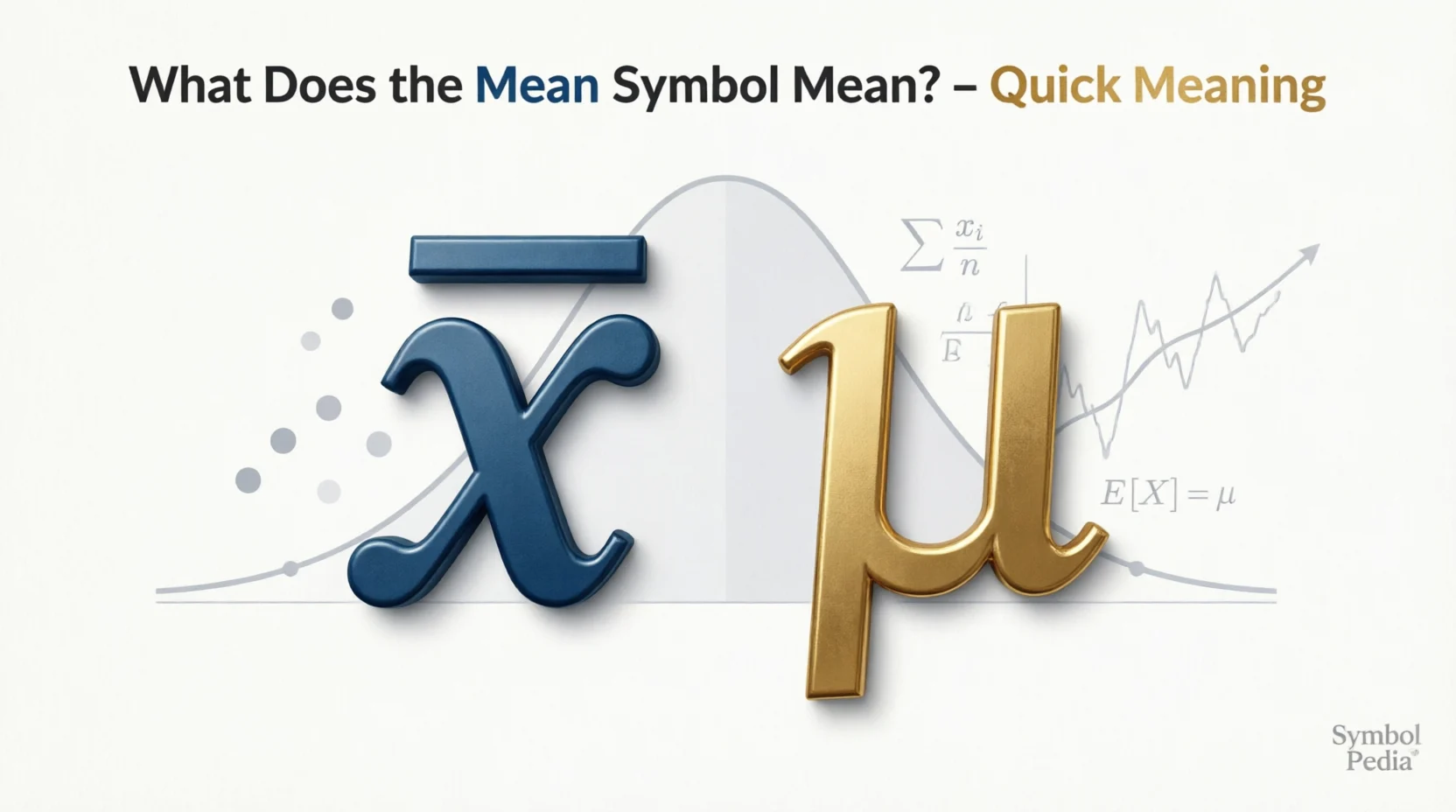
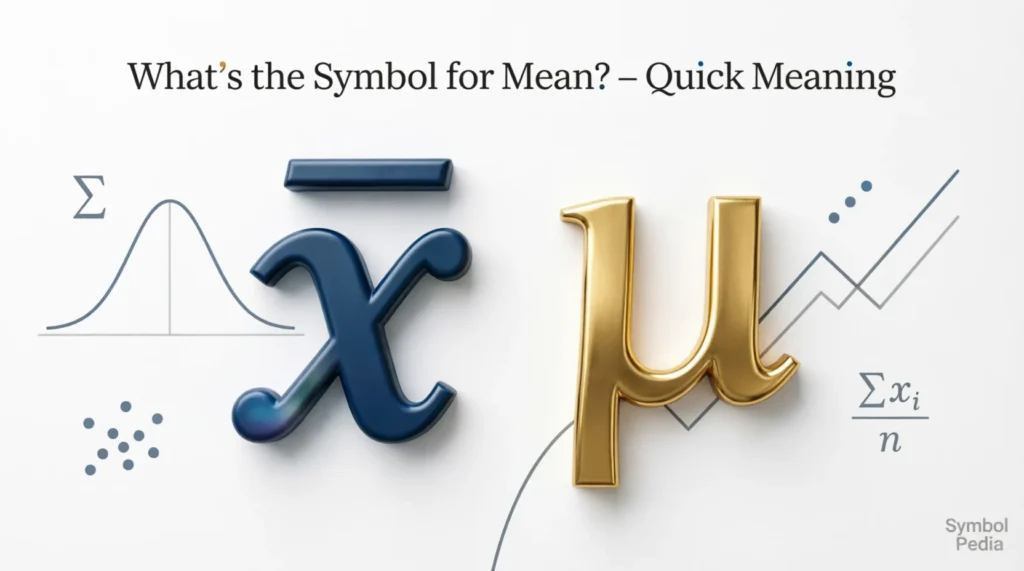
The most common symbol for the mean of a sample is x̄, pronounced “x-bar.” For a population mean, statisticians usually use the Greek letter μ (mu).
Both symbols represent an average, but they are used in different statistical situations.
Understanding this small distinction makes formulas much easier to read. It also helps you avoid one of the most common beginner mistakes in statistics: treating a sample mean and a population mean as though they are exactly the same thing.
In this guide, we will look at what the mean symbol means, where the notation comes from, how it appears in real calculations, how people discuss it in different settings, and how to recognize related symbols.
What’s the Symbol for Mean? – Quick Meaning
The symbol for the arithmetic mean depends on the type of data you are describing.
- x̄ (x-bar) = sample mean
- μ (mu) = population mean
- Σ (capital sigma) = summation, often used when calculating a mean
- n = number of observations in a sample
- N = number of observations in a population
The basic formula for a sample mean is:
x̄ = Σx / n
This means you add all the observed values together and divide the result by the number of observations.
For example, if your test scores are 70, 80, 90, and 100:
x̄ = (70 + 80 + 90 + 100) / 4 = 85
So, the sample mean is 85.
Simple examples
“The sample mean is x̄ = 85.”
“The population mean is represented by μ.”
“Calculate x̄ by adding the values and dividing by n.”
One important point is worth remembering: x̄ does not mean “x with a random line above it.” The bar is part of the statistical notation and tells you that you are looking at the average of the observed x-values.
Origin & Background of the Mean Symbol
The idea of finding an average is much older than modern statistics.
Ancient mathematicians and scholars used forms of averaging when comparing quantities, studying measurements, and solving practical problems. Farmers, merchants, astronomers, and engineers all had reasons to combine several measurements into a representative value.
Modern statistical notation developed much later.
As mathematics became more standardized, symbols made it possible to communicate complicated ideas quickly. Instead of repeatedly writing “the average of all observed x-values,” statisticians could simply write x̄.
The notation became especially useful as statistics developed into a formal mathematical discipline.
The distinction between x̄ and μ is particularly important in inferential statistics.
A researcher often studies a sample because collecting information from an entire population is expensive or impossible. The sample mean, x̄, can then be used to estimate the population mean, μ.
For example, imagine a university has 20,000 students.
A researcher might select 500 students and calculate their average study time. That calculated average is the sample mean, x̄.
The actual average study time of all 20,000 students would be the population mean, μ.
Cultural influence and everyday language
Although these symbols belong to mathematics, the idea behind them appears everywhere.
People casually talk about the “average temperature,” “average salary,” “average score,” or “average age.” In everyday conversation, we usually write the word average rather than x̄ or μ.
Social media has also made statistics more visible.
People frequently share average ratings, average prices, average views, average scores, and other numerical summaries online. That has made mathematical notation more familiar to people who may not have studied statistics recently.
Still, online explanations sometimes mix up the terms. The most reliable rule is simple:
x̄ usually describes a sample average, while μ describes a population average.
Real-Life Conversations About the Mean Symbol
Mathematical symbols often appear in ordinary conversations when students, coworkers, or friends are discussing homework or data.
WhatsApp Conversation
Person A:
I’m stuck on this statistics question. What’s the symbol for mean again?
Person B:
If it’s the sample mean, it’s x-bar: x̄.
Person A:
And μ?
Person B:
That’s usually the population mean.
Person A:
Oh, that was the part confusing me.
Instagram DM
Person A:
What does that x with the line over it mean in your notes?
Person B:
x̄? That means sample mean.
Person A:
So basically the average?
Person B:
Exactly. Add the values and divide by how many there are.
TikTok Comments
Person A:
What does x̄ mean? 😭
Person B:
It means the sample mean, basically the average of the sample.
Person A:
So it’s not the same as μ?
Person B:
Not exactly. μ is normally used for the population mean.
Text Message
Person A:
Teacher said find the mean and use x̄. What does that mean?
Person B:
x-bar is the sample average.
Person A:
So I just add everything and divide by the number of values?
Person B:
Yep, if it’s an ordinary arithmetic mean.
Emotional & Psychological Meaning of the Mean Symbol
At first glance, a symbol such as x̄ may seem completely impersonal. But learning mathematical notation often has an emotional side.
Students frequently become anxious when they see unfamiliar symbols. A simple average that feels obvious in everyday language can suddenly seem complicated when it appears as:
x̄ = Σx/n
The underlying calculation has not necessarily become harder. The notation has simply compressed several familiar ideas into a few symbols.
That is why understanding the meaning behind the notation is more useful than memorizing it blindly.
The mean symbol represents an attempt to summarize several individual observations with one central value.
Think about a teacher looking at the scores of an entire class. Instead of discussing every score separately, the teacher may calculate the class average. The mean gives a quick sense of the group’s overall performance.
In my experience, one of the most useful ways to teach this idea is to say: “x-bar is the average of the x-values you actually collected.”
Once students connect the symbol to that sentence, the formula usually feels much less intimidating.
Usage in Different Contexts
1. Social Media
You may see x̄ or μ in educational posts, statistics tutorials, research discussions, and data-analysis content.
For example:
“The sample mean, x̄, was 42.6.”
Casual social media users are more likely to say “average” rather than use the formal symbol.
2. Friends and Relationships
In conversations between students, x̄ is often used when discussing homework, exams, grades, or statistics projects.
Someone might text:
“I got x̄ = 76. Did you get the same?”
The meaning is simply that their calculated sample average is 76.
3. Work and Professional Settings
In research, business analytics, education, medicine, economics, and many other fields, mean notation can appear regularly.
A report might distinguish between:
- sample mean, x̄
- population mean, μ
- sample standard deviation, s
- population standard deviation, σ
The distinction matters because professionals need to know whether a number describes observed sample data or an entire population.
4. Casual vs. Serious Tone
In casual conversation, “average” is usually clearer:
“The average was 82.”
In a mathematical formula or academic report, notation is more efficient:
“x̄ = 82.”
Neither is more correct in every situation. The appropriate choice depends on your audience.
When NOT to Use the Mean Symbol
There are situations where writing x̄ or μ can create unnecessary confusion.
When talking to beginners
If someone has never studied statistics, writing x̄ without explanation may make a simple idea seem more complicated.
It is often better to write:
“The average (x̄) is 82.”
Then explain the symbol.
When the calculation is not an arithmetic mean
The word “mean” can refer to several different types of averages, including arithmetic, geometric, and harmonic means.
The standard x̄ formula refers to the arithmetic mean unless the context specifies otherwise.
When describing a population incorrectly
Do not automatically use x̄ for every average.
If you are describing the true average of an entire population in statistical notation, μ is generally the appropriate symbol.
When the context is informal
There is no need to use complex notation in an everyday message if “average” communicates the idea more clearly.
Common Misunderstandings About the Mean Symbol
“x̄ and μ mean exactly the same thing.”
They both represent means, but they usually refer to different things.
x̄ is generally the sample mean, while μ is generally the population mean.
“The line over x means negative x.”
No.
The bar in x̄ does not mean that x is negative. It indicates the average of the observed x-values.
“Σ means mean.”
Not exactly.
Σ is the capital Greek letter sigma and represents summation.
In the formula:
x̄ = Σx/n
Σx means to add the relevant x-values together.
“The mean is always one of the original values.”
Not necessarily.
Suppose the values are:
10, 20, 30
The mean is 20, which happens to be one of the original values.
But for:
10, 20, 31
the mean is:
20.33
That value was not originally in the data set.
“Mean and median are the same.”
They are different measures of central tendency.
The mean uses all values in the calculation. The median is the middle value when the data are arranged in order.
Mean Symbol vs. Similar Statistical Symbols
| Symbol | Name | Meaning | Common Use |
|---|---|---|---|
| x̄ | x-bar | Sample mean | Average of sample data |
| μ | Mu | Population mean | Average of an entire population |
| Σ | Sigma | Summation | Adding values together |
| n | n | Sample size | Number of observations in a sample |
| N | N | Population size | Number of members in a population |
| s | s | Sample standard deviation | Measures sample spread |
| σ | Sigma | Population standard deviation | Measures population spread |
| Me | Median | Middle value | Central tendency |
| Mo | Mode | Most frequent value | Frequency-based summary |
Key Insight
The easiest distinction to remember is x̄ = sample mean and μ = population mean. Once you understand that difference, many introductory statistics formulas become much easier to interpret.
How to Respond When Someone Asks “What’s the Symbol for Mean?”
Sometimes the question is not about solving a formula. Someone simply wants a quick explanation.
Casual replies
- “The sample mean is x-bar, written x̄.”
- “Usually x̄ means the average of a sample.”
- “For a population mean, use μ.”
Funny replies
- “The mysterious x with a hat—or technically a bar—is x̄. 😂”
- “It’s x-bar. Statistics just likes making averages look fancy.”
Mature replies
- “The standard symbol for a sample mean is x̄, while μ is used for a population mean.”
- “It depends on whether you are describing a sample or an entire population.”
Respectful replies
- “If you mean the statistical average, the sample mean is written x̄. The population mean is usually μ.”
- “The symbol depends on the context, but x̄ is the one you’ll most often see for a sample mean.”
Regional & Cultural Usage
Mathematical notation is remarkably consistent across countries, although the way people explain it can vary.
Western Culture
In the United States, Canada, the United Kingdom, and other Western educational systems, students commonly encounter x̄ for the sample mean and μ for the population mean.
Textbooks may differ slightly in notation, but these conventions are widespread.
Asian Culture
Across many Asian education systems, students encounter the same standard statistical symbols in mathematics and science courses.
The terminology used by teachers may vary because different countries have different educational traditions and languages, but x̄ and μ remain recognizable statistical notation.
Middle Eastern Culture
Mathematics education in Middle Eastern countries also commonly uses internationally recognized statistical notation.
The surrounding explanation may be given in Arabic, Persian, Turkish, or another local language, but formulas typically retain symbols such as x̄, μ, and Σ.
Global Internet Usage
Online learning has made mathematical symbols almost universal.
A student in one country can post:
“Can someone explain x̄?”
and receive an explanation from someone thousands of miles away.
This is one reason mathematical notation is so powerful: symbols can cross language barriers surprisingly well.
Gen Z vs. Millennials
Younger internet users may encounter statistical notation through TikTok, YouTube, online courses, gaming analytics, sports statistics, and data-driven content.
Millennials may be more likely to remember the notation from school or university.
The difference is generally not the mathematical meaning itself. It is more about where people encounter the symbols and how casually they discuss them.
Is the Mean Symbol Safe for Kids?
Yes. The mean symbol is completely safe and is a normal part of mathematics and statistics education.
For younger students, the main challenge is not safety but understanding.
A child learning averages may benefit from starting with ordinary language:
“Add the numbers, then divide by how many numbers there are.”
Once that idea is comfortable, introduce:
x̄
This approach helps children understand the concept before having to memorize unfamiliar notation.
FAQs About the Mean Symbol
1. What is the symbol for mean?
The most common symbol for a sample mean is x̄, pronounced “x-bar.” The population mean is usually represented by μ, pronounced “mu.”
2. What does x̄ mean?
x̄ means the sample mean, or the arithmetic average of the values in a sample.
3. What does μ mean in statistics?
μ represents the population mean, meaning the average value for an entire population.
4. Is x̄ the same as average?
Usually, yes, when x̄ is being used for an arithmetic sample mean. It represents the sum of the sample values divided by the number of observations.
5. What does Σ mean in the mean formula?
Σ means summation. It tells you to add the relevant values together.
6. How do you calculate x̄?
Use:
x̄ = Σx/n
Add all sample values and divide the total by the number of observations.
7. What is the difference between x̄ and μ?
x̄ is generally the sample mean, while μ is generally the population mean. This distinction is important in statistical analysis.
Conclusion
So, what’s the symbol for mean?
If you are talking about the average of a sample, the answer you are probably looking for is x̄, pronounced “x-bar.” If you are describing the mean of an entire population, the conventional symbol is μ, pronounced “mu.”
The important thing is not simply memorizing the symbols. Understand what they represent.
When you see x̄, think: “This is the average calculated from my sample.”
When you see μ, think: “This refers to the average of the whole population.”
Once that distinction becomes familiar, statistical notation stops looking like a collection of mysterious symbols and starts reading more like a compact language. And that is really what mathematical notation is meant to do: turn complicated ideas into something you can recognize at a glance.
descover more post
Aquarius Zodiac Symbol Meaning The Hidden Power Behind …
What Does the Car Sliding Symbol Mean Warning Light …
What Does the Swirl Symbol Mean A Complete Guide to Its …

Orvian is a passionate researcher and dedicated content creator focused on exploring the deeper meanings behind symbols, signs, and cultural interpretations. With a strong interest in symbolism and human psychology, Orvian simplifies complex ideas into clear, engaging, and easy-to-understand content for readers around the world.
Through consistent research and thoughtful writing, Orvian aims to provide accurate, insightful, and meaningful information that helps users connect with symbols on a deeper level—whether for personal growth, curiosity, or knowledge.
Known for a hardworking mindset and attention to detail, Orvian believes that every symbol carries a story, and every story deserves to be understood.