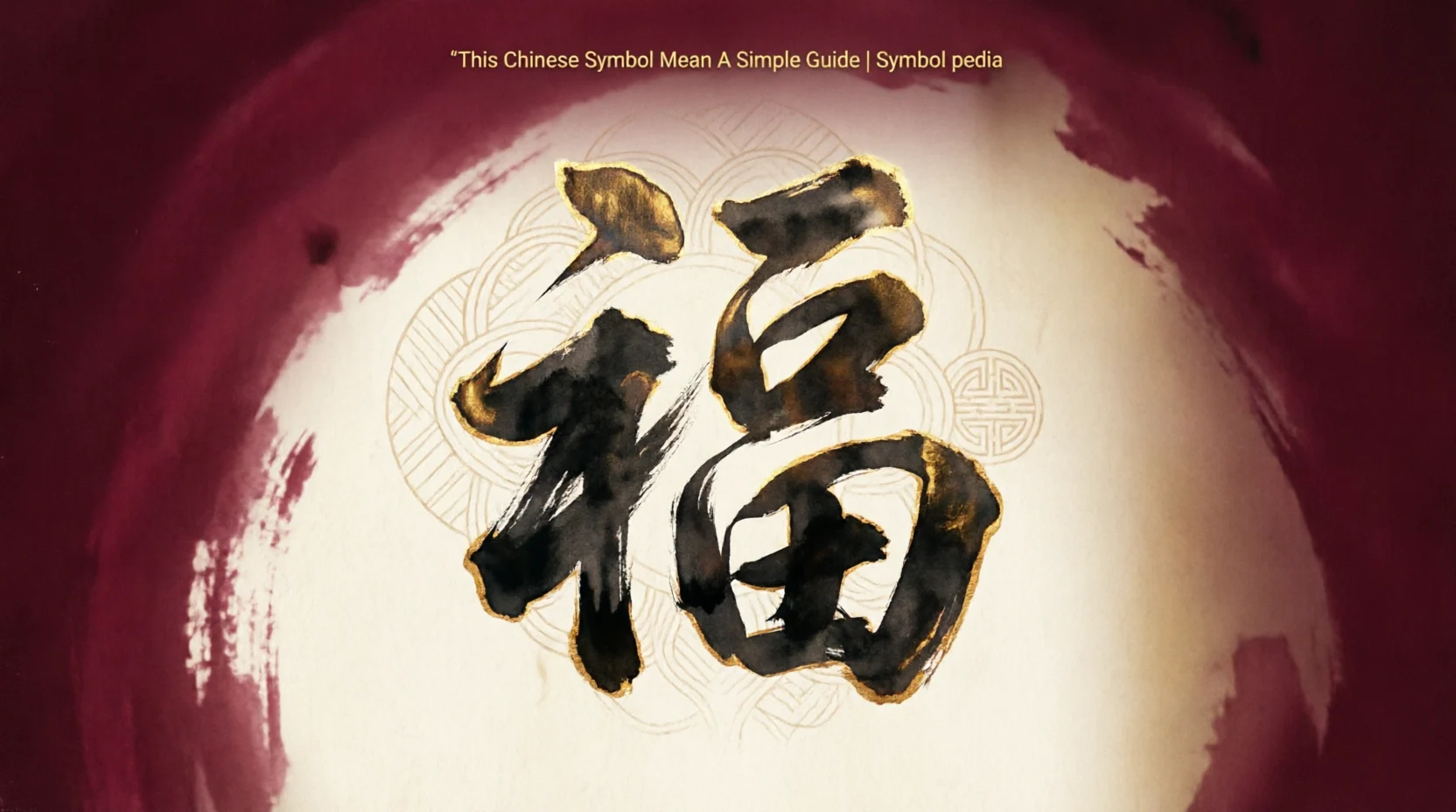
Chinese symbols often look beautiful even when you cannot read them. A single character can appear on a tattoo, necklace, painting, logo, piece of clothing, or social media post and leave you wondering: “What does this Chinese symbol mean?”
The tricky part is that a Chinese character does not always have one simple English equivalent. Its meaning can change depending on pronunciation, context, traditional or simplified writing, and the words around it.
That is why translating a Chinese character by appearance alone can be misleading. A character that looks like a decorative symbol may actually represent a concept such as love, strength, peace, luck, wisdom, happiness, or something completely different.
In this guide, we will explain how to understand Chinese characters, why context matters, how people use them online and in everyday life, and what to consider before using one as a tattoo or personal symbol.
What Does This Chinese Symbol Mean? – Quick Meaning
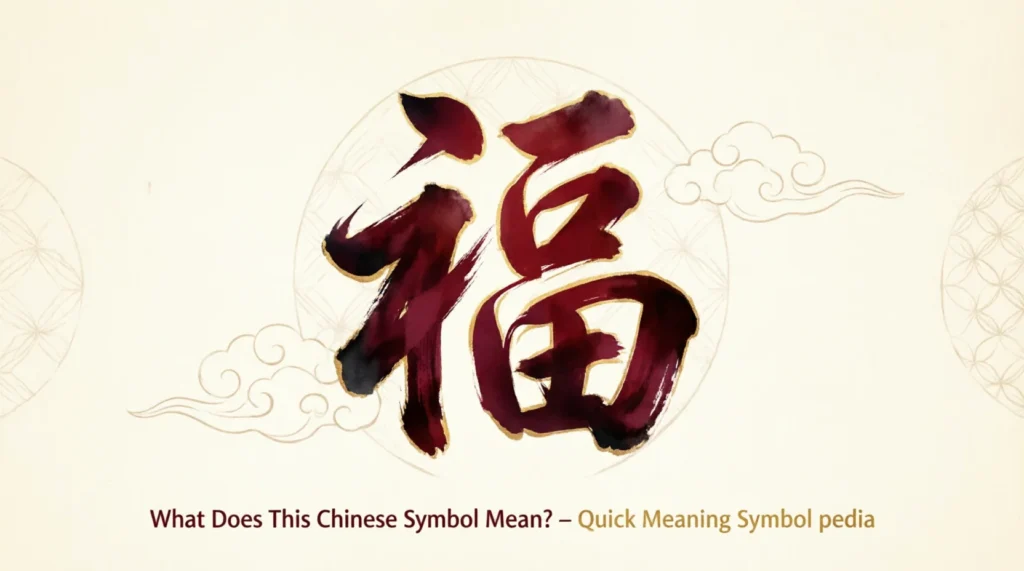
The phrase “what does this Chinese symbol mean” usually refers to someone trying to identify and translate a Chinese character or group of characters.
A Chinese character is generally called 汉字 (hànzì) in Chinese. Unlike many alphabetic writing systems, Chinese writing uses characters that carry meaning and often represent a syllable or morpheme.
The important thing is this:
- A single character can have several related meanings.
- Two or more characters can form a completely different word or expression.
- Traditional and simplified Chinese may use different forms.
- Pronunciation does not always tell an English speaker what the character means.
- A visually attractive character is not necessarily a meaningful “symbol.”
For example:
“爱” can mean “love.”
“福” is associated with “blessing,” “good fortune,” or “happiness.”
“勇” can mean “brave” or “courage.”
So, if someone asks what does this Chinese symbol mean, the correct answer depends on the actual character and the context in which it appears.
Origin & Background of Chinese Symbols
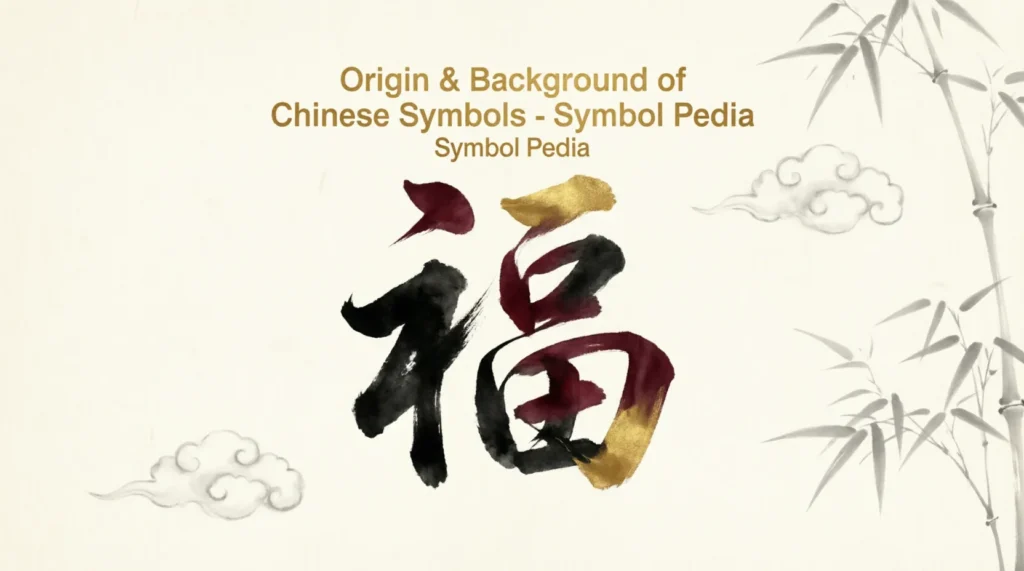
Chinese characters have an extraordinarily long history. Their development can be traced back thousands of years, including early forms found on oracle bones used during ancient China.
Over centuries, writing styles changed. Characters developed through forms such as seal script, clerical script, regular script, and other historical styles.
Modern Chinese writing primarily uses simplified characters in mainland China and Singapore, while traditional characters remain widely used in Taiwan, Hong Kong, and Macau.
This distinction matters when identifying a character.
For example, “love” is written as 爱 in simplified Chinese and 愛 in traditional Chinese. They represent the same basic word, but their written forms are different.
Chinese characters also became culturally influential far beyond China. They appear in Japanese writing, historical East Asian art, calligraphy, martial arts imagery, fashion, tattoos, and contemporary graphic design.
The internet has pushed this fascination even further.
People frequently encounter individual Chinese characters on Instagram, TikTok, Pinterest, clothing, tattoos, and decorative artwork. Because many viewers cannot read Chinese, they naturally search for the English meaning.
That creates one important problem: online images sometimes label characters incorrectly.
A character may be copied from an old tattoo design, stylized until it becomes difficult to recognize, or paired with an inaccurate English translation. This is why checking the exact character is much safer than guessing from its visual appearance.
Real-Life Conversations
1. WhatsApp Conversation
Person A:
“I found this Chinese symbol on a bracelet. Do you know what it means?”
Person B:
“Send me a picture. I don’t want to guess from the shape.”
Person A:
“Apparently it means happiness.”
Person B:
“It might, but let’s check the actual character first.”
This is a realistic example of why visual identification matters. A confident-looking translation is not necessarily an accurate one.
2. Instagram DM
Person A:
“I want this Chinese character tattooed because it means strength.”
Person B:
“Have you had a Chinese speaker confirm it?”
Person A:
“No, I just found it on Pinterest.”
Person B:
“I’d definitely verify it before getting it permanently.”
A tattoo is one situation where taking a few extra minutes to verify a translation can prevent a lasting mistake.
3. TikTok Comments
Person A:
“What does this Chinese symbol mean?”
Person B:
“I think it’s luck.”
Person C:
“Actually, I think it’s blessing.”
Person B:
“Now I’m confused 😂”
This happens constantly online. People may recognize a familiar-looking character but interpret it without considering the surrounding text.
4. Text Message
Person A:
“My friend sent me ‘爱’ and said it was romantic.”
Person B:
“Yeah, that character means love. But the full message would give you more context.”
Person A:
“So one character doesn’t always tell the whole story?”
Person B:
“Exactly. Chinese works a lot through combinations of characters.”
Emotional & Psychological Meaning
Chinese characters often attract people because they combine visual beauty with compressed meaning.
A person might choose a character representing courage because it reminds them of overcoming a difficult period. Someone else might choose a character associated with peace because they want a visual reminder to slow down.
This gives written characters an emotional role beyond ordinary translation.
There is also something psychologically appealing about using a writing system that feels unfamiliar. For someone who does not speak Chinese, a character can feel mysterious, personal, and symbolic.
But that emotional attraction can also encourage assumptions.
I have seen people become attached to a character because they were told it represented “strength” or “love,” only to discover later that the translation was incomplete or incorrect. The lesson is simple: meaning should come before aesthetics when the character represents something important to you.
A Chinese character can certainly carry deep personal meaning, but that meaning should be grounded in accurate language and cultural context.
Usage in Different Contexts
Social Media
Chinese characters frequently appear in usernames, captions, memes, artwork, profile pictures, and aesthetic posts.
On social media, people sometimes use individual characters because they look visually interesting, even when they do not speak Chinese.
Friends & Relationships
Characters connected with love, friendship, happiness, loyalty, or good fortune may appear on gifts and personal messages.
However, a single character may not communicate a complete romantic message. A native speaker would normally consider the full phrase and relationship context.
Work & Professional Settings
Chinese characters can be completely appropriate in professional contexts when used correctly.
For example, Chinese companies, restaurants, cultural organizations, publications, and businesses naturally use Chinese writing.
What is risky is copying an unfamiliar character into branding or professional material without confirming its meaning.
Casual vs. Serious Tone
Using a Chinese character casually as decoration is different from using it to communicate a serious message.
A decorative design can be appreciated aesthetically. A tattoo, business logo, memorial piece, or formal gift deserves much greater linguistic accuracy.
When NOT to Use It
You should avoid using an unidentified Chinese character when its meaning matters.
Be especially careful with:
- Tattoos
- Business logos
- Memorial artwork
- Formal documents
- Religious or ceremonial designs
- Gifts carrying an important personal message
- Products being sold with a claimed translation
Cultural sensitivity matters too.
Chinese writing is not simply a collection of interchangeable “mystical symbols.” Chinese characters belong to living languages and writing traditions used by hundreds of millions of people.
Treating them only as exotic decoration can unintentionally come across as careless or stereotypical.
If the character is going to represent something important, verify it with a reliable Chinese-language source or a fluent speaker.
Common Misunderstandings
“Every Chinese character has only one meaning.”
Not necessarily. Many characters have several related meanings or grammatical functions.
“Chinese symbols are basically pictures.”
Some ancient characters had pictographic origins, but modern Chinese writing is much more complex than a collection of pictures.
“One character always equals one English word.”
Not always. A character may carry a broad concept or function as part of a multi-character word.
“If it looks right, the translation must be right.”
Absolutely not. Artistic fonts, handwriting, calligraphy, low-resolution images, and stylized tattoos can make characters difficult to identify.
“Traditional and simplified characters are different languages.”
They are different writing forms rather than completely separate languages. The relationship is more complicated than simply calling one “Chinese” and the other something else.
Comparison Table
| Expression | Meaning / Role | Typical Use |
|---|---|---|
| Chinese character | A written Chinese unit | Writing, names, words |
| Chinese symbol | Informal English description | Tattoos, artwork, logos |
| Chinese word | One or more characters forming a lexical meaning | Everyday language |
| Chinese phrase | A combination of words or characters | Conversations and writing |
| Chinese calligraphy | Artistic presentation of written characters | Art and decoration |
| Japanese kanji | Chinese-derived characters used in Japanese | Japanese writing |
| Chinese idiom | Fixed expression, often four characters | Formal and everyday communication |
| English translation | Meaning expressed in English | Learning and interpretation |
Key Insight
The biggest mistake is treating a Chinese character, Chinese word, and symbolic design as exactly the same thing. They can overlap, but context determines what the writing actually communicates.
How to Respond When Someone Uses It
If someone sends you a Chinese character and you understand it, your response can be simple.
Casual Replies
- “Oh, that means love, right?”
- “I like that character!”
- “That’s a beautiful meaning.”
Funny Replies
- “Okay, but is that actually what Google says? 😂”
- “I need a Chinese dictionary before I answer this one.”
- “Looks meaningful. Now I need the translation!”
Mature Replies
- “The character has several possible meanings, so I’d need the full phrase for accuracy.”
- “The context matters here. One character doesn’t always give the complete meaning.”
Respectful Replies
- “Could you tell me what the full phrase means?”
- “I want to make sure I understand the character correctly.”
- “Would you mind explaining the cultural meaning behind it?”
If you are unsure, asking is better than pretending you know.
Regional & Cultural Usage
Western Culture
In Western countries, Chinese characters are often encountered through tattoos, restaurants, martial arts, fashion, artwork, and popular culture.
Because many people cannot read Chinese, individual characters can sometimes be treated primarily as visual symbols.
Asian Culture
Across Chinese-speaking communities, characters are part of ordinary written communication rather than mysterious symbols.
A character on a sign, phone screen, book, or message usually functions as normal writing.
Different Asian languages also interact with Chinese characters differently. Japanese, for example, uses kanji alongside hiragana and katakana.
Middle Eastern Culture
In Middle Eastern communities, Chinese characters may be encountered through travel, business, education, social media, tattoos, or cultural interest.
As elsewhere, the safest approach is to verify the character instead of assuming its meaning from a decorative design.
Global Internet Usage
The internet has made individual Chinese characters globally recognizable.
People may search for the meaning of a character after seeing it in a viral video, tattoo photo, product design, username, or meme.
This global exposure has increased curiosity while also increasing the spread of incorrect translations.
Gen Z vs. Millennials
Younger internet users may encounter Chinese characters through TikTok, gaming, fashion, anime-related communities, memes, and social media aesthetics.
Millennials may be more likely to encounter them through tattoos, travel, traditional artwork, martial arts, or older internet culture.
The difference is less about the character itself and more about where people encounter it and how they use it.
Is It Safe for Kids?
Chinese characters are simply part of a writing system, so learning about them is generally no different from learning another language.
The important issue is context.
Parents and educators should encourage children to ask what unfamiliar characters mean rather than copying them from online images. If a character appears on merchandise, a tattoo design, or social media content, the surrounding context should also be considered.
FAQs
What does “what does this Chinese symbol mean” mean?
It usually means someone wants to identify a Chinese character or phrase and understand its English meaning.
Are Chinese characters symbols?
They can function symbolically in art or design, but technically they are characters used in written languages, not merely decorative symbols.
Can one Chinese character have multiple meanings?
Yes. A character may have several related meanings or grammatical uses depending on context.
How can I identify a Chinese character?
The most reliable method is to examine the exact written form and verify it using a Chinese dictionary, translation reference, or fluent speaker.
Are Chinese and Japanese symbols the same?
Chinese characters and Japanese kanji share historical origins, but their pronunciation, meanings, and usage can differ.
Why do Chinese characters look different in tattoos?
Tattoo artists may use calligraphy, decorative fonts, handwritten forms, or distorted designs. These variations can make accurate identification difficult.
Should I verify a Chinese character before getting it tattooed?
Yes. If you do not read Chinese, verify the exact character and intended meaning with a fluent or qualified Chinese speaker before making it permanent.
Conclusion
When someone asks, “What does this Chinese symbol mean?”, the most important answer is not simply a translated English word. The real answer begins with identifying the exact character, understanding its context, and recognizing how Chinese writing actually works.
A character such as 爱, 福, or 勇 can carry a powerful idea, but even familiar characters can mean something different when combined with others.
Chinese writing has thousands of years of history, and its modern use is much richer than the decorative “symbols” many people encounter online.
So if you find a mysterious Chinese character on a tattoo, necklace, photograph, message, or piece of artwork, don’t rely on appearance alone. Look closely, check the context, and verify the translation. That small step can turn simple curiosity into genuine cultural understanding.
descover more post
What Does the Infinity Symbol Mean in Apple Music Complete …
Aquarius Zodiac Symbol Meaning The Hidden Power Behind …
What Does the Swirl Symbol Mean A Complete Guide to Its …

Kavon is a passionate content creator and digital researcher who specializes in decoding symbols, meanings, and modern internet language. With a strong focus on clarity and authenticity, Kavon writes in a way that makes complex ideas simple, relatable, and useful for everyday readers.
Known for a hardworking mindset and attention to detail, Kavon is dedicated to creating content that genuinely helps people understand the deeper meanings behind words, signs, and online expressions. Every article is crafted with care, combining research, real-life insight, and a reader-first approach.
Through Symblpedia, Kavon aims to build a trusted space where curiosity meets clarity—helping users find answers that are not only accurate but also meaningful and easy to understa