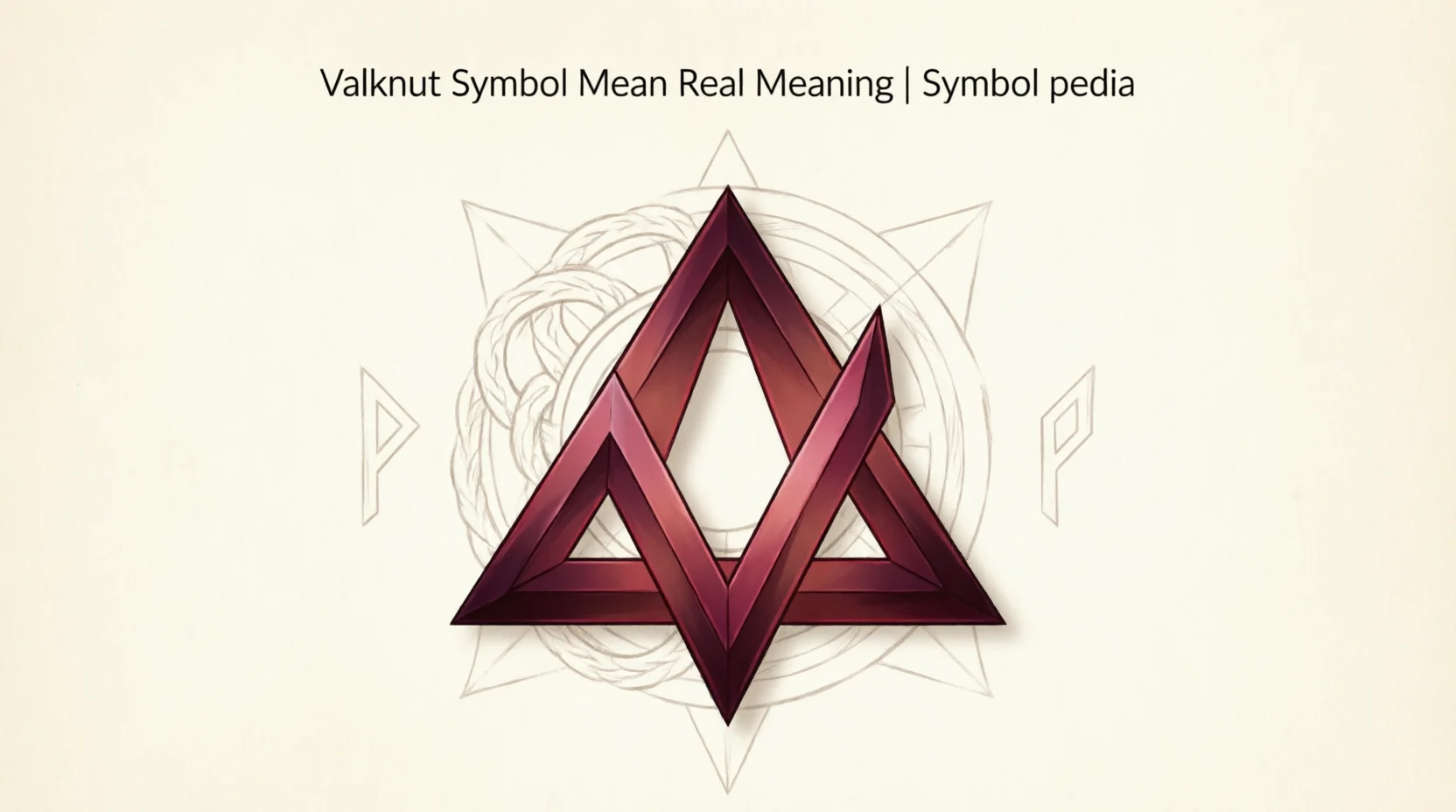
The Valknut symbol is one of the most recognizable designs associated with the Viking Age. Made from three interlocking triangles, it has a striking appearance that naturally makes people wonder what it represents.
So, what does the Valknut symbol mean?
The simplest answer is that the Valknut is strongly associated with death, warriors, Odin, and the transition between life and the afterlife. However, its exact original meaning is not completely known. The name Valknut itself is modern, and scholars continue to debate precisely how people in the Viking Age understood the symbol.
That uncertainty is important. A lot of modern websites present one fixed definition as historical fact, but the surviving evidence does not justify that level of certainty.
Today, people encounter the Valknut on tattoos, jewelry, clothing, artwork, gaming designs, social-media profiles, and modern Norse-inspired décor. For some, it represents courage and strength. For others, it symbolizes death, remembrance, destiny, spiritual transition, or an interest in Norse history.
Understanding those layers makes the symbol much more meaningful than simply calling it a “Viking tattoo.”
What Does the Valknut Symbol Mean? – Quick Meaning
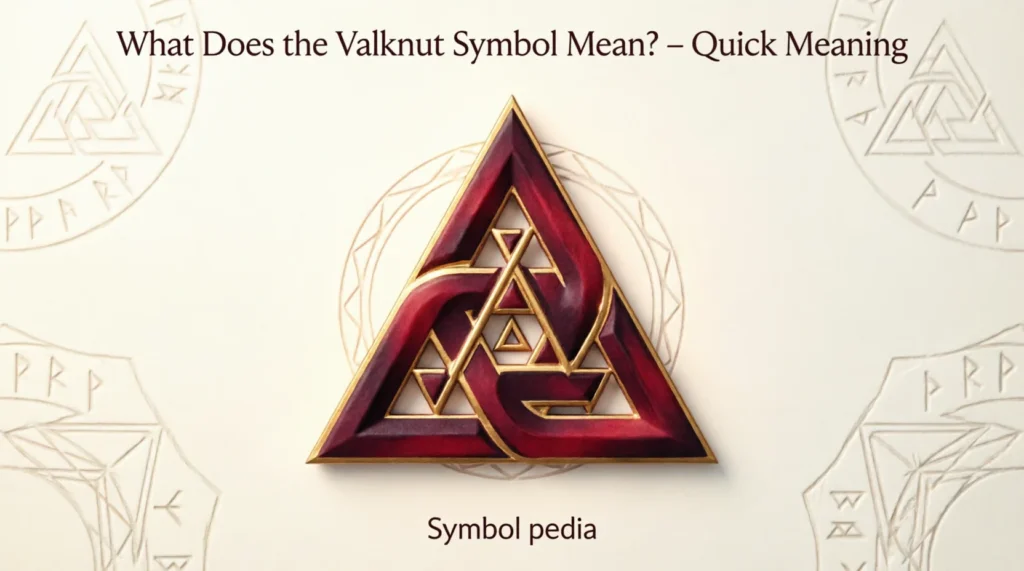
The Valknut is a three-triangle symbol associated with Norse culture and especially with imagery connected to Odin and death.
Its commonly discussed meanings include:
- Death and the afterlife
- Fallen warriors
- Odin and his power
- Transition between life and death
- Courage in the face of mortality
- Spiritual transformation
- Binding and unbinding
- Remembrance of the dead
The word Valknut is generally understood today as something like “knot of the slain” or “knot of those fallen in battle,” although the ancient name of the symbol is not known.
You might see someone explain it casually like this:
“The Valknut represents the journey between life and death.”
Or:
“I got the Valknut because it reminds me to be fearless.”
Another person might simply say:
“It represents my connection to Norse history.”
All three can describe modern interpretations, but they should not be confused with proven historical definitions.
Origin & Background of the Valknut
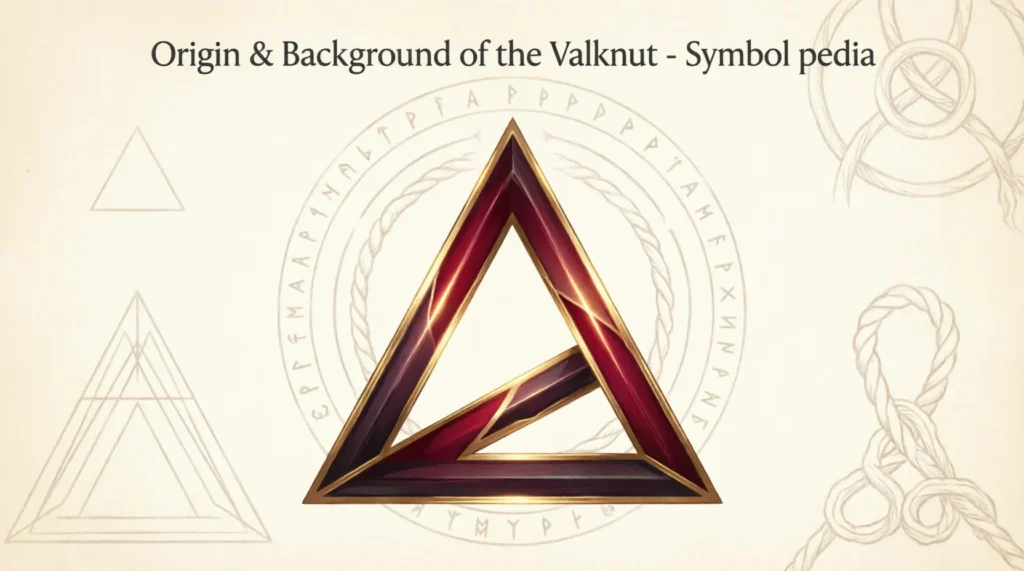
The Valknut is usually drawn as three interlocking triangles, creating a visually complex knot-like shape.
Examples of similar imagery appear in archaeological material associated with the Viking Age and earlier Germanic traditions. One of the best-known examples is found on the Stora Hammars I stone in Gotland, Sweden, where the three-triangle design appears alongside imagery that has been interpreted in connection with Odin, sacrifice, warriors, and death.
That context is one reason scholars connect the Valknut with Odin and the dead.
There is also a broader pattern in Norse art. Odin was associated with warfare, death, wisdom, magic, and the fate of warriors. He was also connected with Valhalla, the hall where certain fallen warriors were believed to be received.
Why is it called Odin’s Knot?
The Valknut is sometimes called “Odin’s knot” because of its archaeological associations with imagery connected to Odin.
However, “Odin’s Knot” is a modern descriptive label rather than a confirmed Viking-Age name.
Some scholars have also compared the design with Hrungnir’s Heart, a three-cornered stone heart described in Snorri Sturluson’s Prose Edda. Whether the Valknut and Hrungnir’s Heart were actually the same symbol remains debated.
This is a good example of why historical symbols deserve a little caution. Ancient people did not leave us a modern dictionary explaining every design.
Cultural influence
Norse mythology has remained influential for centuries through literature, art, historical studies, films, television, games, tattoos, fashion, and modern pagan movements.
The Valknut has consequently taken on meanings beyond the evidence we have from archaeological finds.
For a modern person, it may communicate personal resilience, fascination with Viking history, remembrance, or an interest in Odin.
That does not necessarily mean the person is claiming to follow ancient Norse religion.
Real-Life Conversations About the Valknut
People often encounter the Valknut unexpectedly, especially online. Here are some realistic examples of how someone might ask about it.
WhatsApp Conversation
Person A:
I keep seeing this three-triangle symbol on Viking jewelry. Do you know what it means?
Person B:
I think it’s called the Valknut. It’s connected with Odin and death.
Person A:
Death? That’s darker than I expected.
Person B:
Yeah, but people also interpret it as transition, courage, and the journey between life and death.
Instagram DM
Person A:
Your tattoo looks amazing. Is that a Valknut?
Person B:
Yes! I got it because I love Norse history.
Person A:
Does it have a specific meaning?
Person B:
It’s associated with Odin and fallen warriors. For me, it’s more about remembering people I’ve lost and being brave about life.
Person A:
That actually makes the tattoo much more meaningful.
TikTok Comments
Commenter 1:
What does that three-triangle symbol mean?
Creator:
It’s the Valknut, a Norse symbol often associated with Odin and death.
Commenter 2:
So it literally means death?
Creator:
Not necessarily. That’s one common interpretation. Its exact historical meaning isn’t certain.
Commenter 3:
I appreciate the distinction. TikTok usually makes everything sound 100% certain 😂
Text Message
Person A:
Thinking about getting a Valknut tattoo.
Person B:
You know it’s associated with death, right?
Person A:
Yeah. That’s actually why I like it.
Person B:
Fair enough. What’s the personal meaning?
Person A:
Accepting that life changes and remembering the people who shaped me.
Emotional & Psychological Meaning
Symbols often become more powerful when people give them personal meaning.
The Valknut naturally lends itself to reflection because its historical associations involve mortality, warriors, Odin, and the boundary between life and death.
For someone who has experienced loss, the design may become a reminder that death is part of the human journey.
For another person, it might represent fearlessness.
Someone facing a difficult period may look at the three interlocking triangles and see a reminder to remain strong when life feels uncertain.
There is also something psychologically interesting about the symbol’s structure.
The triangles appear separate, yet they are tightly connected. That visual relationship can encourage modern interpretations involving connection, cycles, fate, transformation, and continuity.
Those interpretations are personal rather than proven Viking-Age meanings, but personal symbolism is part of why symbols remain relevant.
Imagine someone getting a Valknut tattoo after losing a close friend. They may not be trying to recreate an ancient religious practice. They may simply want a permanent visual reminder of mortality, memory, and the strength to keep moving forward.
That distinction matters.
Historical meaning and personal meaning do not always have to be identical.
Valknut Symbol Meaning in Different Contexts
On Social Media
On Instagram, TikTok, Pinterest, and other platforms, the Valknut often appears in posts about:
- Viking history
- Norse mythology
- Odin
- Warrior culture
- Tattoos
- Alternative fashion
- Norse-inspired artwork
- Personal spirituality
Online, its meaning can become simplified into phrases such as “strength,” “warrior spirit,” or “death.”
Those descriptions can be useful shorthand, but they don’t capture the historical uncertainty surrounding the symbol.
Among Friends and Relationships
A person might choose the Valknut as a friendship or relationship symbol because they associate it with loyalty, remembrance, or enduring connections.
That is a modern personal interpretation, not a documented universal Viking tradition.
Work and Professional Settings
The Valknut is generally not appropriate as a professional shorthand for a particular concept.
If you work in history, archaeology, education, or cultural tourism, however, discussing the symbol can be completely appropriate.
The key is context.
Casual vs. Serious Meaning
A Viking-themed gamer might use the Valknut simply because it looks powerful.
A historian might use it when discussing archaeological evidence.
A person with a tattoo might associate it with someone they lost.
The same symbol can therefore carry very different emotional weight.
When NOT to Use the Valknut Symbol
The Valknut is not automatically inappropriate, but context matters.
Avoid treating uncertain history as absolute fact
Don’t confidently claim that the Vikings officially defined the Valknut as one specific concept when the evidence does not establish that.
Be careful in religious contexts
Some people today connect the Valknut with modern Norse religious practices. If you are using it in a religious or spiritual setting, understand the context rather than treating it as a generic decorative icon.
Consider cultural sensitivity
If you are using the symbol commercially, especially in historical or cultural branding, research its background carefully.
Be aware of extremist associations
Some Norse symbols have been appropriated by modern extremist groups. That does not mean every person wearing a Valknut supports extremism, but the broader context can matter, particularly in public or professional settings.
A symbol should be judged through its context, surrounding imagery, and stated meaning, rather than automatically assigning an ideology to everyone who uses it.
Common Misunderstandings About the Valknut
“The Valknut definitely means death.”
Not exactly.
Death is one of its strongest archaeological associations, but scholars do not have a universally accepted explanation for its precise meaning.
“Valknut was the Viking name for the symbol.”
No.
Valknut is a modern term. The original Viking-Age name of the design is unknown.
“It definitely represents Valhalla.”
The connection is understandable because of Odin and fallen warriors, but saying the symbol definitively meant “Valhalla” goes beyond the available evidence.
“Every Valknut tattoo has a religious meaning.”
Not at all.
Some people choose it for historical interest, artistic appeal, personal symbolism, remembrance, or mythology.
“The three triangles have one officially documented meaning.”
There is no universally accepted historical explanation for every aspect of the design.
Valknut Compared With Related Symbols
| Symbol | Common Association | Main Difference |
|---|---|---|
| Valknut | Death, Odin, fallen warriors, transition | Three interlocking triangles |
| Mjölnir | Thor, protection, strength | Thor’s hammer |
| Aegishjalmur | Protection, power, intimidation | Radial magical symbol |
| Yggdrasil | Life, worlds, connection, cosmic order | World tree |
| Vegvísir | Guidance and finding one’s way | Later Icelandic magical symbol |
| Odin’s Ravens | Thought, memory, Odin | Associated with Huginn and Muninn |
| Odin’s Horns | Wisdom and poetic inspiration | Three interlocking drinking horns |
| Hrungnir’s Heart | Mythological giant, three-cornered heart | Similarity to Valknut is debated |
Key Insight
The biggest mistake is treating every Norse symbol as interchangeable. The Valknut has its own archaeological context, and while its connection with Odin and death is strong, its exact meaning remains uncertain.
How to Respond When Someone Uses the Valknut
If someone shows you a Valknut, your response can depend on the situation.
Casual replies
- “That’s the Valknut, right?”
- “I like the design. What does it mean to you?”
- “Is that connected to Odin?”
Funny replies
- “Okay, Viking mode activated.”
- “That symbol definitely looks like it belongs in a Norse saga.”
- “So are we raiding Valhalla now?”
Mature replies
- “I know it has associations with Odin and death. What does it represent personally for you?”
- “Interesting choice. Is your interest historical or spiritual?”
- “The history behind that symbol is fascinating.”
Respectful replies
- “I’ve heard different interpretations of the Valknut. What meaning does it have for you?”
- “I respect the symbolism. I’d be interested to hear why you chose it.”
The best response is often a simple question: “What does it mean to you?”
That leaves room for both historical and personal interpretations.
Regional & Cultural Usage
Western Culture
In Europe and North America, the Valknut frequently appears in tattoos, jewelry, fantasy media, historical discussions, and Norse-inspired fashion.
It can represent anything from Viking heritage interest to personal strength.
Asian Culture
In Asian online communities, the Valknut may appear mainly through gaming, entertainment, tattoo culture, fantasy media, and interest in mythology.
Its meaning is often learned through global internet culture rather than direct historical tradition.
Middle Eastern Culture
In Middle Eastern online spaces, people may encounter the symbol through gaming, tattoos, mythology, history, or social media.
As elsewhere, its meaning depends heavily on the person using it.
Global Internet Usage
The internet has transformed the Valknut into a globally recognizable symbol.
A person in one country may use it for Norse history, while someone elsewhere may see it as a symbol of strength or simply appreciate its geometry.
That is why asking for context is better than assuming intent.
Gen Z vs. Millennials
Younger users may encounter the Valknut through TikTok, gaming, tattoos, memes, fantasy entertainment, and short-form history content.
Millennials may be more likely to have encountered it through books, television, games, tattoos, or earlier online communities.
Neither generation has one fixed interpretation.
Is the Valknut Symbol Safe for Kids?
The symbol itself is not inherently dangerous.
For children, the important issue is context. A child may encounter it in a game, history lesson, cartoon, tattoo design, or online video without understanding its historical associations.
Parents and educators can simply explain that it is an old symbol associated with Norse culture, particularly imagery involving Odin, warriors, and death.
If it appears alongside extremist imagery or hateful messaging, however, the surrounding context should be discussed separately.
Frequently Asked Questions
What does the Valknut symbol mean?
The Valknut is commonly associated with Odin, death, fallen warriors, and the transition between life and the afterlife. Its exact original meaning remains uncertain.
Is the Valknut a symbol of Odin?
It is strongly associated with Odin in archaeological interpretations, particularly because it appears alongside imagery connected with Odin and death.
Does Valknut mean death?
Death is one of its major associations, but the symbol does not have one universally proven definition.
Is Valknut a religious symbol?
Historically, it appears in contexts connected with pre-Christian Scandinavian beliefs. Today, some people use it religiously, while others use it for cultural, historical, artistic, or personal reasons.
Is Valknut the same as Hrungnir’s Heart?
Not necessarily. The two symbols have been compared because of their similar three-cornered appearance, but scholars debate whether they represent the same design.
Is the Valknut a Viking symbol?
Yes, the three-triangle design appears in material associated with the Viking Age, although the modern name “Valknut” was not necessarily used by Vikings themselves.
Is it okay to get a Valknut tattoo?
Yes, but it is wise to understand its historical associations and consider how the design may be interpreted in your particular social or cultural setting.
Conclusion
So, what does the Valknut symbol mean?
At its heart, the Valknut is a mysterious Norse-associated symbol connected with Odin, death, fallen warriors, and the passage between life and death.
But its story is more complicated than a single dictionary definition.
The symbol’s ancient name is unknown, and scholars still debate its precise significance. Its archaeological context gives us strong clues, but not a complete explanation.
That uncertainty doesn’t make the Valknut less meaningful. In some ways, it makes the symbol more fascinating.
Today, someone might wear it to honor Norse history. Another person might choose it to remember someone they lost. Someone else might see it as a reminder to face mortality without fear.
If you’re considering the Valknut for a tattoo, necklace, artwork, or personal symbol, the most important question isn’t only “What did it mean?”
It is also:
“What does it mean to me?”
That is where an ancient symbol can become part of a very modern human story.
descover more post
What Does the Lock Symbol Mean on Snapchat Everything …
Ohm Symbol and Meaning Understanding Ω Its History and …
What Does the Clover Symbol Mean Luck Love Culture More …

Orvian is a passionate researcher and dedicated content creator focused on exploring the deeper meanings behind symbols, signs, and cultural interpretations. With a strong interest in symbolism and human psychology, Orvian simplifies complex ideas into clear, engaging, and easy-to-understand content for readers around the world.
Through consistent research and thoughtful writing, Orvian aims to provide accurate, insightful, and meaningful information that helps users connect with symbols on a deeper level—whether for personal growth, curiosity, or knowledge.
Known for a hardworking mindset and attention to detail, Orvian believes that every symbol carries a story, and every story deserves to be understood.