Have you ever sent a WhatsApp message and noticed a tiny clock symbol beside it instead of the usual check mark?
It can be confusing, especially when you know your internet connection seems fine. You may wonder whether the message failed, whether the other person blocked you, or whether WhatsApp is simply taking its time.
So, what does the clock symbol mean on WhatsApp?
The clock icon generally means that your message has not yet been sent from your phone to WhatsApp’s servers. In other words, WhatsApp is still waiting to send it. The message has been created, but it has not successfully left your device.
This is different from one gray check, two gray checks, and two blue checks. Those symbols tell you what happened after WhatsApp successfully sends the message.
Understanding the clock symbol can save you from unnecessary worry. A clock does not automatically mean you have been blocked, ignored, or muted. Most of the time, it points to a connection, app, phone, or temporary service issue.
Let’s break down exactly what that little clock means and what you can do when it appears.
What Does the Clock Symbol Mean on WhatsApp?
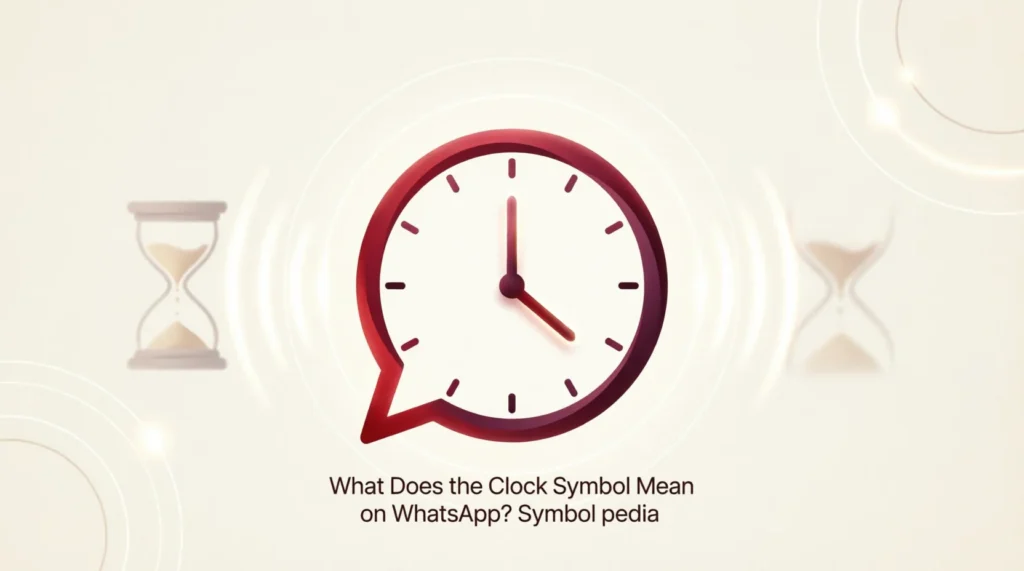
The clock symbol on WhatsApp means your message is waiting to be sent.
WhatsApp has accepted the message on your phone, but the message has not successfully reached WhatsApp’s servers yet.
Think of it like writing a letter and putting it on your desk. The letter exists, but the mail carrier has not picked it up yet.
In simple terms:
- 🕐 Clock: Message is waiting to be sent.
- ✓ One gray check: Message has been sent to WhatsApp’s servers.
- ✓✓ Two gray checks: Message has been delivered to the recipient’s device.
- ✓✓ Two blue checks: Message has been read, assuming read receipts are enabled.
For example:
“Hey, are you coming tonight?” 🕐
The clock means WhatsApp is still trying to send that message.
Another example:
“Call me when you’re free.” 🕐
The recipient has not necessarily received this yet.
The important distinction is that a clock appears before the message reaches WhatsApp’s servers.
Why Does the Clock Symbol Appear on WhatsApp?
There are several reasons you might see a clock icon.
1. Your internet connection is weak
The most common reason is an unstable internet connection.
Your phone may show that Wi-Fi or mobile data is connected, but that doesn’t always mean the connection is actually working well enough for WhatsApp.
You might be connected to a weak Wi-Fi network, for example, while other apps continue working slowly in the background.
2. Your phone temporarily lost internet access
Sometimes your phone briefly disconnects from Wi-Fi or mobile data.
If you send a message during that moment, WhatsApp may place it in a waiting state and display the clock.
Once your connection returns, the message may automatically change to a check mark.
3. WhatsApp is having a temporary service problem
Although less common, WhatsApp itself can experience temporary outages or connectivity problems.
If many people are experiencing the same issue simultaneously, waiting may be all you can do.
4. Background restrictions are affecting WhatsApp
Some phones aggressively restrict background activity to save battery or mobile data.
If WhatsApp isn’t allowed to work normally in the background, messages can sometimes remain pending until you open the app or restore the required permissions.
5. Your phone has connectivity restrictions
Airplane Mode, disabled mobile data, restricted Wi-Fi access, VPN problems, or certain network settings can interfere with WhatsApp’s ability to send messages.
Origin & Background of WhatsApp Message Symbols
WhatsApp’s check marks became part of everyday digital communication because they answer a question people constantly have:
“Did my message actually go through?”
Before messaging platforms offered delivery indicators, sending a message could feel like dropping something into a black hole. You had no immediate way to know whether it had reached the other person.
WhatsApp gradually made communication more transparent by using simple visual indicators.
The system is intentionally minimal:
- A clock indicates that sending has not happened successfully yet.
- One check indicates successful sending.
- Two checks indicate delivery.
- Blue checks can indicate that the message has been read.
This visual language works across languages and cultures. You don’t need to understand a technical explanation to recognize that a clock means something is still waiting.
Social media and messaging culture have also changed how people interpret these symbols. Today, users sometimes attach emotional meanings to ordinary technical indicators.
For example, someone might see a clock and immediately think:
“Did they block me?”
But that’s usually jumping to a conclusion. The clock primarily concerns the sender’s message transmission, not the recipient’s feelings.
Real-Life Conversations About the WhatsApp Clock Symbol
The easiest way to understand the clock is to see how it appears in normal conversations.
1. WhatsApp Conversation
Person A:
Why is there a little clock next to my message?
Person B:
It probably hasn’t sent yet. Check your internet.
Person A:
Oh, my Wi-Fi just disconnected.
Person B:
There you go 😂
2. Instagram DM Discussion
Person A:
Does the WhatsApp clock mean someone blocked me?
Person B:
No, not necessarily. A clock usually means the message hasn’t been sent yet.
Person A:
So they haven’t even received it?
Person B:
Right. Check your connection first.
3. TikTok Comment Example
Person A:
“Why does WhatsApp show a clock after I send a text?”
Person B:
“Your message is still waiting to be sent.”
Person A:
“Thought I got blocked for a second 😭”
Person B:
“Try turning your data off and on.”
4. Text Message Conversation
Person A:
I sent you something on WhatsApp but it’s showing a clock.
Person B:
I’m online. Maybe your internet is acting up.
Person A:
Yeah, I’m on weak mobile data.
Person B:
That explains it.
These situations highlight an important point: the clock is usually a technical status, not a social message.
Emotional & Psychological Meaning of the WhatsApp Clock
Technically, the clock has no hidden emotional meaning.
Psychologically, however, people can react strongly to it.
Messaging apps have trained us to expect immediate feedback. When a message doesn’t move from a clock to a check mark, uncertainty appears.
You may start asking:
- Did my internet stop working?
- Did WhatsApp crash?
- Did they block me?
- Did I accidentally send something incorrectly?
- Why hasn’t it delivered?
That uncertainty is understandable.
I’ve seen how easily people can turn a simple messaging-status symbol into a personal interpretation. Someone waiting for an important reply may already feel anxious, so a clock can make the situation feel more serious than it really is.
The useful habit is to separate technical information from emotional interpretation.
A clock tells you something about the message’s sending status. It doesn’t tell you whether the recipient is angry, ignoring you, busy, or upset.
That’s an important distinction in modern digital communication.
How the Clock Symbol Is Used in Different Contexts
Social Media
People often discuss WhatsApp symbols on TikTok, Instagram, Reddit, and other platforms because messaging indicators can be confusing.
Users commonly ask whether a clock means blocking, rejection, or failed delivery.
In reality, the symbol is primarily technical.
Friends and Relationships
This is where misunderstandings can become emotional.
If you’re waiting to send an important message to a partner or friend, you might worry when the clock doesn’t disappear.
Before assuming anything personal, check your connection.
Work and Professional Settings
The clock can matter when you’re sending something time-sensitive, such as a document, meeting update, or work-related message.
If an urgent message remains stuck with a clock, don’t assume the recipient has seen it.
If necessary, use another reliable communication method.
Casual vs. Serious Situations
For casual messages, waiting a few seconds may not matter.
For serious or urgent communication, however, you should verify that the message has actually been sent and delivered.
When Should You NOT Rely on the Clock Symbol?
The clock itself isn’t inappropriate to discuss, but interpreting it incorrectly can cause problems.
Don’t assume you’ve been blocked
A clock isn’t reliable proof that another person blocked you.
Don’t accuse someone of ignoring you
If the message hasn’t even been sent, the recipient can’t respond to it.
Don’t use WhatsApp status symbols as emotional evidence
Digital indicators don’t reveal someone’s intentions or feelings.
Don’t rely on WhatsApp for emergencies
If something is genuinely urgent or safety-critical, use an appropriate emergency or direct communication method instead of waiting for a messaging app.
Be culturally sensitive
Different people have different expectations around instant messaging.
Someone who doesn’t respond quickly isn’t necessarily being rude. Likewise, a technical delay shouldn’t be interpreted as disrespect.
Common Misunderstandings About the WhatsApp Clock
Several myths surround this tiny symbol.
Myth 1: “The clock means they blocked me.”
Not necessarily.
A clock generally indicates that the message is still waiting to be sent from your device.
Myth 2: “The clock means they haven’t read my message.”
That’s not quite right.
If the message is still showing a clock, it hasn’t reached the normal sent/delivered stages yet.
Myth 3: “The recipient’s phone is definitely offline.”
Not necessarily.
The problem may be on your side, your network, WhatsApp’s service, or your phone’s settings.
Myth 4: “The clock means my message was deleted.”
No.
A pending message is not the same thing as a deleted message.
Myth 5: “The other person can see the message.”
If the message is still displaying the clock, you should not assume the recipient has received it.
WhatsApp Clock Symbol vs. Other Message Indicators
| WhatsApp Symbol | Basic Meaning | What It Tells You |
|---|---|---|
| 🕐 Clock | Waiting to send | Message hasn’t successfully been sent yet |
| ✓ One gray check | Sent | Message reached WhatsApp’s servers |
| ✓✓ Two gray checks | Delivered | Message reached the recipient’s device |
| ✓✓ Blue checks | Read | Message was opened/read, subject to read-receipt settings |
| Microphone icon | Voice message | You’re dealing with an audio message |
| Camera icon | Photo/video | Used for visual media or camera-related actions |
Key Insight
The most important difference is where the message is in the sending process. A clock comes before the standard check marks, so you should troubleshoot your connection or app before making assumptions about the recipient.
How to Respond When Someone Mentions the WhatsApp Clock
If someone asks you what the clock means, you don’t need a complicated technical explanation.
Casual replies
- “It means the message hasn’t sent yet.”
- “Check your internet connection.”
- “It’s still pending.”
Funny replies
- “WhatsApp is making your message wait in line 😂”
- “Your message is still at the loading screen 😭”
- “The internet said: not today.”
Mature replies
- “The clock usually means the message hasn’t been sent successfully yet. I’d check the connection first.”
- “It looks like the message is still pending, so I wouldn’t assume the recipient has received it.”
Respectful replies
- “It doesn’t necessarily mean anything about the other person. It may simply be a connection issue.”
- “Try checking your Wi-Fi or mobile data before worrying about the recipient.”
Regional & Cultural Usage of the WhatsApp Clock
WhatsApp is used worldwide, but people’s interpretations of messaging behavior can differ.
Western Culture
In many Western contexts, messaging indicators are often viewed as practical communication tools.
People may pay attention to delivery and read receipts but generally understand that technical issues happen.
Asian Culture
WhatsApp and similar messaging platforms can play an important role in family, education, business, and everyday communication.
Because messages may be used for important coordination, users can become particularly attentive to whether something has been delivered.
Middle Eastern Culture
Messaging apps are widely used for family communication, social conversations, business, and community connections.
A delayed message can sometimes create concern when people are coordinating plans, but a clock should still be understood primarily as a sending-status indicator.
Global Internet Usage
Across the internet, users have developed their own informal language around messaging symbols.
People might say:
- “It’s stuck on the clock.”
- “My WhatsApp won’t send.”
- “Why is my message pending?”
- “Why isn’t the check mark appearing?”
These expressions generally describe the same basic problem.
Gen Z vs. Millennials
Younger users may be more familiar with messaging-status icons because they’ve grown up with instant communication.
Millennials may also understand them well, but their interpretation can depend more on which messaging platforms they regularly use.
The bigger generational difference isn’t necessarily knowledge of the symbol—it’s how much emotional meaning someone attaches to immediate digital responses.
Is the WhatsApp Clock Symbol Safe for Kids?
Yes. The clock symbol itself is simply a messaging-status indicator and is not harmful or inappropriate for children.
However, children should understand that a message status doesn’t reveal another person’s feelings.
A clock does not mean someone dislikes them, blocked them, or is deliberately ignoring them.
Teaching children to distinguish technical information from emotional assumptions is a useful digital communication skill.
FAQs About the WhatsApp Clock Symbol
What does the clock symbol mean on WhatsApp?
The clock symbol means your WhatsApp message is still waiting to be sent and has not successfully reached WhatsApp’s servers.
Does a WhatsApp clock mean I was blocked?
No. A clock by itself does not prove that someone blocked you. It usually points to a sending or connectivity issue.
Does the clock mean the other person received my message?
No. If the message is still showing a clock, you should not assume the recipient has received it.
Why is my WhatsApp message stuck on the clock?
The most common causes include weak internet, disconnected Wi-Fi, mobile-data problems, phone restrictions, app issues, or temporary WhatsApp connectivity problems.
How do I get rid of the clock symbol on WhatsApp?
Check your internet connection, switch between Wi-Fi and mobile data if possible, reopen WhatsApp, and make sure your phone isn’t restricting the app’s connectivity.
Can a clock change into a check mark automatically?
Yes. If the underlying connection problem is temporary and WhatsApp successfully sends the message, the clock can change to the normal sent indicator.
Should I worry if my message has a clock for a long time?
Not immediately. First troubleshoot your connection and WhatsApp. If the problem continues, investigate whether your phone, network, or app is causing the issue.
Conclusion
So, what does the clock symbol mean on WhatsApp?
In simple terms, it means your message is waiting to be sent. It has not successfully moved into the normal sent, delivered, or read stages yet.
The biggest mistake is turning a technical symbol into a personal conclusion. A clock doesn’t automatically mean you’ve been blocked, ignored, rejected, or forgotten.
When you see it, think practically first: check your internet connection, mobile data, Wi-Fi, app, and phone settings.
That tiny clock is really just WhatsApp saying, “I’m still trying to send this.”
Once you understand that, one of the most confusing WhatsApp symbols becomes surprisingly simple.
descover more post
What Does the Infinity Symbol Mean in Apple Music Complete …
Aquarius Zodiac Symbol Meaning The Hidden Power Behind …
What Does the Swirl Symbol Mean A Complete Guide to Its …

Kavon is a passionate content creator and digital researcher who specializes in decoding symbols, meanings, and modern internet language. With a strong focus on clarity and authenticity, Kavon writes in a way that makes complex ideas simple, relatable, and useful for everyday readers.
Known for a hardworking mindset and attention to detail, Kavon is dedicated to creating content that genuinely helps people understand the deeper meanings behind words, signs, and online expressions. Every article is crafted with care, combining research, real-life insight, and a reader-first approach.
Through Symblpedia, Kavon aims to build a trusted space where curiosity meets clarity—helping users find answers that are not only accurate but also meaningful and easy to understa