If you look closely at the Mexican flag, the green, white, and red stripes are easy to recognize. But the detailed image in the center is where the deeper story begins.
So, what does the symbol on the Mexican flag mean?
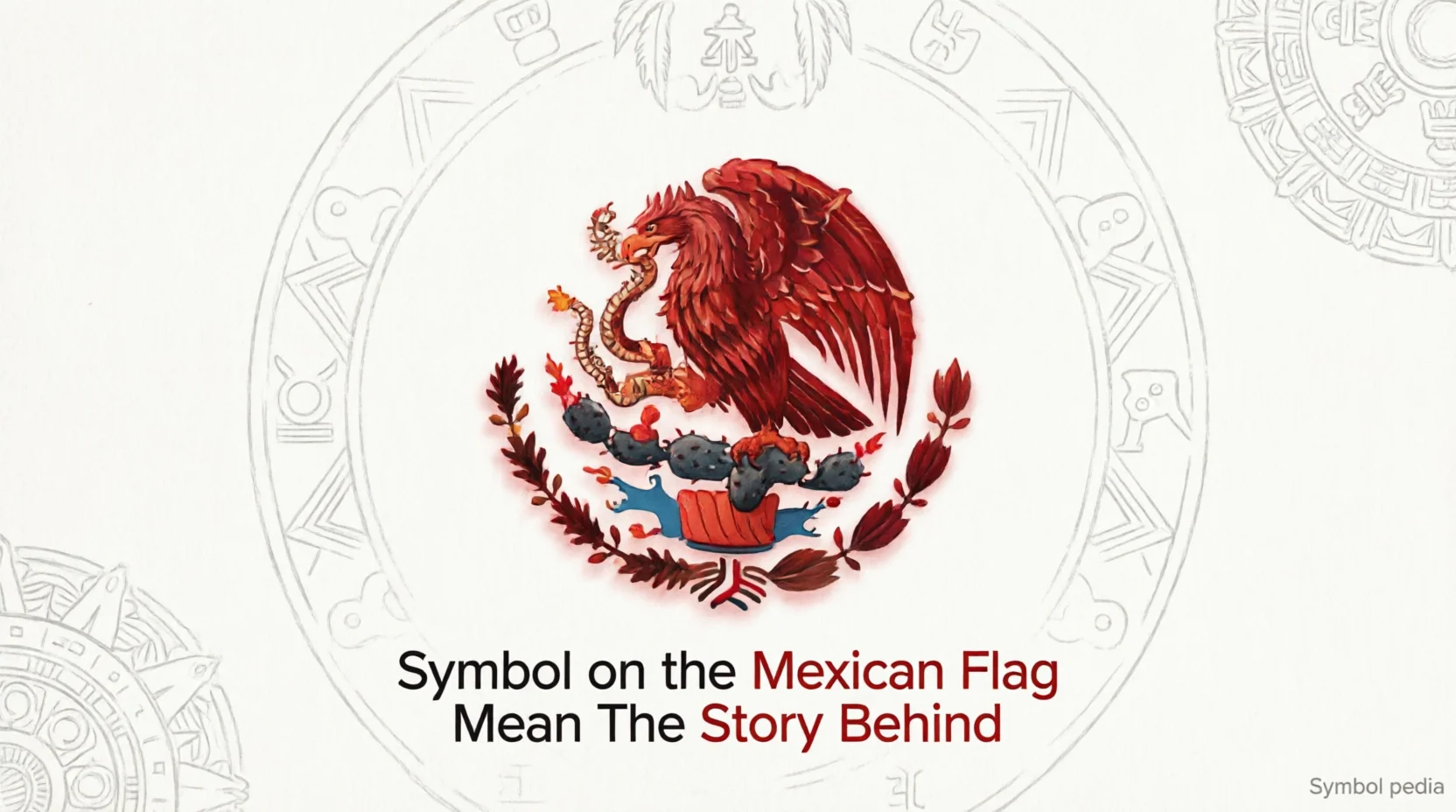
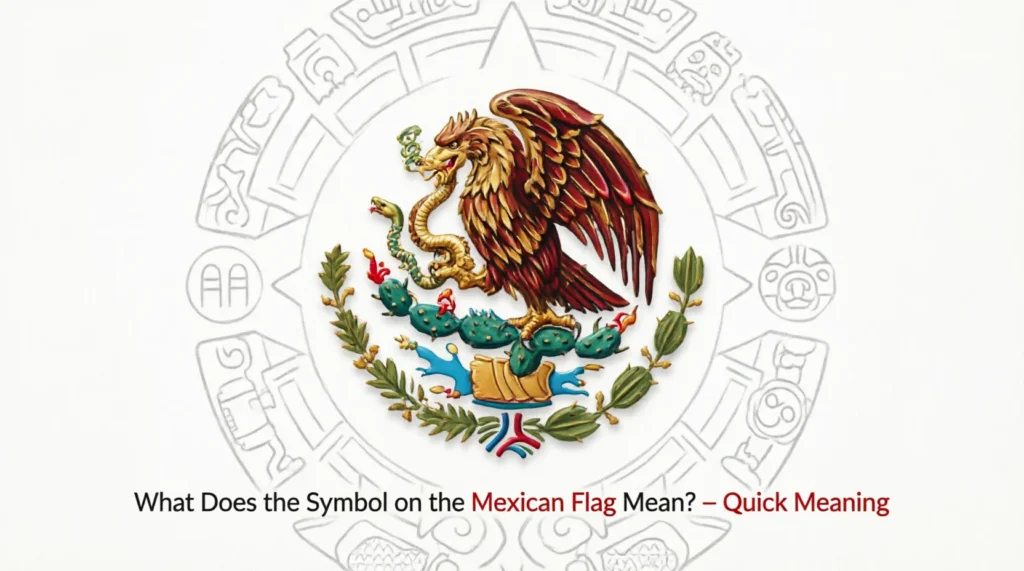
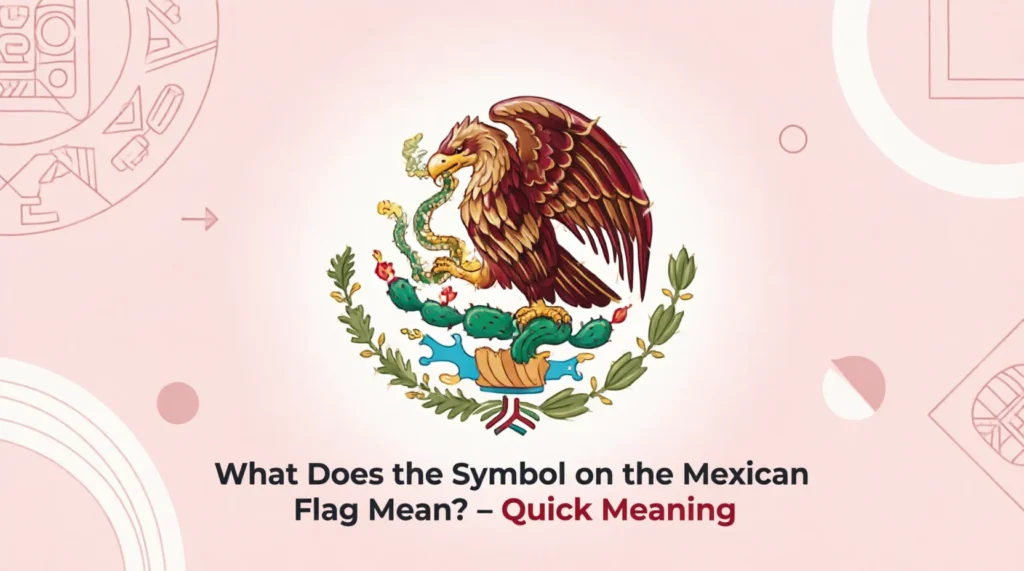
The central emblem shows a golden eagle standing on a prickly pear cactus while holding a snake in its beak and talon. The cactus grows from a rock surrounded by water. Together, these elements represent a foundational story connected with the Mexica people, the history of Tenochtitlan, Mexican identity, and the country’s long journey through change.
Many people search for the meaning of the Mexican flag symbol because the image looks almost like a small historical painting. Why is the eagle there? Why is it fighting a snake? And what does the cactus have to do with Mexico?
The answer is much richer than simply saying that the eagle represents strength.
The emblem connects mythology, geography, history, resilience, and national identity. Understanding each part makes the Mexican flag feel less like a decorative national symbol and more like a visual story passed from one generation to another.
What Does the Symbol on the Mexican Flag Mean? – Quick Meaning
The symbol in the center of Mexico’s flag is the country’s national coat of arms.
Its main elements include:
Eagle: Often associated with strength, courage, power, and the founding story of Mexico.
Snake: Traditionally shown in the eagle’s beak and talon and connected with the legendary scene that guided the Mexica.
Prickly pear cactus: Represents the landscape and the legendary place where the Mexica were instructed to establish their settlement.
Rock and water: Reflect the environment associated with the founding of Tenochtitlan.
Wreath of oak and laurel: Represents strength, victory, and honor in the modern national emblem.
Three colors: Green, white, and red belong to the Mexican flag’s broader national symbolism.
In simple terms, the emblem tells a story about finding a homeland, building a civilization, surviving difficult periods, and developing a distinct Mexican identity.
You might hear someone explain it casually like this:
“The eagle and snake represent the founding story of Mexico.”
Or:
“The cactus is part of the legend behind Tenochtitlan.”
And more simply:
“The whole image represents Mexican history and national identity.”
Orgion background
The story behind the emblem reaches back to the Mexica, the Indigenous people whose capital became Tenochtitlan, located where Mexico City stands today.
According to a famous Mexica tradition, their people had been searching for the place where they should establish their new home. They were instructed to look for an eagle perched on a cactus, traditionally holding a serpent.
When the sign appeared, the location became associated with the founding of Tenochtitlan.
The image eventually became one of the strongest visual references to Mexico’s Indigenous heritage.
There is an important historical detail here: the modern Mexican emblem did not appear exactly as it does today in ancient times. Its design developed and changed over centuries as Mexico itself changed.
During the colonial period, different symbols and traditions existed alongside Indigenous imagery. After Mexico became independent from Spain in the nineteenth century, national symbols became especially important because the new country needed ways to express its own identity.
The eagle, cactus, snake, and surrounding elements were repeatedly redesigned and interpreted.
Mexico’s current national coat of arms is therefore the result of a long historical evolution rather than a single design created at one moment.
The image also became increasingly powerful because it connected modern Mexico with a civilization that existed before Spanish conquest.
Why the Eagle Became So Important
The eagle is one of the most recognizable parts of the emblem.
Eagles have been associated with power and courage in many cultures, but the Mexican eagle has a more specific cultural context because of its connection to the Mexica founding tradition.
The bird is not simply there to say “Mexico is strong.”
Its position on the cactus creates a visual connection between the legendary sign and the place where the Mexica established their city.
The prickly pear, or nopal, has deep importance in Mexican history and culture. In the national emblem, it provides the setting for the legendary eagle.
The cactus also connects the emblem with the Mexican landscape.
That is one reason the symbol feels particularly meaningful: it combines a legendary event with a recognizable element of the natural world.
The Snake and Its Interpretation
The snake is shown being grasped by the eagle.
People sometimes interpret this simply as good defeating evil. That explanation is popular, but it can be too simplistic.
The most important traditional meaning comes from the founding narrative itself. The eagle and snake together form part of the visual sign that identified the location where the Mexica were to establish their settlement.
Modern viewers may naturally give the scene additional meanings such as struggle, victory, or overcoming adversity, but those interpretations should not replace the historical context.
Social Media and Modern Meaning
Today, the Mexican emblem appears everywhere from national celebrations and sports events to social media posts, tattoos, artwork, clothing, and educational materials.
On social media, people often use the eagle-and-snake image as a quick visual expression of Mexican pride.
A person may post the Mexican flag during Independence Day without explaining the emblem at all. The image already communicates belonging, heritage, celebration, or respect for Mexico.
That is one of the interesting things about national symbols: people can understand their emotional meaning even when they do not know every historical detail behind them.
Real-Life Conversations
WhatsApp Conversation
Person A: I was looking at the Mexican flag today. What does the eagle in the middle actually mean?
Person B: It’s part of Mexico’s coat of arms. There’s a traditional story about the Mexica finding an eagle on a cactus.
Person A: So that’s connected to the founding of Tenochtitlan?
Person B: Exactly. That’s the big historical connection.
Instagram DM
Person A: Your Mexican flag tattoo looks amazing. Why did you choose the eagle?
Person B: For me, it represents my connection to Mexico and its history.
Person A: I thought the snake meant something negative.
Person B: A lot of people think that. But the eagle and snake are part of the traditional founding story, so it’s more complicated than good versus evil.
TikTok Comments
Commenter 1: Wait, is that eagle supposed to represent strength?
Commenter 2: Partly, but the image is specifically connected to the Mexica story about finding the place to establish Tenochtitlan.
Commenter 3: I never knew the cactus was important too.
Commenter 2: Yes! The cactus is one of the key parts of the emblem.
Text Message
Person A: Why does Mexico have an eagle eating a snake on its flag?
Person B: It’s actually the national coat of arms.
Person A: What’s the story?
Person B: The traditional story says the Mexica were looking for a sign telling them where to settle. They found the eagle on a cactus, which became associated with Tenochtitlan.
Person A: That’s way more interesting than I expected.
Emotional & Psychological Meaning
National symbols work differently from ordinary signs.
A simple picture can trigger memories of family, birthplace, language, celebrations, food, music, history, and community. That emotional connection is part of why the Mexican coat of arms remains so recognizable.
For many Mexicans and people of Mexican heritage, the emblem can represent belonging.
It can also represent resilience. Mexico’s history includes Indigenous civilizations, Spanish colonization, independence, political conflicts, social transformation, and modernization. The emblem survived many of these changes.
There is something psychologically powerful about that continuity.
Imagine someone living far from Mexico who sees the flag during a holiday celebration. They may not consciously analyze the eagle, cactus, and snake. Instead, the image may remind them of grandparents, family traditions, childhood memories, or a place they consider home.
They communicate feelings before people put those feelings into words.
Usage in Different Contexts
Social Media
On Instagram, Facebook, TikTok, and other platforms, the Mexican emblem can express national pride, heritage, celebration, or cultural identity.
It is especially common around Mexican national celebrations and events involving Mexican culture.
Friends & Relationships
Friends may discuss the emblem casually when talking about travel, history, family heritage, tattoos, or Mexican culture.
Someone might ask, “What does the eagle on the Mexican flag mean?” simply because they noticed it for the first time.
Work and Professional Settings
In professional environments, the emblem should generally be treated as a national symbol rather than a joke or casual decoration.
It may appear in educational presentations, diplomatic settings, cultural events, official documents, or international activities.
Casual vs. Serious Tone
Saying “the eagle represents Mexico’s founding story” is appropriate in casual conversation.
In an academic or historical setting, however, it is better to explain that the emblem is connected to Mexica tradition and that its modern design developed over time.
That small distinction makes your explanation more accurate.
When NOT to Use It
The Mexican coat of arms deserves cultural respect because it is an official national symbol.
Avoid using it carelessly in ways that deliberately mock Mexico, Mexican people, or Indigenous traditions.
It is also wise to avoid reducing the entire emblem to a simplistic statement such as “the eagle means good and the snake means evil.” That interpretation can leave out the much more important historical context.
When discussing Indigenous traditions, remember that legends and historical records do not always function in exactly the same way as modern written history.
Respectful language matters.
Common Misunderstandings
“The Eagle Only Means Strength”
Strength is a reasonable modern interpretation, but it does not tell the whole story.
The eagle’s importance comes primarily from its role in the traditional founding narrative associated with the Mexica.
“The Snake Represents Evil”
This is one of the most common oversimplifications.
The snake is part of the legendary scene involving the eagle and cactus. Interpreting the image purely as good defeating evil can impose a meaning that is not the complete historical explanation.
“The Symbol Has Always Looked Exactly the Same”
It has not.
Mexico’s coat of arms went through different versions and artistic treatments before reaching its modern form.
“The Center Image Is Just a Decoration”
It is much more than decoration.
The central image is Mexico’s national coat of arms and carries historical and cultural meaning.
Comparison Table
Symbol or Expression
Main Meaning
Connection to Mexican Identity
Mexican eagle and cactus
Founding tradition and heritage
Very strong
Mexican flag
National identity and unity
Very strong
Nopal cactus
Landscape, heritage, tradition
Strong
Eagle alone
Strength, power, courage
Broader interpretation
Snake
Part of the founding scene
Strong within the emblem
Tenochtitlan
Mexica capital and historical foundation
Very strong
Mexican Independence symbols
Freedom and national history
Very strong
Mexican national colors
National identity and historical symbolism
Strong
Aztec/Mexica imagery
Indigenous heritage and history
Strong, but context matters
National coat of arms
Official national identity
Very strong
Key Insight
The Mexican flag’s central symbol is best understood as a complete historical image, not as a collection of unrelated objects. The eagle, snake, cactus, rock, and water work together to evoke the traditional story connected with the founding of Tenochtitlan and Mexico’s Indigenous heritage.
How to Respond When Someone Uses It
If someone sends you the Mexican flag or its coat of arms, your response can depend on the situation.
Casual Replies
“That symbol has such an interesting history.”
“I love the story behind the eagle and cactus.”
“The Mexican coat of arms is really distinctive.”
Funny Replies
“That eagle definitely has a serious job.”
“Okay, now I need the full history lesson.”
“I thought it was just an eagle until I learned about the cactus!”
Mature Replies
“It represents an important part of Mexico’s historical and cultural identity.”
“The emblem connects modern Mexico with the traditional Mexica founding story.”
“There is a lot more history behind that image than most people realize.”
“I appreciate the history represented by the emblem.”
“The connection to Tenochtitlan makes the symbol especially meaningful.”
Regional & Cultural Usage
Western Culture
In the United States, Canada, and other Western countries, the Mexican flag is often seen during cultural festivals, sporting events, Mexican Independence celebrations, and discussions about Mexican heritage.
People may recognize the eagle immediately but know less about the Indigenous story behind it.
Asian Culture
In Asian countries, the emblem may be encountered through international sports, geography lessons, travel, history, or online cultural content.
Because the image is visually distinctive, people may recognize Mexico’s flag without knowing the details of the founding tradition.
Middle Eastern Culture
In Middle Eastern communities, the Mexican emblem may similarly appear in international events, travel contexts, educational materials, and online discussions.
The symbolism can be understood as a national emblem even when its specific Mexica background is unfamiliar.
Global Internet Usage
Online, the Mexican flag often functions as a quick expression of Mexican pride, heritage, celebration, or support.
Memes and short-form videos can simplify historical symbols, which is why checking the original cultural context is useful before accepting an oversimplified explanation.
Gen Z vs. Millennials
Younger users may encounter the symbol through TikTok, Instagram, memes, gaming communities, and short educational videos.
Millennials may be more likely to have encountered it through school, television, sports, travel, or traditional media.
The difference is usually less about the symbol itself and more about where people learn its meaning.
Is It Safe for Kids?
Yes. The Mexican coat of arms is a national and cultural symbol and is generally appropriate for children to learn about.
It can actually provide an excellent opportunity to teach children about geography, Indigenous history, national identity, symbolism, and how legends influence cultural traditions.
The important point is to explain the imagery accurately rather than presenting a complicated historical tradition as a simple cartoon story.
FAQs
What does the symbol on the Mexican flag mean?
The central symbol is Mexico’s national coat of arms. It features an eagle, snake, prickly pear cactus, rock, and water connected to the traditional Mexica founding story associated with Tenochtitlan.
Why is there an eagle on the Mexican flag?
The eagle comes from the traditional story in which the Mexica were guided to their settlement by the sight of an eagle associated with a cactus.
What does the snake on the Mexican flag represent?
The snake is part of the traditional eagle-and-cactus scene associated with the founding tradition of Tenochtitlan. It should not simply be interpreted as a symbol of evil.
What does the cactus mean on the Mexican flag?
The prickly pear cactus is central to the founding tradition and also connects the emblem with the Mexican landscape.
Is the Mexican flag symbol an Aztec symbol?
It is more precise to describe its historical Indigenous connection as Mexica, although “Aztec” is widely used in English as a broader historical label. The emblem is strongly associated with the Mexica tradition surrounding Tenochtitlan.
What is the bird on the Mexican flag?
The bird is a golden eagle, shown standing on the cactus and holding a snake.
Why is the Mexican coat of arms important?
It connects Mexico’s modern national identity with Indigenous history, the traditional founding story of Tenochtitlan, and centuries of cultural and political development.
Conclusion
The answer to “what does the symbol on the Mexican flag mean?” is much deeper than “an eagle fighting a snake.”
The image is Mexico’s national coat of arms, and its most recognizable elements—the eagle, snake, cactus, rock, and water—are tied to a traditional Mexica story about finding the place where Tenochtitlan would be established.
Over time, the emblem became part of a much broader national identity.
That is what makes it so powerful. A person looking at the flag may simply see an eagle and cactus, but someone familiar with the history can see a story about migration, settlement, Indigenous heritage, resilience, and the formation of a nation.
Symbols become meaningful when people carry their stories forward.
And the Mexican coat of arms is one of those symbols whose story is still very much alive.