The symbol ~ looks simple, but its meaning can change dramatically depending on where you see it. You might find it in a math problem, a text message, a social media caption, a programming command, or even a dictionary.
So, what does the symbol ~ mean?
In general, ~ is called a tilde. It can mean approximately, similar to, around, or roughly, especially in mathematics and general writing. In informal digital communication, however, people sometimes use it as a stylistic mark to soften a sentence, create a playful tone, or make text look more expressive.
For example, ~10 minutes usually means about 10 minutes, while A ~ B can mean that A and B are similar or related, depending on the subject.
The confusion happens because there is no single universal definition. Its meaning comes from the context surrounding it.
What Does the Symbol ~ Mean? – Quick Meaning
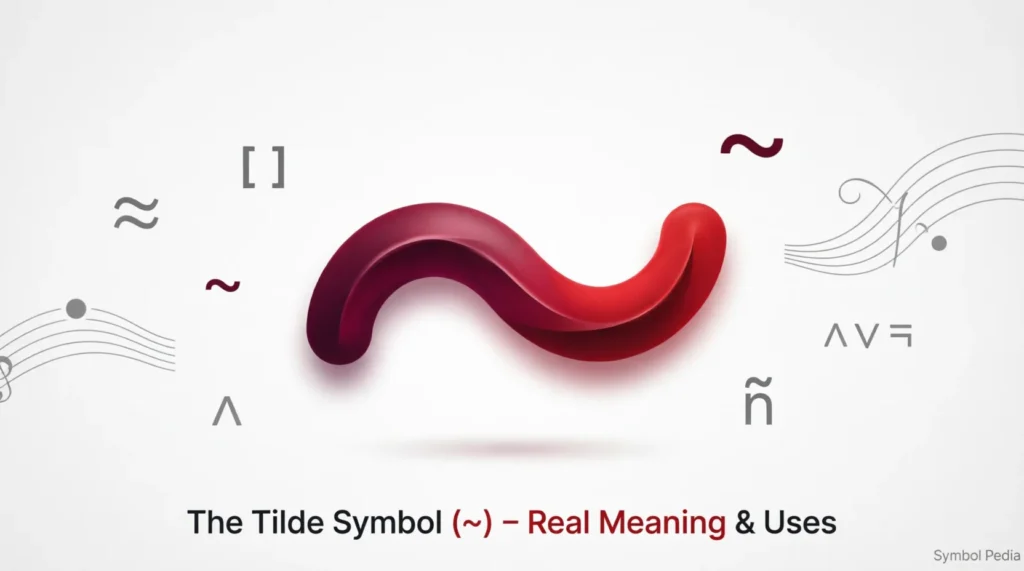
The ~ symbol is known as a tilde. Its most common meanings include:
- Approximately:
~50 people= about 50 people. - Similar to:
A ~ B= A is similar or related to B in certain contexts. - Roughly or around:
~8 PM= around 8 PM. - Mathematical relationship: It can represent a specific type of relation, such as similarity or equivalence.
- Range or informal approximation: In everyday digital writing, it can suggest an estimated amount.
- Stylistic punctuation: In chats, captions, and online communities, it may add a playful, soft, dramatic, or decorative tone.
- Technical meaning: In computing, the tilde has several specialized uses.
Here are a few simple examples:
“I’ll be there in ~10 minutes.”
This means the person expects to arrive in about 10 minutes.
“The event had ~500 visitors.”
This means there were approximately 500 visitors, not necessarily exactly 500.
“We met ~2019.”
In informal writing, this could mean around 2019, although a clearer phrase such as “around 2019” is usually better.
The important point is that ~ does not automatically mean one thing. The sentence, platform, and subject determine its meaning.
Origin & Background of the Tilde Symbol
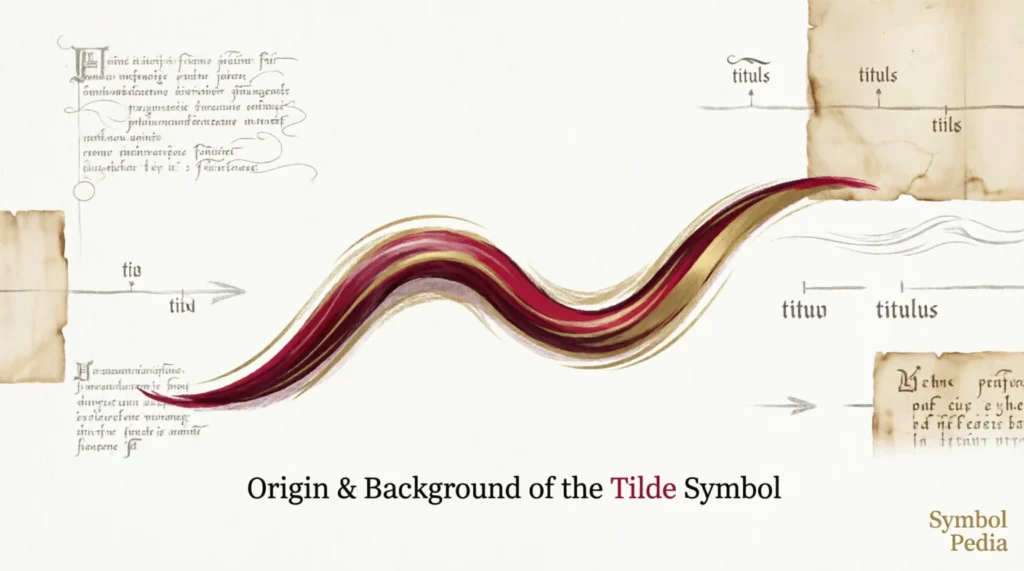
The history of ~ is much older than texting and social media.
The word tilde comes through Spanish and Portuguese usage and ultimately traces back to a Latin term associated with a mark or stroke placed over a letter. One of its most familiar historical roles is in Spanish, where ñ contains a tilde over the n.
Over time, the mark developed additional uses in mathematics, linguistics, dictionaries, and technical writing.
In mathematics, the tilde can indicate relationships such as similarity, approximate equality, or asymptotic behavior, depending on the notation being used. These meanings are precise within their respective fields.
Computing gave the symbol another life.
On Unix-like systems, for example, ~ commonly represents a user’s home directory in a shell. In programming languages and technical environments, the symbol can also have completely different functions.
Then came the internet.
As keyboards, chat rooms, forums, instant messaging, and social platforms became part of everyday communication, people began using punctuation more creatively. A symbol that once belonged mainly to mathematics or technical writing could now become part of someone’s personal writing style.
That’s why seeing ~ in a message does not necessarily mean you are looking at a mathematical expression.
Real-Life Conversations
1. WhatsApp: Approximate Time
Person A:
“What time are you reaching?”
Person B:
“~7:30, depending on traffic.”
Here, ~7:30 means around 7:30. Person B is giving an estimate rather than promising an exact arrival time.
2. Instagram DM: Playful Style
Person A:
“Are you actually coming tonight?”
Person B:
“~maybe~ 😂”
Here, the tildes are not being used mathematically. They create a playful, exaggerated presentation around the word “maybe.”
The exact emotional meaning depends on the people involved, but the formatting makes the message feel less formal.
3. TikTok Comments: Approximation
Person A:
“How many people were at the concert?”
Person B:
“~20k from what I saw.”
In this case, ~20k means approximately 20,000.
The commenter is signaling that the number is an estimate.
4. Text Message: Casual Estimation
Person A:
“How long will the assignment take?”
Person B:
“~2 hours if I don’t get distracted.”
Again, the symbol means roughly or about two hours.
Notice how naturally it fits informal texting. Instead of writing “approximately two hours,” the person uses one small symbol.
Emotional & Psychological Meaning
The tilde becomes especially interesting when it appears outside formal mathematics.
In everyday digital communication, punctuation can influence how a message feels. A period may make a sentence appear firm or final, while extra punctuation, spacing, emojis, or symbols can make the same words feel more playful.
When people use ~ stylistically, they may be trying to create a sense of lightness, softness, exaggeration, irony, or playfulness.
For example:
“okay~”
can feel different from:
“okay.”
The first may sound drawn-out, teasing, cute, theatrical, or deliberately casual. But this is not a fixed dictionary meaning. The interpretation depends heavily on the writer and their relationship with the reader.
I have seen this kind of punctuation confusion happen most often when people from different online communities communicate. One person considers ~ a harmless decorative habit, while another interprets it as sarcasm or flirtation.
That is an important lesson in digital communication: punctuation carries tone, but tone is rarely universal.
Usage in Different Contexts
Social Media
On social media, ~ can mean approximately when placed before a number.
For example:
“~5k likes already!”
means approximately 5,000 likes.
It can also appear as decoration:
“weekend vibes ~”
In that situation, the symbol may simply contribute to the visual style of the post.
Some online communities use repeated tildes or surrounding tildes for expressive effect. However, these stylistic conventions are community-specific rather than universal rules.
Friends & Relationships
Among friends, the tilde can make an informal message look less rigid.
Compare:
“Fine.”
with:
“Fine~”
The second might feel softer, teasing, dramatic, or playful.
But don’t automatically assume it means affection or flirting. A person’s normal texting habits matter more than the symbol itself.
If someone always writes ~, it may simply be part of their typing style.
Work & Professional Settings
In professional communication, use caution.
~ is perfectly legitimate when you are using it for an established technical purpose, mathematical notation, or an approximate figure.
For example:
“Attendance was ~150.”
may be understandable in informal internal communication.
However, in a formal report, customer email, contract, or official document, writing approximately 150 is usually clearer.
Professional readers should not have to guess whether a symbol is decorative or meaningful.
Casual vs. Serious Tone
The difference is largely contextual.
Casual:
“I’ll be there ~5.”
More professional:
“I’ll arrive at approximately 5 PM.”
Both communicate an estimate, but the second removes ambiguity.
When the stakes are high, clarity should win over stylistic brevity.
When NOT to Use the Tilde
There are situations where ~ can create unnecessary confusion.
Avoid It in Formal Writing Without a Clear Purpose
If you’re writing an academic paper, official letter, legal document, or formal business communication, don’t replace ordinary words with symbols simply to save space.
“Approximately 500 participants” is clearer than “~500 participants” for many formal audiences.
Avoid Ambiguous Tone
If you’re discussing something emotionally serious, a decorative tilde may accidentally make your message sound unserious.
For example:
“I’m sorry about what happened~”
could be interpreted in unexpected ways because the symbol changes the visual tone.
A straightforward sentence may be more appropriate.
Be Careful Across Cultures
Online punctuation conventions vary.
A symbol that feels cute or playful to one person may look strange, sarcastic, or confusing to someone from another communication culture.
When communicating across cultures, prioritize clear wording over assumptions about punctuation.
Don’t Assume It Means “Flirty”
This is one of the biggest mistakes people make.
A tilde can appear in playful or affectionate messages, but the symbol itself does not automatically indicate flirting.
Look at the complete message and the established relationship instead.
Common Misunderstandings About ~
“It Always Means Approximately”
Not necessarily.
~ often means approximately, but mathematics, linguistics, programming, dictionaries, and online communication can assign it different functions.
“It Is Internet Slang”
The tilde itself is not slang.
It is a punctuation or typographical symbol with a long history. Internet users simply adopted and adapted it for additional purposes.
“It Means Sarcasm”
There is no universal rule saying that ~ means sarcasm.
Someone may use it sarcastically, but another person may use exactly the same symbol to sound friendly or playful.
“Two Tildes Always Have a Special Meaning”
Not always.
You may see ~~ in different online communities, programming environments, or formatting systems. Its meaning depends on the platform and context.
“It Means the Same Thing as ≈”
Not exactly.
The symbols can both be associated with approximation in some mathematical contexts, but they are not universally interchangeable. Mathematical notation should always be interpreted according to the field and definition being used.
Comparison Table
| Symbol / Expression | Common Meaning | Typical Context | Tone |
|---|---|---|---|
~ | Approximately / similar / stylistic | Math, writing, chat | Depends on context |
≈ | Approximately equal to | Mathematics, science | Formal |
about | Roughly / approximately | Everyday English | Neutral |
around | Approximately | Time, numbers, location | Natural |
roughly | Approximately | Estimates | Neutral |
≅ | Congruent or approximately equal in some contexts | Mathematics | Technical |
= | Exactly equal | Mathematics, general notation | Precise |
… | Trailing thought, omission, continuation | Texting, writing | Often reflective or uncertain |
- | Hyphen, minus, or range depending on context | Writing, math | Context-dependent |
~~ | Repeated tilde; meaning varies | Internet, formatting, technical contexts | Context-dependent |
Key Insight
The safest way to understand ~ is to read the words around it before assigning a meaning. If it appears before a number, approximation is likely. If it appears at the end of a casual message, it may be stylistic. In technical writing, its meaning may be much more specific.
How to Respond When Someone Uses ~
Your response should depend on what the person appears to mean.
Casual Replies
If they write:
“I’ll arrive ~8.”
You can simply say:
“Sounds good!”
or:
“Okay, see you around 8.”
Funny Replies
If someone says:
“~maybe~ 😂”
you could respond:
“That is the least convincing maybe ever 😂”
Mature Replies
If the meaning isn’t obvious:
“Do you mean around 8?”
This is often better than guessing.
Respectful Replies
In professional or cross-cultural conversations:
“Just to confirm, do you mean approximately 8 PM?”
Clear communication is more valuable than trying to decode punctuation.
Regional & Cultural Usage
The tilde itself is international, but its everyday interpretation can vary.
Western Culture
In English-speaking online spaces, ~ is commonly understood as an approximation symbol when placed before numbers.
Its decorative use also appears in various online communities, although it is not universal.
Asian Culture
Digital communication styles across Asian countries are extremely diverse, so there is no single “Asian meaning” for ~.
In some online communities, punctuation and repeated symbols can carry subtle emotional or stylistic meanings. However, those conventions should not be generalized across entire countries or cultures.
Middle Eastern Culture
Arabic-speaking and other Middle Eastern internet users may encounter ~ in English-language technology, mathematics, gaming, and social media.
Its fundamental meaning still depends on context. There is no universal Middle Eastern interpretation that overrides the standard meanings of the symbol.
Global Internet Usage
Online communication has made punctuation increasingly flexible.
A tilde can move between formal notation and casual expression within the same conversation. Someone might use it mathematically in one message and stylistically in another.
That flexibility is one reason context matters so much.
Gen Z vs. Millennials
Generational differences can influence how people interpret digital punctuation, but they should not be treated as strict rules.
Younger internet users often experiment more freely with punctuation, spacing, emojis, capitalization, and formatting. Millennials and older users may be more likely to interpret symbols according to traditional or technical meanings.
Still, individual habits matter more than age alone.
Is It Safe for Kids?
Yes, the ~ symbol itself is harmless.
It is simply a typographical symbol, and children may encounter it in mathematics, language learning, gaming, programming, usernames, or online conversations.
The only concern is context. If a child sees unfamiliar online slang or stylized punctuation, parents and educators should explain that symbols can have different meanings depending on the community or platform.
For younger children, teaching them to ask “What does it mean here?” is more useful than memorizing one definition.
FAQs About the Symbol ~
1. What does the symbol ~ mean in texting?
In texting, ~ can mean approximately when used before a number. At the end of a message, it may also be decorative or create a playful, soft, or drawn-out tone.
2. What is the ~ symbol called?
The ~ symbol is called a tilde. Its name and functions vary across languages, mathematics, computing, and other fields.
3. Does ~ mean approximately?
Often, yes. For example, ~20 people normally means approximately 20 people.
4. Does ~ mean flirting in text?
Not by itself. A tilde can appear in playful or affectionate messages, but it is not a universal flirting symbol. The surrounding words and relationship matter more.
5. What does ~ mean before a number?
Before a number, it commonly means about, around, or approximately.
For example, ~100 means approximately 100.
6. What does ~ mean at the end of a text?
At the end of a casual text, it may be used for stylistic effect. Depending on the writer, it can make the message seem playful, soft, teasing, exaggerated, or informal.
7. Is ~ the same as approximately equal to?
Not always. ~ and ≈ can both be associated with approximation in some mathematical situations, but they are not universally identical. Always follow the notation used in the particular subject.
Conclusion
So, what does the symbol ~ mean?
The simplest answer is “approximately” or “about”, especially when you see it before a number. But that is only part of the story.
The tilde is a remarkably flexible symbol. In mathematics, it can represent a specific relationship. In computing, it can have technical functions. In language, it can appear as part of a letter such as ñ. And online, it can sometimes become a small piece of someone’s personal writing style.
That is why context is everything.
If you see ~500, think “about 500.” If you see ~ in a mathematical expression, check what the notation means in that subject. If you receive “okay~” from a friend, don’t immediately assume it has a hidden romantic or sarcastic meaning.
Digital communication is full of tiny signals, but not every symbol has a secret code behind it. Sometimes a tilde means approximately. Sometimes it expresses a relationship. Sometimes it is simply there because the writer likes how it looks.
When in doubt, read the whole message—not just the symbol. That’s usually the fastest route to understanding what someone really meant.
descover more post
What Does the Swirl Symbol Mean A Complete Guide to Its …
Japanese Symbol Meaning What Popular … – Symbl Pedia
What Does the Lock Symbol Mean on Snapchat Everything …

Kavon is a passionate content creator and digital researcher who specializes in decoding symbols, meanings, and modern internet language. With a strong focus on clarity and authenticity, Kavon writes in a way that makes complex ideas simple, relatable, and useful for everyday readers.
Known for a hardworking mindset and attention to detail, Kavon is dedicated to creating content that genuinely helps people understand the deeper meanings behind words, signs, and online expressions. Every article is crafted with care, combining research, real-life insight, and a reader-first approach.
Through Symblpedia, Kavon aims to build a trusted space where curiosity meets clarity—helping users find answers that are not only accurate but also meaningful and easy to understa