Have you ever seen a tiny ; in a message, caption, piece of writing, or computer code and wondered what it actually means?
The symbol ;, called a semicolon, is one of those punctuation marks that can mean slightly different things depending on where you see it. In ordinary writing, it connects closely related ideas. In texting, it may appear as part of an emoticon such as ;). In programming, it can have a technical function. And in certain social contexts, the semicolon has taken on a much deeper symbolic meaning.
That is why searching “what does the symbol ; mean” can lead to several different answers.
The most important thing to remember is that a semicolon does not have one universal meaning. Its meaning comes from the context around it.
In English grammar, it usually creates a stronger pause than a comma but a softer connection than a full stop. In digital communication, however, people sometimes use it playfully, emotionally, or symbolically.
Let’s look at the semicolon from all these angles so you can recognize what someone means without guessing.
What Does the Symbol ; Mean? – Quick Meaning
The symbol ; is called a semicolon.
Its most common meanings and uses include:
- Connecting closely related sentences: It joins two complete thoughts that belong together.
- Separating complicated list items: It makes long or detailed lists easier to understand.
- Creating a pause: It is stronger than a comma but usually less final than a period.
- Showing a wink in texting: In
;), the semicolon represents the eyes of a winking face. - Programming punctuation: Many programming languages use
;to separate or end statements. - Symbolic meaning: The semicolon can represent continuation, especially in the phrase “my story isn’t over.”
- Creative expression: Writers sometimes use it stylistically to suggest hesitation, connection, or continuation.
Here are three simple examples:
“I wanted to call you; I was too nervous.”
“We bought apples, oranges, and pears; bread, cheese, and butter; and coffee.”
“Okay, I understand ;)”
The first two are traditional punctuation. The third is digital communication.
Origin & Background of the Semicolon
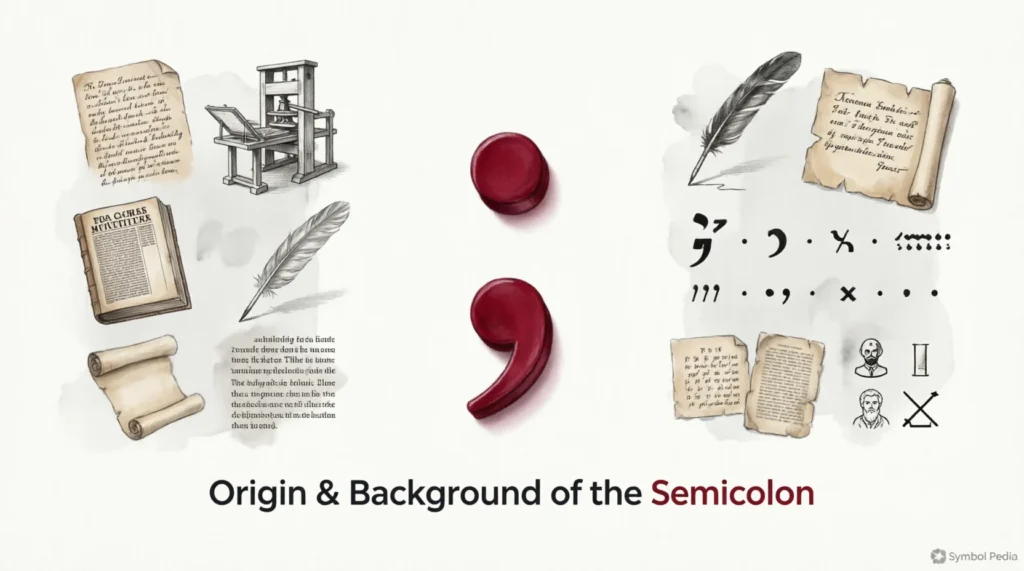
The semicolon has a long history in written language. It developed as a punctuation mark for separating ideas that were related but did not need to be completely separated.
Its modern form became established in European printing during the Renaissance. Printers and writers needed marks that could communicate different degrees of pause and connection.
A period could signal a complete stop. A comma could create a short pause. The semicolon occupied the space between them.
That basic idea still explains its grammatical role today.
Over time, the semicolon became particularly useful in formal and literary English. Skilled writers could use it to connect two independent clauses without adding a conjunction such as “and,” “but,” or “so.”
Digital communication changed its appearance but not its basic identity.
On social media and messaging platforms, the semicolon can be part of emoticons, usernames, programming discussions, or symbolic posts. The rise of online communities also gave the punctuation mark emotional meanings that go beyond grammar.
One especially recognizable example is the semicolon as a symbol of continuation. The idea comes from treating a semicolon as the place where an author could have ended a sentence but chose to continue.
That interpretation became associated with the Project Semicolon movement and broader conversations about mental health, survival, and hope.
So, while the punctuation itself is centuries old, some of its modern cultural meanings are relatively recent.
Real-Life Conversations
1. WhatsApp Conversation
Person A:
“I was going to tell him everything; then I changed my mind.”
Person B:
“Why the semicolon?”
Person A:
“I mean the two thoughts are connected. I didn’t want a full stop.”
Here, the semicolon is being used correctly as punctuation. It connects two closely related complete thoughts.
2. Instagram DM
Person A:
“You really did that ;)”
Person B:
“LOL, what is that supposed to mean?”
Person A:
“A wink. I’m teasing you.”
In this situation, ; is not functioning as formal grammar. It is the eye in a winking emoticon.
3. TikTok Comments
Person A:
“Why does everyone keep posting a semicolon?”
Person B:
“It can symbolize continuing your story instead of ending it.”
Person A:
“Ohhh, I thought it was just punctuation.”
This conversation shows how a simple punctuation mark can develop a symbolic meaning online.
4. Text Message
Person A:
“I have three things to bring tomorrow; my notebook, charger, and headphones.”
Person B:
“Got it. See you tomorrow.”
Here, the semicolon separates the main statement from a list. A colon would often be a more natural choice in this particular sentence, but the example demonstrates how people sometimes use punctuation more flexibly in everyday texting.
Emotional & Psychological Meaning
The emotional meaning of ; depends heavily on context.
When used grammatically, it usually has no special emotional meaning. It simply helps organize thoughts.
But in symbolic communication, the semicolon can suggest continuation, resilience, choice, or an unfinished story.
This interpretation is especially powerful because of the way a semicolon works in a sentence. A writer could end the thought with a period, but instead chooses to continue.
That simple grammatical idea became emotionally meaningful to many people.
For some, the semicolon represents the belief that a difficult chapter does not have to be the final chapter. It can therefore appear in artwork, tattoos, jewelry, social-media posts, and personal stories.
Of course, you should never assume that every semicolon tattoo or post has this meaning. Personal symbols are personal.
I have seen punctuation become surprisingly meaningful in everyday communication. A tiny mark can change how a sentence feels. Compare “Fine.” with “Fine;” and you can immediately sense that punctuation affects our perception, even when the grammatical meaning is unclear.
That is part of what makes digital communication so interesting: people often turn ordinary symbols into emotional shorthand.
Usage in Different Contexts
Social Media
On social media, ; can have several meanings.
It may simply appear in grammatically correct writing, form part of ;), or represent a symbolic message about continuation and resilience.
A post containing only a semicolon may therefore require context before you interpret it.
Friends & Relationships
In casual conversations, the semicolon most commonly appears as punctuation or within a wink emoticon.
For example:
“You really thought I wouldn’t notice ;)”
The ;) gives the sentence a playful or teasing tone.
A semicolon used alone, however, can be confusing unless both people understand the intended symbolism.
Work & Professional Settings
In professional writing, the semicolon is primarily a punctuation mark.
For example:
“The meeting begins at 10 a.m.; please arrive a few minutes early.”
It should not normally be treated as an emotional symbol in business communication.
If you are writing an email, report, application, or formal document, use the semicolon according to standard grammar rather than relying on internet slang.
Casual vs. Serious Tone
The same symbol can feel completely different in different situations.
;) is usually casual and playful.
A semicolon in a formal sentence is grammatical.
A semicolon used in a personal post may carry a serious symbolic meaning.
Context is the key.
When NOT to Use the Symbol ;
Knowing when not to use a semicolon is just as important as knowing when to use one.
Avoid using it simply because you want your sentence to sound sophisticated. A semicolon should have a grammatical purpose.
Do not place it between incomplete fragments that cannot stand as independent sentences.
For example:
“Because I was tired; I went home.”
That is generally incorrect. A comma is more appropriate:
“Because I was tired, I went home.”
You should also avoid assuming that a semicolon automatically communicates emotional meaning.
If someone sends you ;, don’t immediately conclude that they are talking about mental-health symbolism. They may simply have typed punctuation.
Cultural and personal sensitivity also matters. If someone uses a semicolon as a deeply personal symbol, joking about it may come across as insensitive.
Common Misunderstandings About ;
“It always means continuation.”
Not necessarily.
Continuation is one symbolic interpretation, but the standard grammatical function is connecting related ideas.
“A semicolon is basically a fancy comma.”
Not quite.
A semicolon has a specific grammatical role. It can connect two independent clauses that are closely related.
“; and ;) mean the same thing.”
No.
The standalone ; is a semicolon. In ;), it is part of a winking emoticon.
“Every semicolon tattoo has the same meaning.”
No.
Some people associate it with survival or continuation, while others simply like the punctuation mark or have a completely personal reason.
“Semicolons show sadness.”
Not inherently.
The emotional interpretation comes from cultural symbolism and context, not from the punctuation’s basic grammatical function.
Comparison Table
| Symbol / Expression | Common Meaning | Typical Context |
|---|---|---|
; | Semicolon; connects related ideas | Writing, grammar |
;) | Winking or playful tone | Texting, DMs |
, | Short grammatical pause | Everyday writing |
. | Full stop or completed thought | Writing, texting |
: | Introduces an explanation or list | Writing |
… | Pause, hesitation, unfinished thought | Texting, social media |
:) | Smile or friendliness | Texting |
:/ | Uncertainty or awkwardness | Online chat |
! | Excitement, emphasis, surprise | Texting, writing |
? | Question or uncertainty | Writing, messaging |
Key Insight
The semicolon is unusual because its technical meaning and cultural meaning can coexist. In a sentence, it is punctuation; in ;), it can contribute to a playful emoticon; in symbolic contexts, it can represent continuation. Never interpret it without looking at the surrounding message.
How to Respond When Someone Uses ;
Casual Replies
If someone uses a semicolon normally, simply respond to the message itself.
“Makes sense.”
“Got you.”
“Yeah, those thoughts definitely connect.”
Funny Replies
If someone sends ;), you can match the playful energy.
“I see that wink 👀”
“Okayyy, I know what that means.”
“Don’t try to be slick ;)”
Mature Replies
If the semicolon seems symbolic or emotionally meaningful, avoid making assumptions.
“I feel like that symbol means something deeper here. Want to tell me?”
Respectful Replies
If someone explains that the semicolon has personal significance, acknowledge the meaning without minimizing it.
“Thanks for sharing that with me.”
“I understand. That sounds meaningful.”
The best response is usually the simplest one: understand the context before reacting to the symbol.
Regional & Cultural Usage
Western Culture
In American and British English, the semicolon has a well-established grammatical function.
Its symbolic association with continuation and resilience has also become recognizable through online culture, tattoos, and awareness movements.
Asian Culture
Across Asian online communities, the semicolon is commonly encountered through global English, social media, programming, and messaging.
Its grammar-based meaning generally remains the same, although the emotional symbolism may be less familiar to some users depending on age and online community.
Middle Eastern Culture
In Middle Eastern digital communication, users who communicate in English may use the semicolon according to standard English grammar or as part of emoticons.
The symbolic meaning is increasingly recognizable through international social media, but it should not automatically be assumed.
Global Internet Usage
The internet has made punctuation remarkably portable.
A person in one country can use ;), and someone thousands of miles away can immediately understand it as a wink.
At the same time, symbolic meanings can travel between communities and gradually develop new interpretations.
Gen Z vs. Millennials
Generational differences are often more noticeable in digital punctuation style than in the grammatical meaning of ;.
Younger users may use punctuation deliberately to create tone, irony, or aesthetic effects. Older users may use punctuation more literally.
Neither interpretation is automatically correct.
For example, a period after a short text may feel perfectly neutral to one person but unusually serious to another. Digital communication has made punctuation part of tone management.
Is the Symbol ; Safe for Kids?
Yes. The semicolon itself is simply a punctuation mark and is completely safe for children.
The only issue is context.
Children may encounter ;) as a playful emoticon or see semicolon symbolism on social media. If the symbol appears in a serious emotional context, parents or educators should consider the surrounding message rather than interpreting the punctuation alone.
Teaching children basic punctuation and digital context can help them understand why the same symbol may mean different things in different situations.
FAQs
1. What does the symbol ; mean?
The symbol ; is a semicolon. In writing, it connects closely related independent clauses or separates complicated list items.
2. What does ; mean in texting?
In texting, ; may simply be punctuation. When combined with a parenthesis as ;), it commonly forms a winking emoticon.
3. What does a semicolon symbolize emotionally?
A semicolon can symbolize continuation, resilience, or an unfinished story in some cultural contexts. This meaning is especially associated with modern online symbolism.
4. What does 😉 mean in a text?
;) usually represents a wink. Depending on the conversation, it can suggest joking, teasing, flirting, sarcasm, or playful confidence.
5. Why do people get semicolon tattoos?
Some people choose semicolon tattoos to represent continuation, survival, hope, or the idea that their story continues. Others choose the design for personal reasons unrelated to that symbolism.
6. Is a semicolon stronger than a comma?
Generally, yes. A semicolon creates a stronger separation than a comma while still showing a close relationship between ideas.
7. Does the semicolon always have a deep meaning?
No. Most of the time, ; is simply punctuation. Its deeper meaning depends on the person, community, and context in which it appears.
Conclusion
So, what does the symbol ; mean?
At its simplest, ; means semicolon, a punctuation mark used to connect closely related ideas or separate complicated elements in a sentence.
But language rarely stays inside grammar books.
In texting, ;) can turn the mark into a playful wink. Online, the semicolon can represent continuation and personal resilience. In programming, it can serve an entirely technical purpose. In creative writing, it can help control rhythm and show a relationship between thoughts.
That is why context matters more than the symbol itself.
If you see ; in a message, don’t immediately assign it a hidden meaning. Read the words around it, consider the relationship between the people communicating, and notice whether the symbol is being used grammatically, playfully, technically, or symbolically.
A tiny punctuation mark can carry a surprising amount of meaning. The real skill is not memorizing every possible interpretation—it’s learning to recognize which meaning fits the moment.
descover more post
What Does the Infinity Symbol Mean in Apple Music Complete …
Aquarius Zodiac Symbol Meaning The Hidden Power Behind …
What Does the Car Sliding Symbol Mean Warning Light …