If you have seen “IBS” in a text message, comment, or social media post, it can be confusing because the abbreviation has more than one possible interpretation.
The most established meaning of IBS is Irritable Bowel Syndrome, a digestive condition. Major English dictionaries such as Cambridge and Oxford define IBS this way.
However, online slang changes quickly, and some slang references list other meanings, including niche or offensive interpretations. There are also websites that claim IBS can mean “I’m Being Serious,” although this is far less established than the medical meaning.
So, when someone types “IBS,” context matters more than the letters themselves. This guide explains the meanings, examples, tone, and situations where you should—and should not—use the abbreviation.
What Does IBS Mean in Text? – Quick Meaning
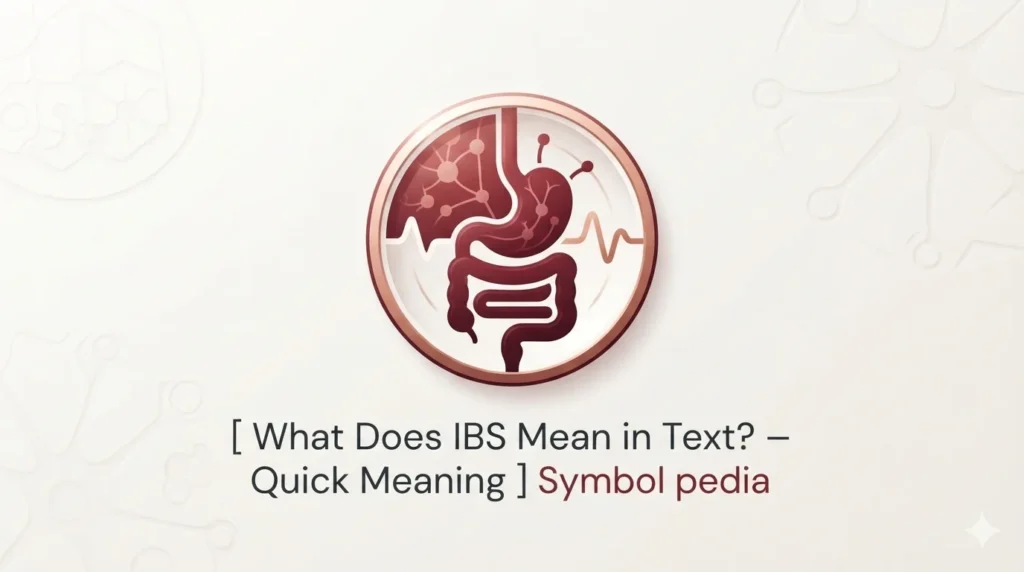
In most ordinary conversations, IBS means “Irritable Bowel Syndrome.”
It is an abbreviation rather than traditional slang. People commonly use it when talking about digestive symptoms, health, food, stress, appointments, or personal experiences.
- IBS = Irritable Bowel Syndrome
- It is commonly used in health-related conversations.
- It can appear in texts, DMs, forums, captions, and comments.
- The exact meaning should always be judged from the surrounding conversation.
- Some niche slang sources give IBS alternative meanings, but these are much less universal.
For example:
“I can’t eat dairy because of my IBS.”
“My IBS has been acting up today.”
“Stress always makes my IBS worse.”
If the conversation is about stomach problems, food, digestion, or stress, Irritable Bowel Syndrome is almost certainly the intended meaning.
Origin & Background of IBS
The abbreviation IBS comes directly from the medical term Irritable Bowel Syndrome.
Unlike newer texting abbreviations such as “LOL” or “BRB,” IBS did not originate primarily as internet slang. It is a shortened form of an established medical expression and has been used in healthcare and everyday conversation for years.
Cambridge Dictionary defines IBS as a condition affecting the bowels that can cause stomach pain, with possible links to digestive or nervous-system factors and stress.
Oxford similarly lists IBS as an abbreviation for irritable bowel syndrome.
The internet has changed how openly people talk about IBS, though.
Digestive health can feel embarrassing or uncomfortable to discuss face-to-face. A short abbreviation gives people a less awkward way to mention the condition.
Someone might feel more comfortable writing:
“My IBS is bad today.”
than explaining their symptoms in detail.
Social media has also created communities where people discuss digestive health, food triggers, stress, and everyday experiences. As a result, IBS has become familiar to many people who may never have encountered the full medical term in a classroom or doctor’s office.
Real-Life Conversations Using IBS
1. WhatsApp Conversation
Person A:
Are you still coming for dinner tonight?
Person B:
I think so, but I might leave early.
Person A:
Everything okay?
Person B:
Yeah, my IBS is acting up again. I don’t feel great.
Here, IBS clearly means Irritable Bowel Syndrome. The context involves physical discomfort and a social plan.
2. Instagram DM
Person A:
That food looked amazing 😭
Person B:
It was! But I definitely regretted eating that much.
Person A:
Omg why?
Person B:
My IBS does not appreciate my food choices 😂
The humor makes the conversation casual, but the abbreviation still refers to the medical condition.
3. TikTok Comment
Person A:
“Why do you always bring your own snacks?”
Person B:
“Because my IBS and random restaurant food don’t get along 😭.”
This is a common style of internet communication: a personal health issue is mentioned briefly, casually, and sometimes with humor.
4. Text Message
Person A:
Can you drive tomorrow morning?
Person B:
Probably, but I’ll let you know tonight.
Person A:
Sure, what’s up?
Person B:
I’ve been having an IBS flare-up, so I’m taking it easy.
Again, the meaning is straightforward because the context is health-related.
Emotional & Psychological Meaning of IBS in Text
When people use IBS in personal conversations, they are often doing more than simply naming a condition.
They may be explaining why they canceled plans, avoided certain foods, needed a bathroom, felt uncomfortable, or became anxious about going somewhere.
For some people, digestive problems can be emotionally difficult to discuss. Using an abbreviation can make the subject feel less exposed.
There is also a practical communication advantage.
Instead of writing a long explanation such as:
“I have a digestive condition that sometimes causes stomach pain and unpredictable symptoms…”
a person can simply say:
“My IBS is acting up.”
The recipient may already understand what that means.
A realistic personal-style scenario
Imagine a friend canceling dinner at the last minute.
At first, you might think they are avoiding you. Then they text, “Sorry, my IBS is really bad today.”
Suddenly, the situation feels different.
The abbreviation has helped them explain something personal without having to describe every physical detail. Good communication often works this way: a few familiar words can carry a surprisingly large amount of context.
How IBS Is Used in Different Contexts
1. Social Media
On Instagram, TikTok, Reddit, Facebook, and similar platforms, people may use IBS while discussing:
- Food
- Restaurants
- Stress
- Travel
- Digestive symptoms
- Personal experiences
- Wellness
- Lifestyle choices
Because social media is informal, people may combine IBS with emojis, jokes, or casual language.
For example:
“That spicy food was a terrible decision 😭 my IBS said absolutely not.”
The tone is humorous, but the underlying reference remains the medical condition.
2. Friends & Relationships
Friends may use IBS when explaining why they cannot eat certain foods, need to change plans, or feel uncomfortable.
A close friend might say:
“I can’t stay out too late tonight. My IBS has been awful.”
Because the relationship is familiar, there is usually no need for a lengthy explanation.
3. Work & Professional Settings
IBS can also appear in workplace communication, but professional wording matters.
A coworker might write:
“I’m not feeling well and may need to work from home today due to a health issue.”
That may be more appropriate than:
“My IBS is killing me today lol.”
If you are speaking with HR, a manager, teacher, or professional contact, use the amount of medical information that is actually necessary.
4. Casual vs. Serious Tone
IBS itself is neutral.
The surrounding words determine whether the message feels serious, humorous, emotional, or matter-of-fact.
Compare:
“My IBS has been causing problems lately.”
with:
“My IBS chose violence today 😂.”
Both refer to the same condition, but their emotional tone is completely different.
When NOT to Use IBS
The abbreviation may be inappropriate when the recipient is unlikely to understand it.
For example, don’t assume everyone knows medical abbreviations.
If you’re talking to someone unfamiliar with the term, writing “Irritable Bowel Syndrome (IBS)” the first time can be clearer.
Avoid using it when:
- The conversation is formal and clarity is important.
- The recipient may not know the abbreviation.
- You are discussing a sensitive health matter with someone you barely know.
- You are using it as a joke about another person’s medical condition.
- The surrounding context makes another meaning more likely.
Also, avoid assuming that every use of “IBS” means the same thing. Some slang websites list alternative meanings, including vulgar or offensive ones. Those meanings are niche and should not automatically be applied to an ordinary conversation.
Common Misunderstandings About IBS
1. Assuming it is always slang
IBS is not primarily a slang expression. Its best-established meaning is the medical abbreviation Irritable Bowel Syndrome.
2. Assuming it means “I’m Being Serious”
Some online abbreviation websites list “I’m Being Serious” as a meaning for IBS. However, this usage is not nearly as established as “Irritable Bowel Syndrome.”
If someone writes:
“IBS, you need to listen to me.”
you should examine the conversation before deciding what they mean.
3. Ignoring context
Context is everything with abbreviations.
“My IBS is getting worse.”
almost certainly refers to the medical condition.
But an unusual sentence such as:
“IBS, I’m not joking.”
could potentially indicate a different abbreviation.
4. Treating it as an insult
Some slang dictionaries record vulgar alternative definitions of IBS. These are not the default meaning and may be offensive.
IBS Meaning Compared With Related Expressions
| Expression | Meaning | Typical Context |
|---|---|---|
| IBS | Irritable Bowel Syndrome | Health, digestion, personal conversations |
| IBS | I’m Being Serious (niche) | Some informal online conversations |
| IBD | Inflammatory Bowel Disease | Medical/health discussions |
| GI issues | Gastrointestinal problems | Health and everyday conversation |
| Stomach problems | General digestive discomfort | Casual conversation |
| Digestive issues | Broad digestive problems | Casual or professional contexts |
| Seriously | Indicates sincerity | General texting |
| JK | Just kidding | Informal texting |
| LOL | Laughing out loud | Casual online communication |
Key Insight
The safest interpretation of IBS is Irritable Bowel Syndrome, especially when the conversation mentions food, stomach pain, digestion, stress, symptoms, or health. Alternative meanings exist, but they are much more dependent on context.
How to Respond When Someone Uses IBS
Your response depends on what the person means and how close you are.
Casual Replies
“Oh no, hope you’re feeling better!”
“Take it easy today.”
“Got you. No worries.”
Funny Replies
If you’re close enough to joke:
“Your stomach has officially filed a complaint 😂.”
“Okay, your digestive system wins this round 😭.”
Keep humor gentle. Don’t joke about someone’s symptoms if they sound genuinely distressed.
Mature Replies
“I’m sorry you’re dealing with that. Take whatever time you need.”
“Thanks for letting me know. Don’t worry about the plans.”
Respectful Replies
“I understand. Please take care of yourself.”
“No need to explain further. I hope you feel better soon.”
If you’re unsure what the abbreviation means, simply ask:
“When you say IBS, do you mean irritable bowel syndrome?”
That’s much better than confidently guessing.
Regional & Cultural Usage of IBS
Western Culture
In the United States, Canada, the UK, Australia, and other English-speaking environments, IBS is widely recognizable as a medical abbreviation.
People may use it casually with friends, especially when discussing food, stress, or lifestyle.
Asian Culture
English abbreviations are frequently mixed with local languages in digital communication across many Asian countries.
IBS may appear in English-language messages even when the rest of the conversation is written in another language.
The level of familiarity can vary depending on age, education, internet exposure, and whether the person has encountered the medical term before.
Middle Eastern Culture
English abbreviations are also common in multilingual online communication throughout the Middle East.
Someone may use “IBS” in an otherwise Arabic, Persian, Turkish, or mixed-language conversation, particularly when discussing health or food.
Still, regional familiarity varies, so spelling out the phrase can prevent confusion.
Global Internet Usage
Online communication has made medical abbreviations increasingly visible outside professional healthcare environments.
People can encounter IBS through:
- TikTok
- YouTube
- Health forums
- Online communities
- Messaging apps
That does not mean every internet user knows the abbreviation automatically.
Gen Z vs. Millennials
Younger users often shorten language when context is obvious, but IBS is somewhat different from deliberately created texting slang.
Gen Z may use humorous phrases such as:
“My IBS said absolutely not 💀.”
Millennials may be more likely to use it directly:
“I’ve been having IBS symptoms lately.”
Neither style changes the core meaning.
Is IBS Safe for Kids?
The abbreviation itself is not inappropriate for children.
However, the topic involves a health condition, so children should understand that IBS is a medical term rather than simply internet slang.
For younger children, saying “irritable bowel syndrome” and explaining it in age-appropriate language may be clearer than relying only on “IBS.”
Parents and educators should also be aware that some slang websites list unrelated and vulgar meanings for the same letters.
So if a child encounters “IBS” online, context should be checked before interpreting it.
FAQs
1. What does IBS mean in text?
IBS most commonly means Irritable Bowel Syndrome, especially when the conversation involves digestion, food, stomach pain, stress, or health.
2. Is IBS a slang word?
Not primarily. IBS is an established abbreviation for Irritable Bowel Syndrome, although some websites list alternative slang meanings.
3. Can IBS mean “I’m Being Serious”?
Some online abbreviation references list “I’m Being Serious” as a possible meaning, but this is much less established than the medical meaning.
4. What does IBS mean on social media?
On social media, IBS usually refers to Irritable Bowel Syndrome, particularly in posts about food, symptoms, stress, or personal health.
5. Is IBS the same as IBD?
No. IBS and IBD are different terms. IBS refers to irritable bowel syndrome, while IBD refers to inflammatory bowel disease.
6. How do I know which meaning of IBS someone intends?
Look at the surrounding words. Mentions of food, stomach problems, symptoms, or health strongly suggest Irritable Bowel Syndrome.
7. Should I use IBS in professional communication?
You can use it when the recipient understands the abbreviation, but in formal or sensitive situations, spelling out Irritable Bowel Syndrome the first time is usually clearer.
Conclusion
So, what does IBS mean in text?
In the vast majority of ordinary health-related conversations, IBS means “Irritable Bowel Syndrome.” It is an established medical abbreviation that has naturally moved into texts, DMs, social media posts, and everyday conversations.
The interesting part is that online language does not always stay neatly defined. Some slang references give IBS alternative meanings, including “I’m Being Serious” and other niche interpretations. Those should be judged carefully rather than assumed automatically.
The simplest rule is this: read the context before reading the acronym.
If someone is talking about food, stomach discomfort, stress, digestion, or symptoms, IBS almost certainly refers to the medical condition. If the surrounding message makes no sense with that interpretation, asking politely is better than guessing.
Once you understand that distinction, seeing “IBS” in a text message becomes much less confusing.
descover more post
What Does the Satellite Symbol Mean on iPhone Meaning …
What Does the Swastika Symbol Mean History Religion and …
What Does the Yellowjackets Symbol Mean Real Meaning …