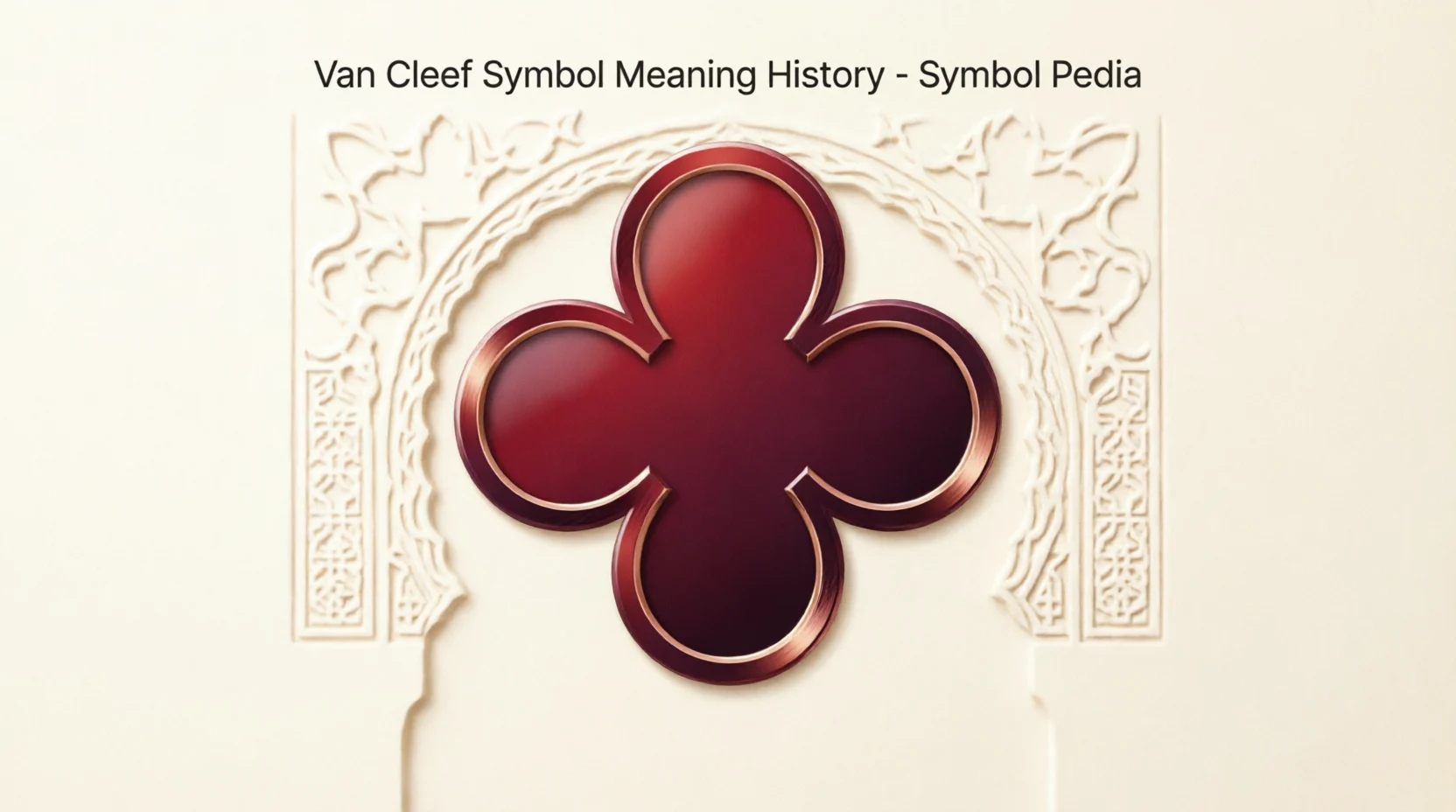
When people see the elegant four-leaf motif associated with Van Cleef & Arpels, one question often comes up: what does the Van Cleef symbol mean?
The answer is more meaningful than simply “a luxury jewelry logo.” The familiar Alhambra motif is closely associated with luck, fortune, harmony, and timeless elegance. Its four rounded clover-like shapes have become one of the most recognizable designs in modern jewelry.
People often search for the meaning because the symbol appears everywhere—from necklaces and bracelets to earrings, rings, fashion posts, and social-media photos. Some wonder whether it has a religious meaning, while others associate it with protection, prosperity, or good fortune.
Understanding the difference between the brand itself, the Alhambra motif, and the personal meanings people attach to the design makes the symbol much easier to appreciate.
What Does the Van Cleef Symbol Mean? – Quick Meaning
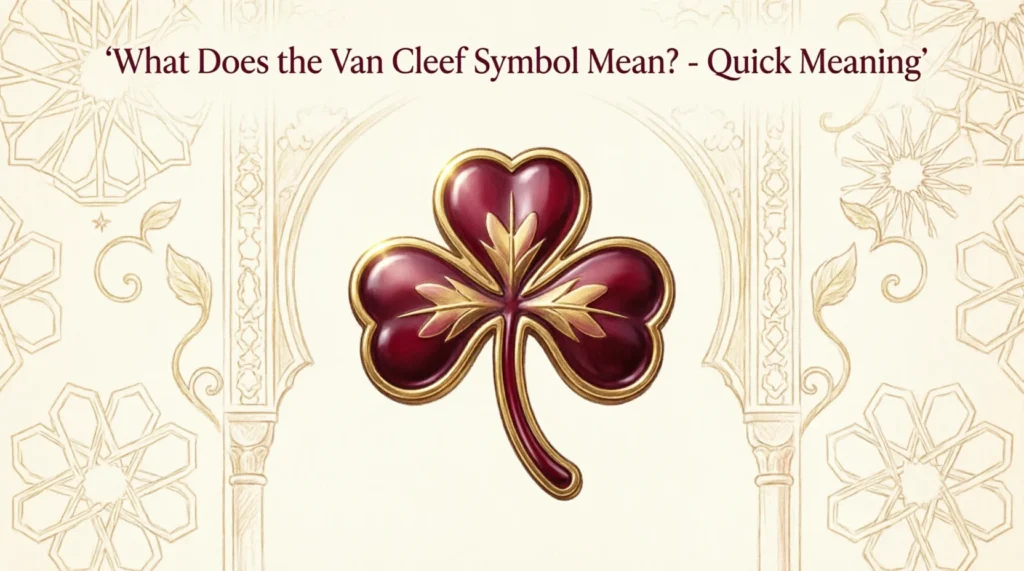
The Van Cleef symbol most commonly refers to the Alhambra motif, the signature four-leaf, clover-like design created by Van Cleef & Arpels.
Its central associations include:
- Good luck
- Good fortune
- Harmony
- Prosperity
- Positive energy
- Elegance and refinement
- Timelessness
- Personal sentimental value
The motif is inspired by the idea of lucky clovers and has become strongly connected with the jewelry house’s identity.
In everyday conversation, someone might describe it like this:
“I wear it because it represents good luck.”
Or:
“The four-leaf design feels like a symbol of fortune.”
Another person might simply say:
“I love the Van Cleef motif because it looks timeless.”
The important point is that the design has a recognized symbolic association with luck, but individual wearers can give it their own emotional meaning.
Origin & Background of the Van Cleef Symbol
The story begins with Van Cleef & Arpels, the French luxury jewelry house founded in Paris in 1906.
The Alhambra collection arrived much later, in 1968, and quickly became an important part of the house’s visual identity.
Its distinctive shape resembles a four-leaf clover. That connection is significant because four-leaf clovers have long been associated with rare good fortune in Western folklore.
The name Alhambra adds another layer of character. It references the Alhambra palace complex in Granada, Spain, a place famous for its ornamental architecture and intricate decorative patterns.
The jewelry motif itself is not simply a reproduction of Spanish architecture. Instead, its name and visual language contribute to the sense of ornament, symmetry, and historical elegance surrounding the collection.
Why Did the Design Become So Recognizable?
Part of the answer is consistency.
The rounded quatrefoil-like shape can appear in different materials, colors, and stones while remaining immediately recognizable. Mother-of-pearl, onyx, malachite, carnelian, diamonds, and other materials can change the personality of the piece without changing its basic visual identity.
That adaptability helped the motif move beyond a single jewelry collection.
It became a cultural shorthand for a particular kind of understated luxury.
Social Media Changed How People See It
Instagram, TikTok, Pinterest, and fashion content have given recognizable luxury symbols an entirely new life.
A person may see the motif worn by a celebrity, influencer, friend, or fashion creator and then become curious about its meaning.
As a result, the Alhambra motif is no longer understood only through traditional jewelry history. Online, people also associate it with:
- Success
- Wealth
- Femininity
- Personal milestones
- Quiet luxury
- Manifestation and positive energy
- Good fortune
Some of these interpretations are personal or contemporary rather than official definitions of the design.
That distinction matters.
Real-Life Conversations About the Van Cleef Symbol
The easiest way to understand how people interpret the motif is to see how it naturally appears in conversation.
WhatsApp Conversation
Person A:
Why does everyone call that four-leaf necklace a Van Cleef symbol?
Person B:
It’s the Alhambra motif. It’s mainly associated with luck and good fortune.
Person A:
Oh, I thought it was some kind of religious symbol.
Person B:
Not specifically. People can give it personal meanings, but the main idea is luck.
Instagram DM
Person A:
Your bracelet is gorgeous 😍 Does the symbol mean anything?
Person B:
Yes! I bought it because I liked the idea of carrying a little reminder of good luck.
Person A:
That actually makes it more special.
Person B:
Exactly. I wanted something beautiful that also felt meaningful.
TikTok Comments
Commenter 1:
Wait, what does the Van Cleef flower mean?
Commenter 2:
It’s the Alhambra motif. People usually connect it with luck and fortune.
Commenter 3:
I always thought it was just a luxury logo 😂
Commenter 2:
It definitely became a luxury icon, but the motif has its own history too.
Text Message
Person A:
Thinking about getting the four-leaf necklace for my graduation.
Person B:
That would be cute. Since it’s associated with good luck, it actually fits graduation perfectly.
Person A:
That’s what I was thinking. New chapter, new luck.
Person B:
Then it has a meaning beyond just being pretty.
Emotional & Psychological Meaning
Symbols become powerful when people attach memories to them.
That is particularly true with jewelry. A necklace or bracelet can mark a graduation, birthday, relationship, career achievement, or completely private turning point.
The Alhambra motif naturally lends itself to this kind of emotional interpretation because luck is something people often want to carry with them.
Someone might wear it before an important interview.
Another person might receive one from a parent to mark a major life transition.
Someone else may buy one after accomplishing something independently and see it as a personal reminder of how far they have come.
From a communication perspective, this is why asking “What does the symbol mean?” does not always have one personal answer.
The established association may be good fortune, but the wearer’s emotional meaning can be much deeper.
A Personal-Style Scenario
Imagine someone starting a new job after months of uncertainty. A small four-leaf pendant becomes their everyday accessory.
Every time they look at it, they remember the moment they finally got the opportunity they were waiting for.
For that person, the symbol is no longer simply associated with luck. It becomes a reminder of resilience and hope.
That is how symbolic objects gain emotional power.
Usage in Different Contexts
On Social Media
On Instagram and TikTok, the motif often appears in fashion, luxury, beauty, and lifestyle content.
People may use phrases such as “lucky charm,” “good fortune,” “timeless piece,” or “my everyday symbol.”
However, a social-media caption doesn’t necessarily represent the official meaning of the motif. It may reflect the creator’s personal interpretation.
Among Friends and Relationships
Friends may give jewelry featuring the motif as a symbolic gift.
In romantic relationships, it can represent wishes for happiness, prosperity, or good fortune. Again, the meaning comes partly from the intention behind the gift.
In Work & Professional Settings
The symbol itself isn’t business slang or professional terminology.
A person might wear it to work simply as jewelry. If they discuss its symbolism, “luck,” “success,” or “new beginnings” may come up.
It’s best not to assume that wearing the motif communicates a specific professional message.
Casual vs. Serious Tone
In casual conversation, someone might call it a “lucky clover” or “Van Cleef flower.”
A more precise explanation would identify it as the Alhambra motif and explain its association with luck and fortune.
When NOT to Use the Van Cleef Symbol as a Symbolic Claim
There is nothing inherently inappropriate about wearing or discussing the motif, but misunderstandings can happen when people assign it meanings that aren’t established.
Don’t Automatically Call It a Religious Symbol
The Alhambra motif should not automatically be described as representing a particular religion.
Its appearance may remind different people of flowers, clovers, architectural shapes, or decorative symbols, but visual resemblance does not establish religious meaning.
Don’t Assume Everyone Knows Its Meaning
Someone may recognize the jewelry immediately without knowing anything about its symbolism.
If you’re explaining it to someone, simply say what it is rather than assuming they already understand the reference.
Be Careful With Cultural Claims
Online discussions sometimes attach mystical, spiritual, or historical meanings to luxury motifs without distinguishing documented history from modern interpretation.
It’s better to say “often associated with” than to present every personal interpretation as historical fact.
Common Misunderstandings
“It’s Just a Logo”
Not exactly.
The Alhambra motif has become strongly identified with Van Cleef & Arpels, but it is also a distinct jewelry design with its own history and symbolism.
“It Always Means Wealth”
The association with luxury is understandable because of the brand’s position in the jewelry world.
However, the symbolic meaning of the Alhambra motif is more closely connected with luck and good fortune than wealth alone.
“It’s a Four-Leaf Clover”
It resembles a four-leaf clover, and the lucky-clover association is important to how people interpret it.
But the actual jewelry motif is more accurately described as the Alhambra motif, rather than simply calling every version a literal clover.
“Everyone Wears It for the Same Reason”
Definitely not.
One person may love its craftsmanship, another may appreciate its history, and another may see it as a lucky personal talisman.
Jewelry symbolism is often subjective.
Van Cleef Symbol vs. Similar Symbols
| Symbol or Expression | Common Meaning | Main Difference |
|---|---|---|
| Van Cleef Alhambra motif | Luck, fortune, harmony | A luxury jewelry motif with a distinctive four-lobed design |
| Four-leaf clover | Good luck | A traditional lucky symbol found in folklore |
| Horseshoe | Protection and good fortune | Strongly connected with traditional folk beliefs |
| Lucky charm | Protection or luck | A broad category rather than one specific design |
| Good-luck charm | Fortune and positive outcomes | Can refer to almost any personal object |
| Flower motif | Beauty, growth, femininity | Meaning varies significantly by flower and culture |
| Infinity symbol | Eternity, continuity | Represents endlessness rather than luck |
| Evil eye | Protection from harmful attention | Has distinct cultural and historical associations |
| Four-leaf design | Fortune | Similar visual association but not necessarily the same jewelry motif |
Key Insight
The biggest distinction is that the Alhambra motif is a specific jewelry design, while symbols such as the four-leaf clover, horseshoe, or lucky charm are broader cultural symbols. They can share the idea of good fortune without being interchangeable.
How to Respond When Someone Asks About the Symbol
If someone asks, “What does the Van Cleef symbol mean?”, your answer can depend on the situation.
Casual Reply
“It’s the Alhambra motif, and it’s commonly associated with good luck and fortune.”
Funny Reply
“Basically, stylish good luck 😂.”
Mature Reply
“The Alhambra motif is associated with luck and good fortune, although people often give it their own personal meaning.”
Respectful Reply
“It’s a signature Van Cleef & Arpels motif commonly connected with good fortune. Its meaning can also be personal to the wearer.”
The mature answer is usually the most accurate because it separates the established symbolism from individual interpretation.
Regional & Cultural Usage
Western Culture
In Western culture, the motif is easily connected with the familiar idea of a four-leaf clover and good luck.
Its luxury-brand association is also especially prominent in fashion conversations.
Asian Culture
Across Asian markets, luxury jewelry can carry additional associations involving prosperity, gifting, milestones, and social status.
However, it would be inaccurate to claim that every Asian culture interprets the motif identically.
Cultural meaning depends heavily on country, family traditions, and individual beliefs.
Middle Eastern Culture
In Middle Eastern luxury and fashion communities, the motif may be appreciated primarily for its elegance, craftsmanship, and recognizable luxury status.
Some wearers may attach personal ideas of fortune or blessing, but those interpretations should not be treated as a universal cultural definition.
Global Internet Usage
Online, meanings move quickly between cultures.
A person in one country may describe the design as a lucky flower, while someone elsewhere may see it mainly as a luxury-fashion symbol.
Social media has made these interpretations overlap.
Gen Z vs. Millennials
Younger users may discuss the motif through ideas such as quiet luxury, aesthetic identity, manifestation, personal style, and status.
Millennial audiences may be more likely to encounter it through traditional jewelry, luxury fashion, gifting, or milestone purchases.
Neither interpretation is inherently more correct.
Is the Van Cleef Symbol Safe for Kids?
Yes. The Alhambra motif itself is simply a jewelry design and has no inherently dangerous or inappropriate meaning.
For children, the important considerations are practical ones—such as the age-appropriateness of the jewelry, small detachable components, and whether the piece is suitable for unsupervised wear.
Symbolically, there is no reason a child cannot understand it as a representation of luck or good fortune.
FAQs
1. What does the Van Cleef symbol mean?
The Van Cleef Alhambra motif is commonly associated with luck and good fortune, while individual wearers may give it additional personal meanings.
2. Is the Van Cleef symbol a four-leaf clover?
The Alhambra motif resembles a four-leaf clover and is associated with the idea of luck, but it is more accurately identified as Van Cleef & Arpels’ Alhambra motif.
3. Is the Van Cleef symbol religious?
No specific religious meaning is inherent to the Alhambra motif. Claims that it universally represents a particular religion should be treated cautiously.
4. Why is Van Cleef associated with luck?
The Alhambra motif’s four-lobed, clover-like appearance connects naturally with the longstanding cultural association between four-leaf clovers and good fortune.
5. What does a Van Cleef necklace symbolize?
A Van Cleef necklace featuring the Alhambra motif can symbolize luck, fortune, elegance, or a personal milestone, depending on the wearer.
6. Can the Van Cleef symbol represent protection?
Some people may personally interpret lucky symbols as protective charms. However, protection is a personal interpretation rather than the primary established meaning of the Alhambra motif.
7. What does the four-leaf Van Cleef design mean spiritually?
There is no single universal spiritual meaning. People may personally associate it with positive energy, luck, hope, or protection, but these interpretations vary.
Conclusion
So, what does the Van Cleef symbol mean?
Most commonly, the answer is luck, good fortune, and positive fortune. The recognizable four-lobed Alhambra motif has become much more than a decorative jewelry pattern—it has developed into a visual symbol that people connect with elegance, personal milestones, and the hope that good things are ahead.
But perhaps the most interesting part is what happens after someone makes the symbol their own.
A necklace can remind one person of a graduation. A bracelet can represent a new beginning. A gift can quietly say, “I hope life treats you well.” And for someone else, it may simply be a beautiful piece of jewelry with a timeless design.
That is the real strength of meaningful symbols: their history gives them a foundation, but personal experience gives them a story.
If you encounter the Van Cleef Alhambra motif in conversation, the safest simple explanation is that it is a signature design associated with luck and good fortune, while its deeper meaning can depend on the person wearing it.
descover more post
What Does the Satellite Symbol Mean on iPhone Meaning …
Statistical Symbol for Mean What It Means How to Use It and …
What Does the Swastika Symbol Mean History Religion and …

Orvian is a passionate researcher and dedicated content creator focused on exploring the deeper meanings behind symbols, signs, and cultural interpretations. With a strong interest in symbolism and human psychology, Orvian simplifies complex ideas into clear, engaging, and easy-to-understand content for readers around the world.
Through consistent research and thoughtful writing, Orvian aims to provide accurate, insightful, and meaningful information that helps users connect with symbols on a deeper level—whether for personal growth, curiosity, or knowledge.
Known for a hardworking mindset and attention to detail, Orvian believes that every symbol carries a story, and every story deserves to be understood.