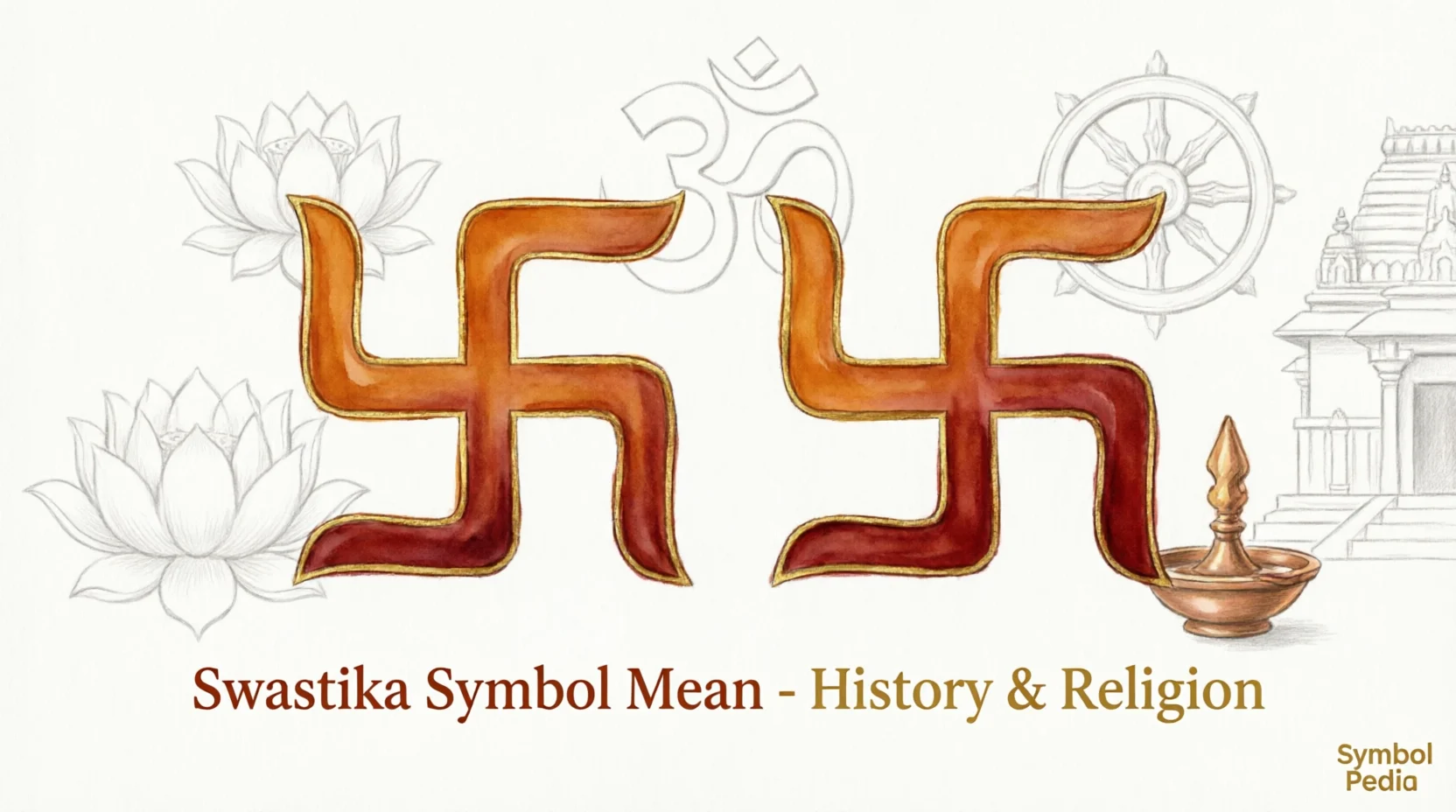
If you search for what does the swastika symbol mean, you may find two very different answers.
In one context, the swastika is an ancient sacred symbol associated with good fortune, well-being, prosperity, and auspiciousness. In another, especially in Europe and much of the Western world, it immediately brings to mind Adolf Hitler, Nazi Germany, antisemitism, and the Holocaust.
Both realities are important.
The swastika existed for thousands of years before the Nazi movement adopted it. The word itself comes from the Sanskrit svastika, generally associated with well-being or good fortune. The symbol has been used in Hinduism, Buddhism, and Jainism and has appeared across different cultures and historical periods.
The Nazis appropriated the symbol in the early twentieth century and transformed its public meaning in much of the modern world. Hitler’s Nazi Party formally adopted the swastika in 1920, using it as a central part of its political identity and propaganda.
That history explains why simply looking at the shape is not enough. Context matters enormously.
What Does the Swastika Symbol Mean? – Quick Meaning
The meaning of the swastika depends heavily on its historical, religious, and cultural context.
Traditionally, the symbol has been associated with ideas such as:
- Good fortune
- Well-being
- Prosperity
- Auspiciousness
- Protection
- Spiritual order
- Cycles and movement
In Hindu, Buddhist, and Jain traditions, it can still carry positive or sacred meanings today. The US Holocaust Memorial Museum notes that the symbol was used for at least 5,000 years before Hitler appropriated it for the Nazi flag.
In modern Western contexts, however, a swastika can strongly signify Nazism, racial hatred, antisemitism, fascism, and genocide, particularly when it appears alongside Nazi imagery.
For example:
“The swastika on the temple represents auspiciousness.”
“That symbol is associated with Nazi Germany in this historical photograph.”
“I recognized the swastika but wasn’t sure which cultural meaning it had.”
The important lesson is simple: the ancient religious symbol and the Nazi symbol share a basic geometric form, but their meanings and contexts are not automatically identical.
Origin & Background of the Swastika
The history of the swastika is remarkably old.
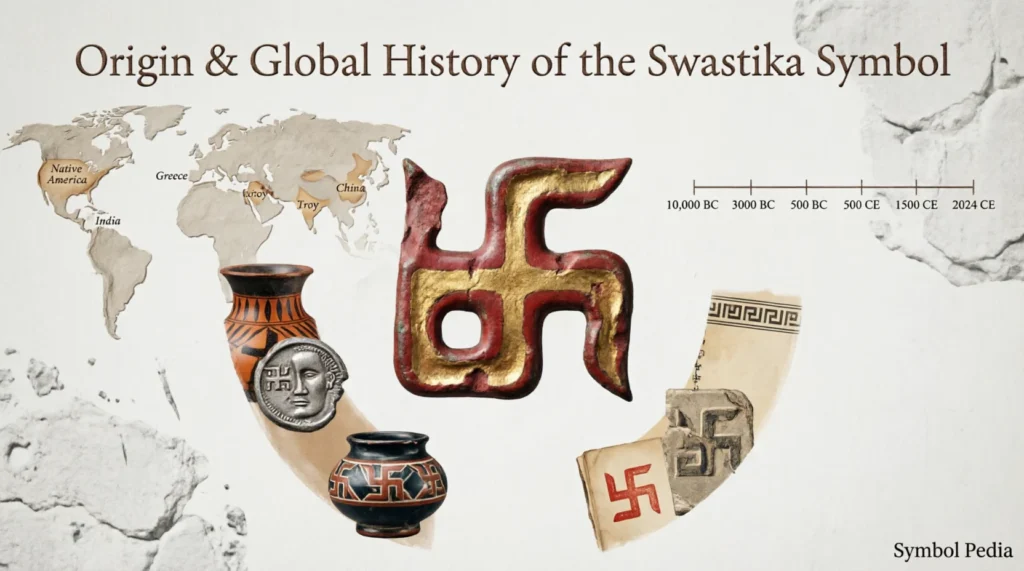
Archaeological evidence shows variations of the hooked-cross motif appearing thousands of years before the twentieth century. The US Holocaust Memorial Museum describes the symbol as having been used at least 5,000 years before Hitler’s adoption of it.
The Sanskrit word svastika is commonly connected with well-being or good fortune. The motif has been used in several parts of Asia and in other ancient cultural settings. Some interpretations have connected the design with movement, cycles, or the sun, although its exact meaning has varied across cultures and historical periods.
The Swastika in Hinduism
In Hindu traditions, the swastika can represent auspiciousness, prosperity, good fortune, and positive beginnings.
It may appear in religious ceremonies, homes, artwork, architecture, and festivals. In these settings, treating the symbol automatically as a Nazi emblem can erase an important part of its much older cultural history.
The Swastika in Buddhism
The symbol also appears in Buddhist traditions, where it can be connected with ideas such as eternity, good fortune, or the teachings and spiritual order of Buddhism.
Its orientation and visual presentation can differ depending on cultural tradition and region.
The Swastika in Jainism
Jainism also uses the swastika as an important religious symbol.
Within Jain traditions, it has specific spiritual associations and can appear in religious artwork and ceremonies. Its meaning therefore cannot be reduced to its twentieth-century political use.
How the Nazis Changed Its Modern Association
The twentieth century dramatically altered how many people perceive the symbol.
German nationalist and racist movements adopted the swastika before the Nazis came to power. In 1920, Adolf Hitler’s Nazi Party formally adopted it as part of its flag and political identity.
The Nazi regime then used the symbol extensively in propaganda, flags, uniforms, posters, badges, and public displays. It became closely associated with the regime’s racist ideology and persecution.
The Nazis falsely promoted a racial ideology centered on an imagined Aryan hierarchy. Their antisemitic worldview became government policy and ultimately contributed to systematic persecution and mass murder during the Holocaust.
This is why the modern meaning of the swastika can be emotionally intense.
Social Media and the Modern Internet
Social media has made the confusion even more visible.
A person might post a photograph of an ancient temple containing a swastika, while someone unfamiliar with the cultural context interprets it as Nazi imagery. Conversely, someone may deliberately use the symbol as extremist propaganda while claiming that it is merely an ancient design.
That is why online interpretation requires context rather than assumptions.
A symbol’s meaning can change depending on where it appears, who is using it, what surrounds it, and what historical message the person is communicating.
Real-Life Conversations
1. WhatsApp Conversation
Person A:
“Why does this house have a swastika outside? Isn’t that a Nazi symbol?”
Person B:
“I thought the same thing at first.”
Person A:
“So why would they put it there?”
Person B:
“In some Hindu traditions, it’s an ancient auspicious symbol connected with good fortune and well-being. It’s much older than Nazism.”
Person A:
“Wow. I honestly didn’t know that.”
Person B:
“Yeah, the historical context completely changes how you understand it.”
2. Instagram DM
Person A:
“I saw a swastika in this temple photo. Is that offensive?”
Person B:
“Not necessarily. In many Asian religious contexts, it’s a traditional sacred symbol.”
Person A:
“So it’s not always referring to Hitler?”
Person B:
“Exactly. The Nazi regime appropriated the symbol, but the symbol itself has a much older history.”
Person A:
“That makes much more sense now.”
3. TikTok Comments
Person A:
“Why is everyone saying this video is about Nazis? It’s showing an ancient temple.”
Person B:
“The symbol has different historical meanings.”
Person A:
“So what’s the original meaning?”
Person B:
“In several traditions, it has positive or sacred associations, including good fortune and well-being.”
Person A:
“That’s something school history classes don’t always explain.”
4. Text Message
Person A:
“Someone drew a swastika on the wall at school. What does it mean?”
Person B:
“Where and how was it drawn?”
Person A:
“It’s next to Nazi references.”
Person B:
“Then the context strongly suggests it’s being used as Nazi imagery rather than as a religious symbol.”
Person A:
“Yeah, that’s what I was worried about.”
Person B:
“Context is really important with this symbol.”
Emotional & Psychological Meaning
Symbols carry emotional weight because people learn to associate shapes with stories, memories, communities, and experiences.
For someone raised in a Hindu, Buddhist, or Jain environment, seeing a swastika may evoke religious tradition, celebration, family, prosperity, or spiritual practice.
For many people educated about twentieth-century European history, the same shape may immediately evoke Nazi Germany, antisemitism, concentration camps, persecution, war, and the Holocaust.
Neither reaction should be dismissed without considering the context behind it.
The psychological power of symbols comes partly from repetition. The Nazi regime used propaganda extensively to communicate its ideology and normalize its political messages.
Imagine someone seeing a swastika on a temple for the first time. Their immediate reaction might be shock because they associate the shape exclusively with Nazism. After learning about its older religious history, that reaction may become more nuanced.
That is an important lesson in communication: recognizing a symbol is not the same as understanding its meaning.
Usage in Different Contexts
Social Media
On social media, context can disappear quickly.
A photograph of a Hindu wedding, Buddhist artwork, or Jain religious site may contain a swastika for entirely traditional reasons. A political post containing Nazi flags and racial slogans carries a very different message.
Captions, surrounding symbols, location, and historical references can help clarify the intended meaning.
Friends and Relationships
If a friend asks about the swastika, avoid assuming that they are asking about Nazism.
A better response is to explain that the symbol has a long history and that its meaning depends on cultural and historical context.
Work and Professional Settings
Professional environments require additional care.
Using historical images for education, museums, documentaries, academic discussions, or Holocaust remembrance may be appropriate. Casual use of Nazi imagery, however, can easily create serious misunderstandings or cause distress.
If the symbol appears in a presentation, explain why it is being shown rather than leaving the audience to guess.
Casual vs. Serious Tone
This is not a symbol that should normally be treated casually when its Nazi association is relevant.
Humor, memes, or provocative posts can quickly turn a historical or cultural discussion into something offensive, especially when the surrounding context suggests racial hatred.
When NOT to Use the Swastika
There are situations where using the symbol can create unnecessary confusion or harm.
Avoid using it as a joke
The Nazi association is extremely serious. Turning it into a joke can trivialize the suffering connected with Nazi persecution and the Holocaust.
Avoid using Nazi versions as decoration
Using Nazi flags or symbols merely because they look visually striking can communicate an extremist message even when that was not the intention.
Be careful with tattoos
A person may intend an ancient religious meaning, but viewers unfamiliar with that tradition may interpret the tattoo as a Nazi reference.
Anyone considering the symbol as body art should understand both its traditional meaning and its modern associations.
Consider the audience
A symbol that is immediately understood in one community may be misunderstood in another.
When the audience is international, additional explanation can prevent unnecessary offense.
Common Misunderstandings
“The swastika was invented by the Nazis.”
This is historically incorrect.
The motif existed for thousands of years before the Nazi movement. The Nazis appropriated an ancient symbol rather than inventing the basic design.
“Every swastika means the same thing.”
Not necessarily.
Its meaning depends on cultural setting, orientation, surrounding imagery, historical period, and intended use.
“If it is ancient, it can never be offensive.”
That is also too simplistic.
An ancient symbol can have legitimate religious meanings while a different use of the same shape can intentionally communicate Nazi ideology or hatred.
“Anyone using a swastika is a Nazi.”
That conclusion can be unfair.
A swastika on a Hindu religious object or Buddhist artwork may have a completely different meaning from one displayed alongside Nazi slogans.
“The Nazi meaning doesn’t matter because the symbol is older.”
The opposite mistake is equally problematic.
The Nazi appropriation is a major part of modern history, and ignoring that history can cause genuine harm and misunderstanding.
Comparison Table
| Symbol or Expression | Common Meaning | Typical Context |
|---|---|---|
| Swastika in Hindu traditions | Auspiciousness, well-being, prosperity | Religious and cultural settings |
| Swastika in Buddhism | Spiritual and auspicious associations | Buddhist art and traditions |
| Swastika in Jainism | Religious and spiritual significance | Jain religious settings |
| Nazi swastika | Nazi ideology, racial hatred, antisemitism | Nazi history and extremist contexts |
| Nazi flag | Political symbol of Nazi Germany | Historical or extremist contexts |
| Peace symbol | Peace and opposition to war | Activism and popular culture |
| ☮ | Peace | Social movements and everyday communication |
| Anti-fascist imagery | Opposition to fascism | Political and historical contexts |
| Good-luck symbols | Fortune and positive wishes | Cultural and personal settings |
| Religious symbols generally | Faith, identity, spirituality | Worship and cultural traditions |
Key Insight
The most important distinction is context. The ancient swastika has meanings rooted in several religious and cultural traditions, while the Nazi version became a powerful symbol of an extremist regime and its racial ideology. Understanding both histories prevents oversimplification.
How to Respond When Someone Uses It
If someone uses or mentions the swastika, your response should depend on the context.
Casual replies
- “It has a much older history than Nazism.”
- “The meaning depends on the cultural context.”
- “Are you referring to the religious symbol or the Nazi symbol?”
Funny replies
Humor should be used carefully because of the symbol’s serious modern associations.
A safer response might be:
- “That symbol definitely needs some historical context.”
Mature replies
- “The symbol has ancient religious meanings, but it was later appropriated by Nazi Germany.”
- “I’d want to understand the context before assuming what the person meant.”
Respectful replies
- “I understand why that symbol can be upsetting. It has different meanings in different traditions, so context matters.”
- “Let’s look at where and how it was being used before interpreting it.”
Regional & Cultural Usage
Western Culture
In much of Europe and North America, the swastika is strongly associated with Nazi Germany and the Holocaust.
The association is particularly powerful because of the Nazi regime’s extensive use of the symbol in political propaganda and official imagery.
In countries such as Germany, public use of Nazi symbols is also subject to legal restrictions in certain circumstances.
Asian Culture
In parts of Asia, the symbol can still be recognized primarily through its older religious and cultural meanings.
It may appear on temples, religious artwork, homes, ceremonies, and traditional objects, particularly within Hindu, Buddhist, and Jain contexts.
That does not mean Asian communities are unaware of the Nazi association. Rather, the historical and cultural context may be different.
Middle Eastern Culture
In Middle Eastern settings, recognition of the symbol can vary widely depending on education, religious background, travel, media exposure, and familiarity with European history.
As with any international symbol, assumptions should be avoided.
Global Internet Usage
The internet has brought these different interpretations into direct contact.
A user may encounter a religious swastika in an Asian cultural post and immediately interpret it through the lens of Nazi history. Another user may encounter explicit Nazi imagery and attempt to defend it by pointing to the symbol’s ancient origins.
Both situations demonstrate why context matters.
Gen Z vs. Millennials
Younger internet users may encounter the swastika primarily through memes, gaming communities, historical content, social media, or discussions about extremism.
Millennials and older generations may have encountered it more often through traditional history education, films, documentaries, or news coverage.
However, age alone does not determine understanding. Cultural background and education can be much more influential.
Is the Swastika Symbol Safe for Kids?
The symbol itself requires context rather than a simple “safe” or “unsafe” label.
A child learning about Hinduism, Buddhism, Jainism, or ancient history may encounter the symbol in a legitimate educational or religious setting.
At the same time, children should understand that the Nazi appropriation of the symbol is connected to racism, antisemitism, persecution, and the Holocaust.
For younger children, an age-appropriate explanation is usually better than simply saying that the symbol is “bad.”
A useful lesson is: symbols can have different meanings, and historical context helps us understand which meaning is intended.
FAQs
What does the swastika symbol mean?
The swastika has several meanings. Traditionally, it has been associated with good fortune, well-being, auspiciousness, and spirituality in several Asian religious traditions. It was later appropriated by Nazi Germany, giving it a powerful association with Nazism and racial hatred in many modern contexts.
Is the swastika originally a Nazi symbol?
No. The swastika predates Nazism by thousands of years. It was used in different cultures long before Adolf Hitler and the Nazi Party adopted it.
What does a swastika mean in Hinduism?
In Hindu contexts, the swastika is traditionally associated with auspiciousness, prosperity, good fortune, and well-being. It may appear in religious ceremonies, homes, temples, and artwork.
Why is the swastika associated with Hitler?
The Nazi Party adopted the swastika as a central political symbol in 1920. Nazi propaganda then used it extensively on flags, posters, uniforms, badges, and other materials.
Is every swastika a Nazi symbol?
No. A swastika appearing in a Hindu, Buddhist, Jain, or historical cultural context does not automatically represent Nazism. Context is essential.
Why do some people find the swastika offensive?
Because Nazi Germany transformed the symbol into a central emblem of its racist ideology and propaganda. The Nazi regime persecuted millions of people and carried out the Holocaust, making the symbol deeply painful and threatening for many people.
Is it okay to use a swastika today?
It depends entirely on the context and intended meaning. Religious and educational uses can have legitimate purposes, while Nazi or extremist uses can communicate hatred and intimidation. In some countries, Nazi symbols are also legally restricted.
Conclusion
So, what does the swastika symbol mean?
The honest answer is more complicated than a single definition.
The swastika is an ancient symbol with thousands of years of history. In Hinduism, Buddhism, Jainism, and other cultural traditions, it can represent positive ideas such as auspiciousness, well-being, prosperity, or spiritual significance.
But the Nazi appropriation of the symbol created another powerful and painful meaning. Nazi Germany placed the swastika at the center of its propaganda and racial ideology, permanently connecting the symbol with Nazism, antisemitism, persecution, and the Holocaust for many people.
That is why context matters so much.
If you see a swastika on an ancient temple, religious artwork, or traditional object, do not automatically assume it represents Nazism. If you see it alongside Nazi flags, extremist slogans, or racial propaganda, the historical context is entirely different.
Understanding both sides of its history does not erase either one. Instead, it allows us to talk about the symbol accurately, respectfully, and without reducing a complicated history to a single assumption.
descover more post
What Does the Lock Symbol Mean on Snapchat Everything …
Ohm Symbol and Meaning Understanding Ω Its History and …
What Does the Clover Symbol Mean Luck Love Culture More …

Orvian is a passionate researcher and dedicated content creator focused on exploring the deeper meanings behind symbols, signs, and cultural interpretations. With a strong interest in symbolism and human psychology, Orvian simplifies complex ideas into clear, engaging, and easy-to-understand content for readers around the world.
Through consistent research and thoughtful writing, Orvian aims to provide accurate, insightful, and meaningful information that helps users connect with symbols on a deeper level—whether for personal growth, curiosity, or knowledge.
Known for a hardworking mindset and attention to detail, Orvian believes that every symbol carries a story, and every story deserves to be understood.