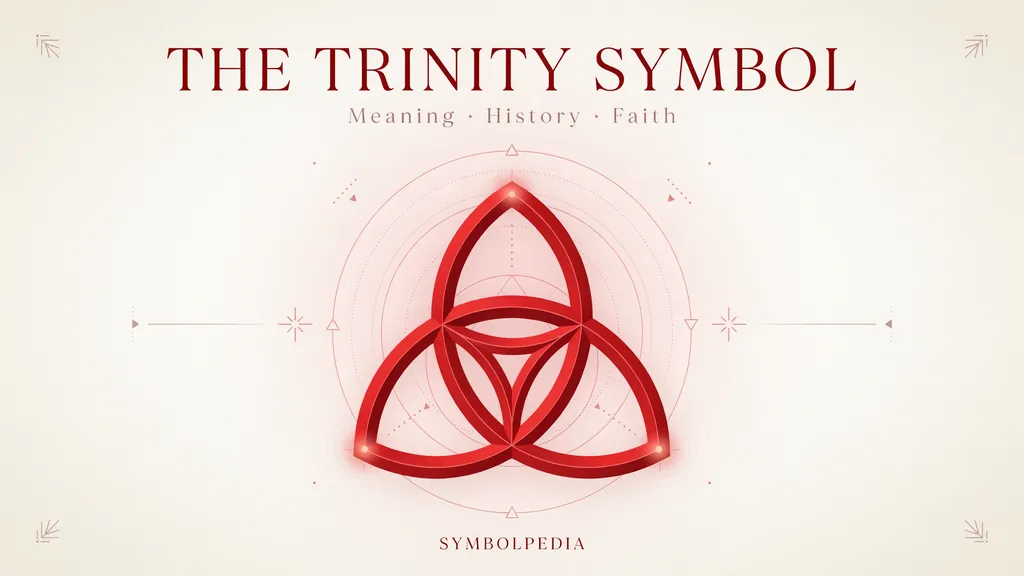
The trinity symbol is most commonly associated with the Christian belief in the Holy Trinity: the Father, the Son, and the Holy Spirit. It represents three distinct persons understood as one God.
For many people, however, the symbol raises a bigger question: Why three? What does the design actually represent? Is it only religious, or can it have a broader spiritual meaning?
Those questions matter because “trinity” can refer to both a specific Christian theological idea and a more general concept of three interconnected parts. The meaning can therefore change depending on the symbol, culture, and context in which you see it.
Whether you encountered a trinity symbol on jewelry, a tattoo, artwork, social media, or a religious object, understanding its history helps prevent common misunderstandings.
What Does the Trinity Symbol Mean? – Quick Meaning
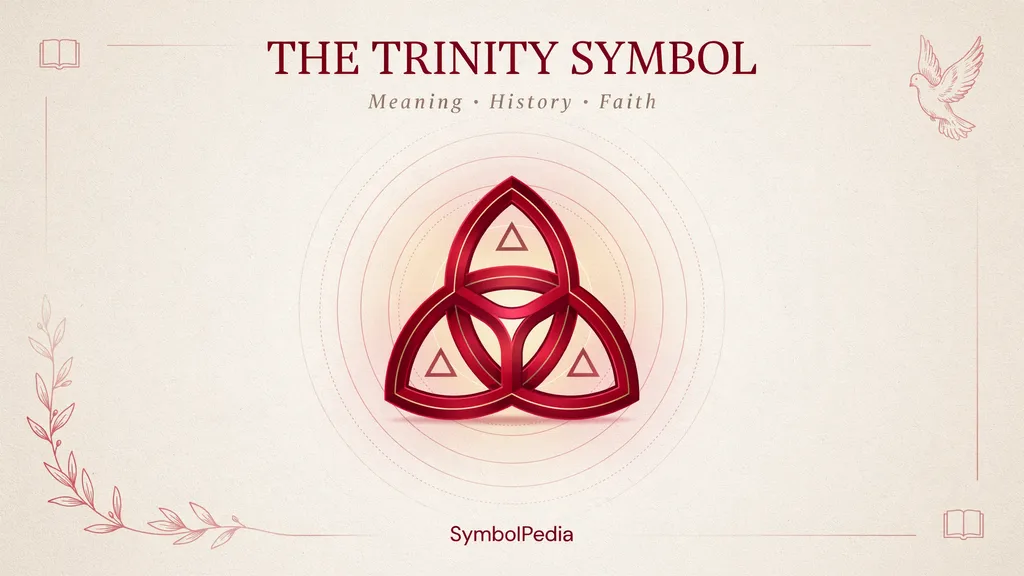
The trinity symbol generally represents three connected elements forming a unified whole.
In Christianity, the most important interpretation is the Holy Trinity:
- The Father — God the Father
- The Son — Jesus Christ
- The Holy Spirit — the Spirit of God
- One God — three distinct persons within one divine nature
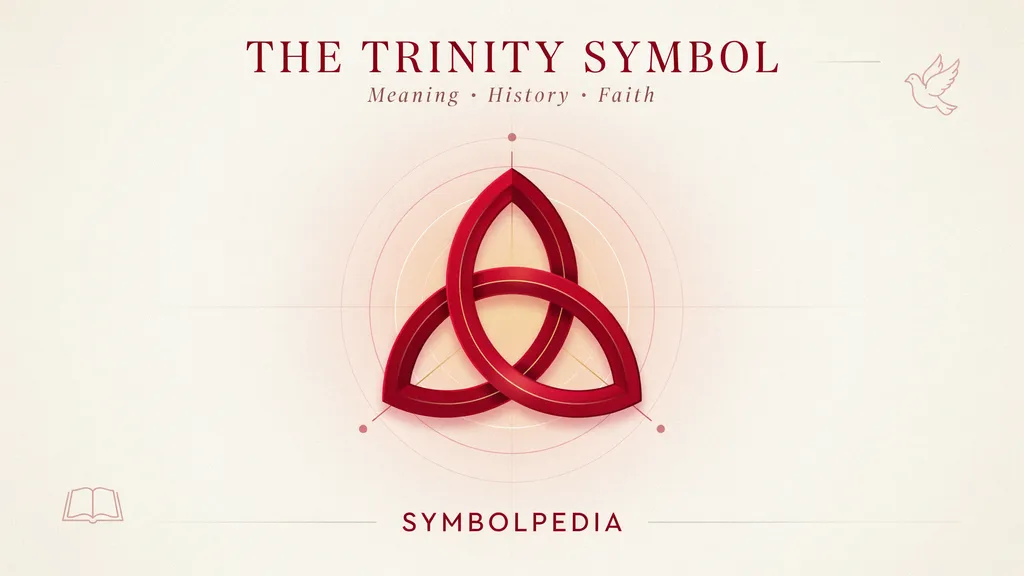
A common Christian trinity symbol is the triquetra, also called the Trinity Knot. It consists of three interwoven loops.
Another familiar representation is the Shield of the Trinity, a diagram connecting the Father, Son, and Holy Spirit while emphasizing that they are one God.
You might see the idea expressed casually as:
“The three parts represent one divine reality.”
Or:
“It symbolizes unity within three.”
Or simply:
“Father, Son, and Holy Spirit.”
Importantly, not every three-part symbol is a Christian Trinity symbol. Similar-looking designs can have completely different historical or cultural meanings.
Origin & Background of the Trinity Symbol
The theological idea of the Trinity developed within early Christianity as Christians tried to explain their belief in God while also affirming the divinity of Jesus and the Holy Spirit.
The word Trinity itself comes from the Latin trinitas, meaning “threefold” or “three.” The concept became increasingly defined through early Christian theological debates and church councils.
The Council of Nicaea in 325 CE was especially important in establishing orthodox Christian teaching about the relationship between God the Father and the Son. Later theological developments helped articulate the relationship of the Holy Spirit as well.
The important point is that the doctrine and the visual symbol are not the same thing. Christianity’s belief in the Trinity predates many of the artistic symbols later used to represent it.
The Triquetra and Christianity
The triquetra, or Trinity Knot, became strongly associated with Christian ideas of three-in-one unity, particularly in medieval European Christian art and manuscript traditions.
Its three interlocking sections naturally lend themselves to the idea of interconnectedness.
However, its history is more complicated than simply saying “the triquetra was invented as a Christian symbol.” Similar three-lobed motifs existed in earlier Celtic and other artistic traditions.
That is why it is better to say that Christianity adopted and gave theological significance to certain three-part designs, rather than assuming every ancient three-loop symbol originally meant the Christian Trinity.
Cultural Influence
Over centuries, trinity imagery appeared in:
- Churches and stained glass
- Medieval manuscripts
- Religious paintings
- Crosses and devotional objects
- Jewelry
- Gravestones
- Tattoos
- Modern graphic design
Today, the symbol can be deeply religious for one person and primarily symbolic or aesthetic for another.
Social media has broadened that range even further. A person might use a Trinity Knot because of Christian faith, Irish heritage, family tradition, spirituality, or simply appreciation for its interwoven design.
Real-Life Conversations
1. WhatsApp Conversation
Person A:
“I’m thinking about getting the Trinity Knot tattooed.”
Person B:
“Does it have a religious meaning for you?”
Person A:
“Kind of. I like the idea of three things being connected. For me it represents faith, family, and strength.”
Person B:
“That makes sense. Just remember some people will recognize it as a Christian Trinity symbol.”
Here, the symbol has a personal interpretation, while still carrying its established religious association.
2. Instagram DM
Person A:
“What does that three-loop symbol in your necklace mean?”
Person B:
“It’s a Trinity symbol. I wear it because of my Christian faith.”
Person A:
“So the three loops mean three gods?”
Person B:
“No. That’s the part people often misunderstand. Christianity teaches one God in three persons: Father, Son, and Holy Spirit.”
The conversation shows why context matters. The symbol is not intended to represent three separate gods in traditional Christian theology.
3. TikTok Comments
Commenter:
“Is this the Celtic symbol for three?”
Creator:
“It’s a Trinity Knot, often associated with the Christian Trinity.”
Another commenter:
“I’ve also seen it used for family and eternal connection.”
Creator:
“Exactly. Modern people sometimes give it personal meanings beyond its traditional religious association.”
This reflects how symbols can accumulate additional meanings as they move between cultures and generations.
4. Text Message
Person A:
“Why did you choose the Trinity symbol for your wedding invitation?”
Person B:
“We wanted something representing unity.”
Person A:
“Is it specifically religious?”
Person B:
“Yes, for us. It represents our faith and the idea of being connected through God.”
The same symbol can therefore communicate something deeply personal without needing a long explanation.
Emotional & Psychological Meaning
Symbols work partly because they allow people to communicate complicated ideas without writing an entire explanation.
The Trinity symbol can evoke feelings of unity, belonging, faith, connection, continuity, and spiritual identity.
For a Christian, seeing the symbol may immediately bring to mind prayer, God, Jesus, the Holy Spirit, church, or family traditions.
For someone using a Trinity Knot more generally, the three connected elements may represent relationships or personal values.
Psychologically, interconnected imagery can feel reassuring because it visually communicates that separate parts can still belong to one larger whole.
Imagine someone wearing a small Trinity pendant inherited from a grandparent. The object may represent much more than theology. It can carry memories of childhood, family gatherings, religious traditions, and someone they loved.
That emotional layer is one reason symbols remain powerful even when their original history is centuries old.
Usage in Different Contexts
Social Media
On Instagram, TikTok, Pinterest, and other platforms, Trinity symbols can appear in:
- Faith-based profiles
- Christian artwork
- Tattoo posts
- Jewelry designs
- Spiritual discussions
- Celtic-inspired aesthetics
- Memorial posts
The intended meaning isn’t always obvious from the image alone.
Friends & Relationships
People sometimes use three-part symbolism to represent:
- Family
- Friendship
- Love
- Past, present, and future
- Mind, body, and spirit
These interpretations may be personal rather than traditionally Christian.
Work & Professional Settings
The Trinity symbol is not generally a standard workplace symbol.
If it appears in a company logo, presentation, or design, don’t automatically assume it represents Christianity. Businesses may use three-part shapes to communicate balance, cooperation, or interconnected systems.
Casual vs. Serious Tone
In a serious religious conversation, “Trinity” normally refers specifically to Christian theology.
In casual conversations, someone might use “trinity” metaphorically to describe three closely connected things, such as “the trinity of good food, music, and friends.”
Those are very different uses.
When NOT to Use the Trinity Symbol
The Trinity symbol isn’t inherently inappropriate, but context matters.
Avoid Misrepresenting Its Meaning
Don’t claim that every triquetra automatically means the Holy Trinity. Historical symbols can have multiple interpretations.
Be Sensitive Around Religion
For many Christians, the Trinity isn’t merely decorative. It represents a central belief about God.
Using it mockingly or deliberately distorting its religious meaning can understandably offend people.
Don’t Assume Everyone Shares Your Interpretation
If you’re using the symbol for a tattoo, business design, or gift, consider explaining your intended meaning when necessary.
Be Careful With Historical Claims
The internet sometimes presents simplified statements such as “this symbol has always meant X.” Symbolic history is rarely that straightforward.
Common Misunderstandings
“The Trinity Means Three Gods”
This is one of the biggest misunderstandings.
Traditional Christian theology does not teach three separate gods. The Trinity describes one God in three persons: Father, Son, and Holy Spirit.
“Every Triquetra Is Christian”
Not necessarily.
The triquetra has been used in different cultural and artistic contexts. Its meaning depends on where, when, and how it is being used.
“The Three Loops Have Only One Meaning”
They don’t.
A person may interpret three connected loops as faith, family, eternity, balance, or another personal idea.
“Trinity and Triquetra Are Exactly the Same Thing”
Not quite.
Trinity is a theological concept. Triquetra is a type of visual motif. The triquetra can be used to represent the Trinity, but the terms aren’t interchangeable in every context.
“It Is Just Decoration”
Sometimes it is. Sometimes it carries profound religious or personal significance.
The safest approach is to consider context rather than guessing.
Trinity Symbol vs. Similar Symbols
| Symbol or Expression | Main Meaning | How It Differs |
|---|---|---|
| Triquetra / Trinity Knot | Three interconnected elements | Often associated with Christian Trinity |
| Shield of the Trinity | Father, Son, Holy Spirit | Explicit Christian theological diagram |
| Celtic-inspired knotwork | Interconnection and continuity | Broader cultural/artistic category |
| Triple spiral | Can have prehistoric or modern symbolic meanings | Not automatically Christian |
| Triquetra tattoo | Depends on the wearer | May combine religious and personal meanings |
| “Holy Trinity” | Father, Son, Holy Spirit | The theological concept itself |
| “Mind, body, spirit” | Holistic three-part model | Spiritual but not specifically Christian |
| “Three-in-one” | Unity of three components | General metaphor rather than a fixed doctrine |
Key Insight
The most important distinction is between the symbol, the religious doctrine, and the personal interpretation. They can overlap, but they aren’t always identical.
How to Respond When Someone Uses the Trinity Symbol
If someone sends or wears the symbol and you’re unsure what they mean, a simple question is usually best.
Casual Replies
- “What does the symbol mean to you?”
- “Is that the Trinity Knot?”
- “I like the design—does it have a special meaning?”
Funny Replies
- “Okay, now I need the backstory 😂”
- “Three loops and one mystery—explain!”
- “I recognize the symbol, but I want your version of the meaning.”
Mature Replies
- “I know it can have religious significance. What does it represent for you?”
- “I don’t want to assume its meaning, so tell me what it symbolizes in your case.”
Respectful Replies
- “Is it connected to your faith?”
- “That’s meaningful. Would you mind explaining its significance?”
- “I appreciate the symbolism. What does it represent personally?”
Asking rather than assuming is especially useful when symbols have multiple cultural interpretations.
Regional & Cultural Usage
Western Culture
In many Western Christian communities, the Trinity symbol is most readily connected with Father, Son, and Holy Spirit.
At the same time, Celtic-inspired versions have become popular in jewelry, tattoos, weddings, and decorative art.
Asian Culture
The Christian Trinity may be less immediately familiar in communities where Christianity is not the dominant religious tradition.
A three-part symbol might therefore be interpreted through broader ideas of balance, spirituality, or design unless the religious context is clear.
However, Christian communities throughout Asia use traditional Trinity symbolism as part of their worship and religious identity.
Middle Eastern Culture
The Trinity has particular importance in historic Christian communities of the Middle East, where Christianity has ancient roots.
Because religious identity can be culturally significant, it’s especially important not to reduce the symbol to a generic “three things becoming one” explanation when discussing its traditional Christian meaning.
Global Internet Usage
Online, meanings often blend.
A Trinity Knot may appear in a Christian post, a Celtic-inspired tattoo, a wedding design, or a personal spirituality account.
The image alone doesn’t always tell you which interpretation the person intends.
Gen Z vs. Millennials
Younger internet users may encounter the symbol through tattoos, fashion, Pinterest-style graphics, gaming communities, or short-form videos before learning its religious history.
Millennials may be more likely to have encountered the symbol through jewelry, Christian culture, Celtic aesthetics, or popular media.
Neither group has one universal interpretation. Context matters more than age.
Is the Trinity Symbol Safe for Kids?
Yes. The Trinity symbol itself is generally harmless for children.
The important issue is understanding its context. If a child asks about it, explain that it is commonly connected with Christian beliefs about the Father, Son, and Holy Spirit.
If the symbol appears in a tattoo, game, video, or social-media post, you can also explain that symbols sometimes have different meanings depending on who is using them.
It’s a good opportunity to teach children not to judge a symbol solely by its appearance.
FAQs About the Trinity Symbol
1. What does the Trinity symbol mean?
The Trinity symbol commonly represents the Christian belief in one God existing as three persons: the Father, the Son, and the Holy Spirit.
2. What is the Trinity Knot?
The Trinity Knot, or triquetra, is a three-loop design frequently associated with the Christian Trinity and also used in broader Celtic-inspired artwork.
3. Does the Trinity symbol represent three gods?
No. In traditional Christian theology, the Trinity means one God in three persons, not three separate gods.
4. Is the Trinity Knot always a Christian symbol?
No. Although it is strongly associated with Christian Trinity symbolism, similar designs have appeared in different cultural and artistic contexts.
5. What does a Trinity tattoo mean?
A Trinity tattoo can represent Christian faith, unity, family, spirituality, eternity, or another personal meaning chosen by the wearer.
6. Is the Trinity symbol Celtic?
The triquetra is strongly associated with Celtic-inspired art today, but its history and use are more complex than simply labeling it an exclusively Celtic or exclusively Christian symbol.
7. What do the three parts of the Trinity represent?
In Christian theology, they represent the Father, the Son, and the Holy Spirit, understood as three persons of the one God.
Conclusion
So, what does the Trinity symbol mean? In its most recognized Christian sense, it represents the Holy Trinity: the Father, the Son, and the Holy Spirit—three persons united as one God.
But the visual symbol can carry additional layers depending on its form and context. A Trinity Knot may express faith for one person, family connection for another, and simply an appreciation for interwoven Celtic-style design for someone else.
That’s what makes symbols fascinating. A few curves or connected lines can carry centuries of history while still becoming part of someone’s very personal story.
If you see a Trinity symbol and aren’t sure what someone intends by it, don’t rely on appearance alone. Look at the context, ask respectfully, and let the person explain what the symbol means to them.
descover more post
What Does the Lock Symbol Mean on Snapchat Everything …
Ohm Symbol and Meaning Understanding Ω Its History and …
What Does the Clover Symbol Mean Luck Love Culture More …

Orvian is a passionate researcher and dedicated content creator focused on exploring the deeper meanings behind symbols, signs, and cultural interpretations. With a strong interest in symbolism and human psychology, Orvian simplifies complex ideas into clear, engaging, and easy-to-understand content for readers around the world.
Through consistent research and thoughtful writing, Orvian aims to provide accurate, insightful, and meaningful information that helps users connect with symbols on a deeper level—whether for personal growth, curiosity, or knowledge.
Known for a hardworking mindset and attention to detail, Orvian believes that every symbol carries a story, and every story deserves to be understood.