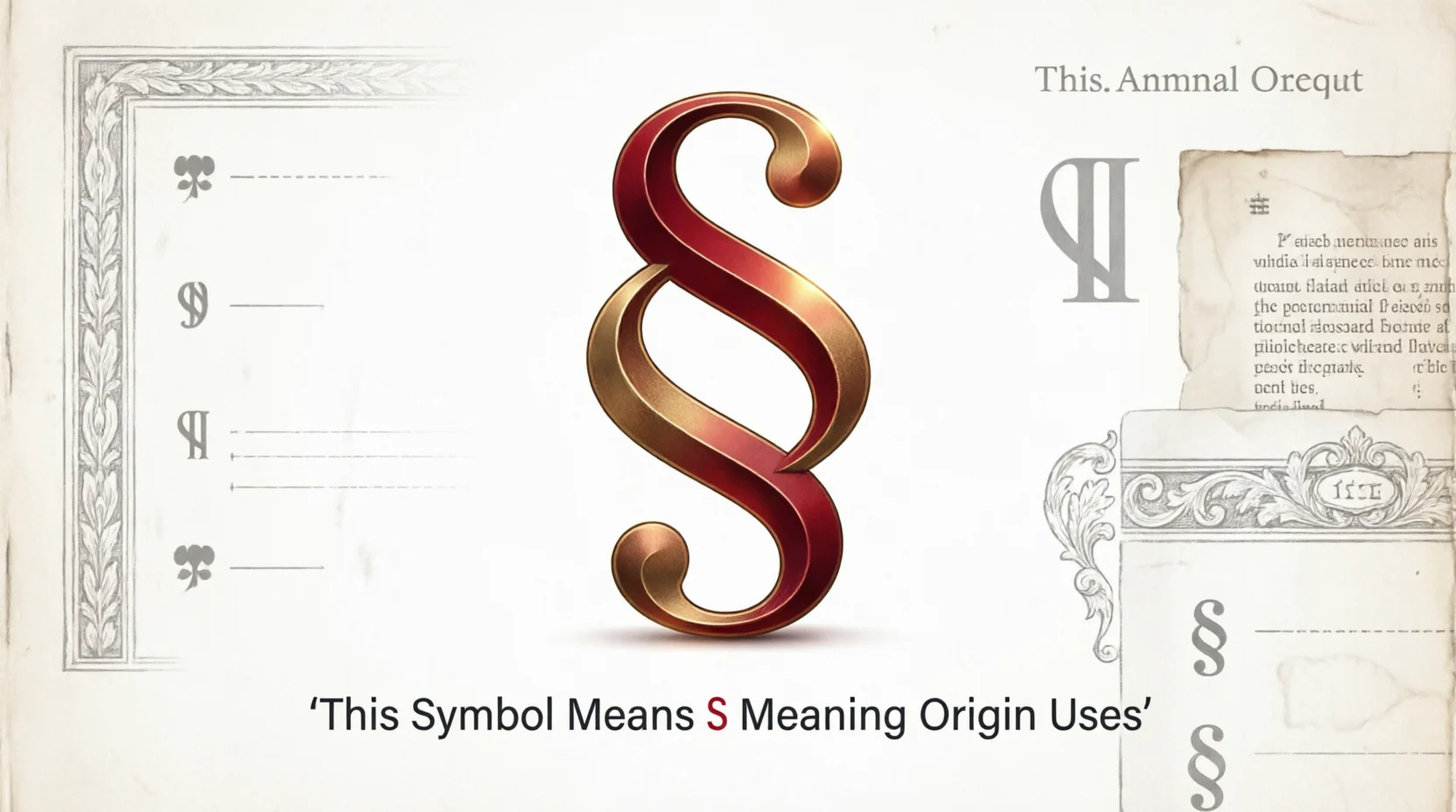
If you have ever seen the symbol § in a book, legal document, website, or academic paper and wondered what it means, you are not alone. It looks a little like a fancy letter S, but it has a specific purpose.
The § symbol is called the section sign. It is mainly used to identify a particular section of a document, especially in laws, regulations, contracts, academic writing, and other organized texts.
For example, you might see something like § 12. This means “Section 12.” When more than one section is being referenced, the plural form §§ is often used.
Understanding this symbol can make unfamiliar documents much easier to read. It also helps explain why you may see it beside numbers rather than used as ordinary punctuation.
§ Symbol – Quick Meaning
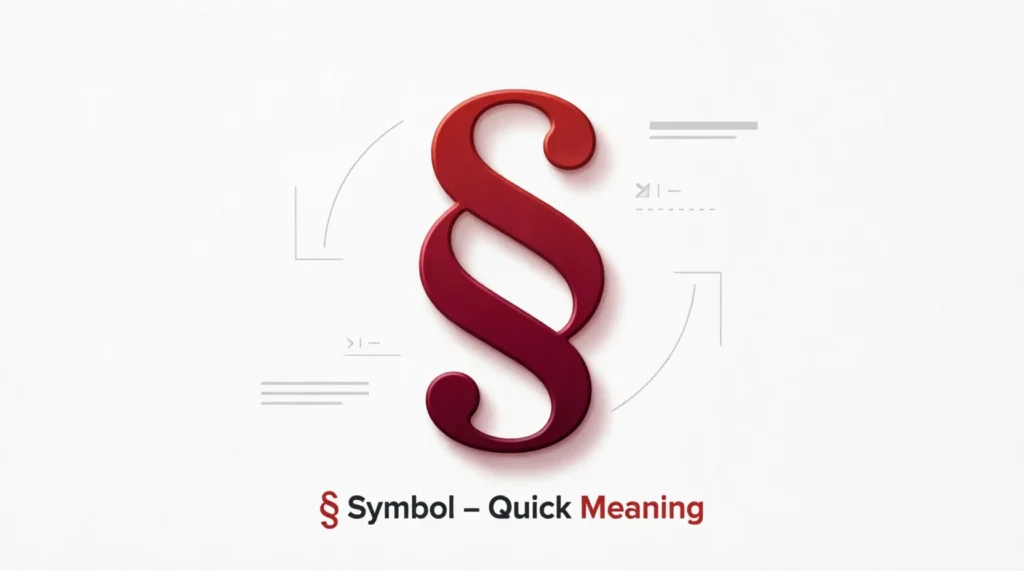
The § symbol means “section.” It is used to point readers toward a specific numbered section of a larger written document.
Here is the basic idea:
- § = section
- § 5 = Section 5
- § 10 = Section 10
- §§ 5–7 = Sections 5 through 7
- § 3(a) = Section 3, subsection (a)
You might encounter it in a legal reference such as:
“See § 15 for further details.”
This simply means:
“See Section 15 for further details.”
Another example might be:
“The rule is explained in § 4.”
Again, the symbol is replacing the written word section.
The symbol itself does not usually carry an emotional or hidden meaning. Its meaning depends heavily on context, and in formal writing it is primarily a practical reference mark.
Origin & Background of the § Symbol
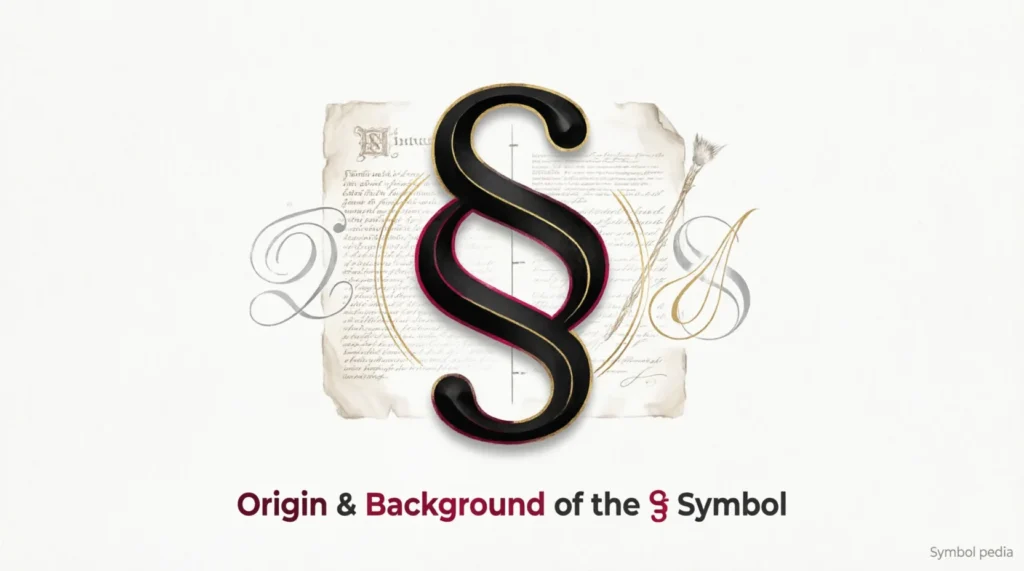
The exact historical development of the section sign is complicated, but its use is closely connected with the long tradition of organizing written texts into identifiable sections.
Before modern word processors and digital documents, writers needed efficient ways to guide readers through lengthy manuscripts. A distinctive mark could draw attention to a particular passage without requiring the word “section” to be written repeatedly.
The modern § became especially associated with legal and scholarly writing. Lawyers, judges, academics, publishers, and government institutions use section numbers to make references precise.
The shape is sometimes described as resembling two connected forms of the letter S. Its appearance has also led to the informal description “section symbol,” although section sign is the standard name.
Over time, the mark became particularly recognizable in legal citations. A complicated law may contain hundreds or thousands of numbered provisions, so a compact symbol is useful when repeatedly referring to them.
Today, the symbol also appears in digital documents, online legal databases, academic resources, and websites.
Social media has made people more likely to encounter unusual symbols outside their traditional environments. Someone may copy a legal quotation, textbook passage, or historical reference into a post and include §, prompting readers to search for its meaning.
That is why searches for “what does this symbol mean §” often come from people who have seen it without knowing its formal name.
Real-Life Conversations
1. WhatsApp Conversation
Person A:
“I’m reading this document and it keeps saying § 8. What does that mean?”
Person B:
“It means Section 8. The symbol is used instead of writing the whole word.”
Person A:
“Oh, that makes sense. I thought it was some kind of special legal code.”
Person B:
“It can look intimidating, but it’s basically a shortcut for ‘section.’”
2. Instagram DM
Person A:
“What is this § symbol in the caption?”
Person B:
“It’s called the section sign.”
Person A:
“So § 12 means section 12?”
Person B:
“Exactly.”
Person A:
“Okay, I was definitely overthinking it 😂”
3. TikTok Comments
Person A:
“Can someone explain what § 3 means?”
Person B:
“It means Section 3. You’ll see it a lot in laws and official documents.”
Person A:
“So it isn’t a new texting symbol?”
Person B:
“Nope. It’s much older than TikTok.”
4. Text Message
Person A:
“My professor wrote ‘see § 6’ on my paper.”
Person B:
“That means ‘see Section 6.’”
Person A:
“Thank goodness. I thought I had missed some abbreviation.”
Person B:
“No, just a formal reference symbol.”
Emotional & Psychological Meaning of the § Symbol
Unlike emojis or internet slang, § does not normally express an emotion.
It does not automatically mean happiness, anger, sarcasm, affection, secrecy, or excitement. Its purpose is functional: it helps readers locate a specific part of a document.
Still, symbols can influence how people feel about a message.
When someone sees § in a legal or official document, it may create an impression of formality, authority, or seriousness. That reaction comes from the context surrounding the symbol rather than from the symbol itself.
For example, seeing:
“§ 24(b)”
may feel more formal than:
“Section 24(b)”
because the first version resembles professional legal writing.
I have seen this kind of confusion often when people encounter formal symbols outside school or professional settings. The unfamiliar appearance can make a simple reference seem much more complicated than it really is.
The useful lesson is simple: do not assign an emotional meaning to § unless the surrounding context clearly gives it one.
Usage in Different Contexts
Social Media
On social media, the section sign is usually seen when users share information from laws, regulations, books, historical documents, or academic sources.
For example:
“According to § 10, the rule applies to…”
It may also appear when someone copies text directly from a formal source.
It is not a common replacement for words such as “okay,” “love,” “laugh,” or “wow.”
Friends & Relationships
In everyday conversations between friends, § is uncommon.
If someone sends “§ 7” without context, you would probably need to ask what they are referring to. The symbol alone does not communicate a standard relationship-related message.
Work & Professional Settings
This is where the symbol becomes much more useful.
You may see it in:
- Contracts
- Policies
- Legal correspondence
- Government regulations
- Terms and conditions
- Academic publications
- Technical documents
- Formal reports
A writer can use § 20 instead of repeatedly writing “Section 20,” making references shorter and easier to scan.
Casual vs. Serious Tone
The symbol generally has a formal tone because of its association with law and structured documents.
Writing “Please review § 5” feels more formal than “Please check Section 5.”
Neither is necessarily better. The appropriate choice depends on your audience and the style of the document.
When NOT to Use It
Although the § symbol is useful, it is not appropriate everywhere.
Avoid using it when your audience may not recognize it and there is no benefit from the abbreviation. In a simple message, writing “Section 5” may be clearer.
For example, instead of texting:
“Read § 5.”
you could write:
“Read Section 5.”
The second version is usually more natural in an ordinary conversation.
You should also avoid assuming that every reader understands specialized symbols. Legal and academic professionals may recognize § immediately, while a general audience may not.
Cultural context can matter too. Symbols and punctuation conventions vary across languages and publishing traditions, so a formal mark familiar in one environment may look unusual somewhere else.
Common Misunderstandings About §
1. Thinking It Is an Emoji
The section sign is not an emoji.
Although modern phones and computers can display it as a character, it is a typographic symbol with a specific function.
2. Thinking It Means “Paragraph”
A section and a paragraph are not necessarily the same thing.
A section can contain several paragraphs, subsections, lists, or other material. § identifies a section, not simply any paragraph of text.
3. Thinking It Is a Dollar Sign
The shape can cause confusion at first glance, but § and $ are completely different symbols.
The dollar sign is associated with currency, while the section sign identifies sections in documents.
4. Assuming It Has a Secret Internet Meaning
There is no universal hidden slang definition for §.
If you see it online, look at the surrounding words. In most formal contexts, it means section.
5. Confusing § With §§
One section is commonly represented by §.
When referring to multiple sections, you may see §§.
For example:
“See §§ 8–10.”
means:
“See Sections 8 through 10.”
Comparison Table
| Symbol or expression | Meaning | Common use |
|---|---|---|
| § | Section | Legal, academic, formal documents |
| §§ | Sections | Multiple section references |
| ¶ | Paragraph / pilcrow | Editing and document structure |
| # | Number / hashtag | Numbers, social media, tagging |
| $ | Dollar / currency | Money and prices |
| Art. | Article | Laws, constitutions, formal documents |
| Sec. | Section | Formal and informal references |
| Subsec. | Subsection | Legal and technical writing |
| Cl. | Clause | Contracts and legal documents |
| Para. | Paragraph | Academic and formal references |
Key Insight
The most important distinction is that § is a document-navigation symbol, not ordinary internet slang. When you see it beside a number, think “Section” first.
How to Respond When Someone Uses §
Because § is normally a reference symbol, your response depends on why the person used it.
Casual Replies
- “Do you mean Section 5?”
- “That’s the section symbol, right?”
- “Which section are you referring to?”
Funny Replies
- “Okay, lawyer mode activated 😂”
- “I see the fancy S, but which section?”
- “You had me wondering what that symbol meant for a second.”
Mature Replies
- “Yes, § refers to a specific section of the document.”
- “I understand. Please point me to the relevant section.”
- “Could you clarify which provision you mean?”
Respectful Replies
- “Thank you. I’ll review Section 8.”
- “Could you explain which section you are referencing?”
- “Understood. I’ll check the cited provision.”
The best response is usually straightforward. Since § does not have a standard emotional meaning, there is no special slang response required.
Regional & Cultural Usage
Western Culture
In countries where English-language legal and academic traditions are common, the section sign is strongly associated with formal documents.
Readers in legal, academic, government, and publishing environments may recognize it immediately.
Asian Culture
Usage varies significantly across Asian countries and languages.
People working with international law, English-language research, or multinational companies may encounter § regularly, while people outside those fields may be less familiar with it.
This is one reason spelling out “Section” can sometimes be more accessible for a broad audience.
Middle Eastern Culture
The same basic principle applies. People working with international contracts, regulations, academic publications, or English-language legal materials may encounter the symbol.
Its meaning does not fundamentally change simply because the document is being read in a different region.
Global Internet Usage
The internet has brought specialized symbols into everyday view.
Someone can encounter § while reading a legal article, government website, Wikipedia-style reference, academic paper, or reposted document without having any professional connection to law.
That wider exposure explains why the symbol can suddenly appear in casual online conversations.
Gen Z vs. Millennials
Neither Gen Z nor Millennials has a universally accepted slang meaning for §.
Younger users may be more likely to encounter it online and ask about it, but that does not turn it into a standard Gen Z abbreviation.
The symbol’s meaning remains primarily tied to sections and formal references.
Is the § Symbol Safe for Kids?
Yes. § is generally harmless and has no inherently adult or offensive meaning.
Children may encounter it in textbooks, websites, school materials, rules, or other documents.
The important part is teaching context. A child who sees § 4 should understand that it normally means Section 4, rather than assuming it is secret slang or inappropriate language.
FAQs
What does the § symbol mean?
The § symbol means “section.” It is mainly used to identify a particular section of a legal, academic, technical, or formal document.
What is the § symbol called?
It is called the section sign. It is also commonly described informally as the section symbol.
What does § 5 mean?
§ 5 means “Section 5.” The symbol is simply a compact way of writing the word “Section.”
What does §§ mean?
§§ means “sections” and is commonly used when referring to more than one section.
Is § an emoji?
No. § is a typographic symbol, not an emoji. It has a specific function in formal writing and document references.
Does § have a slang meaning in texting?
There is no widely recognized standard texting slang meaning for §. Its usual meaning is “section,” especially when followed by a number.
Where is the § symbol commonly used?
It is commonly found in laws, regulations, contracts, academic writing, policies, government documents, and other structured texts.
Conclusion
The § symbol is much simpler than it first appears. It is called the section sign, and its primary job is to help readers identify a particular section of a document.
When you see § 7, read it as “Section 7.” When you see §§ 7–9, read it as “Sections 7 through 9.”
Its formal appearance can make it seem mysterious, especially when it suddenly appears in a social media post or text copied from a legal document. But once you recognize it, there is very little mystery left.
The next time you come across that unusual double-curved S, you can confidently read it as a signpost: look for the section number that follows.
descover more post
What Does the Lock Symbol Mean on Snapchat Everything …
Ohm Symbol and Meaning Understanding Ω Its History and …
What Does the Clover Symbol Mean Luck Love Culture More …