
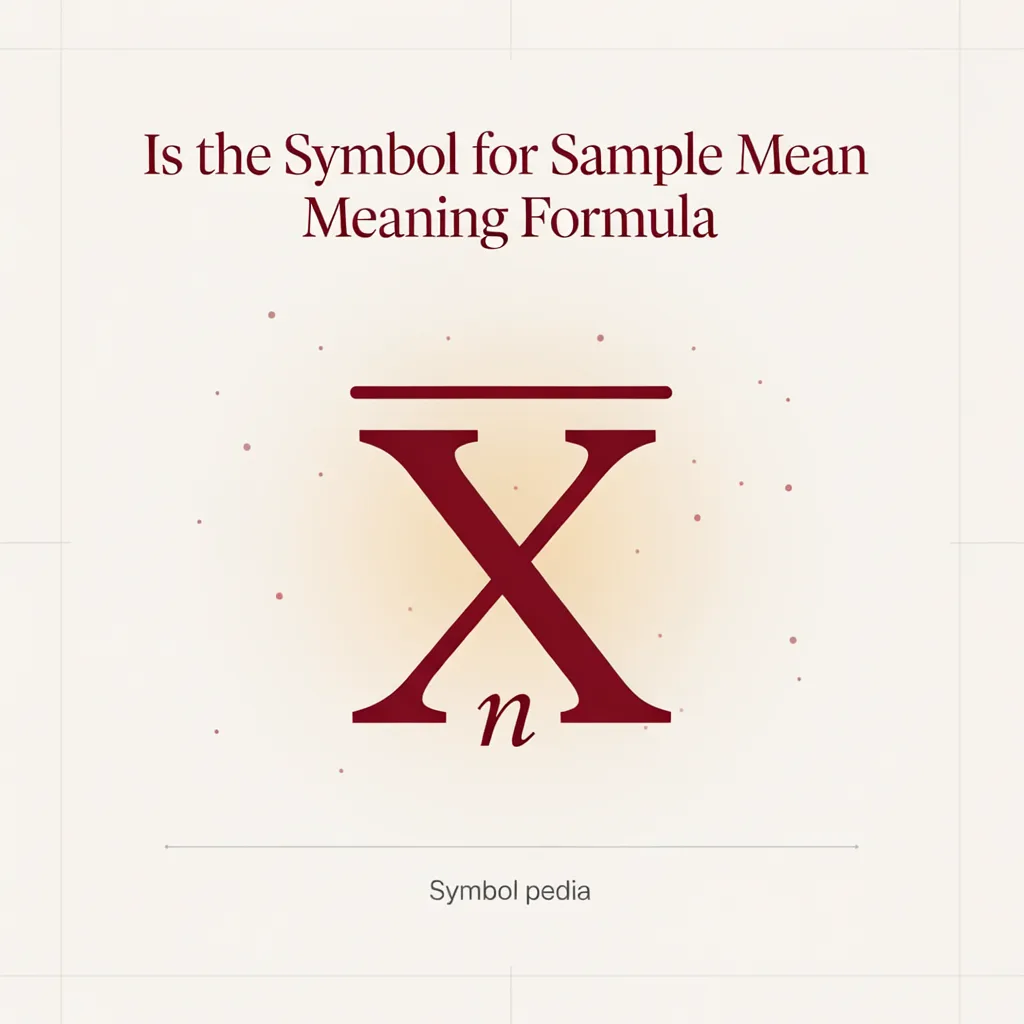
If you have ever opened a statistics textbook and wondered, “What is the symbol for sample mean?” you are not alone. The notation can look unfamiliar at first, especially when you see a small line above a lowercase x.
The symbol for the sample mean is x̄, pronounced “x-bar.” It represents the average value calculated from a sample of observations.
For example, if five students receive scores of 70, 75, 80, 85, and 90, the sample mean is:
x̄ = (70 + 75 + 80 + 85 + 90) ÷ 5 = 80
The idea is simple: add all the sample values together and divide by the number of values.
What makes the notation important is that statistics often distinguishes between a sample and an entire population. Once you understand that difference, symbols such as x̄ and μ become much easier to recognize.
What Is the Symbol for Sample Mean? – Quick Meaning
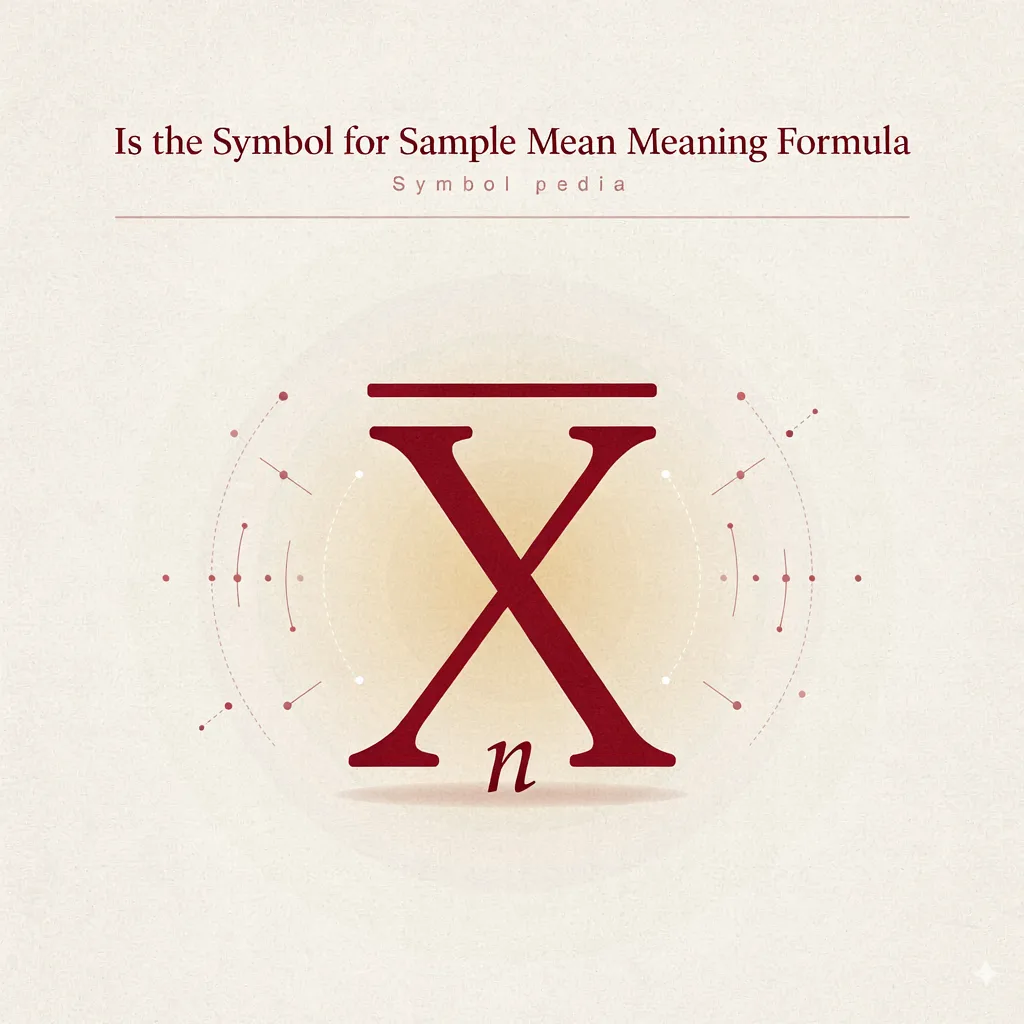
The standard symbol for the sample mean is:
x̄
It is read as “x-bar.”
Here is what it means:
- x represents an individual observation or value.
- The bar over x indicates that the values have been averaged.
- x̄ represents the mean of a sample.
- The sample mean is commonly used to estimate the population mean.
The basic formula is:
x̄ = Σx / n
Where:
- x̄ = sample mean
- Σx = sum of all sample observations
- n = number of observations in the sample
For example:
“The sample mean of the test scores is 82.”
Or:
“Calculate x̄ for the following five observations.”
Another common example is:
“The researcher used x̄ to summarize the average response from the participants.”
The symbol may look small, but it carries an important statistical meaning.
Why Does the Sample Mean Use x̄?
The notation x̄ follows a useful mathematical convention.
The letter x is commonly used to represent a variable or observation. When a horizontal bar is placed over it, the notation indicates that we are talking about the average of those observations.
So you can think of it this way:
x = an individual value
x̄ = the average of several x values
This distinction becomes particularly useful when working with larger datasets.
Suppose your sample contains:
4, 6, 8, 10, 12
Each number is an individual observation, represented generally by x.
Their average is:
x̄ = 8
Instead of repeatedly writing “the average of the five observations,” statisticians can simply write x̄.
That makes equations shorter, clearer, and easier to interpret.
Sample Mean vs. Population Mean
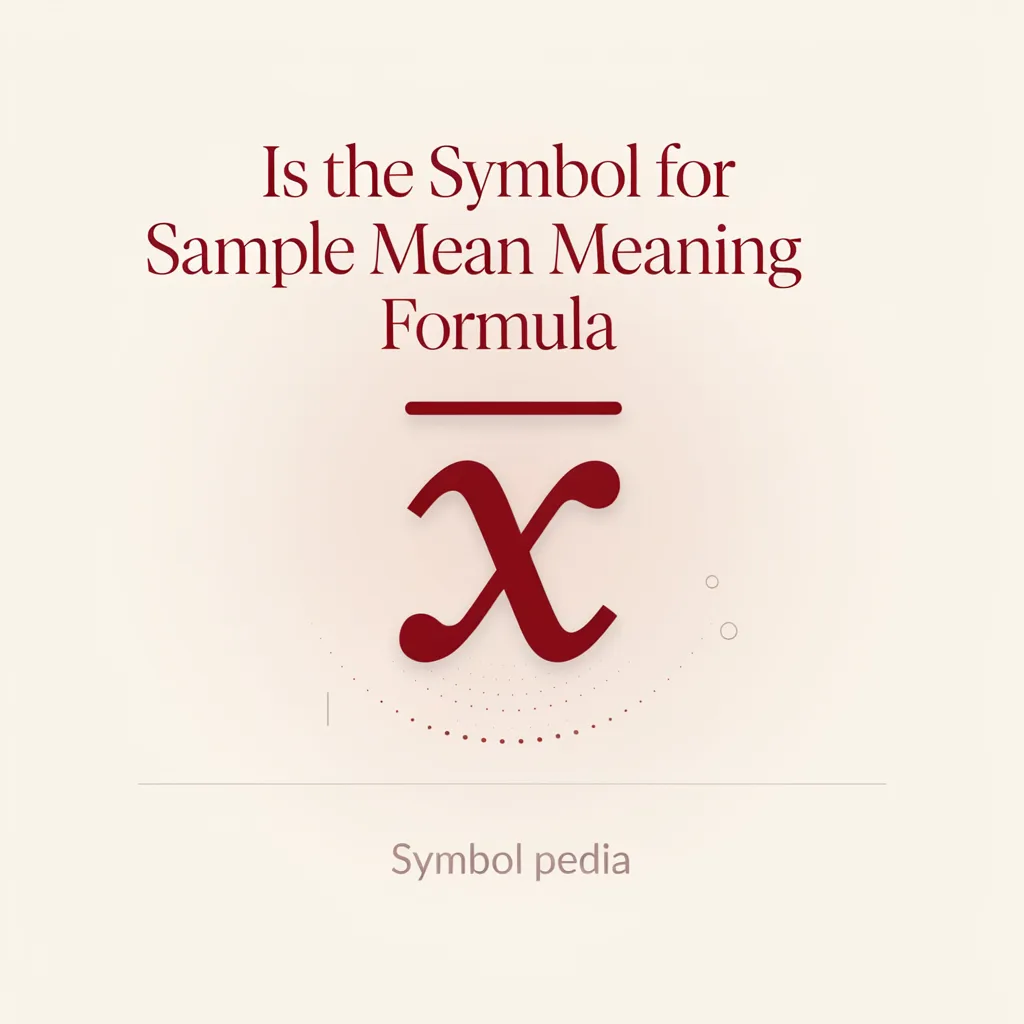
One of the most important things to understand is that x̄ is generally used for a sample mean, while μ (mu) is commonly used for a population mean.
These symbols may seem similar in purpose, but they describe different groups.
| Symbol | Name | Usually Represents |
|---|---|---|
| x̄ | Sample mean | Average of a sample |
| μ | Population mean | Average of an entire population |
| x | Observation | An individual sample value |
| Σ | Sigma | Summation or total |
Imagine a university has 20,000 students.
If you calculate the average age of all 20,000 students, you are dealing with the population mean, represented by μ.
If you randomly select 300 students and calculate their average age, that result is a sample mean, represented by x̄.
This distinction matters because researchers often cannot collect information from every member of a population.
Instead, they study a representative sample and use x̄ to learn something about the larger population.
Origin and Background of the Sample Mean Symbol
The idea of an average is much older than modern statistical notation.
People have used forms of averaging for centuries when comparing prices, measurements, populations, trade quantities, and other numerical information.
Modern statistics gradually developed more formal mathematical notation as probability and statistical theory became established.
The letter x became widely used for variables and observations, while notation involving a bar over a letter became a convenient way of identifying an average.
The exact historical development of statistical notation involved many mathematicians and statisticians rather than one simple moment when someone “invented” x-bar.
Today, x̄ is widely recognized in statistics education, research, mathematics, economics, psychology, business, engineering, and the social sciences.
Cultural Influence
Statistical notation has also become part of everyday academic culture.
Students may encounter x̄ in school mathematics, university statistics courses, scientific papers, research reports, and data-analysis discussions.
Although the symbol itself is not a social-media abbreviation, people sometimes search for it online because they have seen it in a screenshot, homework problem, calculator result, or educational video and want a straightforward explanation.
Social Media and Online Learning
Platforms such as TikTok, Instagram, YouTube, and educational websites have made mathematical notation more visible outside traditional classrooms.
A student may see:
x̄ = Σx/n
in a short statistics lesson and immediately wonder what the bar over the x means.
The answer is straightforward: it identifies the sample average.
The way people encounter the symbol may have changed, but its mathematical meaning has remained consistent.
Real-Life Conversations About x̄
Understanding the symbol becomes easier when you see how people naturally talk about it.
WhatsApp Conversation
Person A:
I keep seeing x-bar in my statistics notes. What does it actually mean?
Person B:
It means sample mean—the average of the values in your sample.
Person A:
So if my numbers are 10, 20, and 30, x-bar is 20?
Person B:
Exactly. Add them and divide by three.
Instagram DM
Person A:
Can you explain the difference between x-bar and mu?
Person B:
Sure. x-bar is usually the sample mean, while μ is the population mean.
Person A:
Oh, so the group you’re studying determines which one you use?
Person B:
Right. That’s the key idea.
TikTok Comments
Person A:
Why does the teacher keep saying “x-bar”?
Person B:
Because the little line over x means average.
Person A:
That makes way more sense than the textbook explanation 😂
Text Message
Person A:
I calculated the average as 76. Is that x-bar?
Person B:
Yes, if those numbers came from your sample.
Person A:
Finally, statistics is starting to make sense.
Person B:
One symbol at a time!
These conversations reflect a common experience: the mathematics is often easier than the notation initially makes it seem.
Emotional and Psychological Meaning of x̄
Unlike internet slang, x̄ does not express an emotion or personality trait. It is a mathematical symbol.
However, there can still be a psychological reason people struggle with it.
Symbols compress information.
For someone new to statistics, x̄ may look intimidating because a single character represents an entire idea: the average of a collection of sample observations.
Once the meaning becomes familiar, the symbol often feels much less complicated.
There is also an interesting learning pattern here. Many students initially believe they are “bad at statistics” when the real problem is simply unfamiliar notation.
For example, a student might understand how to calculate an average perfectly well but become confused when the teacher replaces the word “average” with x̄.
That is not necessarily a mathematical problem. It is a language problem.
Learning statistics is partly about learning the vocabulary and symbols of a new mathematical language.
Usage of x̄ in Different Contexts
Social Media and Online Education
When x̄ appears in educational posts, it usually means the sample mean.
A teacher might write:
“Find x̄ for the dataset.”
Students are expected to calculate the average of the given sample values.
On social media, the notation may appear in short tutorials, exam-preparation videos, or statistics explanations.
Friends and Relationships
In ordinary conversations between friends, x̄ is not normally used unless they are discussing statistics, research, schoolwork, or data.
A student might casually say:
“Our x-bar was 84 on the survey results.”
Here, the term has a technical meaning rather than an emotional or conversational one.
Work and Professional Settings
The sample mean is common in professional research.
Businesses may calculate the average customer rating from a sample of customers.
Researchers may calculate the average response time from selected transactions.
Quality-control teams may calculate average measurements from a sample of manufactured products.
In these situations, x̄ can appear in formulas, reports, charts, or statistical analyses.
Casual vs. Serious Tone
The notation itself is neutral.
It is not formal or informal in the way slang can be. However, explaining it to a beginner may call for plain language:
“x-bar simply means the average of your sample.”
In a research paper, the same idea may be presented through a formal equation and statistical notation.
When NOT to Use x̄
The symbol x̄ should not automatically be used whenever you mean “average.”
Its most common statistical use is the sample mean.
If you are discussing the mean of an entire population, μ is generally the appropriate notation.
You should also avoid using x̄ when the quantity is not actually a mean.
For example, the median and mode are different measures of central tendency.
Another important point is that notation can vary by textbook, field, or instructor. If your course defines a symbol differently, follow the notation established in that context.
Cultural and Educational Sensitivity
Different countries and educational systems may teach mathematical notation with slightly different conventions.
A student should not assume that every teacher will use identical symbols in every situation.
The safest approach is to check the definitions given in the particular course, textbook, or research context.
Common Misunderstandings About x̄
Misunderstanding 1: x-bar Means One Special Number
Not exactly.
x̄ represents the calculated mean of a particular sample. Its numerical value depends on the observations being analyzed.
Misunderstanding 2: x-bar and μ Are Always the Same
They can have the same numerical value in a particular situation, but conceptually they represent different things.
x̄ refers to a sample mean, while μ generally refers to a population mean.
Misunderstanding 3: The Bar Means “Negative”
No.
The horizontal bar over x does not mean negative x.
It is part of the notation identifying the average.
Misunderstanding 4: x-bar Is the Same as Median
It is not.
The mean is calculated by adding values and dividing by their number.
The median is the middle value after the data are ordered.
Misunderstanding 5: Every Average Is Automatically a Sample Mean
Only when the values represent a sample from a larger population is x̄ the appropriate sample-mean notation.
Context matters.
Comparison Table: x̄ and Related Statistical Terms
| Symbol or Term | Meaning | Example |
|---|---|---|
| x̄ | Sample mean | Average of 50 surveyed customers |
| μ | Population mean | Average of every customer in the population |
| x | Individual observation | One customer’s rating |
| Median | Middle value | Middle score after sorting |
| Mode | Most frequent value | Rating that appears most often |
| Σx | Sum of observations | Total of all sample values |
| n | Sample size | Number of observations |
| Range | Difference between maximum and minimum | 95 − 60 = 35 |
| Standard deviation | Measures spread around the mean | How widely scores vary |
| Average | General everyday term | Usually refers to the arithmetic mean |
Key Insight
The most important distinction is not memorizing symbols individually. It is understanding what group the data describe. Once you know whether you are working with a sample or a population, x̄ and μ become much easier to use correctly.
How to Respond When Someone Uses x̄
If someone mentions x̄ in a conversation, your response depends on the situation.
Casual Reply
“That’s the sample average, right?”
Funny Reply
“The tiny line that makes statistics look scarier than it is?”
Mature Reply
“Yes, x-bar represents the mean calculated from a sample.”
Respectful Reply
“Thanks for clarifying. I understand that x̄ refers to the sample mean.”
If someone asks you what it means, the simplest useful response is:
“x-bar is the sample mean—the average of the values in a sample.”
There is no need to make the explanation complicated.
Regional and Cultural Usage
Mathematical notation is more universal than everyday language, but teaching styles can differ across cultures and education systems.
Western Culture
In the United States, Canada, the United Kingdom, and other Western educational environments, x̄ is commonly introduced in statistics and mathematics courses as the sample mean.
Students often encounter it alongside μ, σ, and other statistical notation.
Asian Culture
Across many Asian education systems, statistical notation is also widely used in mathematics, science, economics, and research.
Students may encounter x̄ in examination preparation, university courses, scientific studies, and data-analysis classes.
The notation itself generally remains the same even when teaching methods differ.
Middle Eastern Culture
In Middle Eastern universities and schools, students studying statistics, engineering, economics, medicine, and social sciences may also encounter x̄.
The mathematical concept is broadly international, although textbooks and classroom terminology may differ.
Global Internet Usage
Online education has made mathematical notation increasingly accessible worldwide.
A student can see x̄ in a video from another country and still recognize the underlying concept because mathematical notation crosses many language barriers.
Gen Z vs. Millennials
The difference here is less about the meaning of x̄ and more about how people learn it.
Younger learners may encounter the symbol through short videos, interactive lessons, online calculators, and social-media education.
Older learners may remember seeing it primarily in textbooks, lectures, printed worksheets, or traditional classroom settings.
The notation itself has not changed simply because the learning environment has changed.
Is x̄ Safe for Kids?
Yes. x̄ is completely safe for children.
It is an ordinary mathematical symbol used to teach averages and statistics.
For younger students, the main challenge is not safety but comprehension. A simple explanation such as “x-bar means the average of your sample numbers” is usually much easier to understand than a complicated statistical definition.
Parents and teachers can introduce the concept using familiar examples such as test scores, sports statistics, temperatures, or the number of books read.
FAQs
What is the symbol for sample mean?
The standard symbol for the sample mean is x̄, pronounced “x-bar.” It represents the arithmetic average of observations in a sample.
What does x-bar mean in statistics?
x̄ means the sample mean. It is calculated by adding all sample observations and dividing their total by the number of observations.
What is the formula for x̄?
The common formula is:
x̄ = Σx/n
Here, Σx is the sum of the observations and n is the number of observations in the sample.
Is x-bar the same as the population mean?
No. x̄ generally represents the sample mean, while μ is commonly used for the population mean.
How do you pronounce x̄?
It is usually pronounced “x-bar.”
Why is there a line above the x?
The bar distinguishes the average from an individual observation represented by x. Therefore, x̄ indicates the mean of the relevant observations.
Is x-bar the same as average?
In the usual statistical context, x̄ is the arithmetic average of a sample. However, “average” is a broader everyday term, so context is important.
Conclusion
So, what is the symbol for sample mean?
The answer is x̄, pronounced “x-bar.”
It represents the arithmetic mean calculated from a sample and is one of the most commonly used symbols in introductory statistics.
The important thing is not simply memorizing the symbol. Understand what it represents: a collection of observations has been combined into one number that summarizes their central value.
Remember the basic relationship:
x̄ = Σx/n
And keep the sample-versus-population distinction in mind:
x̄ → sample mean
μ → population mean
Once that difference clicks, the notation becomes much less intimidating. What initially looks like a mysterious line over a letter is really just a compact way of saying something you already understand: find the average of the sample.
descover more post
What Does the Infinity Symbol Mean in Apple Music Complete …
Aquarius Zodiac Symbol Meaning The Hidden Power Behind …
What Does the Swirl Symbol Mean A Complete Guide to Its …

Orvian is a passionate researcher and dedicated content creator focused on exploring the deeper meanings behind symbols, signs, and cultural interpretations. With a strong interest in symbolism and human psychology, Orvian simplifies complex ideas into clear, engaging, and easy-to-understand content for readers around the world.
Through consistent research and thoughtful writing, Orvian aims to provide accurate, insightful, and meaningful information that helps users connect with symbols on a deeper level—whether for personal growth, curiosity, or knowledge.
Known for a hardworking mindset and attention to detail, Orvian believes that every symbol carries a story, and every story deserves to be understood.