Seeing an orange symbol appear on your car’s dashboard can be unsettling, especially when you are driving and have no idea whether you should keep going or stop immediately.
The good news is that an orange or amber dashboard light does not always mean an emergency. In most vehicles, orange warning lights generally indicate that something needs attention, inspection, or maintenance. However, the exact meaning depends on the symbol, the vehicle manufacturer, and sometimes the way the light behaves.
If you have searched “what does the orange symbol on my dashboard mean,” you are probably looking at a small amber icon and trying to decide whether it is safe to continue driving. That is an important question because dashboard warning systems are designed to communicate problems quickly, often before a driver notices symptoms while driving.
An orange light can represent something as simple as low windshield-washer fluid or a maintenance reminder. It can also indicate issues involving the engine, tire pressure, traction control, emissions system, or another important component.
The key is not to judge the warning by its color alone. You need to identify the actual symbol and understand what your particular vehicle is telling you.
What Does the Orange Symbol on My Dashboard Mean? – Quick Meaning
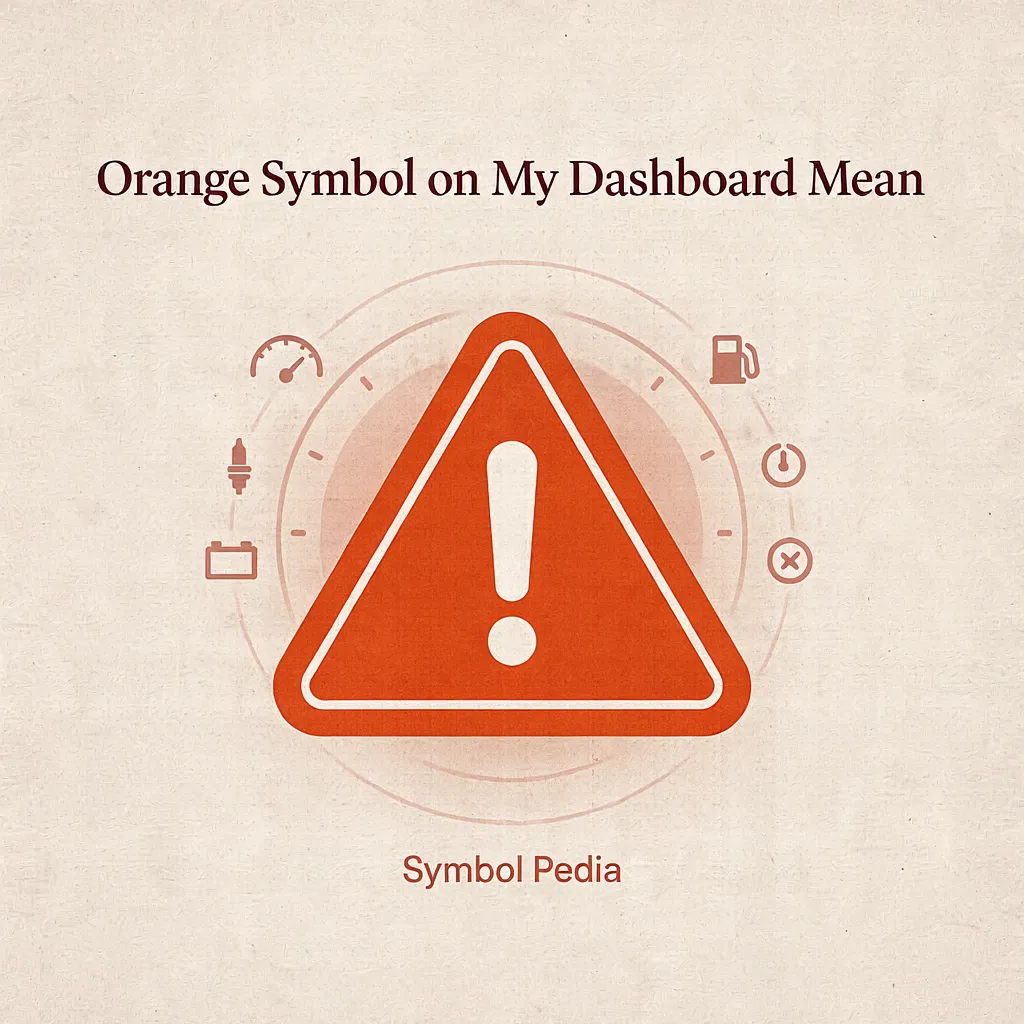
An orange or amber dashboard symbol usually means caution: something needs attention, checking, or servicing.
Unlike a red warning light, an orange light commonly indicates that the situation is less immediately dangerous. That does not mean you should ignore it.
Depending on your vehicle, an orange dashboard light may mean:
- The engine or emissions system has detected a fault.
- Tire pressure is low.
- Traction control or stability control is operating or has been disabled.
- A maintenance service is due.
- A driver-assistance system has detected a problem.
- Fuel or another vehicle fluid may be low.
- A specific vehicle system needs inspection.
For example:
“The orange engine light came on, so I’m going to get the car checked.”
“My tire symbol is orange. I should check the tire pressure.”
“The dashboard light is amber, but the car still drives normally.”
One important distinction is worth remembering: orange usually means caution, while red generally signals a more urgent warning. But colors and symbols vary between manufacturers, so your owner’s manual is always the final authority for your specific vehicle.
Origin & Background of Dashboard Warning Symbols
Dashboard warning lights developed as automobiles became more complex.
Early cars had relatively simple instruments. Drivers mainly needed information such as speed, fuel level, and engine temperature. As vehicles gained electronic controls, anti-lock brakes, airbags, emissions systems, traction control, and advanced driver-assistance features, manufacturers needed a standardized way to communicate problems.
That is where familiar symbols became increasingly important.
Instead of displaying a long sentence such as “Your tire pressure monitoring system has detected low pressure,” a vehicle can display a recognizable tire-shaped icon. The driver can then consult the owner’s manual for the exact explanation.
Colors became part of this visual language too.
Green and blue lights commonly communicate that a feature is active. Orange or amber generally communicates caution or a system requiring attention. Red tends to communicate a more urgent condition.
The symbols themselves have also become part of everyday driving culture. People recognize the basic engine-shaped “check engine” icon even if they have never learned anything about automotive diagnostics.
Social media has made these symbols even more familiar. Drivers regularly post dashboard photos asking, “What does this light mean?” A single picture can generate dozens of guesses, but online comments should never replace the manufacturer’s instructions or professional diagnosis.
The meaning of a warning light has also evolved as cars have become smarter. A modern dashboard may warn you about lane-assistance systems, hybrid batteries, electronic parking brakes, sensors, regenerative braking, or charging systems—things that would have been unfamiliar to drivers a generation ago.
Real-Life Conversations About an Orange Dashboard Symbol
WhatsApp Conversation
Person A:
My car just showed an orange symbol. It looks like a horseshoe with an exclamation mark.
Person B:
That sounds like the tire-pressure warning.
Person A:
So can I drive home?
Person B:
Check the tire pressures first. If one tire looks low, don’t keep driving normally until you’ve dealt with it.
Person A:
Good thing I asked. I thought orange meant it wasn’t important.
Instagram DM
Person A:
Do you know what the orange engine symbol means?
Person B:
The check-engine light?
Person A:
Yeah. The car feels completely normal.
Person B:
It can still indicate a stored fault. I’d check the owner’s manual and arrange a diagnostic scan rather than ignoring it.
Person A:
That’s what I was worried about.
TikTok Comments
Person A:
“What does this orange triangle mean? It just appeared today.”
Person B:
“Could be different things depending on the car. What’s the make and model?”
Person A:
“2022 model.”
Person B:
“That’s not enough to identify it. Post the symbol clearly or check the manual.”
Person A:
“Fair point. I didn’t realize the symbols vary by manufacturer.”
Text Message
Person A:
Orange warning light just came on while I was driving.
Person B:
Is it flashing or steady?
Person A:
Steady.
Person B:
What symbol is it?
Person A:
Engine-shaped.
Person B:
Get it checked soon. If it starts flashing or the car begins running badly, treat that as more urgent.
Person A:
I’ll get it looked at tomorrow.
These conversations illustrate something important: the color alone isn’t enough to diagnose a dashboard warning. The symbol, behavior of the vehicle, and manufacturer’s instructions all matter.
Emotional & Psychological Meaning of an Orange Dashboard Warning
Although an orange dashboard symbol is simply a technical warning, the driver’s reaction is often emotional.
A sudden light can trigger anxiety because the driver immediately thinks, “How much is this going to cost?” or “Am I going to break down?”
That reaction is completely understandable.
Dashboard warnings appear without much context. You may be driving to work, taking your children somewhere, or traveling on a highway when a small icon suddenly lights up.
The brain naturally treats unexpected changes as potential threats. When you don’t recognize the symbol, uncertainty makes the warning feel more serious than it may actually be.
I have found that the best response is to replace panic with three simple questions:
What symbol is showing? Is it steady or flashing? Does the vehicle feel or sound different?
Those questions turn a vague worry into useful information.
For example, a steady amber maintenance-related light on a car behaving normally is a very different situation from a flashing warning accompanied by shaking, loss of power, smoke, overheating, or unusual noises.
Modern communication works the same way. A symbol gives you a quick signal, but you need context to understand the message.
Orange Dashboard Symbols in Different Contexts
On the Road
If an orange warning appears while you’re driving, don’t immediately assume the worst.
Look at the symbol carefully if it is safe to do so. Avoid taking your attention away from traffic to investigate while moving.
If the vehicle is behaving normally, find a safe place to stop and consult the owner’s manual.
With Friends and Family
People often send dashboard photos to friends or family members for quick advice.
That’s fine as a first step, but remember that someone recognizing the symbol from another car doesn’t necessarily mean it has the same meaning in your vehicle.
At a Repair Shop
A mechanic may ask exactly when the light appeared, whether it is steady or flashing, and whether you noticed changes in performance.
Useful details include:
- When the light first appeared
- Whether it comes and goes
- Whether it flashes
- Whether the car feels different
- Whether another warning appeared at the same time
- Whether you recently refueled, serviced, or repaired the car
These details can make diagnosis much easier.
In a Professional Setting
If you drive a company vehicle, rental car, taxi, delivery vehicle, or fleet vehicle, don’t simply assume someone else will handle the warning.
Follow the organization’s vehicle-reporting procedure and document the warning promptly.
When NOT to Ignore an Orange Dashboard Symbol
An orange warning should not automatically be treated as harmless.
Do not ignore it simply because the vehicle appears to be driving normally. Some faults begin with no noticeable symptoms.
You should also avoid continuing to drive if the warning is accompanied by serious symptoms such as:
- Significant loss of engine power
- Heavy smoke
- Overheating
- Strong burning smells
- Severe vibration
- Strange mechanical noises
- Difficulty steering
- Brake problems
- A rapidly flashing warning light
If a warning appears alongside a red warning light, pay particular attention to the red warning because it may indicate a more urgent condition.
If you believe the vehicle is unsafe, pull over somewhere safe and seek appropriate assistance rather than attempting to reach your destination.
Common Misunderstandings About Orange Dashboard Lights
“Orange means it’s safe.”
Not necessarily.
Orange generally communicates caution rather than an immediate emergency, but the exact meaning depends on the symbol and vehicle.
“Every orange engine light means the engine is broken.”
No.
A check-engine warning can be triggered by many different issues, ranging from relatively minor faults to problems requiring prompt attention.
“If the car drives normally, I can ignore it.”
That’s risky.
Some problems do not produce obvious driving symptoms at first.
“All cars use the same symbols.”
Many dashboard symbols are standardized or widely recognizable, but manufacturers can use different designs, meanings, and warning strategies.
“I can tell what the warning means from its color.”
Color gives you a clue, not a diagnosis.
The actual icon is much more important.
“Turning the car off fixes the problem.”
Sometimes a warning disappears temporarily after restarting. That doesn’t necessarily mean the underlying issue has disappeared.
If a warning returns, investigate it.
Orange vs. Other Dashboard Warning Colors
| Dashboard signal | General meaning | Typical response |
|---|---|---|
| Orange/Amber | Caution or attention required | Check the symbol and arrange inspection if necessary |
| Red | More urgent warning | Stop or seek assistance when appropriate |
| Green | System or feature is active | Usually informational |
| Blue | Feature/status information | Usually informational |
| Flashing warning | Potentially greater urgency | Consult the manual and respond promptly |
Key Insight
Think of dashboard colors as a traffic-light language for your vehicle. Orange generally tells you, “Pay attention,” rather than simply saying, “Everything is fine.” The symbol itself tells you what deserves that attention.
How to Respond When Someone Asks About an Orange Dashboard Symbol
If someone sends you a picture and asks what the light means, avoid confidently guessing.
Casual Reply
“Send me a clear photo of the symbol and your car’s make/model. It could mean different things depending on the vehicle.”
Funny Reply
“Your car is basically texting you. 😂 Send me the symbol before we decide what it’s saying.”
Mature Reply
“Orange usually means the car needs attention rather than an immediate emergency, but the exact symbol matters. Check the owner’s manual and have it inspected if necessary.”
Respectful Reply
“I’d rather not guess because dashboard symbols vary between vehicles. If you share the make, model, year, and symbol, we can narrow it down.”
The mature approach is particularly useful because a confident but incorrect diagnosis can encourage someone to ignore a genuine vehicle problem.
Regional & Cultural Usage of Dashboard Symbols
Dashboard symbols are increasingly global, but drivers’ reactions to them can differ culturally.
Western Culture
Drivers in North America and Europe are generally accustomed to color-coded vehicle warnings and may quickly associate amber with caution.
Vehicle inspection and maintenance practices can also influence how seriously drivers respond.
Asian Culture
In many Asian markets, drivers encounter a wide range of domestic and international vehicle brands.
Because dashboard designs vary considerably, consulting the manufacturer’s manual is especially useful rather than relying solely on familiarity with one car.
Middle Eastern Culture
Drivers may encounter extreme heat, dusty environments, long-distance travel, and heavy air-conditioning use depending on the region.
Those conditions can make proper vehicle maintenance especially important. A warning that appears during demanding driving conditions should not automatically be dismissed.
Global Internet Usage
The internet has made it common to photograph a dashboard and ask strangers for an explanation.
This can be helpful for identifying a symbol, but crowdsourced answers are not a substitute for the vehicle’s manual or professional diagnosis.
Gen Z vs. Millennials
Younger drivers may be more comfortable photographing the dashboard and asking on TikTok, Instagram, Reddit, or messaging apps.
Millennial and older drivers may be more likely to consult a manual, mechanic, or experienced family member.
Neither approach is automatically better. The safest habit is to use online information for identification and authoritative vehicle information for the final decision.
Is an Orange Dashboard Symbol Safe for Kids?
The symbol itself is not something children need to worry about, but children should understand that dashboard warnings can be important.
A child can learn a simple rule: never touch dashboard controls while the vehicle is moving, and tell an adult if they notice something unusual.
Parents should avoid teaching children that “orange means safe.” Instead, explain that different colors and symbols communicate different levels of attention.
FAQs About Orange Dashboard Symbols
What does an orange symbol on my dashboard usually mean?
An orange or amber dashboard symbol generally means caution, a system notification, or a problem that requires attention. The exact meaning depends on the symbol and vehicle.
Is an orange dashboard light serious?
It can be. Orange usually indicates less immediate urgency than red, but some orange warnings still require prompt inspection.
Can I drive with an orange warning light on?
It depends on the warning. If the vehicle is operating normally, the light is steady, and the owner’s manual does not instruct you to stop, you may sometimes continue cautiously to a safe location or repair facility. Follow your vehicle’s specific instructions.
What is the difference between an orange and red dashboard light?
Orange generally indicates caution or a condition requiring attention, while red commonly indicates a more urgent warning. The exact response depends on the symbol.
Why did my orange dashboard light disappear?
Some warnings can temporarily disappear when the condition is no longer detected. However, a disappearing warning does not always mean the underlying issue is permanently resolved.
Should I check the owner’s manual?
Yes. Your owner’s manual is one of the most reliable sources for identifying dashboard symbols because manufacturers can use different warning systems and meanings.
What information should I provide when asking what an orange light means?
Provide the car’s make, model, year, exact symbol, whether it is steady or flashing, and any changes in how the vehicle drives. A clear photo is also extremely helpful.
Conclusion
So, what does the orange symbol on my dashboard mean?
In most cases, an orange or amber light is your car’s way of saying, “Pay attention—something needs checking.” It is generally less urgent than a red warning, but that doesn’t make it something you should automatically ignore.
The most important thing is to identify the symbol rather than relying on color alone.
If your tire-pressure light appears, check the tires. If the check-engine light comes on, arrange appropriate diagnostics. If a driver-assistance warning appears, find out whether the system has simply been disabled or whether there is a fault.
And if the warning comes with overheating, smoke, severe vibration, major loss of power, braking problems, or another dangerous symptom, prioritize safety over reaching your destination.
A dashboard warning isn’t your car trying to scare you. It’s communication. Once you learn how to read that language, those mysterious orange symbols become much less intimidating—and you can respond calmly instead of guessing.
descover more post
What Does the Satellite Symbol Mean on iPhone Meaning …
Statistical Symbol for Mean What It Means How to Use It and …
What Does the Swastika Symbol Mean History Religion and …

Kavon is a passionate content creator and digital researcher who specializes in decoding symbols, meanings, and modern internet language. With a strong focus on clarity and authenticity, Kavon writes in a way that makes complex ideas simple, relatable, and useful for everyday readers.
Known for a hardworking mindset and attention to detail, Kavon is dedicated to creating content that genuinely helps people understand the deeper meanings behind words, signs, and online expressions. Every article is crafted with care, combining research, real-life insight, and a reader-first approach.
Through Symblpedia, Kavon aims to build a trusted space where curiosity meets clarity—helping users find answers that are not only accurate but also meaningful and easy to understa