Symbols can say a lot without using a single sentence. Some represent love, others power, identity, rebellion, spirituality, or a particular person. The prince symbol is especially interesting because its meaning depends heavily on the context in which you see it.
When people search for prince symbol meaning, they are often referring to the distinctive symbol associated with the legendary musician Prince. It is commonly known as the Love Symbol, a unique glyph that Prince famously adopted as his identity in the 1990s.
At first glance, the symbol can look mysterious. It combines shapes that resemble traditional gender symbols with a flowing, almost musical design. But its meaning goes deeper than simply representing a famous singer.
The symbol became connected with creativity, individuality, love, freedom, gender fluidity, and the refusal to be defined by conventional labels.
Understanding that background makes the symbol much more meaningful. Whether you have seen it in music history, on artwork, jewelry, clothing, tattoos, or social media, knowing where it came from helps explain why it continues to attract attention decades later.
Prince Symbol Meaning – Quick Meaning
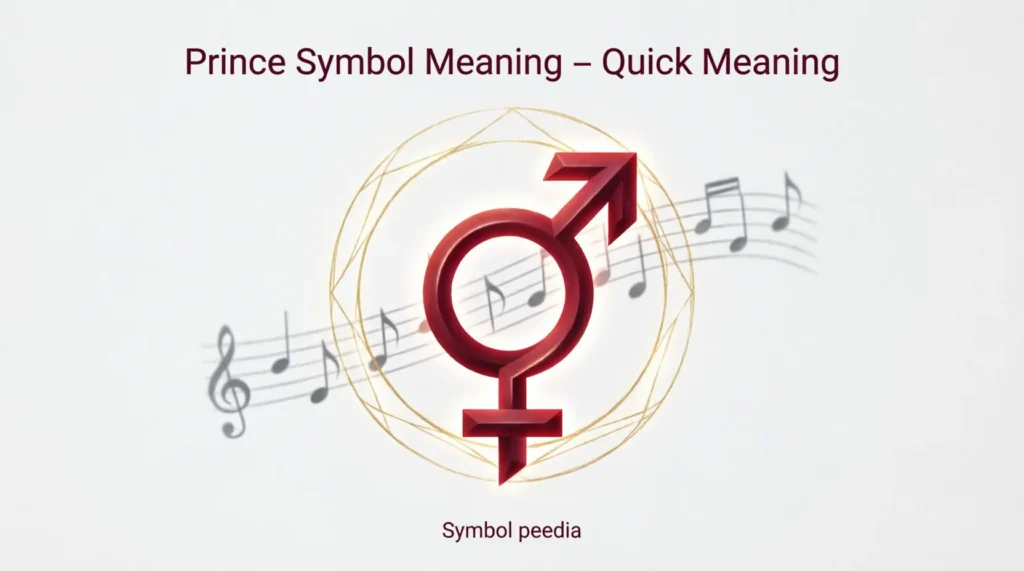
The Prince symbol, usually called the Love Symbol, is a personal symbol created and famously used by musician Prince.
In simple terms, it can represent:
- Love and emotional connection
- Individuality and self-expression
- Creativity and artistic freedom
- Breaking conventional labels
- Masculine and feminine energy together
- Personal transformation
- Mystery and independence
- Prince’s artistic identity and legacy
The symbol became especially significant when Prince changed his name to an unpronounceable symbol in 1993.
You may see someone use it today to express admiration for Prince or to communicate ideas of individuality and freedom.
For example:
“That tattoo is the Prince symbol. It represents freedom to me.”
Or:
“I love the Prince symbol because it doesn’t fit into one category.”
And in a social-media caption:
“Stay different. Stay fearless. 💜”
The important point is that the symbol does not have only one universal meaning. Its interpretation can change depending on whether it is being used in a musical, personal, artistic, romantic, or symbolic context.
Origin & Background of the Prince Symbol
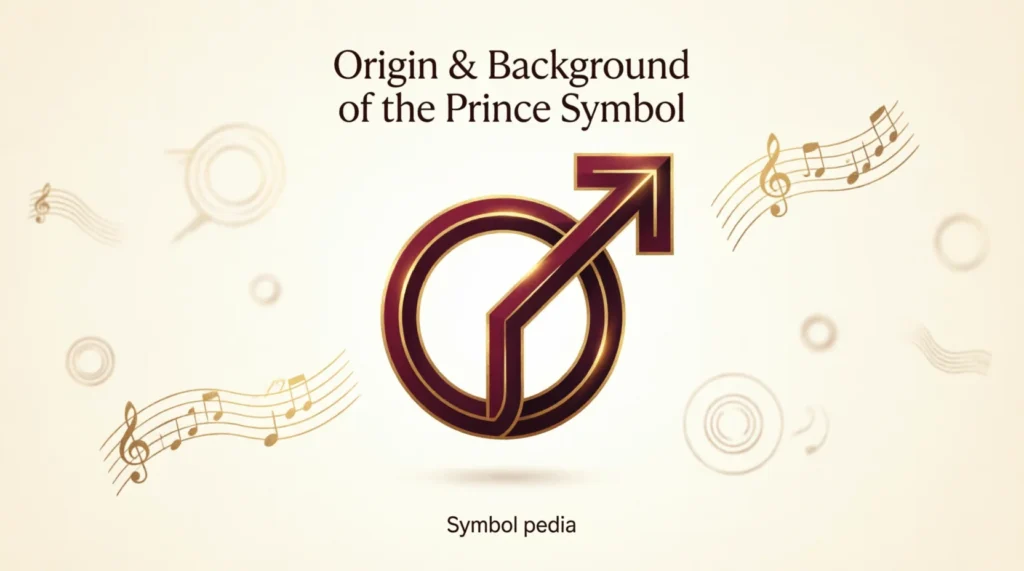
The story of the Prince symbol is closely connected to Prince Rogers Nelson, one of the most influential musicians of the modern era.
Prince was known for refusing to fit comfortably into established categories. His music crossed boundaries between funk, rock, pop, R&B, soul, and other styles. His appearance and public identity also challenged traditional expectations.
In 1993, during a highly publicized dispute with his record label Warner Bros., Prince changed his name to a symbol.
Instead of using the familiar name “Prince,” he became associated with an unpronounceable glyph that was often referred to as the Love Symbol.
The decision was not simply a visual rebranding exercise. It became part of Prince’s larger struggle over artistic control and identity.
His record contract and disagreements with Warner Bros. had become a major issue. Prince famously appeared in public with the word “slave” written on his face, communicating his frustration with the restrictions he believed the business relationship placed on his creative freedom.
The symbol therefore became connected with independence and control over one’s identity.
The glyph itself has an unusual visual structure. It incorporates forms that resemble the traditional symbols associated with male and female identities, while also containing a cross-like element and a curved lower section.
Its exact visual interpretation has generated discussion for years. Rather than treating it as a simple mathematical or universally standardized symbol, it is more accurate to understand it as a deliberately personal piece of Prince’s artistic language.
Why Was It Called the Love Symbol?
The symbol became widely known as the Love Symbol, which adds another layer to its interpretation.
Prince’s work frequently explored love, intimacy, sexuality, spirituality, desire, and emotional vulnerability. His music rarely treated these subjects as completely separate categories.
The symbol’s combination of different visual elements can therefore be understood as reflecting Prince’s interest in bringing seemingly opposite ideas together.
That ambiguity was part of its power.
It was not supposed to be an ordinary logo with one obvious definition. It was something people could look at, interpret, and discuss.
How the Symbol Became Part of Pop Culture
Prince’s enormous cultural influence helped transform the glyph into something recognizable far beyond the music industry.
After his death in 2016, the symbol became even more strongly associated with his legacy.
Fans have used it on artwork, memorials, clothing, jewelry, tattoos, posters, and social-media posts. For some people, it simply means “Prince.” For others, it represents the qualities they associate with him: originality, courage, sensuality, creativity, and independence.
That difference matters.
A symbol can begin with a specific historical meaning and eventually develop a broader cultural meaning.
The Prince symbol is a good example of that process.
Real-Life Conversations About the Prince Symbol
The following examples show how people might naturally discuss the symbol today.
WhatsApp Conversation
Person A:
I finally got that little Prince symbol tattoo.
Person B:
The Love Symbol?
Person A:
Yeah. I know it’s connected to Prince, but for me it’s also about being comfortable with who I am.
Person B:
That actually makes it more meaningful.
Person A:
Exactly. I wanted something that represented individuality rather than just a celebrity.
Here, the symbol has both its historical association with Prince and a personal interpretation.
Instagram DM
Person A:
Where did you get that necklace?
Person B:
It’s the Prince symbol. I’ve been a fan forever.
Person A:
I thought it was some kind of astrology symbol 😂
Person B:
Haha, you’re definitely not the first person to think that.
This shows why the symbol can be confusing to people who have never encountered Prince’s history.
TikTok Comments
Commenter 1:
What does that symbol mean?
Commenter 2:
It’s Prince’s Love Symbol.
Commenter 3:
Didn’t he use that instead of his name?
Commenter 2:
Yep. It became part of his identity during his fight for artistic control.
The conversation illustrates how social media has introduced younger audiences to symbols that originated before their generation.
Text Message
Person A:
Thinking about getting the Prince symbol tattooed.
Person B:
Does it mean something personal to you?
Person A:
Yeah. I like the idea of not letting other people decide who you’re supposed to be.
Person B:
Then I think it fits you perfectly.
This is an example of how a cultural symbol can eventually acquire personal meaning.
Emotional & Psychological Meaning of the Prince Symbol
The emotional appeal of the Prince symbol comes partly from its ambiguity.
People are naturally drawn to symbols that allow them to express something complicated without explaining every detail. A person may not want to write “I value freedom, creativity, individuality, and emotional openness” on a necklace or tattoo.
A symbol can communicate those ideas much more quietly.
For Prince fans, the glyph can trigger memories of music, performance, confidence, and artistic rebellion.
For others, it represents the broader idea of refusing to be placed inside a rigid box.
A Symbol of Individuality
One of the strongest psychological associations is individuality.
Prince deliberately moved away from a conventional name and embraced an unusual symbol. That decision made identity itself part of his artistic expression.
This can resonate with people who have experienced pressure to behave, dress, think, or live according to expectations.
A Symbol of Freedom
The Prince symbol can also represent freedom.
Because of the circumstances surrounding Prince’s name change, the symbol became linked with his desire for greater control over his work and identity.
Someone using the symbol today may therefore be saying, in effect, “I want to define myself.”
A Symbol of Blended Identity
The visual design has also encouraged interpretations involving masculine and feminine qualities.
Prince’s own public image frequently challenged traditional ideas about masculinity. He could appear powerful and delicate, glamorous and rebellious, sensual and spiritual.
That complexity is one reason the symbol continues to attract people interested in identity and self-expression.
A Personal-Style Example
Imagine someone who has spent years trying to meet everyone else’s expectations. Eventually, they choose a small Prince symbol as a tattoo after making a major life change.
To an outsider, it may look like a music reference.
To that person, it may quietly mean, “I finally get to be myself.”
That is where symbols become powerful: the public meaning and private meaning can exist at the same time.
Usage in Different Contexts
On Social Media
On Instagram, TikTok, X, Facebook, and other platforms, the Prince symbol may appear in captions, profile descriptions, fan posts, tribute content, or music discussions.
It can communicate admiration for Prince without requiring a long explanation.
Someone might post the symbol alongside a favorite Prince song or an image from his career.
Among Friends and Relationships
Between friends, the symbol is usually associated with music, fandom, creativity, or individuality.
A Prince fan might use it as an inside reference with another fan.
In romantic contexts, its association with love can also make it feel emotionally expressive, although the symbol should not automatically be interpreted as a romantic message.
In Work or Professional Settings
The symbol is less common in formal professional communication.
It may be appropriate in creative industries, music discussions, entertainment projects, or personal branding where cultural references are understood.
However, putting an unexplained symbol into a formal email or business presentation may confuse people.
Casual vs. Serious Tone
The symbol can work in both casual and serious contexts.
A casual use might simply celebrate Prince’s music.
A serious use might represent personal freedom, identity, artistic independence, or a major life transition.
Context determines the emotional weight.
When NOT to Use the Prince Symbol
The Prince symbol is generally harmless as a cultural or artistic reference, but context still matters.
Avoid assuming that everyone understands it. Someone unfamiliar with Prince may interpret it as an astrology, religious, gender-related, or decorative symbol.
It is also wise to avoid presenting your personal interpretation as the only official meaning.
For example, saying “This symbol officially means masculine and feminine energy” can be misleading. The glyph has a specific history connected to Prince, while many modern interpretations have developed around its appearance and cultural significance.
Be Careful With Cultural or Religious Interpretations
Because the design contains several familiar-looking shapes, people sometimes assign religious or spiritual meanings to it.
Those interpretations may be personally meaningful, but they should not automatically be presented as the historical reason Prince used the symbol.
That distinction keeps the explanation accurate.
Common Misunderstandings About the Prince Symbol
“It Is Just a Gender Symbol”
Not exactly.
The design incorporates shapes that have encouraged gender-related interpretations, but its strongest historical association is with Prince and his Love Symbol.
“It Is an Astrology Symbol”
It can resemble symbols found in astrology, but it was not created as a conventional zodiac symbol.
Someone unfamiliar with Prince may easily mistake it for one.
“It Has Only One Meaning”
Symbols rarely work that way.
The Prince symbol has a historical meaning, a pop-cultural meaning, and potentially a deeply personal meaning for individual users.
“Using It Always Means You Are a Prince Fan”
Not necessarily.
A person might use it because they admire Prince, but someone else may use it because they connect with ideas such as freedom, creativity, or individuality.
Prince Symbol vs. Similar Expressions
| Symbol or Expression | Main Meaning | Connection to Prince Symbol |
|---|---|---|
| Prince Love Symbol | Prince, love, identity, artistic freedom | Original cultural reference |
| ♥ Heart | Love, affection, emotional warmth | Shares the love association |
| ♂ Male symbol | Traditionally represents male identity | Visually related to part of the glyph |
| ♀ Female symbol | Traditionally represents female identity | Visually related to interpretations of the glyph |
| ♛ Crown | Royalty, power, status | Can represent the word “prince” more literally |
| ✨ Sparkles | Creativity, excitement, beauty | Often used to express artistic energy |
| Rebel / nonconformist imagery | Independence and resistance | Shares the theme of challenging convention |
| Prince’s name | Identifies the musician | More direct than the symbolic glyph |
Key Insight
The biggest difference is that the Prince symbol is both a historical identity marker and an open-ended cultural symbol. A crown may simply mean royalty, while the Love Symbol carries a much more personal story involving music, identity, creativity, and independence.
How to Respond When Someone Uses the Prince Symbol
Your response should depend on the context.
Casual Replies
- “Is that the Prince Love Symbol?”
- “Big Prince fan?”
- “That symbol looks so cool.”
- “I recognized that immediately!”
Funny Replies
- “I knew Prince had entered the chat 😂”
- “Okay, that’s definitely a serious Prince reference.”
- “My brain went straight to astrology for a second.”
Mature Replies
- “I like how much history that symbol carries.”
- “It represents more than just a visual design.”
- “The connection with artistic freedom makes it especially interesting.”
Respectful Replies
- “I know it is associated with Prince. Does it have a personal meaning for you?”
- “That’s a meaningful choice. What does it represent to you?”
- “I appreciate the symbolism behind it.”
Asking about someone’s personal interpretation is often better than assuming you already know what the symbol means to them.
Regional & Cultural Usage
The Prince symbol is globally recognizable, but familiarity differs between cultures and generations.
Western Culture
In the United States and much of Western popular culture, the symbol is strongly associated with Prince.
People familiar with his career may immediately recognize it as the Love Symbol.
It can evoke his music, fashion, performances, and approach to artistic identity.
Asian Culture
In Asian countries, recognition varies significantly depending on exposure to Western pop culture and Prince’s music.
Younger internet users may recognize the glyph visually without knowing its entire history.
Some may encounter it through fashion, music content, tattoos, or social media rather than through Prince’s original albums.
Middle Eastern Culture
In Middle Eastern communities, the symbol may be less immediately recognizable as a Prince reference for people who were not exposed to his music.
Online cultural exchange has nevertheless made Western music symbols increasingly familiar to younger audiences.
The visual design may sometimes be interpreted independently before its connection to Prince becomes clear.
Global Internet Usage
The internet has changed how cultural symbols travel.
A symbol that once belonged primarily to a musician’s identity can now appear in memes, fan communities, tattoos, fashion posts, music videos, and short-form content.
This means someone can understand the symbol emotionally or aesthetically before learning its history.
Gen Z vs. Millennials
Millennials are generally more likely to have encountered Prince’s work during his lifetime, although familiarity varies.
Gen Z may encounter the symbol through streaming platforms, social media, documentaries, older relatives, music discussions, or viral cultural references.
This creates an interesting difference: one generation may see the symbol as a direct Prince reference, while another may first encounter it as an intriguing piece of visual culture.
Neither interpretation is automatically wrong. They simply come from different cultural experiences.
Is the Prince Symbol Safe for Kids?
Yes, the Prince symbol itself is generally safe for children because it is a cultural and artistic symbol.
However, context matters.
Prince’s music and public image sometimes involved adult themes, sexuality, and mature subject matter. Parents or teachers should therefore consider the surrounding content rather than judging the symbol alone.
If a child asks what it means, a simple explanation is enough: it is a symbol famously associated with the musician Prince and is often called the Love Symbol.
FAQs
What does the Prince symbol mean?
The Prince symbol, commonly called the Love Symbol, is associated with musician Prince. It can represent love, creativity, individuality, artistic freedom, and Prince’s identity.
Why did Prince use a symbol instead of his name?
Prince adopted the symbol publicly in the 1990s during a major dispute with his record label. It became an important part of his artistic identity and his expression of independence.
Is the Prince symbol a love symbol?
Yes. It is widely known as the Love Symbol, although its meaning extends beyond romance and can include identity, creativity, freedom, and artistic expression.
Does the Prince symbol represent gender?
The design contains visual elements that have been interpreted in relation to masculine and feminine symbolism. However, it should not be reduced to a simple gender symbol because its historical identity is specifically tied to Prince.
Can I use the Prince symbol as a tattoo?
Yes, people may choose it as a tattoo to express admiration for Prince or ideas such as individuality, creativity, love, or freedom. Its personal meaning can be different for each person.
Is the Prince symbol a religious symbol?
It is not primarily recognized as a traditional religious symbol. Some people may give it spiritual interpretations, but its well-established cultural association is with Prince and his Love Symbol.
Why is the Prince symbol still popular?
Its unusual design, connection to Prince’s legacy, and themes of individuality and self-expression have helped it remain culturally relevant long after its introduction.
Conclusion
The prince symbol meaning is much richer than a simple dictionary definition.
At its most direct level, the symbol is inseparable from Prince and the Love Symbol he adopted as part of his identity. But its cultural life has grown beyond that original story.
For some people, it represents love. For others, it means creativity, independence, gender complexity, rebellion, or the courage to live outside conventional expectations.
That flexibility is precisely what makes the symbol so memorable.
Prince did not choose an ordinary logo. He chose something difficult to categorize, difficult to pronounce, and impossible to reduce to a single conventional label. In many ways, that reflected the artist himself.
So if you see the Prince symbol on a necklace, tattoo, social-media profile, album tribute, or piece of artwork, don’t assume it has only one message.
It might simply say, “I love Prince.”
Or it might say something more personal: I am allowed to define myself.
And sometimes, that is the most powerful meaning a symbol can carry.
descover more post
What Does the Swirl Symbol Mean A Complete Guide to Its …
What Does the Cadillac Symbol Mean History Hidden …
Sample Mean Symbol Statistics Meaning Formula Examples …