The hoopoe is one of the most distinctive birds in the world. With its striking orange-brown crest, black-and-white wings, and unusual call, it has captured human attention for centuries. But beyond its appearance, the hoopoe carries deep symbolic meaning in spirituality, literature, mythology, and cultural traditions.
The hoopoe symbol meaning is commonly associated with wisdom, spiritual guidance, transformation, intuition, and the search for truth. In some traditions, the bird represents a messenger who helps people move beyond confusion and discover a deeper understanding of themselves.
People search for the meaning of the hoopoe for different reasons. Some encounter the bird in nature and wonder whether its appearance has spiritual significance. Others see it in a dream, a piece of artwork, a religious story, or a tattoo and want to understand the symbolism behind it.
The interpretation can change depending on the cultural or personal context. In Persian literature, for example, the hoopoe plays an important role as a guide on a spiritual journey. In Islamic tradition, it appears in the story of Prophet Solomon and the Queen of Sheba. These associations give the bird a meaning that extends far beyond its physical appearance.
It is important, however, to distinguish established cultural traditions from modern spiritual interpretations. Seeing a hoopoe does not prove that a supernatural message has been sent to you, but the encounter can still inspire reflection, curiosity, and personal growth.
Let’s explore what the hoopoe represents, where its symbolism comes from, and how its meaning can be understood in everyday life.
Hoopoe Symbol Meaning – Quick Explanation
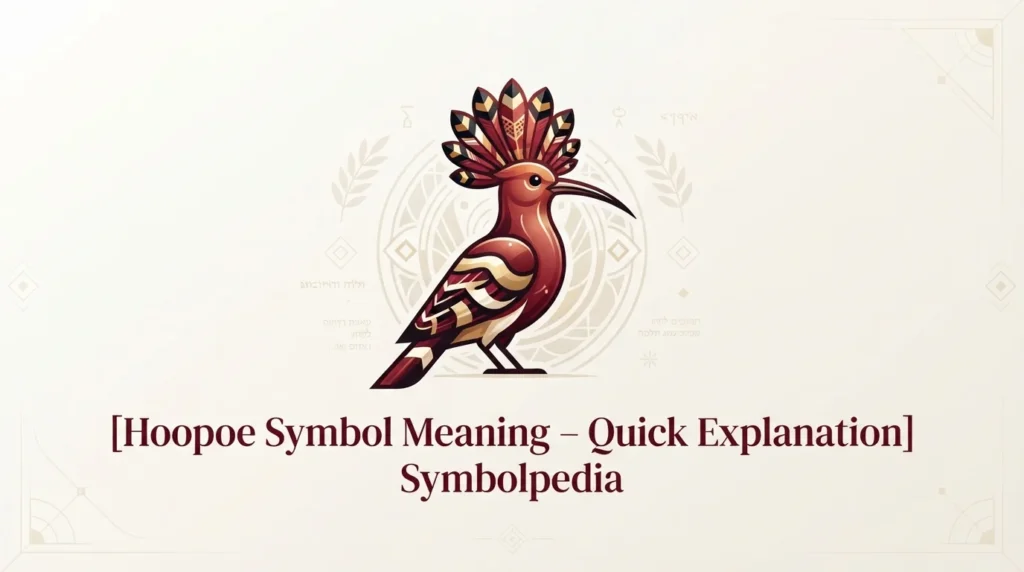
The hoopoe is often interpreted as a symbol of wisdom, guidance, discovery, and spiritual awakening. Its precise meaning depends on the tradition, story, or personal experience in which it appears.
Common symbolic associations include:
- Wisdom: Seeking knowledge rather than accepting everything at face value.
- Spiritual guidance: Helping someone find direction during a period of uncertainty.
- Transformation: Moving from confusion toward greater understanding.
- Truth and discovery: Looking beneath appearances to find meaningful answers.
- Communication: Delivering information that changes someone’s perspective.
- Individuality: Appreciating the qualities that make someone different.
- Patience: Understanding that personal growth often takes time.
Here are three examples of how people might use this symbolism:
- “The hoopoe reminds me to keep searching for the truth.”
- “I see the hoopoe as a symbol of guidance during difficult times.”
- “Its unusual crest reminds me that being different can be a strength.”
These are illustrative interpretations rather than fixed meanings shared by everyone.
The central idea is that the hoopoe can represent a journey toward knowledge, clarity, and a deeper understanding of life.
Origin and Background of Hoopoe Symbolism
The hoopoe in nature
The hoopoe, scientifically known as Upupa epops, is a bird recognized by its long, narrow bill, distinctive crest, and patterned wings. Its natural range includes parts of Europe, Asia, Africa, and surrounding regions, although distribution varies by species and season.
Its striking appearance makes it easy to recognize, while its habit of searching the ground for insects gives it an interesting relationship with the earth.
People have long attached symbolic meaning to animals based on their behavior, appearance, and role in stories. The hoopoe’s distinctive crest, alert movements, and association with searching for food may help explain why it has inspired ideas about awareness and discovery.
These natural characteristics can inspire symbolism, but they do not establish a supernatural meaning.
The hoopoe in ancient traditions
The hoopoe appears in several cultural traditions across regions where people have encountered the bird.
In some historical traditions, birds were viewed as messengers because they moved between the earth and the sky. This imagery encouraged people to associate them with communication, transition, and knowledge.
The hoopoe became particularly important in Middle Eastern and Persian cultural history, where it appears in religious narratives and influential literature.
Its symbolism developed through these stories rather than from one universal belief system.
The hoopoe in the Quran
One of the best-known appearances of the hoopoe is in the Quran, in Surah An-Naml, particularly verses 20–28.
In the account, Prophet Solomon notices that the hoopoe is absent from his assembly. When the bird returns, it reports information about the people of Sheba and their queen, including their worship of the sun.
Solomon then sends a message to the queen through the bird.
This story gives the hoopoe an important narrative role: it observes, discovers information, and communicates something significant to a ruler.
For many readers, the episode makes the hoopoe a symbol of observation, responsible communication, and the importance of information. Its role is especially memorable because a small bird contributes knowledge that influences the course of events.
The Quranic account is a religious narrative, while interpretations of its broader symbolic meaning can vary among readers and scholars.
The hoopoe in Persian literature
The hoopoe also holds a celebrated place in Persian literature, particularly in The Conference of the Birds, the mystical poem by Farid ud-Din Attar.
In this allegorical work, a group of birds sets out on a difficult journey to find the Simurgh, a legendary bird associated with spiritual understanding. The hoopoe serves as their guide, encouraging them to undertake the journey and explaining the challenges they must face.
The journey passes through seven valleys, commonly understood as stages of spiritual development. The birds must confront fear, attachment, uncertainty, and the limitations of their own understanding.
In this setting, the hoopoe represents guidance, spiritual discipline, and the courage to seek a truth greater than immediate comfort.
This is one of the strongest foundations for the hoopoe’s modern association with spiritual awakening. Unlike interpretations based only on contemporary symbolism, this meaning has a clear literary source.
The hoopoe in modern culture
Today, the hoopoe appears in illustrations, poetry, educational material, spiritual discussions, and nature photography.
Some people associate it with mindfulness or personal transformation because of its traditional role as a guide. Others appreciate it simply as a beautiful and unusual bird.
Social media has made symbolic interpretations easier to share, but it can also blur the distinction between established cultural meanings and personal beliefs.
When exploring the hoopoe’s symbolism, it is useful to understand both the historical sources and the modern interpretations inspired by them.
Real-Life Conversations: What the Hoopoe Symbol Means to Different People
The following fictional conversations show how the hoopoe’s symbolism might appear in everyday life. They reflect possible personal interpretations, not universal spiritual rules.
1. WhatsApp: Seeing a hoopoe in the garden
Person A: “A hoopoe landed near my window this morning. I’ve never seen one that close.”
Person B: “That’s amazing! They’re such unusual-looking birds.”
Person A: “I looked up their symbolism, and apparently they’re associated with wisdom and guidance.”
Person B: “Maybe it’ll inspire you to explore something new. Sometimes nature gives us a good reason to pause.”
Person A: “I like that. I’ve been thinking about making a big change lately.”
This conversation illustrates how a memorable encounter with wildlife can encourage reflection. The bird does not necessarily predict a future event, but the experience may help someone think differently about a decision.
2. Instagram DMs: Discovering a spiritual symbol
Person A: “I keep seeing hoopoe illustrations in Persian artwork. Do they mean something spiritual?”
Person B: “Yes, especially in Persian mystical literature. The hoopoe guides the other birds in The Conference of the Birds.”
Person A: “That explains why so many illustrations show it leading other birds.”
Person B: “Exactly. It’s often interpreted as a guide on the journey toward wisdom.”
The exchange shows how learning about a symbol’s cultural background can give artwork a richer meaning.
3. TikTok comments: Understanding the bird’s meaning
Person A: “Why do people say the hoopoe represents transformation?”
Person B: “I think it’s connected to the bird’s role as a guide in spiritual stories.”
Person A: “So it’s more about the journey than the bird itself?”
Person B: “That’s one way to interpret it. The meaning depends on the tradition.”
This conversation highlights an important distinction: symbolism often comes from stories and interpretations rather than from an animal possessing an inherent spiritual message.
4. Text messages: Choosing a meaningful tattoo
Person A: “I’m considering a hoopoe tattoo. I want something that represents finding my direction.”
Person B: “That sounds meaningful. Have you read about its role in Persian poetry?”
Person A: “Yes! I love the idea of a guide helping others through a difficult journey.”
Person B: “Then the hoopoe could represent the kind of person you’re trying to become.”
Person A: “That’s exactly what I want it to mean.”
For this person, the hoopoe becomes a symbol of personal intention. Its significance comes from the connection between the bird’s literary role and the individual’s life.
Emotional and Psychological Meaning of the Hoopoe
Symbols can help people express emotions that are difficult to describe directly. A bird associated with guidance, for example, may become meaningful to someone who feels uncertain about the future.
The hoopoe’s symbolism can be explored through several psychological themes.
Finding direction during uncertainty
People often search for symbols when they are facing a transition, such as changing careers, ending a relationship, moving to a new place, or questioning their beliefs.
The hoopoe’s role as a guide in Persian mystical literature makes it a natural image for someone trying to find direction.
Thinking about the bird may encourage questions such as, “What am I trying to understand?” or “Which direction reflects my values?”
The value lies in the reflection rather than in assuming that the bird knows what will happen next.
Developing confidence in your individuality
The hoopoe has a distinctive crest and an appearance that sets it apart from many other birds.
As a personal symbol, it can represent the courage to embrace qualities that make you different. This interpretation may resonate with people who have felt pressure to fit in or hide parts of their personality.
The bird can serve as a reminder that individuality does not have to be a disadvantage.
Learning to communicate responsibly
The hoopoe’s role in the Quranic account of Solomon also lends itself to reflection on communication.
The bird brings information that matters to the wider story. Its role can inspire people to think about the importance of observation, accuracy, and sharing information responsibly.
In everyday life, this might mean listening carefully before speaking or checking facts before passing along a message.
A personal-style scenario
Imagine someone who has spent months feeling stuck between two career paths. One afternoon, they see a hoopoe searching for insects in a nearby garden.
Curious about the bird, they discover its association with guidance and the search for wisdom in Persian literature. The story prompts them to reconsider what they genuinely value rather than choosing a path simply because other people expect it.
The bird has not magically provided an answer. Instead, learning about its symbolism has given the person a useful way to reflect on a difficult choice.
That is one of the most meaningful ways to engage with symbolism: allowing it to encourage thought without treating it as a substitute for judgment.
Usage of Hoopoe Symbolism in Different Contexts
Social media and online artwork
On Instagram, Pinterest, TikTok, and other platforms, the hoopoe may appear in nature photographs, spiritual illustrations, poetry, or educational posts.
Creators may use the bird to communicate themes of discovery, guidance, or individuality. A hoopoe illustration paired with a sunrise, for example, might suggest a new beginning.
However, a photograph of a hoopoe does not automatically carry a spiritual message. The creator’s caption and the cultural context determine how the image is intended to be understood.
Friends and relationships
In relationships, the hoopoe can serve as a metaphor for helping someone find their way without controlling their choices.
A friend might give another person a hoopoe illustration after a difficult period, using it to represent encouragement, thoughtful guidance, or the courage to begin again.
In a romantic relationship, the bird might symbolize two people learning and growing together. This is a personal interpretation, not a universally established romantic meaning.
Work and professional settings
The hoopoe is not a standard symbol of professional success, so its meaning in a workplace will usually depend on the individual or organization using it.
A writer might choose the bird as an emblem of research and discovery. An educator might use it in a lesson about literature, cultural traditions, or wildlife.
If the symbol appears in a company logo or presentation, look for an explanation from the organization rather than assuming that it communicates a particular spiritual message.
Casual versus serious contexts
In casual settings, the hoopoe may simply be appreciated for its appearance or used as a playful nature reference.
In a serious discussion about faith, literature, or cultural heritage, it is more appropriate to explain the tradition behind the interpretation.
This distinction helps prevent personal symbolism from being mistaken for an established religious teaching.
When Not to Use the Hoopoe Symbol
Although the hoopoe has positive associations in several traditions, its symbolism should be used thoughtfully.
Avoid presenting personal beliefs as universal facts
It is reasonable to say that the hoopoe represents guidance to you. It is less accurate to claim that everyone must interpret the bird in the same way.
Explain whether your interpretation comes from literature, religion, personal experience, or a modern spiritual practice.
Be respectful of religious traditions
The hoopoe’s role in the Quran is meaningful to many Muslims. When discussing this account, represent the narrative accurately and avoid inventing religious teachings about the bird.
Likewise, do not assume that every person from a Muslim-majority country interprets the hoopoe identically.
Avoid using symbolism to frighten people
Seeing a hoopoe should not be treated as proof of bad luck, impending death, betrayal, or a specific future event.
If someone is anxious about an encounter, encourage a grounded interpretation rather than reinforcing frightening predictions.
Consider the setting
A hoopoe tattoo or decorative illustration may be appropriate in one setting but misunderstood in another.
If you use the bird in educational or professional material, explain the meaning you intend to communicate. This is especially important when drawing on religious or literary traditions that audiences may not know.
Common Misunderstandings About Hoopoe Symbolism
1. The hoopoe always means spiritual awakening
Spiritual awakening is one possible interpretation, particularly in discussions influenced by Persian mystical poetry. It is not the only meaning associated with the bird.
In other settings, the hoopoe may be a natural subject, a literary character, or a reference to the Quranic narrative.
2. Seeing a hoopoe guarantees good luck
There is no reliable basis for claiming that every hoopoe sighting predicts good fortune.
Someone may personally regard an encounter as encouraging or meaningful, but that experience should not be confused with a guaranteed prediction.
3. The hoopoe has the same meaning in every culture
Cultural symbolism develops through different stories, environments, and belief systems.
The hoopoe’s importance in Persian literature and its appearance in the Quran provide specific historical contexts. Modern interpretations may draw on these traditions, but they are not interchangeable with every cultural belief about birds.
4. A hoopoe in a dream has one fixed interpretation
Dream interpretation is highly personal. A hoopoe in a dream might remind someone of a journey, a memory, a question, or a recent experience.
There is no single interpretation that can reliably explain every person’s dream.
5. Every hoopoe image is spiritual
Sometimes a hoopoe image is simply an illustration of a bird. Its crest, coloring, and wing patterns make it an appealing subject for artists and photographers.
The image’s intended meaning depends on its presentation and context.
Comparison Table: Hoopoe Symbolism and Related Symbols
| Symbol | Common symbolic association | Relationship to hoopoe symbolism |
|---|---|---|
| Hoopoe | Guidance, wisdom, discovery | Particularly associated with guidance in Persian mystical literature |
| Owl | Wisdom, observation | Shares the association with knowledge, though cultural meanings vary |
| Eagle | Strength, vision, freedom | Often represents power and a broad perspective |
| Dove | Peace, hope, reconciliation | Emphasizes calm, harmony, and peace |
| Phoenix | Rebirth, renewal | More directly associated with rising after destruction or hardship |
| Butterfly | Change, transformation | Commonly represents personal change and new beginnings |
| Compass | Direction, purpose | Shares the metaphor of finding one’s way |
| Lantern | Illumination, understanding | Represents light or insight during uncertainty |
Key Insight
The hoopoe stands out because its association with guidance has a specific literary foundation in The Conference of the Birds, while its Quranic appearance emphasizes observation and communication. Other symbols may express similar ideas, but each has its own cultural and historical background.
How to Respond When Someone Uses the Hoopoe Symbol
If someone shares a hoopoe image or describes it as a spiritual symbol, your response can reflect your relationship with that person and the conversation’s purpose.
Casual replies
- “That’s such a beautiful bird!”
- “I didn’t know the hoopoe had that much symbolism.”
- “Its crest makes it really distinctive.”
- “I like the idea of connecting nature with personal growth.”
Funny replies
- “So this bird is the guide of the group?”
- “That crest definitely makes a statement!”
- “Who knew birdwatching could lead to a philosophy lesson?”
These replies are suitable for friendly conversations where humor is welcome.
Mature replies
- “Its role in Persian literature makes the symbolism especially interesting.”
- “I like how the meaning changes depending on the cultural context.”
- “The connection between guidance and the search for knowledge is thought-provoking.”
Respectful replies
- “Thank you for sharing that interpretation. I’d like to learn more about its background.”
- “Is that meaning connected to a particular religious or literary tradition?”
- “I appreciate the symbolism. Where did you first encounter it?”
A thoughtful question can lead to a deeper conversation without assuming that the other person shares your beliefs.
Regional and Cultural Usage of Hoopoe Symbolism
Western culture
In Western settings, the hoopoe may be encountered through birdwatching, nature writing, mythology, art, or discussions of world literature.
Some audiences may associate it with wisdom or spiritual discovery after learning about Persian poetry. Others may simply recognize it as an unusual bird.
There is no single Western interpretation that applies to everyone.
Asian culture
Across Asia, the hoopoe’s significance varies with geography, religious traditions, literature, and local relationships with wildlife.
In areas where the bird is familiar, it may appear in everyday observations of nature. In literary or spiritual discussions, people may also encounter interpretations influenced by Persian and Middle Eastern traditions.
Asia contains many distinct cultures, so it would be misleading to assign one symbolic meaning to the entire region.
Middle Eastern culture
The hoopoe has a particularly notable place in the Quranic story of Prophet Solomon and the Queen of Sheba.
For many Muslim readers, the bird’s role in this narrative makes it a memorable example of observation and communication within a larger religious story.
Its appearance in Persian literature also connects it with influential cultural and literary traditions across parts of the broader region.
These associations should be understood in their individual contexts rather than combined into one universal religious interpretation.
Global internet usage
Online platforms allow people to share hoopoe photographs, artwork, quotations, and spiritual interpretations across borders.
This can introduce the bird’s literary background to people who have never seen one in person.
However, online content may simplify historical traditions or present personal beliefs as established facts. Checking the original literary or religious source can provide a more accurate understanding.
Gen Z versus Millennials
Both Gen Z and Millennials may use the hoopoe in digital artwork, tattoos, nature content, or personal discussions about growth.
Younger users might discover the symbol through short-form videos or illustrated posts, while others may encounter it through books, religious study, or cultural education.
These are possible routes of discovery, not fixed generational differences. Personal interests often matter more than age.
Is the Hoopoe Symbol Safe for Kids?
Yes. The hoopoe is a bird, and learning about its symbolism can be a useful way to introduce children to wildlife, literature, and cultural traditions.
Adults can explain that different people interpret symbols in different ways. A child might learn about the bird’s appearance, its role in the Quranic narrative, or its place in Persian poetry without being told that a sighting predicts the future.
The most helpful approach is to encourage curiosity, respect for cultural differences, and an understanding of the distinction between a story’s symbolism and a factual claim.
Frequently Asked Questions
1. What does the hoopoe symbolize spiritually?
The hoopoe is often associated with spiritual guidance, wisdom, and the search for truth, particularly through its role in Persian mystical literature.
2. What does the hoopoe symbolize in Islam?
The hoopoe appears in the Quran’s account of Prophet Solomon and the Queen of Sheba in Surah An-Naml. It reports important information and carries a message from Solomon to the queen.
3. What does a hoopoe sighting mean?
A sighting may simply be an encounter with a distinctive wild bird. Some people personally interpret it as a reminder to seek wisdom or direction, but there is no universal spiritual message attached to every sighting.
4. What does the hoopoe represent in Persian literature?
In Farid ud-Din Attar’s The Conference of the Birds, the hoopoe guides other birds on a difficult journey toward spiritual understanding. It is therefore commonly associated with guidance and the pursuit of wisdom.
5. What does a hoopoe tattoo mean?
A hoopoe tattoo may represent wisdom, individuality, guidance, or personal transformation. Its meaning depends on the wearer’s intentions and the cultural references behind the design.
6. What does a hoopoe in a dream mean?
There is no scientifically established universal meaning for dreaming about a hoopoe. The dream may have personal significance depending on the dreamer’s memories, emotions, and experiences.
7. Is the hoopoe a symbol of good luck?
Some people may view a hoopoe encounter as encouraging or fortunate, but good luck is not a universal meaning established across all traditions. Its symbolism varies with cultural and personal context.
Conclusion
The hoopoe is much more than a striking bird. Its appearance in the Quran and its celebrated role in Persian mystical poetry have made it a meaningful symbol of guidance, knowledge, and discovery.
For some people, it represents the courage to ask difficult questions. For others, it evokes responsible communication, individuality, or the search for a clearer direction in life.
Its symbolism is most meaningful when understood in context. The hoopoe does not have to be a supernatural sign to inspire reflection, and its cultural significance does not require everyone to interpret it in exactly the same way.
Whether you discovered the bird in a garden, a religious story, a poem, or a piece of artwork, its symbolism offers an invitation to remain curious and open to learning.
Sometimes the most valuable meaning of a symbol is not a prediction about what will happen next. It is the question it encourages you to ask about the person you are becoming.
discover more post
What Does ML Mean in Slang Text Real Meaning 2026
What Does Hou Mean in Text Meaning Uses 2026
What Does Thi Mean in Text Real Meaning 2026 – Symbl Pedia

Kavon is a passionate content creator and digital researcher who specializes in decoding symbols, meanings, and modern internet language. With a strong focus on clarity and authenticity, Kavon writes in a way that makes complex ideas simple, relatable, and useful for everyday readers.
Known for a hardworking mindset and attention to detail, Kavon is dedicated to creating content that genuinely helps people understand the deeper meanings behind words, signs, and online expressions. Every article is crafted with care, combining research, real-life insight, and a reader-first approach.
Through Symblpedia, Kavon aims to build a trusted space where curiosity meets clarity—helping users find answers that are not only accurate but also meaningful and easy to understa