Have you ever noticed an ibis bird in a painting, tattoo, piece of jewelry, ancient Egyptian artwork, or spiritual illustration and wondered what it represents? Although it may look like an ordinary long-legged bird, the ibis has a fascinating history connected to wisdom, knowledge, protection, and spiritual symbolism.
The ibis symbol meaning is especially significant in ancient Egyptian culture, where the bird was closely associated with Thoth, the god of wisdom, writing, learning, and the moon. Its distinctive curved beak and elegant appearance made it a recognizable figure in religious art and sacred imagery.
Today, people explore ibis symbolism for different reasons. Some are interested in ancient mythology, while others encounter the bird in spiritual artwork, nature photography, dreams, or tattoos. For many, the ibis represents intellectual growth, patience, adaptability, and the importance of looking beneath the surface.
However, the ibis does not have one universal meaning. Its symbolism depends on the cultural tradition, the particular species, and the setting in which it appears.
In this guide, you will discover the ibis symbol’s historical origins, spiritual interpretations, psychological associations, cultural significance, and modern uses. You will also learn how to interpret the bird without confusing established historical facts with contemporary spiritual beliefs.
Ibis Symbol Meaning: Quick Overview
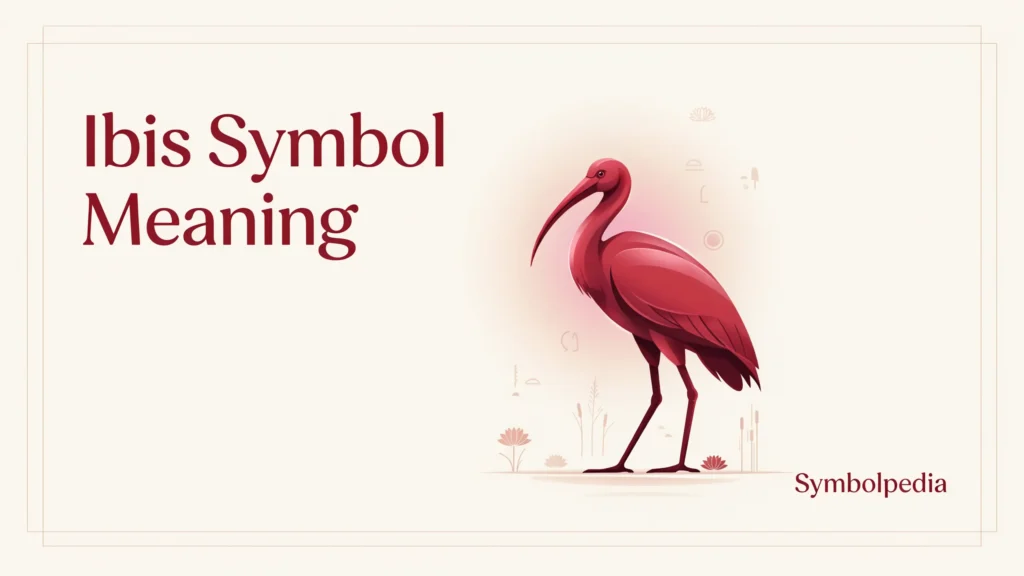
The ibis is a wading bird recognized by its long legs, slender body, and characteristically curved bill. Different ibis species appear in wetlands, marshes, coastal environments, and other habitats around the world.
Symbolically, the bird is associated with several ideas.
- Wisdom and knowledge: Its strongest historical association comes from ancient Egyptian connections with Thoth.
- Writing and communication: Thoth’s role as a divine scribe links ibis imagery with language, learning, and recordkeeping.
- Spiritual insight: Modern spiritual interpretations sometimes associate the bird with reflection, awareness, and inner understanding.
- Patience: Its methodical searching for food can inspire the idea of careful observation.
- Adaptability: The ibis can symbolize adjusting to changing circumstances and finding opportunities in different environments.
- Protection and sacredness: In ancient Egyptian religious contexts, sacred ibis imagery was connected with devotion to Thoth.
Consider these illustrative examples:
- “The ibis represents wisdom and the pursuit of knowledge.”
- “An ibis tattoo can symbolize curiosity and personal growth.”
- “Seeing an ibis in nature can remind someone to slow down and observe their surroundings.”
The first statement reflects a well-established historical association. The tattoo and personal-reflection examples describe possible modern interpretations rather than universal beliefs.
Origin and Background of the Ibis Symbol
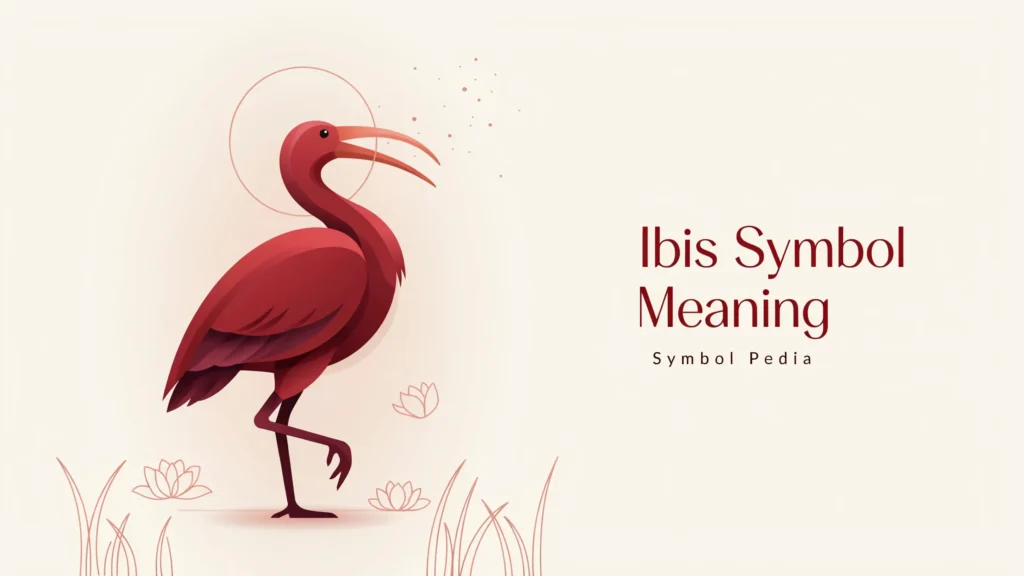
The ibis in ancient Egyptian civilization
The ibis became particularly important in ancient Egypt because of its association with Thoth, a deity connected with wisdom, writing, knowledge, calculation, and the ordering of the universe.
Thoth was frequently depicted as a man with the head of an ibis or, in some representations, as an ibis itself. This distinctive appearance helped establish the bird as a recognizable religious symbol.
Because Thoth was associated with scribes and intellectual activities, the ibis became linked with the preservation of knowledge and the responsible use of language.
For ancient Egyptians, writing was more than a practical skill. It played an important role in administration, religious rituals, literature, and the transmission of cultural knowledge. The ibis therefore acquired significance beyond its physical appearance.
The sacred ibis and religious offerings
The African sacred ibis (Threskiornis aethiopicus) held an important place in ancient Egyptian religious practice.
Archaeological discoveries have revealed large numbers of ibis mummies associated with religious offerings. Worshippers dedicated these birds to Thoth, seeking to participate in established devotional practices.
These offerings demonstrate that ibis symbolism was not simply an artistic convention. It was part of a broader religious system involving sacred animals, temples, rituals, and beliefs about divine relationships.
The ibis also appeared in religious objects, amulets, statues, and decorative representations. Its association with Thoth made it an enduring image of sacred knowledge.
How the symbol evolved
As ancient Egyptian religion became a subject of historical study, the ibis increasingly appeared in museum collections, educational books, archaeological exhibitions, and popular accounts of mythology.
Its image subsequently entered modern artistic and spiritual contexts, including tattoos, jewelry, illustrations, and decorative designs.
Today, some people use the ibis as a symbol of intellectual curiosity or personal transformation. Others choose it because of its elegant shape, ecological importance, or connection with Egyptian history.
These modern meanings are not all inherited directly from ancient religion. Some are contemporary interpretations inspired by the bird’s appearance and behavior.
Understanding this distinction helps explain why the same ibis image can represent sacred wisdom to one person and simply symbolize a love of nature to another.
Real-Life Conversations: How People Interpret Ibis Symbolism
The following fictional conversations illustrate how people might discuss the ibis in everyday life.
1. WhatsApp: Discovering the Ancient Meaning
Person A: “I found this ibis design for my study journal. Do you know what it means?”
Person B: “I think it has something to do with ancient Egypt.”
Person A: “You’re right! It’s associated with Thoth, the god of wisdom and writing.”
Person B: “That actually makes it perfect for a journal.”
Meaning: The ibis works as a reminder of learning, curiosity, and the importance of recording ideas.
2. Instagram DMs: Choosing a Tattoo
Person A: “I’m thinking about getting an ibis tattoo.”
Person B: “That’s an unusual choice. Is there a meaning behind it?”
Person A: “I like the connection with wisdom. I want something that reminds me to keep learning.”
Person B: “I love that. It’s personal without being too obvious.”
Meaning: Here, the ibis represents an individual’s commitment to education and self-development. The interpretation comes from the person’s own intentions.
3. TikTok Comments: Ancient Egyptian Art
Person A: “Why does Thoth have a bird’s head?”
Person B: “He’s often shown with the head of an ibis.”
Person C: “The ibis is connected with wisdom and writing, right?”
Person B: “Exactly. Thoth is associated with knowledge, writing, and divine recordkeeping.”
Meaning: The conversation highlights the ibis’s historical connection with Thoth and the intellectual qualities associated with the deity.
4. Text Messages: A Meaningful Encounter
Person A: “I saw an ibis near the water this morning. It was beautiful.”
Person B: “Did you know some people connect it with wisdom and reflection?”
Person A: “I didn’t know that. I was actually thinking about a big decision.”
Person B: “Maybe it can be a reminder to take your time and think carefully.”
Meaning: The bird becomes a personal symbol of reflection. This is a modern interpretation, not evidence that the encounter predicts an event or carries a supernatural message.
Emotional and Psychological Meaning of the Ibis
Symbols can influence how people understand their experiences because they provide a visual way to express abstract ideas.
A bird associated with wisdom, for example, may remind someone to approach a difficult situation thoughtfully. Another person might see the same bird and feel connected to history, nature, or a particular spiritual tradition.
The emotional meaning comes partly from cultural associations and partly from personal experience.
Wisdom and intellectual growth
The strongest historical symbolic connection is wisdom through Thoth.
People who admire the ibis may use its image to represent curiosity, critical thinking, education, and the willingness to learn from experience.
An ibis pendant or illustration can serve as a personal reminder to question assumptions rather than accept every answer immediately.
Patience and observation
The ibis searches for food by probing through mud, shallow water, and other environments, depending on the species.
A modern symbolic interpretation might connect this behavior with patience and careful investigation. The bird becomes a reminder that worthwhile discoveries sometimes require time and attention.
This is a metaphor inspired by animal behavior, not a fixed meaning shared by every culture.
Reflection and inner awareness
Some contemporary spiritual interpretations connect the ibis with mindfulness and self-understanding.
Its association with knowledge may encourage people to reflect on their choices, examine their motivations, and become more aware of their surroundings.
For someone facing uncertainty, the image might represent the value of pausing before making an important decision.
A personal-style scenario
Imagine someone beginning a new course after years of doubting their abilities. They choose an ibis illustration for the first page of their notebook because they associate it with learning and wisdom.
Whenever the work becomes difficult, the image reminds them why they started.
The bird does not magically create confidence. Instead, the symbol helps the person reconnect with a meaningful goal.
That is one of the most practical ways symbolism can influence everyday life: it gives a personal value a visible form.
Ibis Symbolism in Different Contexts
On social media
On Instagram, Pinterest, and other visual platforms, ibis imagery may appear in posts about Egyptian mythology, wildlife, spiritual art, or tattoo inspiration.
A caption describing the ibis as a symbol of wisdom usually draws on its historical association with Thoth. Other posts may assign meanings such as transformation or intuition based on contemporary spiritual beliefs.
When interpreting these posts, consider whether the creator is discussing documented history, personal symbolism, or a spiritual tradition.
In friendships and relationships
Someone might choose an ibis design as a gift for a student, teacher, writer, or friend who enjoys learning.
In this setting, the bird could represent admiration for intelligence, encouragement, or a shared interest in ancient history.
A gift does not automatically communicate a hidden romantic meaning. The giver’s explanation and the relationship itself are more reliable guides.
In work and professional settings
The ibis can be a meaningful visual choice for educational projects, historical presentations, writing-related artwork, and organizations inspired by knowledge.
However, it is not a universally recognized business symbol. If an organization uses the bird in a logo, its meaning may be specific to that organization.
For a professional presentation, explain the connection with Thoth rather than assuming every audience member will recognize it.
In spiritual and personal settings
Some people incorporate ibis imagery into meditation spaces, journals, or personal artwork as a reminder of wisdom, reflection, and awareness.
Others appreciate the bird without assigning it any spiritual significance.
Both approaches are valid. The important distinction is between a personal interpretation and a historical claim about what a culture believed.
Casual versus serious use
In casual conversation, someone might simply call the ibis an interesting or beautiful bird.
In a historical or religious discussion, it is more appropriate to explain its relationship with Thoth, sacred ibis offerings, and ancient Egyptian practices.
The meaning changes with the purpose of the conversation, not necessarily with the bird itself.
When Not to Use the Ibis Symbol
Although ibis imagery is generally suitable for art, education, and personal expression, context matters.
1. Avoid presenting modern interpretations as ancient facts. Wisdom and writing have strong historical connections with Thoth and the ibis. Claims that the bird guarantees prosperity, predicts the future, or delivers a supernatural message are not established historical facts.
2. Be respectful of religious history. Ancient Egyptian sacred animals had significance within a religious tradition. Avoid reducing their entire meaning to a fashionable aesthetic when discussing their historical role.
3. Check the intended design. An ibis image may be confused with other long-billed birds, such as herons or cranes. If historical accuracy matters, identify the species and visual details carefully.
4. Do not assume everyone shares the same beliefs. Some people appreciate spiritual interpretations, while others prefer historical, scientific, or artistic explanations.
5. Consider the purpose of a tattoo or logo. If you choose an ibis to represent wisdom, be prepared to explain that personal meaning. The bird does not carry an identical message for every observer.
Common Misunderstandings About the Ibis Symbol
Misunderstanding 1: Every ibis represents Thoth
The ibis has many species, and the bird exists independently of ancient Egyptian religion. Its association with Thoth is historically important but does not define every ibis in every context.
Misunderstanding 2: The ibis has one universal spiritual meaning
Wisdom is a particularly well-established association in ancient Egyptian symbolism. Other meanings, such as personal transformation, intuition, and new beginnings, may appear in contemporary spiritual interpretations but are not universal.
Misunderstanding 3: Seeing an ibis predicts something
There is no established scientific evidence that encountering an ibis predicts good fortune, danger, or a specific future event.
A person may choose to treat the experience as a meaningful reminder, but that is different from proving that the encounter is an omen.
Misunderstanding 4: Ibis symbolism is only about religion
The bird is also important as wildlife. Different ibis species have distinctive ecological roles, and some have become subjects of conservation concern.
People can appreciate ibis imagery for its natural beauty, artistic form, and ecological significance without any religious interpretation.
Misunderstanding 5: An ibis tattoo has a fixed message
One person might choose the bird to honor ancient Egyptian history. Another might use it to represent education, a personal milestone, or an appreciation of birds.
The design alone cannot tell you the wearer’s exact intention.
Ibis Symbol Compared With Related Symbols
| Symbol | Common association | Connection with the ibis |
|---|---|---|
| Ibis | Wisdom, Thoth, sacred knowledge | A historical Egyptian symbol associated with the deity |
| Owl | Wisdom and observation | A widely recognized modern symbol of knowledge |
| Falcon | Kingship and divine power in ancient Egypt | Connected with other important Egyptian deities, including Horus |
| Scarab | Renewal and protection in ancient Egyptian symbolism | Shares a place in ancient Egyptian religious imagery |
| Ankh | Life and vitality | Another recognizable symbol from ancient Egyptian culture |
| Feather | Lightness, truth, or freedom in different traditions | May appear in related Egyptian artistic contexts, though its meaning depends on the specific image |
| Crane | Grace, longevity, or good fortune in some traditions | Another long-legged bird with distinct cultural associations |
| Heron | Patience, solitude, or observation in modern interpretations | Similar in appearance but not identical to an ibis |
Key Insight
The ibis stands out because of its specific association with Thoth and ancient Egyptian knowledge. Although other birds and Egyptian symbols can also represent wisdom, life, or protection, their histories are different. Similar visual forms do not mean identical cultural significance.
How to Respond When Someone Uses the Ibis Symbol
If someone shares an ibis image, tattoo, or reference, the best response depends on the conversation.
Casual replies
- “That’s a beautiful bird.”
- “I like the design. What’s the story behind it?”
- “I didn’t know the ibis had such a rich history.”
Funny replies
- “A bird with a whole mythology behind it? That’s impressive.”
- “I thought it was just a bird, and now I’m learning ancient Egyptian history.”
- “That might be the most educational bird I’ve seen today.”
Mature replies
- “The connection with Thoth is fascinating.”
- “I appreciate how the design connects nature with history.”
- “Is the meaning personal, or is it based on ancient Egyptian symbolism?”
Respectful replies
- “Thank you for sharing what it means to you.”
- “I’d love to learn more about its cultural background.”
- “That’s an interesting symbol, especially given its historical significance.”
Asking about someone’s personal connection is often the most useful response because it avoids assuming what the image means to them.
Regional and Cultural Usage of the Ibis Symbol
The ibis does not carry one identical meaning across the world. Its interpretation depends on local wildlife, cultural history, religious traditions, and modern artistic influences.
Western culture
In many Western settings, people encounter ibis symbolism through museum collections, books about Egyptian mythology, nature documentaries, and modern tattoos.
The bird may be associated with knowledge through Thoth, while some people simply appreciate its unusual appearance.
Asian culture
Asia contains a wide range of cultural traditions and ibis species. In Japan, for example, the Japanese crested ibis (Nipponia nippon) is an important conservation symbol associated with wildlife protection and the restoration of threatened populations.
This provides a different context from ancient Egyptian symbolism. It demonstrates why the meaning of an ibis should not be reduced to a single cultural interpretation.
Middle Eastern culture
The ibis’s ancient Egyptian associations are particularly relevant to the historical study of Egypt and its religious traditions.
Across the broader Middle East, however, interpretations vary, and there is no single regional belief that assigns the ibis one universal spiritual meaning.
Modern audiences may encounter it through archaeology, religious history, environmental education, or decorative art.
Global internet usage
Online platforms bring historical symbolism, wildlife photography, and contemporary spiritual interpretations together.
As a result, the ibis may represent wisdom in one post, wildlife conservation in another, and personal growth in a third.
Readers should distinguish between historical evidence, conservation messaging, and individual spiritual interpretations.
Gen Z versus Millennials
Younger and older internet users alike may choose ibis imagery for tattoos, jewelry, illustrations, or social media posts.
Some people use the bird to communicate individuality or an interest in mythology, while others prefer its natural appearance.
There is no established rule that Gen Z or Millennials interpret the ibis differently. Personal interests and cultural exposure usually provide better explanations than age alone.
Is the Ibis Symbol Safe for Kids?
Yes. The ibis is an ordinary bird and a generally appropriate subject for children’s education, artwork, and wildlife observation.
Learning about its connection with ancient Egyptian history can introduce children to mythology, archaeology, writing, and animal conservation.
Adults can explain that the ibis was associated with Thoth in ancient Egyptian religion while clarifying that modern spiritual interpretations are beliefs rather than scientifically verified claims.
Children should also learn that different cultures can assign different meanings to the same animal.
Frequently Asked Questions
1. What does the ibis symbol mean spiritually?
In contemporary spiritual interpretations, the ibis may represent wisdom, reflection, awareness, or personal growth. Its strongest historical religious association is with Thoth in ancient Egypt.
2. Why is the ibis associated with wisdom?
The ibis is associated with wisdom because ancient Egyptians connected it with Thoth, a deity linked to knowledge, writing, calculation, and divine recordkeeping.
3. What does an ibis tattoo mean?
An ibis tattoo can represent learning, curiosity, ancient Egyptian history, or personal development. Its exact meaning depends on the person wearing it.
4. Is the ibis a sacred bird?
The ibis, particularly the African sacred ibis, had religious significance in ancient Egypt. Sacred ibis mummies were dedicated as offerings associated with Thoth.
5. What does seeing an ibis mean?
Seeing an ibis may simply mean that you have encountered a bird in its habitat. You can personally associate the experience with wisdom or reflection, but there is no scientific evidence that it predicts a particular event.
6. What is the difference between an ibis and an ibis-headed Thoth?
An ibis is a bird. Thoth is an ancient Egyptian deity who was often depicted with the head of an ibis. The bird is associated with the deity, but they are not the same thing.
7. Is the ibis a symbol of good luck?
Some individuals may interpret the ibis as a positive symbol, but good luck is not its single established or universal meaning. Its most recognized historical association is with Thoth and wisdom.
Conclusion
The ibis symbol meaning combines natural beauty, ancient Egyptian religious history, and modern personal interpretation.
Its most important historical connection is with Thoth, the deity associated with wisdom, writing, knowledge, and calculation. Through this connection, the ibis has become a recognizable symbol of learning and intellectual curiosity.
In contemporary settings, the bird may also represent patience, reflection, adaptability, or personal growth. These interpretations can be meaningful, especially when they connect with someone’s experiences or aspirations, but they should not be confused with universal cultural beliefs.
Whether you encounter an ibis in ancient artwork, a tattoo, a museum, or the natural world, take a moment to consider its context. The story behind the image often reveals more than the image alone.
Sometimes, a small symbol can open the door to a much larger appreciation of history, nature, and the ways people find meaning in the world.
discover more post
What Does WTVV Mean in Text Real Meaning 2026
What Does SMTTT Mean in Text Real Meaning 2026
What Does BFG Mean in Text The Real Meaning 2026