If you have ever looked at Goku’s orange martial arts uniform and wondered what the symbol on his chest actually means, you are not alone. The mark looks simple, but it carries a surprisingly important part of Goku’s story.
The interesting detail is that Goku has worn several different symbols on his gi throughout Dragon Ball. The most recognizable one is the turtle-shaped kanji 亀, which means “turtle” in Japanese and represents Master Roshi’s Turtle School. Later, Goku wears other symbols that reflect different stages of his training and personal growth.
So, if you searched “what does the symbol on Goku’s gi mean?”, the short answer depends on which version of Goku’s gi you are looking at.
The symbol is not just decoration. It can identify Goku’s teacher, his school, or even his own development as a martial artist.
What Does the Symbol on Goku’s Gi Mean? – Quick Meaning
The most famous symbol on Goku’s gi is:
亀 — Kame — “Turtle”
It represents the Turtle School, the martial arts school associated with Master Roshi, also known as the Turtle Hermit.
In simple terms:
- 亀 (Kame) = turtle
- It represents Master Roshi’s Turtle School
- Goku wears it as a sign of his martial arts training
- It connects him with teachers and fellow students such as Krillin and Yamcha
- The symbol represents discipline, training, and the tradition Goku came from
You might hear fans describe it in simple conversations like:
“That’s the Turtle School symbol.”
Or:
“Goku’s wearing Master Roshi’s kanji.”
And someone unfamiliar with Japanese characters might simply ask:
“What does the symbol on Goku’s gi mean?”
That question becomes even more interesting because Goku eventually stops wearing the Turtle symbol and adopts his own kanji.
The Symbol Has More Than One Meaning in Goku’s Story
One important detail is often missed in quick explanations: Goku does not wear exactly the same symbol throughout the entire series.
His gi changes as his journey develops.
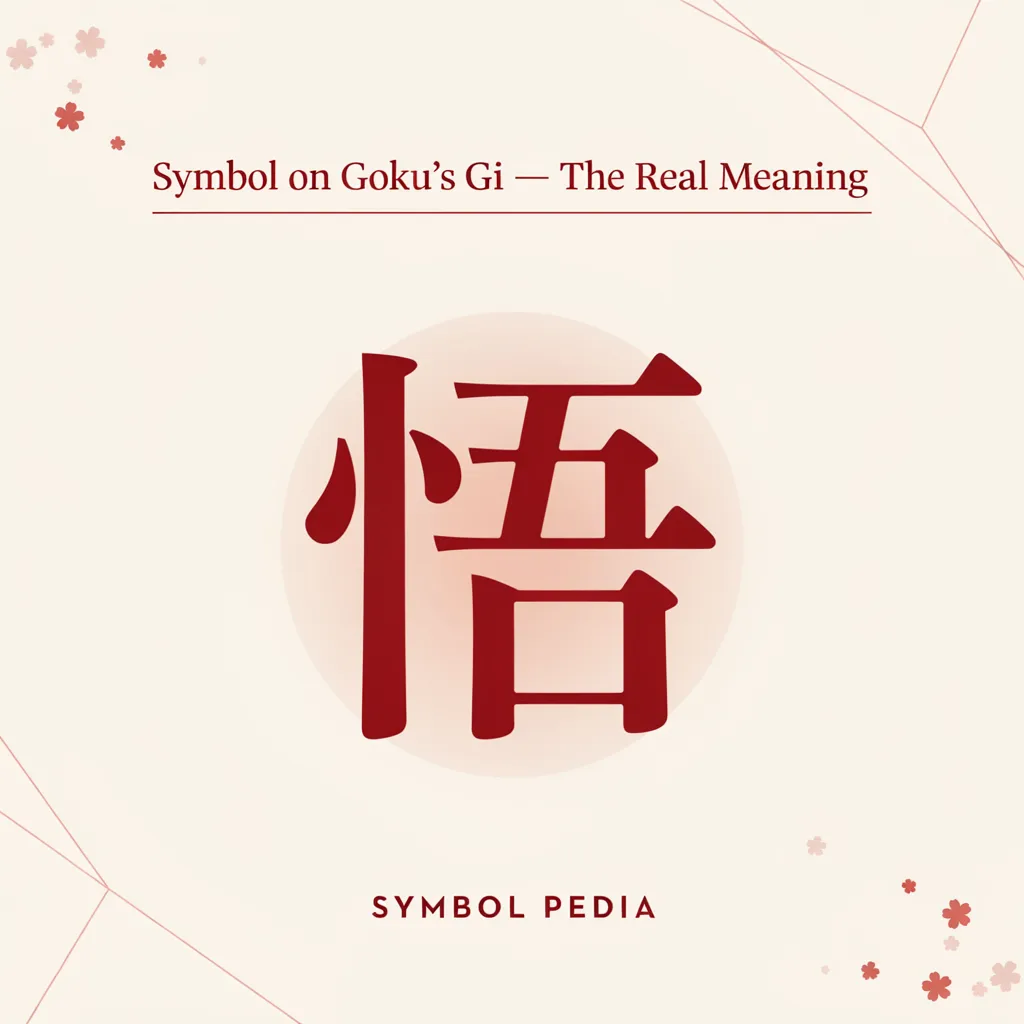
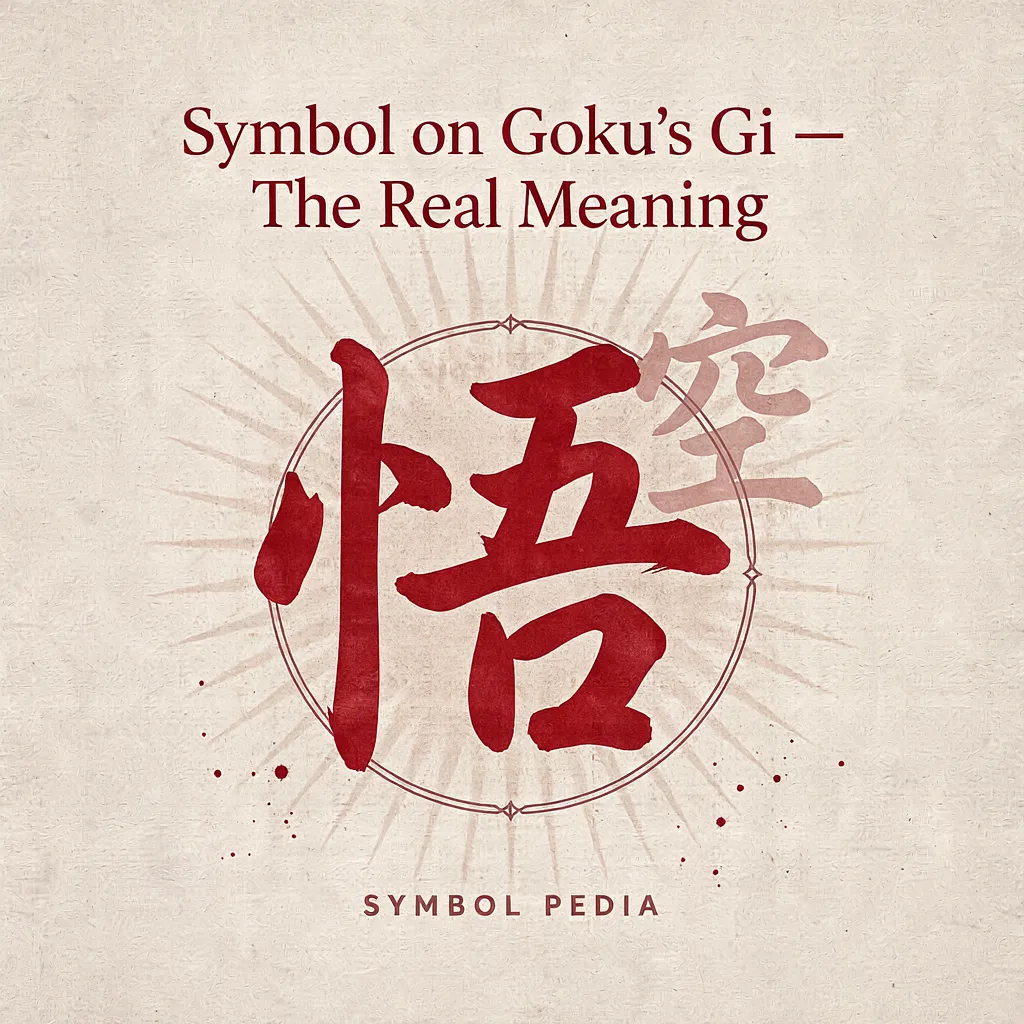
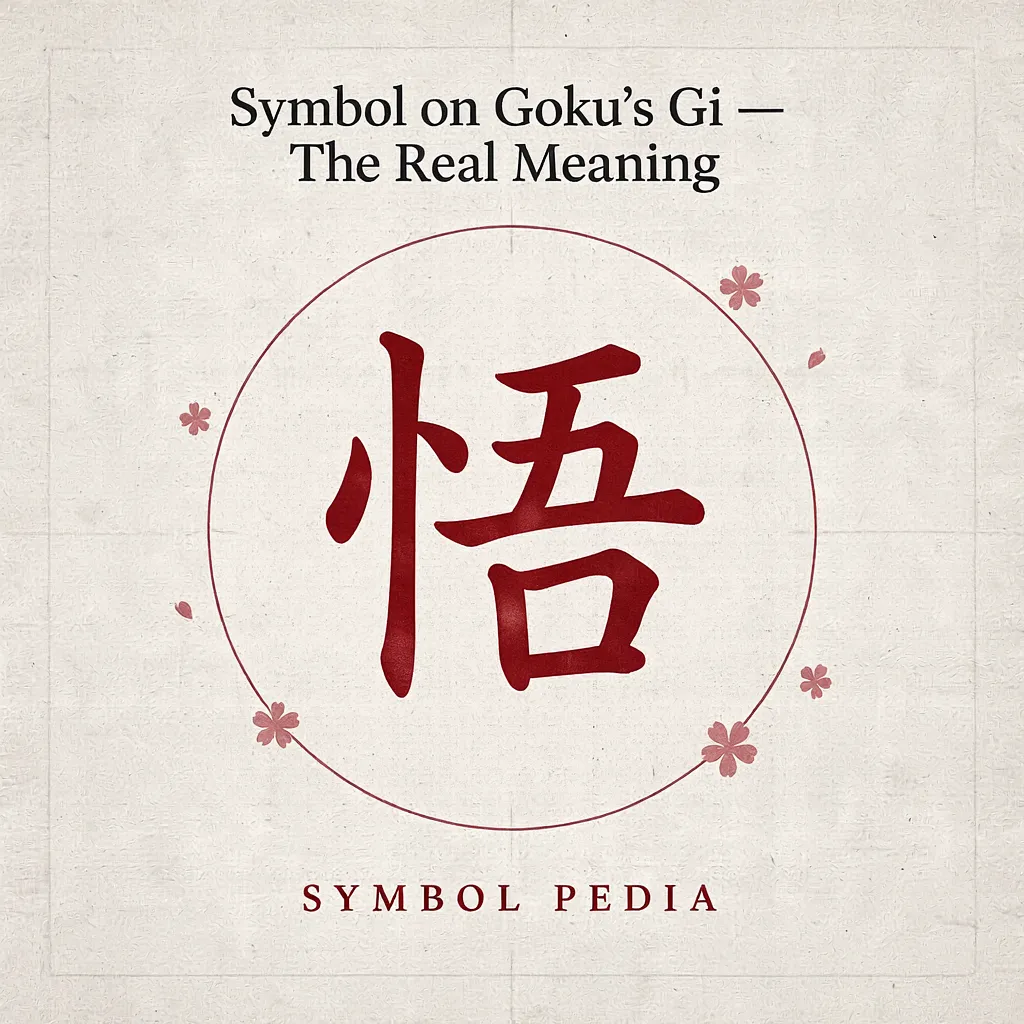
Early on, the 亀 (Kame) symbol identifies him with Master Roshi’s Turtle School. After Goku trains with King Kai, another symbol appears on his clothing. Later, Goku wears 悟 (Go), a kanji associated with his own name and commonly interpreted in the series as relating to wisdom or enlightenment.
There is therefore a deeper story behind the patches.
Goku begins as a student carrying his teacher’s symbol.
Eventually, he becomes a master in his own right.
That change is one reason the symbols are so meaningful to longtime Dragon Ball fans.
Origin & Background of Goku’s Gi Symbol
To understand the symbol, it helps to understand the martial arts tradition behind it.
Goku’s orange uniform is generally associated with the Turtle School, founded and taught by Master Roshi. Students who complete his training can wear the 亀 kanji on their martial arts clothing.
Goku and Krillin are two of the most recognizable students connected with the symbol.
The mark therefore works almost like a school emblem.
Instead of simply saying, “I study under this teacher,” the character on the uniform visually tells viewers where the fighter’s martial arts roots come from.
Why a turtle?
The turtle is connected directly to the identity of the Turtle School.
It also fits the broader personality of Master Roshi’s teaching philosophy. Martial arts in Dragon Ball are not presented simply as a way to become physically powerful.
Training involves patience, discipline, persistence, and learning how to improve yourself.
That makes the humble turtle a fitting emblem for a school whose students eventually become extraordinarily powerful.
The Kamehameha connection
There is another reason the symbol feels so familiar.
Goku learns the famous Kamehameha technique from Master Roshi.
“Kame” means turtle, so the Turtle School identity appears throughout Goku’s martial arts journey rather than existing as an isolated logo.
The symbol, the school, the teacher, and the technique all belong to the same part of Goku’s story.
Goku’s Symbols Change as He Grows
Goku’s changing kanji can almost be read as a visual timeline.
1. 亀 — Kame
This is the Turtle School symbol.
It represents Goku as a student of Master Roshi and his connection to the school’s martial arts tradition.
2. 界王 — Kaiō
After training under King Kai, Goku’s uniform incorporates King Kai’s symbol.
The two kanji 界王 refer to King of Worlds, reflecting his connection to King Kai and the new level of training he receives.
3. 悟 — Go
Later, Goku wears 悟, pronounced Go in this context.
It is associated with Goku’s own name and carries meanings connected with understanding, wisdom, or enlightenment.
This is arguably the most interesting transition.
Goku is no longer simply advertising his teacher’s school.
He has developed his own identity.
4. No Kanji
During parts of Dragon Ball Z, Goku wears a simpler gi without a kanji symbol.
That change can be viewed practically as a design change, but symbolically it also fits Goku’s independence from the formal identities of his earlier training.
5. Whis’ Symbol
During his training with Whis, Goku eventually wears a gi featuring Whis’ signature.
Unlike the Turtle School kanji, this is not simply another Japanese word meaning “turtle” or “wisdom.” It is specifically Whis’ mark.
So when someone says “the symbol on Goku’s gi,” it is worth checking which era or outfit they mean.
Real-Life Conversations About Goku’s Gi Symbol
Sometimes the easiest way to understand a symbol is to see how people actually talk about it.
WhatsApp Conversation
Person A:
Why does Goku have that Japanese-looking symbol on his shirt?
Person B:
The famous one means “turtle.” It represents Master Roshi’s Turtle School.
Person A:
Seriously? I always thought it was Goku’s name.
Person B:
Not the original one. Later he wears his own kanji too.
Person A:
Okay, that makes way more sense now.
Instagram DM
Person A:
I’m thinking about getting Goku’s symbol as a tattoo.
Person B:
Which one?
Person A:
The one on his orange gi.
Person B:
If you mean 亀, that’s the Turtle School symbol.
Person A:
Oh wow. So it’s connected to Master Roshi?
Person B:
Exactly. It represents his martial arts roots.
TikTok Comments
Commenter 1:
What does the symbol on Goku’s gi actually mean?
Commenter 2:
亀 means turtle. It’s the symbol of Master Roshi’s Turtle School.
Commenter 3:
Wait, I thought every symbol on Goku’s shirt meant the same thing.
Commenter 2:
Nope. His gi symbols change throughout the series.
Commenter 3:
That’s actually a cool detail.
Text Message
Person A:
Is Goku wearing his own name on his shirt?
Person B:
Sometimes, yes.
Person A:
Sometimes?
Person B:
Yeah. His later “Go” symbol is 悟. Earlier he wears the Turtle School symbol 亀, and he also has King Kai’s symbol during another part of Z.
Person A:
Dragon Ball has way more symbolism than I realized.
Emotional & Psychological Meaning
The reason Goku’s gi symbols feel meaningful is that they reflect something very human: where you come from versus who you become.
The Turtle symbol represents belonging.
Goku is part of a school. He has a teacher. He has fellow students. He is learning from someone who came before him.
That is an important stage of personal development.
Later, his own 悟 symbol suggests a different idea: Goku has developed far beyond being simply someone’s student.
He still respects his teachers, but his identity is no longer completely defined by them.
That distinction makes the symbol emotionally interesting.
A simple personal-style example
Imagine someone wearing the logo of the school where they learned their first skill.
Years later, they become successful enough to teach others themselves.
The original logo would still matter because it represents where everything began.
That is similar to how Goku’s Turtle School symbol works within his story.
It is a reminder of his beginning, even after he becomes vastly more powerful.
What Goku’s Symbol Represents Emotionally
Depending on the symbol, Goku’s gi can communicate several ideas:
- Respect for teachers
- Belonging
- Discipline
- Personal growth
- Martial arts tradition
- Self-discovery
- Independence
- Wisdom and understanding
That is why fans sometimes choose Goku’s kanji for artwork, clothing, or tattoos.
They may not simply be expressing love for Dragon Ball.
They may also identify with the idea of constantly learning and becoming stronger.
Usage in Different Contexts
On Social Media
Fans commonly use images of Goku’s gi symbol when discussing Dragon Ball, anime symbolism, martial arts, character development, or Japanese kanji.
A caption such as “Back to my roots” can make the Turtle symbol especially meaningful because it connects Goku with his earliest martial arts training.
Among Friends & Relationships
Among anime fans, the symbol is generally understood as a fandom reference.
A Goku-inspired shirt or tattoo can become an easy conversation starter.
Someone might recognize 亀 immediately, while another person may ask what it means.
Work & Professional Settings
The symbol has no special professional meaning in ordinary English-speaking workplaces.
If someone wears it at work, it will usually be interpreted as an anime or martial arts reference rather than a formal Japanese business symbol.
Casual vs. Serious Tone
In casual conversation, people may simply call it “Goku’s symbol.”
In a more detailed discussion, it is better to distinguish between Kame, King Kai’s kanji, Goku’s Go symbol, and Whis’ signature.
That prevents a common misunderstanding.
When NOT to Use Goku’s Symbol
There is nothing inherently offensive about the Turtle School symbol, but context still matters.
Don’t Pretend It Means Something It Doesn’t
If you’re using 亀, don’t tell people it literally means “strength,” “warrior,” or “Goku.”
Its direct meaning is turtle.
Its association with strength and martial arts comes from the Dragon Ball story.
Be Careful With Japanese Kanji Tattoos
If you’re considering a permanent tattoo, make sure you know exactly which character you’re getting.
A character that looks cool may have a completely different meaning from what you expect.
Don’t Treat Every Goku Symbol as Identical
Calling every mark on Goku’s clothing “the Goku symbol” oversimplifies the story.
The different symbols correspond to different stages of his journey.
Common Misunderstandings About Goku’s Gi Symbol
“The symbol means Goku.”
Not necessarily.
The famous 亀 symbol means turtle, not Goku.
“Goku always wears the Turtle symbol.”
No.
His gi changes throughout the story, and there are periods when he wears King Kai’s symbol, his own 悟 symbol, or no kanji at all.
“悟 literally means Goku.”
No.
悟 is a kanji with meanings related to understanding, realization, wisdom, or enlightenment. It is also the character used for the “Go” in Goku’s name.
“The Turtle symbol is just a cool logo.”
It is more than that within the story.
It identifies Goku with the martial arts school of Master Roshi.
“The symbol is Chinese.”
The character 亀 is a Japanese kanji, although kanji themselves originated historically from Chinese writing.
In the Dragon Ball context, it is being used as Japanese writing.
Goku Gi Symbols Compared
| Symbol | Reading | Basic Meaning | What It Represents |
|---|---|---|---|
| 亀 | Kame | Turtle | Master Roshi’s Turtle School |
| 界王 | Kaiō | King of Worlds | King Kai’s training |
| 悟 | Go | Understanding / wisdom / enlightenment | Goku’s own identity |
| None | — | No kanji | Simpler, independent gi design |
| Whis’ mark | — | Whis’ signature | Goku’s training under Whis |
Key Insight
The most famous symbol on Goku’s gi is 亀, meaning “turtle,” but Goku’s clothing symbols change as his martial arts journey develops. The symbols are essentially visual markers of his teachers, training, and growing identity.
How to Respond When Someone Asks About It
Casual Replies
- “It means ‘turtle’ and represents Master Roshi’s Turtle School.”
- “That’s the Turtle School symbol.”
- “It’s basically Goku’s martial arts school emblem.”
Funny Replies
- “Yep, Goku proudly represents the turtle squad.”
- “It’s the official badge of being trained by Master Roshi.”
- “Basically: certified Turtle School student.”
Mature Replies
- “The symbol 亀 means ‘turtle’ in Japanese and represents the Turtle School founded by Master Roshi.”
- “It reflects Goku’s early martial arts training and his connection to Master Roshi.”
Respectful Replies
- “If you mean the 亀 symbol, it represents Master Roshi’s Turtle School. Goku also wears other kanji at different points in the series.”
That last answer is particularly useful because it avoids giving an incomplete explanation.
Regional & Cultural Usage
Western Culture
In the United States, Canada, the United Kingdom, and other Western countries, Goku’s symbol is usually recognized as an anime reference.
Among Dragon Ball fans, 亀 can immediately suggest Goku, Master Roshi, Krillin, or the Kamehameha.
Asian Culture
In Asian communities familiar with Japanese media, the character may be recognized more naturally as Japanese kanji.
However, familiarity varies considerably from person to person.
Someone may recognize the Dragon Ball design without actually knowing how to read the character.
Middle Eastern Culture
Across Middle Eastern anime communities, Goku is extremely recognizable, particularly among generations that grew up watching dubbed anime.
The symbol is generally understood as part of Goku’s identity rather than as an everyday Japanese expression.
Global Internet Usage
Online, the symbol has effectively become a piece of Dragon Ball visual language.
You may see it in fan art, memes, cosplay, clothing, gaming communities, profile images, and tattoo designs.
Its fandom meaning is often more important than its literal translation.
Gen Z vs. Millennials
Older fans who watched Dragon Ball Z during its original television era may associate the symbol strongly with childhood memories.
Younger fans may discover the same mark through Dragon Ball Super, games, YouTube, TikTok, streaming platforms, or online fandoms.
The context may differ, but the symbol remains recognizable.
Is the Goku Symbol Safe for Kids?
Yes, the Turtle School symbol itself is generally harmless for children.
It is simply the Japanese character 亀, meaning “turtle,” and within Dragon Ball it represents Master Roshi’s martial arts school.
The important point is context. Parents should distinguish the harmless symbol from other Dragon Ball imagery or themes that may involve fantasy violence.
FAQs
What does the symbol on Goku’s gi mean?
The famous 亀 symbol means “turtle” in Japanese and represents Master Roshi’s Turtle School.
What does 亀 mean on Goku’s shirt?
亀 is the Japanese kanji for turtle, or kame. It identifies Goku with the Turtle School.
Is Goku’s symbol his name?
Not always. Goku wears several symbols throughout the series. His own kanji is 悟, read as Go in his name.
What does Goku’s Go symbol mean?
悟 has meanings related to understanding, realization, wisdom, or enlightenment. It is associated with Goku’s own identity.
Why does Goku change the symbol on his gi?
The changes correspond to different stages of his training and personal development, including his time with Master Roshi and King Kai.
What does King Kai’s symbol on Goku’s gi mean?
界王 refers to King Kai, commonly translated as “King of Worlds.” Goku wears it after training under King Kai.
Is the symbol on Goku’s gi Chinese or Japanese?
The writing is Japanese kanji in the context of Dragon Ball. Kanji historically originated from Chinese characters, but Japanese uses them as part of its writing system.
Conclusion
So, what does the symbol on Goku’s gi mean?
If you are talking about the classic 亀 mark, it means “turtle” and represents Master Roshi’s Turtle School. It is a symbol of Goku’s early martial arts education, discipline, and connection to the teacher who helped shape him.
But Goku’s story goes deeper than one symbol.
As he grows, his gi changes. He wears King Kai’s symbol, eventually adopts 悟, his own kanji, and at other points wears a gi without kanji or one bearing Whis’ signature.
That progression is what makes Goku’s clothing so interesting.
The symbols tell a quiet story: first you learn from others, then you discover your own path.
And perhaps that is why the simple turtle on Goku’s orange gi has remained so memorable for generations of fans.
descover more post
What Does the Lock Symbol Mean on Snapchat Everything …
Ohm Symbol and Meaning Understanding Ω Its History and …
What Does the Clover Symbol Mean Luck Love Culture More …

Orvian is a passionate researcher and dedicated content creator focused on exploring the deeper meanings behind symbols, signs, and cultural interpretations. With a strong interest in symbolism and human psychology, Orvian simplifies complex ideas into clear, engaging, and easy-to-understand content for readers around the world.
Through consistent research and thoughtful writing, Orvian aims to provide accurate, insightful, and meaningful information that helps users connect with symbols on a deeper level—whether for personal growth, curiosity, or knowledge.
Known for a hardworking mindset and attention to detail, Orvian believes that every symbol carries a story, and every story deserves to be understood.