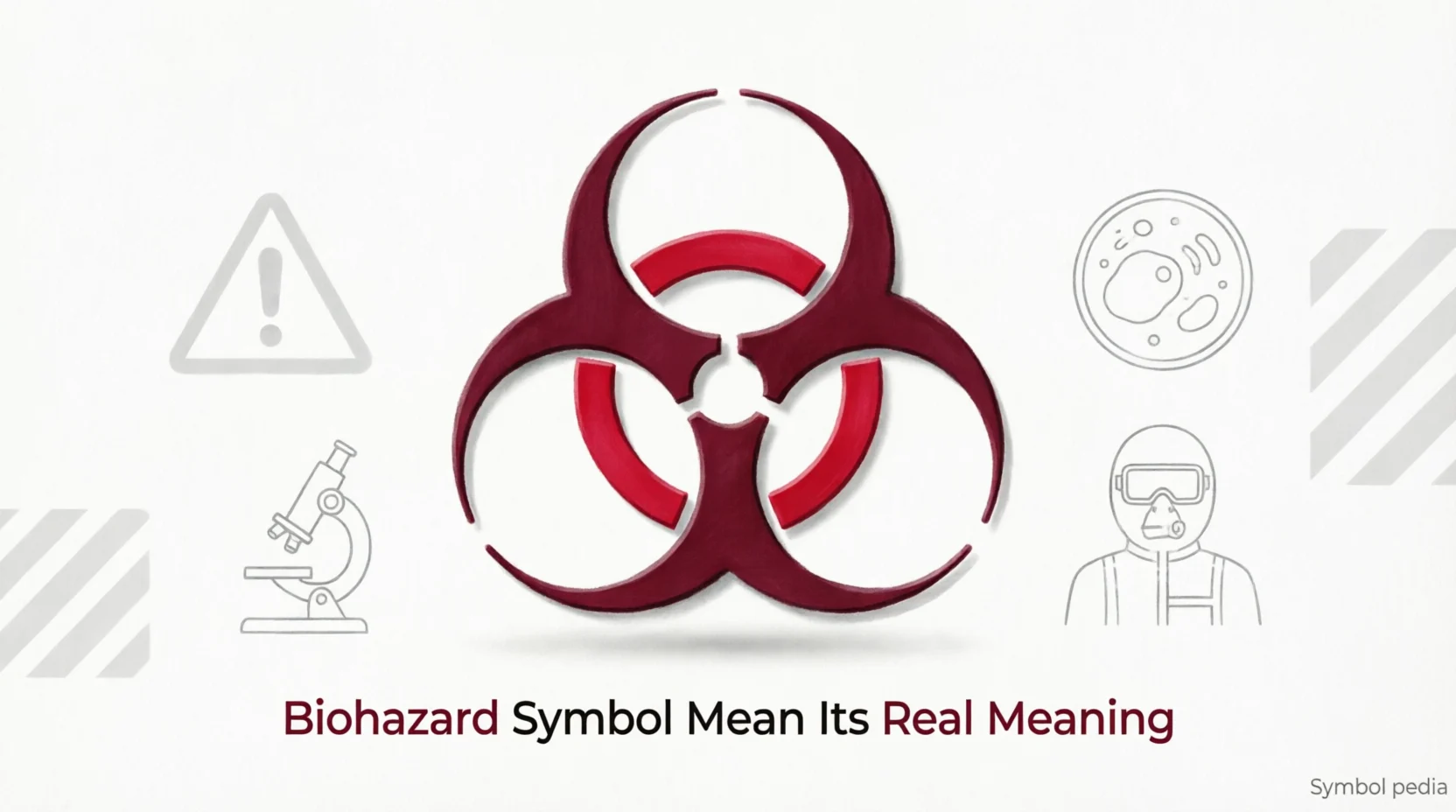
Have you ever seen a black symbol made of three curved shapes around a central circle and wondered, what does the biohazard symbol mean?
The symbol is designed to communicate one important message quickly: biological material or conditions may present a hazard to human health, animals, or the environment.
You may notice it on laboratory doors, containers holding biological waste, medical facilities, research equipment, or warning labels. Unlike ordinary signs that simply provide information, the biohazard symbol is meant to make people pause and recognize that special care may be necessary.
Many people also encounter it online, in movies, video games, tattoos, clothing designs, or social media posts. In those settings, its meaning can become more symbolic, sometimes representing danger, contamination, disease, fear, or something considered “toxic.”
Understanding the difference between its literal safety meaning and its figurative cultural meaning makes the symbol much easier to interpret.
What Does the Biohazard Symbol Mean? – Quick Meaning
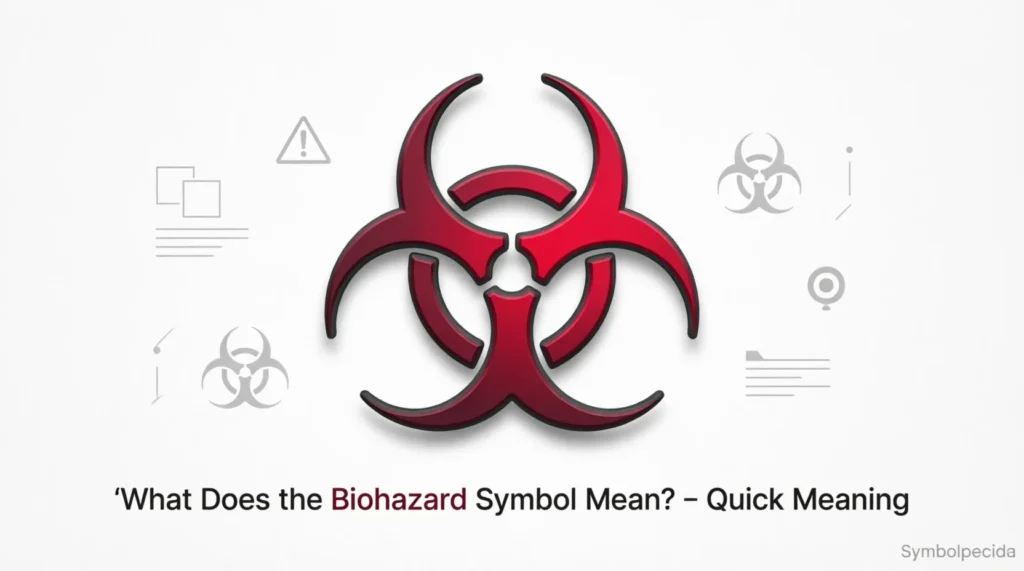
The biohazard symbol is an internationally recognized warning symbol used to identify biological substances, materials, or situations that could pose a biological risk.
In simple terms, it means:
- Biological hazard may be present.
- Contact may require special precautions.
- The material should not be handled casually.
- Protective procedures may be required.
The symbol does not automatically mean that something is poisonous or radioactive. It specifically points toward a biological hazard.
For example:
“That container has a biohazard symbol, so don’t open it.”
“The laboratory door has a biohazard warning.”
“Follow the safety instructions whenever you see this symbol.”
The exact risk depends on the material and environment where the symbol appears.
Origin & Background of the Biohazard Symbol
The modern biohazard symbol has an interesting history because it was created specifically to solve a communication problem.
In the late 1960s, scientists and safety professionals recognized the need for a warning symbol that could communicate biological danger quickly and consistently.
The symbol was developed at Dow Chemical Company in the United States in 1966. A team led by environmental health engineer Charles L. Baldwin worked on creating a design that would be distinctive, memorable, and easy to recognize.
The designers wanted something that did not look like an ordinary alphabetic character or familiar logo. It needed to stand out and remain recognizable even when viewed from different angles.
The resulting design uses three interlocking curved shapes surrounding a central circle. Its unusual appearance helps distinguish it from other hazard symbols.
Over time, the symbol became strongly associated with laboratories, infectious materials, medical waste, and biological research.
Why Is the Design So Memorable?
One reason the biohazard symbol works well is its visual simplicity.
It contains repeated shapes arranged symmetrically around a center. This creates a pattern that is difficult to confuse with everyday signs.
Its strong contrast, commonly black against a yellow or orange background, also helps attract attention.
The design is not intended to tell you exactly what the hazard is. Instead, it gives you an immediate reason to stop and look for additional safety information.
Cultural Influence
Outside scientific and medical environments, the symbol gradually became a cultural shorthand for danger.
Films, television shows, video games, music, fashion, and internet culture have used it to suggest contamination, outbreaks, dystopian environments, or forbidden experiments.
Because of this exposure, many people recognize the symbol even if they have never worked in a laboratory.
Social Media Impact
On social media, the symbol is sometimes used metaphorically.
Someone might describe a chaotic situation as “biohazard” or use the symbol jokingly to describe something extremely unpleasant.
That usage is different from the official safety meaning.
A meme using ☣️ may communicate humor or exaggeration, while the same symbol on a laboratory container is a genuine warning.
Real-Life Conversations
WhatsApp Conversation
Person A: Why does that box have that strange warning symbol?
Person B: The biohazard symbol? It means there could be biological material inside.
Person A: So I shouldn’t touch it?
Person B: Right. Don’t handle it unless you’re authorized and know the proper safety procedure.
Instagram DM
Person A: I keep seeing this ☣️ symbol in horror posts. What does it actually mean?
Person B: Literally, it’s a biological hazard warning.
Person A: Oh, so the posts are using it because it looks dangerous?
Person B: Exactly. Online, people often use it symbolically for something toxic, contaminated, or disturbing.
TikTok Comments
Commenter 1: Why does everyone keep using this symbol?
Commenter 2: ☣️ It’s the biohazard symbol.
Commenter 1: Does it mean radiation?
Commenter 2: No. Radiation has a different symbol. This one specifically relates to biological hazards.
Text Message
Person A: The door at work has a biohazard sign on it.
Person B: Is it part of a medical or laboratory area?
Person A: Yeah.
Person B: Then follow the posted instructions and don’t enter restricted areas without permission.
Emotional & Psychological Meaning
The biohazard symbol has a powerful psychological effect because humans naturally respond to visual warnings.
Its unusual shape, strong contrast, and association with disease or contamination can create an immediate feeling of caution.
Even when people do not know the technical definition, they often understand that the symbol means “stop and pay attention.”
What Emotion Does It Express?
Depending on context, it can suggest:
- Fear
- Caution
- Danger
- Uncertainty
- Contamination
- Threat
- Curiosity
- Discomfort
In a laboratory, the emotion should lead to responsible behavior.
On social media, however, the same symbol may simply be used for dramatic humor.
Why Do People Use It Symbolically?
People often borrow warning symbols because the meaning is already emotionally powerful.
Calling something “biohazard” metaphorically can suggest that it is extremely unpleasant, chaotic, toxic, or something people should avoid.
For example, a person might jokingly call an extremely messy kitchen a “biohazard.”
The statement is not necessarily claiming that the kitchen contains a genuine biological hazard. It is exaggeration for effect.
A Human Example
Imagine walking into a research facility and seeing the symbol on a closed container. Even without knowing what is inside, you would probably become more careful.
Now imagine seeing the same symbol attached to a funny social media post about someone’s disastrous cooking.
The symbol has not changed, but the context has changed its emotional function.
That is an important lesson in modern visual communication: symbols can carry both literal and cultural meanings.
Usage in Different Contexts
Social Media
On social platforms, ☣️ is often used as an attention-grabbing emoji or visual joke.
It can imply:
- Something disgusting
- A chaotic situation
- Toxic behavior
- An uncomfortable experience
- A dangerous-looking situation
- Dark humor
The meaning is usually figurative unless the post is specifically discussing biological safety.
Friends & Relationships
Friends may use the symbol playfully.
Someone might write:
“Your room is officially ☣️.”
This normally means the room is extremely messy, not that it contains an actual biological threat.
It can also describe a relationship or personality metaphorically as “toxic,” although this usage should be understood from context.
Work & Professional Settings
Professional use is much more serious.
The symbol may appear in:
- Laboratories
- Hospitals
- Research facilities
- Waste-handling areas
- Medical settings
- Biological research environments
- Containers and equipment
In these situations, treat it as a genuine safety warning.
Casual vs. Serious Tone
The same symbol can therefore have completely different meanings.
Casual: “My fridge is a biohazard ☣️.”
Serious: “The container is marked with a biohazard warning.”
Context determines whether the expression is humorous or safety-related.
When NOT to Use the Biohazard Symbol
Although the symbol is common online, it should not be treated as a universal decoration for anything “dangerous.”
Don’t Use It to Give Fake Safety Information
Using a biohazard symbol on an ordinary object can cause unnecessary fear or confusion.
Official warning symbols should communicate real hazards accurately.
Don’t Mock Genuine Biological Risks
Using biological hazards as the punchline of a joke can be insensitive in situations involving real disease outbreaks, medical emergencies, or people directly affected by illness.
Be Careful in Professional Settings
Do not place or reproduce hazard symbols on workplace containers, doors, or materials unless they are being used appropriately.
A misleading warning can create serious communication problems.
Consider Cultural Context
People from different backgrounds may interpret a hazard symbol differently.
Someone familiar with laboratories may immediately understand the technical meaning, while another person may simply interpret it as “danger.”
Common Misunderstandings
“It Means Radiation”
This is one of the most common mistakes.
The biohazard symbol and the radiation warning symbol are different. Biohazard refers to biological risks, while the trefoil radiation symbol relates to ionizing radiation.
“It Means Poison”
Not necessarily.
A poisonous chemical can require a different hazard classification and warning symbol. The biohazard symbol specifically communicates a biological hazard.
“It Always Means Someone Is Sick”
No.
The symbol can identify biological materials, waste, equipment, areas, or procedures where biological hazards may be present. Its presence does not tell you that a particular person is infected.
“It Is Just a Scary Symbol”
Not in its official use.
The design may look intimidating, but its purpose is practical: to communicate a safety concern quickly.
“The Emoji Always Means a Real Hazard”
No.
Online, ☣️ can be used metaphorically, humorously, or aesthetically. Always consider where and how it appears.
Biohazard Symbol vs. Similar Expressions
| Symbol or Expression | Main Meaning | Typical Context |
|---|---|---|
| ☣️ Biohazard | Biological hazard | Laboratories, medical settings, safety warnings |
| ☢️ Radiation | Radiation hazard | Nuclear, radiological, or radiation-related environments |
| ⚠️ Warning | General caution or danger | Everyday warnings and notices |
| ☠️ Skull and crossbones | Poison, toxicity, or severe danger | Toxic substances and symbolic danger |
| “Toxic” | Harmful, unhealthy, or metaphorically damaging | Relationships, environments, online discussions |
| “Danger” | Serious potential hazard | General safety communication |
| “Contaminated” | Presence of unwanted or harmful contamination | Medical, scientific, food, or environmental contexts |
Key Insight
The most important distinction is context. A symbol on a regulated safety label should be interpreted literally, while the same symbol in a meme, caption, or conversation may be figurative.
How to Respond When Someone Uses It
Your response should depend on whether the symbol is being used literally or jokingly.
Casual Replies
If a friend uses ☣️ humorously:
- “Okay, what happened?”
- “That bad?”
- “Now I’m curious 😂”
- “Should I be worried?”
Funny Replies
For playful situations:
- “Do I need protective equipment?”
- “That sounds serious ☣️😂”
- “I’m staying far away.”
- “Emergency mode activated.”
Mature Replies
When the situation sounds serious:
- “What exactly is the risk?”
- “Is there a safety procedure we should follow?”
- “Let’s check the instructions before handling it.”
Respectful Replies
In a professional or medical context:
- “Understood. I’ll follow the posted safety instructions.”
- “Thanks for letting me know.”
- “I’ll avoid handling it without authorization.”
When in doubt, don’t joke first. Clarify the context.
Regional & Cultural Usage
The official meaning of the biohazard symbol is broadly consistent internationally, but its social and emotional associations can vary.
Western Culture
In the United States and Europe, the symbol is strongly associated with laboratories, medical waste, infectious materials, and science-fiction imagery.
Popular entertainment has also made it familiar to people who have never encountered it professionally.
Asian Culture
Across many Asian countries, the symbol is also recognized as a biological warning.
However, online communities may use it creatively in memes, gaming, fashion, and digital communication, where it can carry exaggerated or humorous meanings.
Middle Eastern Culture
The symbol generally retains its international safety meaning in medical, laboratory, and professional environments.
In informal online communication, interpretation can shift toward the broader idea of danger, contamination, or something undesirable.
Global Internet Usage
Internet culture has made the symbol more flexible.
A person might use ☣️ to describe a terrible smell, an embarrassing situation, toxic behavior, or an absurdly messy environment.
This is a good example of how digital communication can turn a technical symbol into emotional shorthand.
Gen Z vs. Millennials
Younger internet users may be more comfortable using symbols like ☣️ playfully alongside emojis, memes, and slang.
Millennials may recognize the same symbol primarily through science-fiction, workplace, medical, or safety contexts.
Neither interpretation is automatically wrong. Context tells you which meaning is intended.
Is the Biohazard Symbol Safe for Kids?
Yes, seeing or learning about the symbol is not inherently unsafe for children.
In fact, teaching children that certain warning signs mean “stop and ask a trusted adult” can support basic safety awareness.
The important point is context.
A child should understand that a biohazard warning is not something to investigate or touch. If they see the symbol on an unfamiliar container, door, or piece of equipment, they should stay away and tell a responsible adult.
Online, parents and educators can also explain that the emoji ☣️ may be used jokingly and does not always indicate a real biological hazard.
FAQs
What does the biohazard symbol mean?
The biohazard symbol warns that biological materials, substances, or environments may present a biological risk and may require special precautions.
What does ☣️ mean in texting?
In texting, ☣️ can literally refer to a biological hazard, but it is often used figuratively to describe something dangerous, toxic, disgusting, or chaotic.
Is the biohazard symbol the same as the radiation symbol?
No. The biohazard symbol indicates biological hazards, while the radiation symbol indicates a radiation hazard.
Why is the biohazard symbol used?
It provides a quick visual warning so people can recognize a potential biological hazard without needing to read a long explanation first.
Where can you see the biohazard symbol?
It can appear in laboratories, healthcare environments, biological research facilities, waste-handling areas, and on containers or equipment associated with biological hazards.
Does the biohazard symbol mean something is poisonous?
Not necessarily. Poison or chemical toxicity can require different warning symbols. Biohazard specifically relates to biological hazards.
Why do people use the biohazard emoji online?
People use ☣️ online both literally and humorously. It can represent contamination, danger, toxicity, chaos, or something unpleasant depending on the conversation.
Conclusion
So, what does the biohazard symbol mean? At its core, it is a warning that a biological hazard may be present and that appropriate precautions may be necessary.
Its official meaning is practical and serious, especially in laboratories, healthcare environments, research facilities, and biological-waste areas.
But language does not stay inside laboratories. Online communities have given the symbol additional emotional meanings. Today, ☣️ can suggest danger, toxicity, contamination, chaos, or even humor.
The key is to read the context before interpreting the symbol.
If you see it on an official warning label, take it seriously. If you see it in a meme or text message, look at the surrounding conversation before assuming there is a real hazard.
Once you understand that difference, this unusual symbol becomes much easier to recognize—and much harder to misunderstand.
descover more post
What Does the Lock Symbol Mean on Snapchat Everything …
Ohm Symbol and Meaning Understanding Ω Its History and …
What Does the Clover Symbol Mean Luck Love Culture More …

Orvian is a passionate researcher and dedicated content creator focused on exploring the deeper meanings behind symbols, signs, and cultural interpretations. With a strong interest in symbolism and human psychology, Orvian simplifies complex ideas into clear, engaging, and easy-to-understand content for readers around the world.
Through consistent research and thoughtful writing, Orvian aims to provide accurate, insightful, and meaningful information that helps users connect with symbols on a deeper level—whether for personal growth, curiosity, or knowledge.
Known for a hardworking mindset and attention to detail, Orvian believes that every symbol carries a story, and every story deserves to be understood.