A white wolf is a striking image. Its pale fur, sharp eyes, and quiet presence often create a feeling of mystery, freedom, and strength. Across art, stories, spiritual discussions, and modern social media, the white wolf has become a powerful symbol of independence, loyalty, intuition, and transformation.
But what does the white wolf symbol mean, really?
For some people, it represents inner strength and the courage to stand alone. For others, it symbolizes spiritual protection, wisdom, purity, or a deep connection with nature. Its meaning can also change depending on whether it appears in a dream, tattoo, piece of artwork, spiritual practice, or personal message.
This variety can make the symbol confusing. A white wolf is not automatically a sign of good luck, a supernatural guide, or a message from the universe. Its interpretation depends on cultural background, personal beliefs, and the situation in which it appears.
In this guide, we will explore the white wolf symbol meaning from spiritual, psychological, cultural, and everyday perspectives. You will discover what it can represent, how people use it online, what it means in tattoos and dreams, and how to interpret it without treating every symbolic association as a universal fact.
White Wolf Symbol Meaning – Quick Explanation
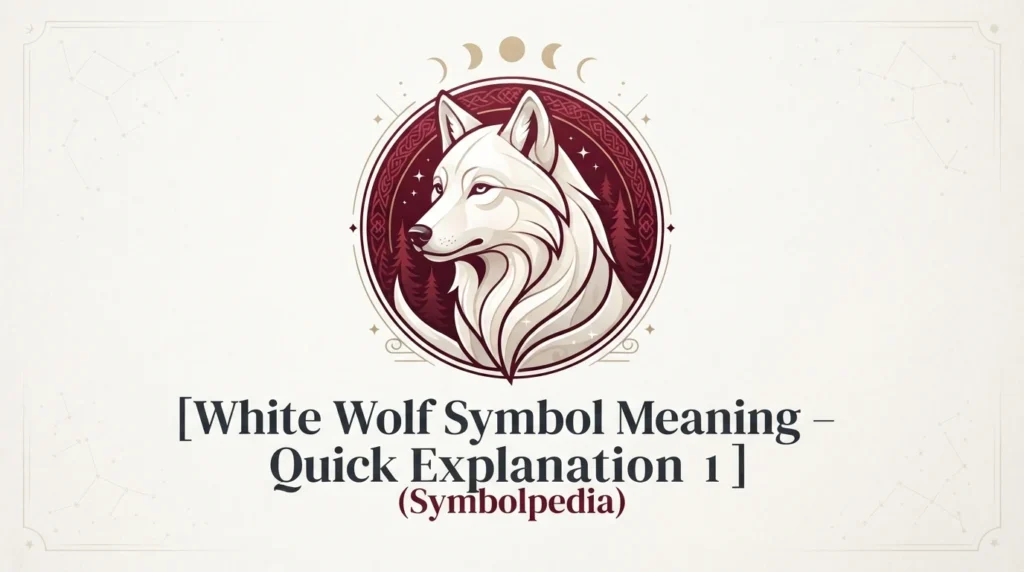
The white wolf commonly symbolizes strength, loyalty, independence, intuition, spiritual awareness, and transformation. Its white coloring may add associations with purity, peace, clarity, or mystery.
Here are some of its most familiar symbolic interpretations:
- Strength: The ability to face challenges without giving up.
- Loyalty: Commitment to family, friends, and a trusted community.
- Independence: Confidence in choosing your own path.
- Intuition: Paying attention to instincts and subtle feelings.
- Purity and clarity: Seeking honesty, peace, or a fresh beginning.
- Spirituality: A personal connection with nature, mystery, or inner wisdom.
- Transformation: Moving beyond an old identity and becoming more confident.
For example, someone might describe a difficult period in their life by saying, “I had to find my inner white wolf.” They may mean they learned to trust themselves and face problems independently.
Someone else might choose a white wolf tattoo to represent loyalty to their family while maintaining their personal freedom.
A third person may use a white wolf as a profile picture because they identify with its calm, mysterious appearance.
These interpretations overlap, but they are not identical. The symbol becomes more meaningful when you understand what it represents to the individual using it.
Origin and Background of the White Wolf Symbol
The white wolf symbol does not come from one single tradition. Its meaning has developed through relationships between humans and wolves, folklore, literature, spiritual beliefs, and modern popular culture.
Wolves in human history
Wolves have occupied an important place in human imagination for thousands of years. As social predators with strong family relationships, they have inspired admiration, fear, respect, and curiosity.
Their coordinated hunting, communication, and care for young have made them natural symbols of cooperation and loyalty. Their ability to survive in challenging environments has also contributed to their association with resilience and independence.
However, wolves have not always been viewed positively. In some European folktales, they appear as dangerous creatures that threaten people or livestock. In other stories, wolves represent intelligence, guardianship, or a powerful connection with the wilderness.
The white wolf inherits some of these broader wolf associations, but its white coat adds another layer of interpretation.
The symbolism of white
In many artistic and cultural settings, white is associated with light, cleanliness, peace, innocence, or spiritual clarity.
Combining white with the wolf creates an interesting contrast. The wolf can represent wild instincts and untamed nature, while the color white may suggest calmness, purity, or mystery.
This combination can symbolize someone who possesses strength without cruelty or independence without losing compassion.
Color symbolism is not universal, however. White can also be associated with mourning or death in some cultural traditions. Its meaning depends on the setting and the beliefs of the people interpreting it.
White wolves in mythology and folklore
Wolves appear in numerous cultural traditions, but it is important not to treat all wolf stories as versions of the same white wolf legend.
In Norse mythology, wolves have significant roles in stories involving gods, fate, and cosmic conflict. In Roman mythology, the she-wolf associated with Romulus and Remus represents a form of nurturing and protection.
Some Indigenous cultures also have important relationships with wolves in their traditional stories and teachings. These traditions are diverse, and wolves may carry meanings connected with family, responsibility, hunting, land, or spiritual relationships.
A white wolf may appear in contemporary interpretations inspired by these themes, but it would be inaccurate to claim that every culture traditionally regards white wolves as spiritual guardians.
The influence of modern media
Films, fantasy novels, video games, and digital artwork have helped popularize the image of the mysterious white wolf.
In fantasy settings, white wolves often appear as companions, protectors, rare creatures, or guides through dangerous landscapes. Their appearance can suggest that a character is entering a period of change or discovering hidden abilities.
Social media has expanded these associations. People use white wolf images in profile pictures, inspirational posts, usernames, and spiritual artwork to communicate strength, individuality, or mystery without explaining their feelings in words.
As a result, the white wolf has become a flexible symbol that people can adapt to their own experiences.
Real-Life Conversations: What the White Wolf Symbol Can Mean
The following fictional conversations illustrate how people might interpret a white wolf in everyday situations. They show personal associations rather than universal spiritual rules.
1. WhatsApp: A symbol of personal strength
Person A: “Why did you change your profile picture to a white wolf?”
Person B: “It reminds me of how I felt when I was going through a difficult time.”
Person A: “Because it looks strong?”
Person B: “Exactly. It reminds me that I can keep going, even when things get difficult.”
What this means: Here, the white wolf represents resilience and self-confidence. The person connects the image with a personal experience rather than a fixed cultural meaning.
2. Instagram DMs: Loyalty and independence
Person A: “Your white wolf tattoo looks amazing. Does it mean something?”
Person B: “It represents loyalty to my family, but also learning to stand on my own.”
Person A: “I like that combination.”
Person B: “That’s what makes it personal to me.”
What this means: The white wolf represents two qualities that can exist together: commitment to others and the ability to make independent decisions.
3. TikTok comments: Spiritual interpretation
Person A: “I keep seeing white wolf videos on my feed. Is there a spiritual meaning?”
Person B: “Some people associate white wolves with intuition, protection, or transformation.”
Person A: “So does it mean something is about to happen?”
Person B: “Not necessarily. It can also be a reminder to reflect on what’s happening in your life.”
What this means: The conversation distinguishes a spiritual interpretation from a guaranteed prediction. A symbol can encourage reflection without proving that an event is coming.
4. Text messages: A new beginning
Person A: “I chose a white wolf for my journal cover.”
Person B: “That’s interesting. Why a wolf?”
Person A: “I’m starting a new chapter in my life. I want to be more confident and trust myself.”
Person B: “Then it sounds like a good reminder.”
What this means: The white wolf becomes a personal symbol of growth, independence, and a fresh start.
Emotional and Psychological Meaning of the White Wolf
Symbols can be emotionally powerful because they allow people to express complicated experiences through a single image.
A white wolf may represent something that is difficult to explain directly: a need for freedom, a desire to feel protected, or the determination to keep moving forward.
Strength after difficult experiences
People sometimes connect wolves with the ability to survive hardship. A white wolf can represent the moment when someone stops defining themselves by past difficulties and begins to recognize their own resilience.
This does not mean a person must handle every challenge alone. Genuine strength can also involve asking for help, setting boundaries, and accepting support.
The balance between solitude and belonging
Wolves are often described as symbols of independence, but real wolves are also social animals. Many live in family groups and depend on cooperation.
This creates a meaningful contrast in symbolism.
The white wolf can represent a person who values solitude but still wants genuine relationships. They may enjoy their own company without rejecting friendship, love, or family.
For someone recovering from a difficult relationship, the symbol might represent learning to feel comfortable alone while remaining open to future connections.
Intuition and self-trust
The wolf’s association with sharp senses and awareness makes it a natural image for intuition.
In a symbolic sense, a white wolf may remind someone to notice their feelings, pay attention to patterns, and think carefully before making a decision.
Intuition should not replace evidence or careful judgment. Instead, it can be one part of understanding a situation.
A personal-style example
Imagine someone who has spent years trying to please everyone around them. They regularly agree to things they do not want to do because they fear disappointing others.
After a period of reflection, they choose a white wolf as their phone wallpaper. To them, it represents the courage to establish boundaries, make independent choices, and remain kind without abandoning their own needs.
The image does not magically change their life. It serves as a reminder of the person they want to become.
That is one of the most useful ways to understand symbolic meaning: an image can help someone focus on a value they want to practice.
White Wolf Symbol Meaning in Different Contexts
1. Spirituality and personal growth
In contemporary spiritual interpretations, a white wolf may represent protection, intuition, inner wisdom, or a transition into a new stage of life.
Some people interpret seeing a white wolf as a reminder to reconnect with themselves or pay attention to their surroundings.
These are matters of personal belief, not established evidence that a supernatural force is communicating with someone.
2. Tattoos and body art
A white wolf tattoo can represent strength, loyalty, independence, family, or survival.
The design changes the interpretation. A white wolf standing alone may emphasize independence, while a wolf with cubs may suggest family and protection.
A wolf facing forward may communicate confidence or vigilance. A wolf beneath a moon may emphasize mystery, nature, or a connection with nighttime imagery.
Before choosing a tattoo inspired by a cultural or spiritual tradition, research its specific meaning rather than assuming the design has the same significance everywhere.
3. Dreams
Dreams involving white wolves can feel vivid, especially when the animal appears calm, threatening, or unusually intelligent.
Some popular dream interpretations associate a peaceful white wolf with self-trust or protection. A frightening wolf may reflect feelings of uncertainty, vulnerability, or conflict.
However, dreams do not have a universal symbolic dictionary. A dream’s meaning may be influenced by recent experiences, emotions, memories, and personal associations.
Instead of treating a white wolf dream as a prediction, consider how you felt during the dream and what is happening in your life.
4. Social media and profile pictures
A white wolf profile picture can communicate confidence, mystery, loyalty, or an interest in wildlife and fantasy art.
It may also simply reflect someone’s favorite animal or preferred visual style.
You should not assume that a person is lonely, aggressive, spiritual, or emotionally distant just because they use a wolf image.
5. Work and professional settings
The white wolf is not a standard professional symbol with one established business meaning.
A company, team, or creative project might use it to represent resilience, cooperation, or leadership. In that case, the intended meaning should come from the organization’s own message.
In formal communication, explain the symbolism when it is relevant instead of expecting everyone to recognize it.
6. Casual versus serious use
In casual conversations, a white wolf emoji, illustration, or reference can communicate an aesthetic preference or personal mood.
In serious discussions about identity, spirituality, or cultural heritage, it is better to explain what the symbol means to you and avoid making sweeping claims about what it means to everyone.
When NOT to Use the White Wolf Symbol
The white wolf is not inherently offensive, but some uses may be insensitive or misleading.
Avoid claiming that one interpretation represents every culture. Different communities have distinct histories, beliefs, and relationships with wolves.
Do not use the symbol to make unsupported spiritual promises. A white wolf image cannot guarantee protection, success, or a particular future event.
Be careful when borrowing sacred imagery. If a design is connected with a specific community or spiritual tradition, learn about its meaning and whether it is appropriate to use outside that context.
Do not judge someone by their chosen image. A white wolf tattoo or profile picture does not prove that a person has a particular personality, belief system, or emotional history.
The symbol is most meaningful when used thoughtfully rather than as a shortcut for making assumptions about people.
Common Misunderstandings About White Wolf Symbolism
Misunderstanding 1: A white wolf always means purity
White is often associated with purity, but that is only one possible interpretation. A white wolf may represent mystery, resilience, independence, or danger depending on the artwork and context.
Misunderstanding 2: Seeing a white wolf is always a spiritual sign
Some people interpret an encounter or repeated image spiritually. Others see it as an ordinary experience or a reminder of a personal goal.
There is no reliable basis for claiming that every white wolf sighting carries a supernatural message.
Misunderstanding 3: White wolves symbolize loneliness
The lone wolf is a familiar cultural image, but wolves are social animals. A white wolf can symbolize independence without implying that a person wants to be isolated.
Misunderstanding 4: All wolf tattoos mean aggression
Wolf imagery can express courage, guardianship, loyalty, family, or appreciation for wildlife. A white wolf design does not automatically communicate hostility.
Misunderstanding 5: Every culture shares the same interpretation
Symbolism varies across communities and traditions. It is more accurate to describe particular interpretations than to assign one universal meaning to every white wolf image.
Comparison Table: White Wolf and Related Symbols
| Symbol | Common symbolic associations | Difference from a white wolf |
|---|---|---|
| White wolf | Strength, loyalty, independence, intuition | Combines wolf symbolism with associations linked to white coloring |
| Black wolf | Mystery, power, shadow, resilience | Often emphasizes darkness or the unknown in modern symbolic art |
| Lone wolf | Independence, solitude, self-reliance | Focuses on being alone rather than on white coloring |
| Eagle | Vision, freedom, leadership | Commonly emphasizes perspective and soaring above obstacles |
| Owl | Wisdom, observation, mystery | More strongly associated with knowledge and perception |
| Bear | Strength, protection, endurance | Often represents physical power and protective instincts |
| White dove | Peace, hope, purity | Usually communicates peace more directly than the wolf does |
| Phoenix | Rebirth, renewal, transformation | Focuses on rising again after destruction or loss |
| Wolf pack | Family, teamwork, belonging | Emphasizes cooperation and social bonds rather than individual independence |
Key Insight
The white wolf is especially flexible because it combines the wolf’s associations with instinct, resilience, and social bonds with meanings people attach to white coloring. Its interpretation depends on the design, culture, and personal experience behind it.
How to Respond When Someone Uses the White Wolf Symbol
If someone shares a white wolf image, tattoo, or spiritual interpretation, your response can depend on how well you know them and the conversation’s tone.
Casual replies
- “That white wolf design looks incredible!”
- “I love the meaning behind that image.”
- “Is the white wolf your favorite animal?”
Funny replies
- “That’s a seriously majestic profile picture!”
- “The wolf has more mysterious energy than I do.”
- “That looks like the main character of a fantasy story.”
Mature replies
- “What does the white wolf symbolize for you?”
- “I like how the design combines strength and independence.”
- “Does it represent a particular experience in your life?”
Respectful replies
- “I’d love to understand the meaning behind your symbol.”
- “Is that connected to a cultural or spiritual tradition?”
- “Thank you for explaining what it means to you.”
Asking someone about their personal interpretation is often the best response because it allows them to explain their own connection instead of having their beliefs assumed.
Regional and Cultural Usage of the White Wolf Symbol
Western culture
In many contemporary Western stories and artworks, wolves represent wilderness, independence, family bonds, and survival. White wolves often receive an additional sense of mystery or rarity.
Fantasy entertainment and modern tattoo culture have strengthened these associations, although meanings differ from one individual to another.
Asian cultures
Asian cultures are diverse, and wolf symbolism varies across regions and traditions. Wolves may appear in folklore, literature, contemporary fantasy, and wildlife imagery, but their roles are not identical throughout Asia.
A white wolf used in modern artwork may be interpreted through global fantasy conventions rather than a particular traditional belief.
Middle Eastern cultures
Interpretations of wolves across the Middle East vary by community, historical setting, and storytelling tradition. In some contexts, wolves may be associated with danger or the wilderness, while contemporary art may present them as symbols of strength and freedom.
White coloring does not automatically create the same spiritual interpretation across the region.
Global internet culture
Online platforms bring together people who interpret symbols through different languages, fandoms, spiritual interests, and personal experiences.
As a result, the white wolf has become a versatile image for expressing individuality, resilience, and mystery. A viral interpretation, however, should not be mistaken for a belief shared by everyone.
Gen Z versus Millennials
Gen Z and Millennials may encounter white wolf imagery through different online communities, games, films, tattoo trends, or inspirational content.
Younger users might use the image as an aesthetic statement or profile identity, while others may connect it with personal growth or nature.
These are possibilities, not strict generational rules. Personal interests and community influence are often more important than age.
Is the White Wolf Symbol Safe for Kids?
Yes, white wolf imagery is generally suitable for children when presented in an age-appropriate way.
A white wolf illustration can encourage curiosity about wildlife, nature, storytelling, and the importance of animal families. Some fantasy images may be frightening to younger children, so the specific artwork matters.
If a child asks about the spiritual meaning of a white wolf, explain that people interpret symbols differently. Encourage curiosity without presenting supernatural claims as established facts.
It is also a good opportunity to discuss real wolves, their habitats, their social behavior, and the importance of respecting wildlife.
Frequently Asked Questions
1. What does the white wolf symbolize spiritually?
In contemporary spiritual interpretations, a white wolf may represent intuition, protection, inner wisdom, or personal transformation. These meanings vary according to individual beliefs and traditions.
2. What does a white wolf mean in a tattoo?
A white wolf tattoo can symbolize independence, loyalty, strength, family, or resilience. The design and the wearer’s personal experiences influence its meaning.
3. Is a white wolf a symbol of good luck?
Some individuals may associate white wolves with positive change or protection, but there is no universal tradition establishing them as a guaranteed sign of good luck.
4. What does seeing a white wolf in a dream mean?
A white wolf in a dream may personally represent confidence, uncertainty, intuition, or change. Dream meanings are subjective and should not be treated as reliable predictions.
5. What does a white wolf mean in love?
In a romantic context, a white wolf may represent loyalty, trust, independence, or protecting a relationship. The meaning depends on the person using the image.
6. What is the difference between a white wolf and a lone wolf symbol?
A white wolf combines wolf imagery with associations related to white coloring, such as clarity or mystery. A lone wolf specifically emphasizes solitude, independence, or self-reliance.
7. Does the white wolf have the same meaning in every culture?
No. Wolf symbolism and the cultural meaning of white vary across communities. The most accurate interpretation considers the particular tradition, artwork, or personal context.
Conclusion
The white wolf symbol meaning reaches beyond its striking appearance. It can represent strength, loyalty, independence, intuition, and the courage to move through life’s uncertainties. For some people, it also carries spiritual associations with protection, wisdom, or transformation.
Yet no single interpretation explains every white wolf image. Its meaning changes with cultural background, personal beliefs, artistic details, and the experiences of the person who chooses it.
Perhaps that is what makes the white wolf such a compelling symbol. It brings together two qualities that people often struggle to balance: the freedom to stand on their own and the desire to remain connected to others.
Whether you encounter a white wolf in a dream, choose it for a tattoo, or use it as a personal reminder, take time to consider what it means to you. A symbol does not need one universal definition to become meaningful.
Sometimes, the most powerful meaning is the one that reminds you to stay resilient, trust your judgment, protect the relationships that matter, and keep moving forward with purpose.
discover more post
What Do DS Mean in Text Real Meaning Examples 2026
What Does LKR Mean in a Text Message Meaning 2026
What’s FT Mean in Text Real Meaning Examples 2026

Kavon is a passionate content creator and digital researcher who specializes in decoding symbols, meanings, and modern internet language. With a strong focus on clarity and authenticity, Kavon writes in a way that makes complex ideas simple, relatable, and useful for everyday readers.
Known for a hardworking mindset and attention to detail, Kavon is dedicated to creating content that genuinely helps people understand the deeper meanings behind words, signs, and online expressions. Every article is crafted with care, combining research, real-life insight, and a reader-first approach.
Through Symblpedia, Kavon aims to build a trusted space where curiosity meets clarity—helping users find answers that are not only accurate but also meaningful and easy to understa