
The viper symbol meaning is often connected to hidden power, danger, protection, transformation, wisdom, and the ability to survive difficult situations. A viper is a venomous snake known for its patience, sharp instincts, and defensive nature. Because of these qualities, it can represent both a serious warning and a powerful symbol of personal strength.
When people search for the meaning of a viper, they may be curious about a tattoo, a dream, a spiritual symbol, artwork, or the deeper message behind seeing this snake repeatedly. Others want to understand why the viper appears in mythology, religious stories, or modern symbolic designs.
The meaning is not always negative. Although a viper can represent betrayal, hidden threats, or dangerous intentions, it can also symbolize courage, self-protection, independence, and the ability to change.
The most important thing to understand is that a viper does not have one universal symbolic meaning. Its interpretation depends on the culture, the situation, its appearance, and the emotions connected to it.
A viper shown with its fangs exposed may communicate a warning or readiness to defend itself. A calm viper may suggest patience, awareness, or quiet strength. A viper shedding its skin may represent renewal and leaving an old identity behind.
In this guide, we will explore the viper’s symbolism in different cultures, its psychological meaning, its connection to spirituality, and how its appearance can change the message.
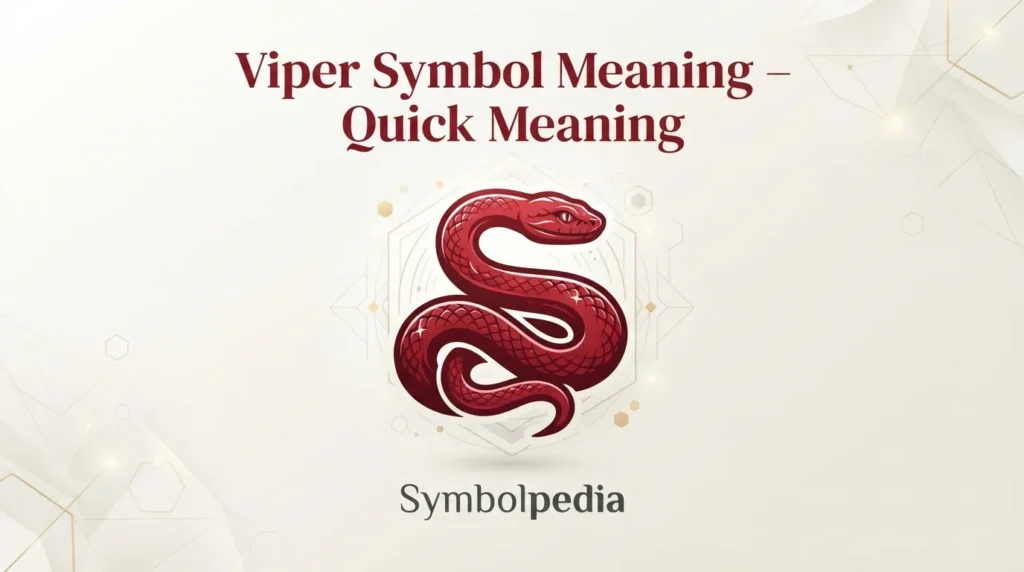
2. Viper Symbol Meaning – Quick Meaning
Green Bush Viper (Atheris chlorechis) · iNaturalist
Portrait of a snout viper changing its skin, Vipera latastei, A Lataste’s Viper
8
The viper symbol meaning generally revolves around danger, hidden strength, instinct, protection, transformation, and wisdom.
A viper is a venomous snake, and its natural characteristics influence how people interpret it symbolically.
Here are the most common meanings:
- Danger: A viper can represent a threat, harmful intentions, or a situation requiring caution.
- Protection: Its defensive abilities symbolize protecting personal boundaries and standing against threats.
- Transformation: Snake shedding is commonly used as a metaphor for renewal, growth, and changing identity.
- Wisdom: Its patience and awareness can represent careful observation and thoughtful decisions.
- Hidden power: A viper may symbolize strength that does not need to be displayed constantly.
- Instinct: It can represent trusting your awareness and recognizing situations that feel unsafe.
- Resilience: Its survival abilities can symbolize recovering from difficult experiences.
- Temptation: In some religious and literary contexts, snake imagery represents deception or dangerous attraction.
Short examples of symbolic meaning
- “The viper represents my strength.” This suggests confidence, independence, and the ability to protect yourself.
- “A viper appeared in my dream.” This may reflect fear, caution, conflict, or a personal association with snakes.
- “I want a viper tattoo.” This could communicate resilience, transformation, danger, or a powerful personal identity.
The interpretation depends on the person’s intention rather than the animal alone.
3. Origin & Background of Viper Symbolism
Viper symbolism developed from the relationship between humans and venomous snakes.
People observed their defensive behavior, their ability to remain concealed, their venom, and their unusual movement. These characteristics became useful metaphors for human experiences.
The viper could represent something dangerous that deserved respect. It could also represent an individual who survived through patience, awareness, and careful action.
Ancient cultural influence
Snake imagery appears in ancient religious art, mythology, and storytelling across different societies.
However, it is important to distinguish the viper from other snakes.
The Egyptian cobra, for example, was associated with royal protection and authority. The cobra is not a viper, even though both are venomous snakes.
In ancient Greek traditions, snakes appeared in connections with healing, protection, religious practices, and mythological creatures.
The snake associated with Asclepius, the Greek god of healing, became an influential image of medicine. This broader serpent symbolism helps explain why snakes can represent both poison and healing.
The meanings were not identical everywhere.
A snake that protected a sacred place could have a different meaning from one that threatened a hero or appeared in a story about temptation.
Research into ancient Greek snake imagery emphasizes that cultural context matters: the same animal could communicate protection, danger, sacredness, or transition depending on its role. MDPI+1
Biblical influence
The Bible strongly influenced the negative interpretation of snake imagery in many Western societies.
In Matthew 3:7 and Matthew 12:34, the expression “brood of vipers” is used in criticism of people considered hypocritical or morally corrupt.
This expression is especially relevant to viper symbolism because it associates the animal with harmful behavior, deception, and danger.
However, the Bible does not identify every serpent as a viper.
The serpent in Genesis is not explicitly described as a viper, and different biblical passages use snake imagery in different ways.
Understanding this distinction prevents the common mistake of treating all snake symbolism as identical.
Social media impact
Today, viper imagery is frequently used in tattoos, profile pictures, fantasy artwork, fashion, gaming, and personal branding.
On social media, a viper may communicate:
- A fearless personality
- A protective attitude
- A mysterious identity
- A warning against disrespect
- A desire for independence
- A personal transformation
A person might choose a viper image because it represents an experience they survived.
Another person may use it because they appreciate the animal’s appearance or natural behavior.
Neither interpretation is automatically correct for everyone.
Modern snake symbolism is flexible because people use animal imagery to express personal experiences rather than follow one fixed cultural definition.
4. Real-Life Conversations
The following examples are illustrative conversations showing how people might discuss viper symbolism in everyday communication.
They are not traditional definitions or quotations from a particular cultural source.
Example 1: WhatsApp – Personal strength
Person A: I finally got that viper tattoo I was telling you about.
Person B: That looks intense. Why a viper?
Person A: It reminds me of everything I survived last year.
Person B: So it’s more about strength than danger?
Person A: Exactly. I learned to protect myself without explaining everything to everyone.
Meaning: Here, the viper symbolizes resilience, boundaries, and personal strength.
The tattoo is connected to a difficult experience rather than a desire to frighten people.
Example 2: Instagram DM – Understanding a symbol
Person A: What does your viper profile picture mean?
Person B: Honestly, I like the symbolism.
Person A: Like danger?
Person B: More like being careful about who I trust. I don’t want to be aggressive, but I don’t want people taking advantage of me either.
Person A: That actually makes sense.
Meaning: The viper represents caution, independence, and self-protection.
The conversation also shows why interpreting someone’s profile picture without asking can lead to misunderstandings.
Example 3: TikTok comments – Spiritual interpretation
Person A: I keep seeing snake symbolism in spiritual videos. Is a viper supposed to mean transformation?
Person B: Snakes are often connected with transformation because they shed their skin.
Person A: So it means I’m entering a new phase?
Person B: You can interpret it that way if it feels meaningful to you. It isn’t a universal prediction, though.
Meaning: The viper is interpreted as a personal reminder of change.
The response respects spiritual interest without presenting symbolic interpretation as a guaranteed message.
Example 4: Text messages – Relationship boundaries
Person A: My friend said I have a viper personality.
Person B: Did they mean you’re dangerous?
Person A: I think they meant I don’t tolerate disrespect anymore.
Person B: That’s different. Having boundaries doesn’t automatically make you a bad person.
Person A: Exactly. I just don’t want to keep accepting the same treatment.
Meaning: The viper becomes a metaphor for defending personal boundaries.
Depending on the speaker’s tone, the same description could be affectionate, critical, or intimidating.
5. Emotional & Psychological Meaning
The viper symbol can express complicated emotions because it combines vulnerability with the ability to defend oneself.
Its appearance may suggest that something powerful is present even when it is not immediately visible.
The emotion behind the symbol
One of the strongest emotional associations is caution.
A person who chooses viper imagery may want to communicate that they have learned to recognize harmful situations.
The message might be:
“I am aware of what can hurt me, and I will not ignore it.”
This does not necessarily mean the person is angry or aggressive.
Sometimes the symbol represents a quiet decision to stop allowing others to cross personal boundaries.
Why people use viper symbolism
People may connect with the viper for several reasons.
They want to express independence. The animal can represent making decisions without constantly seeking approval.
They want to communicate resilience. Its survival-oriented qualities can become a metaphor for recovering from difficult experiences.
They appreciate its mysterious appearance. The viper’s natural shape and behavior make it visually compelling.
They want to express caution. The symbol can communicate awareness of risks and the importance of choosing relationships carefully.
They associate it with change. Snake imagery often appears in discussions of renewal, identity, and personal growth.
These interpretations are possibilities, not psychological diagnoses.
A tattoo, drawing, or profile image cannot reliably reveal someone’s personality or emotional history.
A personal-style scenario
Imagine someone who spent years trying to please everyone around them.
They constantly accepted unfair treatment because they worried that setting boundaries would make people dislike them.
Eventually, they learned that being kind does not require accepting disrespect.
They choose a viper tattoo because it reminds them to remain aware, protect their peace, and make decisions confidently.
For that person, the viper does not symbolize cruelty.
It represents the moment they learned that self-respect and kindness can exist together.
What the viper reveals about modern communication
Modern communication often relies on symbols because people want to express complex feelings quickly.
A single image can communicate confidence, mystery, anger, personal history, or an interest in nature.
But symbols also create ambiguity.
Someone may interpret a viper as a warning while its owner sees it as a reminder of personal growth.
The most reliable way to understand the meaning is to consider the surrounding context or ask the person directly.
6. Usage in Different Contexts
Social media
On Instagram, TikTok, Facebook, and other platforms, viper imagery can create a mysterious or powerful visual identity.
A person might use a viper in their profile picture to communicate independence, strength, or interest in wildlife.
In captions, the symbol may accompany messages about resilience, self-respect, or personal transformation.
For example:
“My silence doesn’t mean weakness.”
When paired with a viper image, the caption might suggest patience and controlled strength.
However, some audiences may interpret the combination as a threat.
Friends and relationships
In friendships, the viper can represent loyalty, caution, or protecting someone from harmful behavior.
A friend might describe another person as a viper because they believe that person is dishonest or manipulative.
That interpretation is negative.
Alternatively, someone might choose a viper symbol to remind themselves not to ignore unhealthy relationship patterns.
The difference depends on whether the symbol is used to describe another person’s behavior or express the user’s personal values.
Work and professional settings
Viper symbolism is less common in ordinary professional communication.
A viper logo might be appropriate for a wildlife organization, sports team, gaming brand, or creative project.
However, using viper imagery in a workplace message about conflict could create an unnecessarily aggressive impression.
For example, sending a colleague a picture of a striking viper after an argument might be interpreted as intimidation.
Professional communication should prioritize clarity over symbolic ambiguity.
Casual versus serious tone
CASUAL
A viper emoji or image might be used jokingly among friends who understand the context.
For example:
“Don’t mess with my snacks 🐍”
The meaning could be playful rather than threatening.
SERIOUS
A viper image in a conversation about betrayal, anger, or revenge may communicate hostility.
In serious situations, it is better to express the intended message directly.
7. When NOT to Use Viper Symbolism
Although the viper can represent strength and protection, its associations with venom and danger make it unsuitable for every situation.
Avoid using it to threaten someone
Sending viper imagery during an argument may make the other person feel unsafe.
Even if you intend it as a metaphor for confidence, the recipient may interpret it as a warning of physical harm.
Be careful in professional communication
A viper symbol in an email signature, workplace presentation, or message about a disagreement may create an aggressive impression.
Use it only when the context clearly supports the imagery.
Respect cultural and religious context
Snake symbolism has different meanings across religious and cultural traditions.
In some contexts, snakes are connected with healing, sacred protection, or spiritual knowledge.
In others, they are associated with evil, temptation, or danger.
Avoid assuming that everyone interprets a viper in the same way.
Do not use it to label someone’s personality
Calling someone a viper can be deeply insulting.
It may suggest that the person is dishonest, dangerous, or manipulative.
If you want to describe a specific behavior, explain what happened instead of relying on an animal label.
Avoid treating spiritual interpretations as facts
Seeing a viper in a dream or encountering one in nature does not establish that something bad will happen.
Symbolic meanings can help people reflect on their emotions, but they cannot reliably predict events.
8. Common Misunderstandings
Misunderstanding 1: A viper always represents evil
This is incorrect.
Vipers can symbolize danger, but modern interpretations also include protection, resilience, awareness, and transformation.
The meaning depends on the context.
Misunderstanding 2: Every snake symbol represents a viper
A viper is a specific type of snake.
Cobras, pythons, boas, and other snakes have different biological characteristics and cultural histories.
Although their symbolic meanings sometimes overlap, they should not automatically be treated as identical.
Misunderstanding 3: Viper symbolism is always spiritual
Some people use viper imagery for spiritual reflection.
Others choose it for its appearance, association with wildlife, personal identity, or artistic meaning.
A viper tattoo does not automatically indicate a spiritual belief.
Misunderstanding 4: A viper tattoo means someone is dangerous
A tattoo cannot reliably reveal someone’s character.
The owner may associate the animal with personal growth, protection, or an important memory.
Misunderstanding 5: Seeing a viper predicts betrayal
There is no reliable evidence that encountering a viper predicts betrayal or future misfortune.
Such interpretations belong to personal beliefs, folklore, or dream symbolism.
Misunderstanding 6: Venom always represents destruction
Venom is dangerous, but snake venom also has scientific importance.
Researchers study venom compounds for their potential applications in medicine.
This provides another reason why snake imagery can carry associations with both harm and healing.
9. Comparison Table
The viper shares symbolic qualities with several other animals and expressions.
| Symbol | Common meaning | Main difference |
|---|---|---|
| Viper | Danger, protection, instinct, hidden strength | Combines defensive power with caution |
| Cobra | Authority, protection, intimidation | Often associated with hood displays and specific cultural imagery |
| Python | Power, mystery, strength | Commonly associated with size and constriction |
| Eagle | Freedom, vision, leadership | Emphasizes perspective and independence |
| Wolf | Loyalty, instinct, survival | Often connected with social bonds and group identity |
| Scorpion | Defense, danger, resilience | Emphasizes a defensive sting |
| Phoenix | Renewal, rebirth, recovery | Focuses more directly on rising after destruction |
| Dove | Peace, hope, gentleness | Represents calm rather than defensive power |
| Guardian | Protection and safety | Communicates protection without necessarily suggesting danger |
| Healer | Recovery, care, restoration | Focuses on healing rather than the threat of injury |
Similar expressions
- “Quiet strength” – Power that does not need constant attention.
- “Trust your instincts” – Pay attention to your awareness and judgment.
- “Protect your peace” – Maintain emotional boundaries.
- “Shedding the old self” – Moving beyond an outdated identity.
- “A hidden threat” – Something dangerous that is not immediately obvious.
Opposite meanings
The viper’s symbolic opposites depend on which quality is being emphasized.
If the viper represents danger, a dove may represent peace.
If it represents secrecy, an open book may represent transparency.
If it represents defensive strength, a healing symbol may represent care and restoration.
There is no single opposite that applies to every interpretation.
Key Insight
The viper is a powerful symbol because it can represent both danger and protection. Its meaning becomes clearer when you consider whether the image emphasizes venom, patience, defensive behavior, transformation, or personal identity.
11. How to Respond When Someone Uses Viper Symbolism
If someone shares a viper tattoo, profile picture, or symbolic image, your response should depend on the relationship and the context.
You do not need to assume that the image has a negative meaning.
Casual replies
- “That design looks really cool.”
- “I like the symbolism.”
- “That’s a powerful animal choice.”
- “The details are amazing.”
Funny replies
- “Okay, now I know not to steal your snacks.”
- “That’s one way to say you have boundaries.”
- “You definitely chose the dramatic option.”
- “That snake looks like it has an attitude.”
These replies work best when you already share a playful relationship.
Mature replies
- “What does the viper represent to you?”
- “Is it connected to a personal experience?”
- “I like how the design combines strength and mystery.”
- “Does the symbolism have a particular meaning for you?”
These questions encourage the person to explain their own interpretation.
Respectful replies
- “I appreciate the meaning behind your design.”
- “That’s an interesting symbol.”
- “I can see how it represents protection.”
- “Thanks for explaining what it means to you.”
The most respectful response is often the simplest: ask what the symbol means to the person who chose it.
12. Regional & Cultural Usage
Viper symbolism varies across cultures because different societies have different relationships with snakes.
It is important to avoid treating entire regions as if everyone shares the same interpretation.
Western culture
In many Western contexts, viper imagery can be associated with danger, deception, temptation, or aggression.
These associations are influenced partly by biblical language and popular storytelling.
At the same time, modern Western tattoos and artwork may use vipers to represent resilience, independence, protection, or transformation.
A viper in a horror movie may represent a threat.
A viper tattoo chosen after a difficult life experience may represent personal strength.
The context changes the interpretation.
Asian culture
Snake symbolism in Asian cultures is diverse.
In Chinese traditions, the snake is one of the zodiac animals and can carry associations with intelligence, intuition, mystery, and personal characteristics.
However, Chinese zodiac symbolism generally refers to the snake as a zodiac animal, not specifically to a viper.
Other Asian traditions have their own serpent imagery, religious narratives, and cultural associations.
For this reason, it is inaccurate to claim that all Asian cultures interpret vipers as symbols of wisdom or good fortune.
The specific tradition matters.
Middle Eastern culture
Snake symbolism in Middle Eastern societies is influenced by religious traditions, folklore, literature, and local relationships with wildlife.
In some contexts, snakes represent danger or deception.
In others, snake imagery may appear in stories about healing, protection, or the natural world.
Islamic traditions, like other religious traditions, include different references to snakes across literature and interpretation.
There is no single universal Islamic viper symbol meaning.
A person’s interpretation may depend on their religious understanding, cultural background, and the specific situation.
Global internet usage
Online, viper symbolism has become more flexible.
People use snake images in:
- Gaming usernames
- Tattoo designs
- Fashion
- Music artwork
- Profile pictures
- Fantasy characters
- Wildlife content
A viper emoji or image may be playful, intimidating, mysterious, or simply decorative.
The intended meaning often comes from the accompanying caption or conversation.
Gen Z versus Millennials
Generational differences are not absolute, but social media habits can influence how symbols are used.
Some younger internet users may use snake imagery as part of an aesthetic identity, a joke, or a short visual expression of confidence.
Millennials may also use the symbol in tattoos, online profiles, gaming, and personal branding.
Neither generation has one fixed interpretation.
The strongest influence is usually the individual’s experience and the platform where the image appears.
13. Is It Safe for Kids?
Viper symbolism is generally safe for children when discussed as animal imagery, mythology, art, or a metaphor for personal strength.
Children can learn about vipers as real animals and understand why venomous snakes should be treated with caution.
The important distinction is between symbolic imagery and real-world behavior.
A viper may represent courage in a story, but children should not approach or handle wild snakes.
Parents and educators can explain that snakes are part of nature and that observing wildlife from a safe distance is important.
If a viper image is used in a game, tattoo design, or social media post, its meaning should be explained according to the context.
For younger children, a simple explanation works well:
“A viper is a type of snake. People sometimes use it as a symbol of strength or danger, but the animal itself is not a sign that something bad will happen.”
14. Frequently Asked Questions
1. What does a viper symbolize spiritually?
A viper may symbolize transformation, protection, instinct, awareness, and personal strength in modern spiritual interpretations. The meaning depends on individual beliefs and cultural context.
2. Is a viper a symbol of good luck or bad luck?
A viper is not universally considered lucky or unlucky. Some interpretations emphasize danger, while others focus on protection, resilience, or transformation.
3. What does a viper tattoo mean?
A viper tattoo may represent strength, independence, protection, caution, transformation, or personal survival. Its meaning depends on the design and the person wearing it.
4. What does a viper symbolize in a dream?
A viper in a dream may reflect fear, conflict, caution, or personal associations with snakes. Dream interpretations are subjective and do not reliably predict future events.
5. What does a black viper symbolize?
A black viper may symbolize mystery, hidden strength, danger, or a powerful personal identity. The meaning depends on the artwork and the individual’s intention.
6. What does a viper symbolize in the Bible?
Biblical viper imagery is often associated with deception, hypocrisy, and moral danger, especially in the expression “brood of vipers.” However, not every biblical serpent is identified as a viper.
7. Is a viper symbol always negative?
No. A viper can represent danger, but it can also symbolize protection, resilience, patience, transformation, and awareness. Its interpretation depends on the context.
15. Conclusion
The viper symbol meaning is much deeper than danger alone.
It can represent hidden strength, careful awareness, protection, transformation, and the courage to defend personal boundaries. Its venom gives it associations with risk, while its natural behavior inspires ideas about patience, instinct, and survival.
Across history, snake imagery has carried different meanings, from religious danger to healing, protection, and renewal. The viper’s specific meaning depends on the cultural setting and the way the symbol is used.
In modern life, a viper tattoo or image may represent someone who has learned to protect themselves, someone who values independence, or someone who simply appreciates the animal’s beauty.
The most meaningful interpretation is the one supported by the person’s own experience and the surrounding context.
A viper does not have to represent aggression. It can also remind us that strength, awareness, and self-respect can exist quietly.
When you understand the context, you can interpret viper symbolism with greater confidence without assuming that every image carries the same message.
discover more post
Brown Recluse Symbol Meaning Hidden Messages 2026
Blue Dragonfly Symbol Meaning Spiritual Messages 2026
Wolf Spider Symbol Meaning Strength Independence 2026