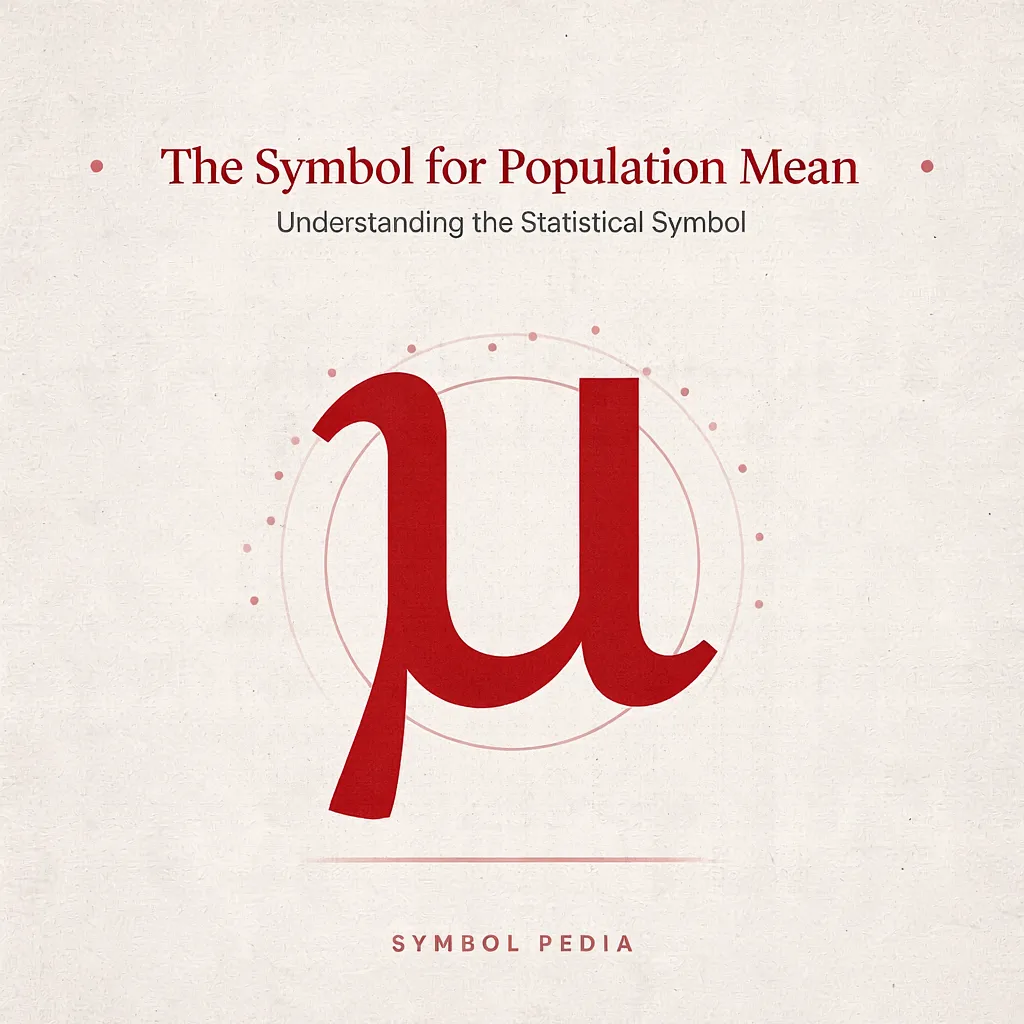
If you’ve ever studied statistics, research methods, economics, psychology, or data analysis, you’ve probably come across the term population mean. One of the most common questions students and professionals ask is: What is the symbol for population mean?
At first glance, statistical symbols can seem confusing. A tiny Greek letter may appear in textbooks, research papers, or classroom assignments, leaving many people wondering what it actually represents and why it matters.
Understanding the symbol for population mean is important because it forms the foundation of statistical analysis. Whether you’re calculating average income in a country, measuring student performance, or analyzing customer satisfaction, the population mean helps summarize data in a meaningful way.
This guide explains the symbol, its origins, practical applications, common misunderstandings, and how it is used in everyday communication about data.
What Is the Symbol for Population Mean? – Quick Meaning
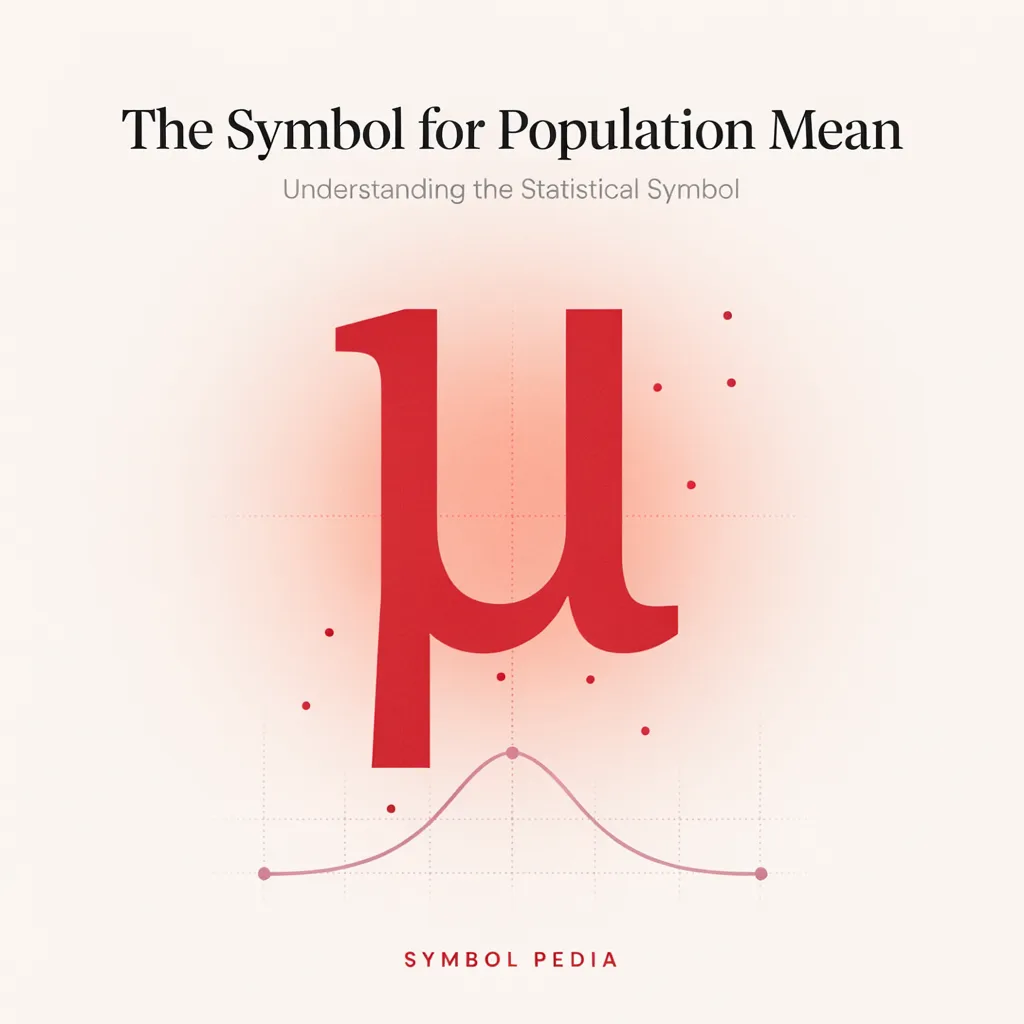
The symbol for population mean is:
μ (Greek letter Mu)
It represents the average value of an entire population.
Key Facts
- Symbol: μ
- Pronunciation: “Mew” or “Myoo”
- Meaning: Average of all values in a population
- Used in statistics, research, economics, education, and science
Simple Examples
“The population mean income is μ = $45,000.”
“Researchers found the population mean score was μ = 82.”
“The value of μ represents the average across the entire population.”
In statistics, whenever you see μ, think of the true average of the complete group being studied.
Origin & Background
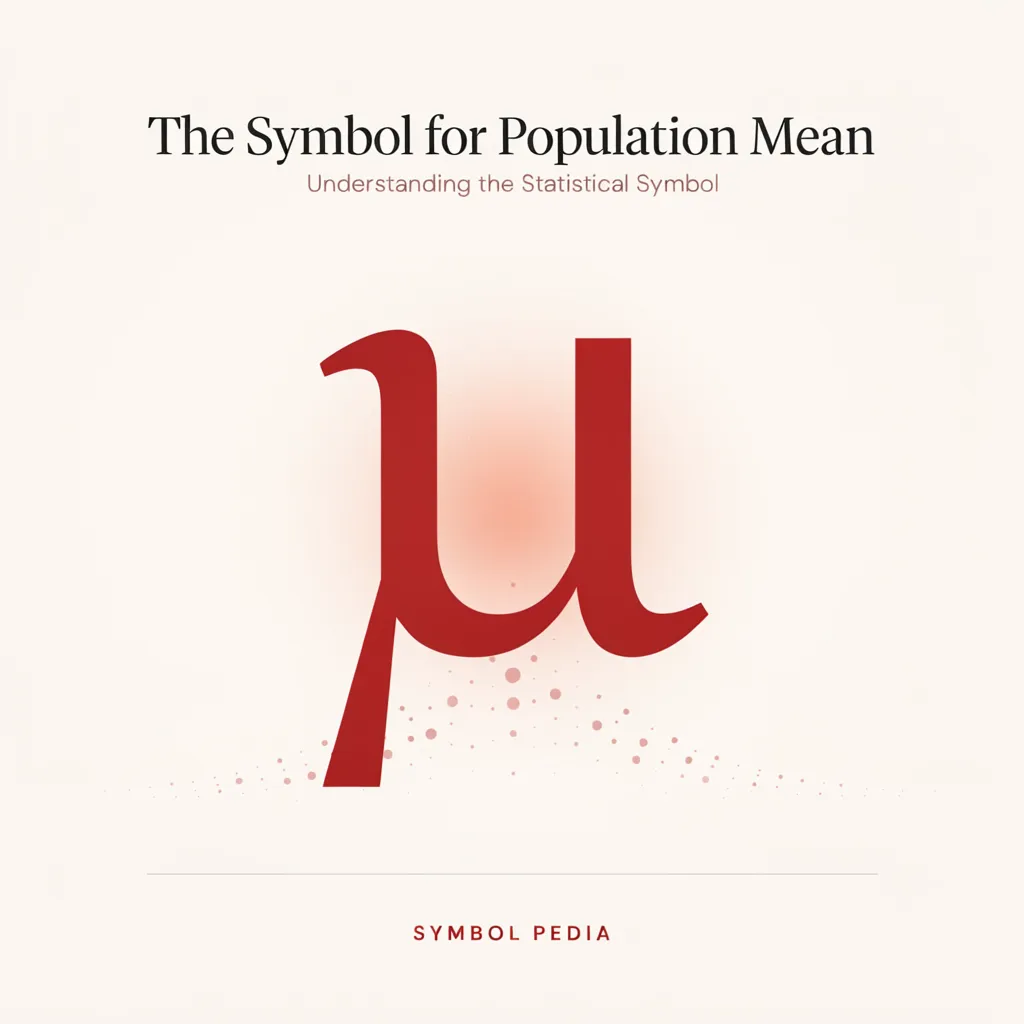
The symbol μ comes from the Greek alphabet and has been used in mathematics and science for centuries.
Statisticians adopted Greek letters because they provide a clear distinction between theoretical population values and sample values.
As statistical methods became widely used during the nineteenth and twentieth centuries, symbols such as μ became standardized across textbooks, universities, and research institutions.
Today, μ appears everywhere:
- Academic journals
- Government reports
- Medical studies
- Economic research
- Business analytics
- Social science surveys
The rise of data-driven decision-making has made statistical symbols more visible than ever. Students encounter μ in classrooms, while professionals use it in reports and presentations.
Even social media discussions about polls, surveys, and analytics sometimes reference statistical averages, indirectly connecting modern digital culture with traditional statistical concepts.
Real-Life Conversations
WhatsApp Conversation
Person A: I got confused in my statistics homework.
Person B: Which part?
Person A: What does μ mean?
Person B: That’s the population mean—the average of the whole population.
Instagram DM
Person A: Why does the report use μ instead of average?
Person B: Because statisticians use μ as the symbol for the population average.
Person A: Oh, that makes much more sense now.
TikTok Comments
User 1: What is μ supposed to mean?
User 2: Population mean.
User 1: So basically the true average?
User 2: Exactly.
Text Message
Friend 1: What’s the difference between x̄ and μ?
Friend 2: x̄ is the sample mean. μ is the population mean.
Friend 1: Thanks, I always mix those up.
Emotional & Psychological Meaning
While μ itself is simply a mathematical symbol, it represents something psychologically important: our desire to understand the bigger picture.
Humans naturally look for patterns and averages. We want to know:
- What’s normal?
- What’s typical?
- What’s expected?
The population mean helps answer these questions.
When researchers calculate μ, they are trying to describe reality as accurately as possible. It becomes a benchmark against which individuals and groups can be compared.
I remember helping a student who felt overwhelmed by statistical symbols. Once she understood that μ simply meant “the true average of everyone in the population,” statistics suddenly became far less intimidating. The symbol wasn’t mysterious anymore—it was just a shorthand way to describe a familiar idea.
Usage in Different Contexts
Social Media Analytics
Data analysts often calculate average engagement rates, impressions, and audience behavior.
Population means help summarize large datasets.
Friends & Relationships
Although people rarely say “population mean” in everyday conversation, surveys about dating preferences, friendship habits, and lifestyle trends often rely on population averages.
Work and Professional Settings
Businesses use population means to analyze:
- Employee performance
- Customer satisfaction
- Sales figures
- Productivity metrics
Understanding μ helps professionals interpret reports correctly.
Casual vs Serious Contexts
In casual settings, people simply say “average.”
In academic or professional settings, μ provides precision and consistency.
When NOT to Use It
There are situations where using μ may create confusion.
Informal Conversations
Most people won’t recognize the symbol immediately.
Non-Statistical Discussions
Using statistical notation unnecessarily can make communication seem overly technical.
Educational Settings with Beginners
When teaching newcomers, it’s often helpful to explain “average” before introducing μ.
Cross-Cultural Communication
Not everyone has studied statistical notation, so defining the symbol is important.
Common Misunderstandings
Confusing μ with Sample Mean
This is the most common mistake.
- Population Mean = μ
- Sample Mean = x̄
These are not identical.
Assuming It Means Any Average
μ specifically refers to the average of an entire population.
Thinking It’s a Mathematical Formula
μ is not a formula.
It is a symbol representing a specific value.
Believing Population Data Is Always Available
In reality, researchers often estimate μ because collecting data from every individual can be difficult.
Comparison Table
| Symbol | Meaning | Usage |
|---|---|---|
| μ | Population Mean | Entire population |
| x̄ | Sample Mean | Sample data |
| M | Mean (general notation) | Informal statistics |
| Median | Middle value | Ordered data |
| Mode | Most frequent value | Frequency analysis |
| σ | Population Standard Deviation | Variability measure |
| Range | Highest minus lowest | Data spread |
Key Insight
The most important distinction is between μ and x̄. One represents the true average of an entire population, while the other estimates that average using a sample.
How to Respond When Someone Uses It
Casual Replies
- “That’s the population average.”
- “It means the average for everyone in the group.”
Funny Replies
- “It’s just statistics trying to look fancy.”
- “Don’t worry, μ is friendlier than it looks.”
Mature Replies
- “μ represents the true average across the entire population.”
Respectful Replies
- “The symbol μ refers to the population mean in statistics.”
Regional & Cultural Usage
Western Culture
Statistics education commonly introduces μ in high school and university courses.
Asian Culture
Countries with strong STEM education systems often emphasize statistical notation early in academic programs.
Middle Eastern Culture
Universities and research institutions use the same international statistical symbols, including μ.
Global Internet Usage
Online learning platforms, research communities, and educational websites universally recognize μ as the population mean.
Generational Differences
Gen Z
More likely to encounter μ through online courses, educational videos, and digital learning platforms.
Millennials
Often learned the symbol through traditional classroom instruction and university coursework.
Despite differences in learning methods, the meaning remains the same worldwide.
Is It Safe for Kids?
Yes.
The symbol μ is completely educational and safe for children.
It is commonly taught in mathematics, statistics, economics, and science courses.
The only challenge is ensuring students understand the difference between population mean and sample mean.
FAQs
What is the symbol for population mean?
The symbol for population mean is μ (mu).
How do you pronounce μ?
It is usually pronounced “mew” or “myoo.”
Is μ the same as average?
μ specifically represents the average of an entire population.
What is the difference between μ and x̄?
μ is the population mean, while x̄ is the sample mean.
Why do statisticians use Greek letters?
Greek letters help distinguish theoretical population values from sample statistics.
Where is μ used?
It is used in statistics, economics, psychology, science, education, and business analytics.
Can μ be estimated?
Yes. Researchers often estimate μ using sample data when studying an entire population is impractical.
Conclusion
The answer to the question “What is the symbol for population mean?” is straightforward: μ (mu).
Although it may initially appear intimidating, μ simply represents the average value of an entire population. Understanding this symbol helps unlock many important concepts in statistics and data analysis.
Whether you’re a student preparing for an exam, a researcher analyzing data, or a professional reading reports, recognizing μ gives you a stronger foundation for interpreting information accurately.
Statistics often looks complicated because of its symbols. Once you learn what those symbols represent, however, they become powerful shortcuts that make understanding data much easier.
The next time you see μ in a textbook, report, or research paper, you’ll know exactly what it means—and why it matters.
descover more post
Aquarius Zodiac Symbol Meaning The Hidden Power Behind …
What Does the Swirl Symbol Mean A Complete Guide to Its …
Japanese Symbol Meaning What Popular … – Symbl Pedia

Kavon is a passionate content creator and digital researcher who specializes in decoding symbols, meanings, and modern internet language. With a strong focus on clarity and authenticity, Kavon writes in a way that makes complex ideas simple, relatable, and useful for everyday readers.
Known for a hardworking mindset and attention to detail, Kavon is dedicated to creating content that genuinely helps people understand the deeper meanings behind words, signs, and online expressions. Every article is crafted with care, combining research, real-life insight, and a reader-first approach.
Through Symblpedia, Kavon aims to build a trusted space where curiosity meets clarity—helping users find answers that are not only accurate but also meaningful and easy to understa