
If you’ve ever taken a statistics class, worked with research data, or explored data analysis online, you’ve probably come across the sample mean symbol. At first glance, it can look confusing, especially because several symbols in statistics appear similar but represent completely different ideas.
Many people search for sample mean symbol statistics because they want to understand what the symbol means, how it’s written, when it’s used, and how it differs from the population mean. Whether you’re a student preparing for an exam, a researcher analyzing data, or simply curious about statistical notation, understanding this single symbol makes many statistical concepts much easier.
In this guide, you’ll learn the meaning of the sample mean symbol, its background, practical uses, common mistakes, and real-life examples that make statistics feel much more approachable.
Sample Mean Symbol Statistics – Quick Meaning
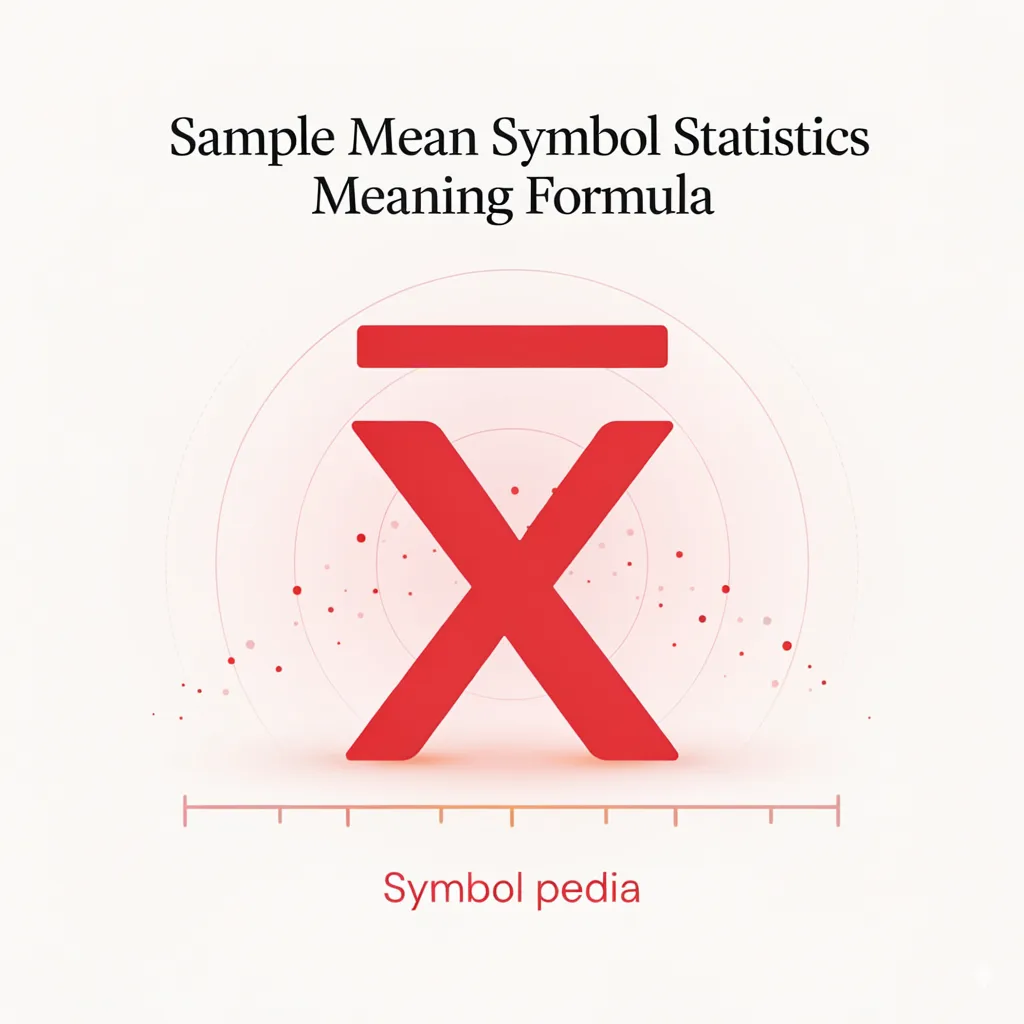
The sample mean symbol is:
x̄ (pronounced “x bar”)
It represents the average value of a sample taken from a larger population.
In simple terms:
- x̄ = Sample Mean
- It calculates the average of only the selected sample.
- It estimates the population average.
- It’s one of the most frequently used symbols in statistics.
Quick examples
“The sample mean (x̄) of 50 students’ test scores was 82.”
“Researchers compared the sample mean before and after treatment.”
“The sample mean helped estimate the average income of the city.”
Origin & Background
Statistics has existed for centuries, but mathematical notation became standardized during the nineteenth and twentieth centuries.
The symbol x̄, called “x bar,” was adopted because mathematicians needed a quick way to distinguish a sample average from individual observations and from the population average.
The horizontal bar placed above the letter x naturally suggested an average or summarized value.
Today, x̄ appears everywhere:
- Statistics textbooks
- Scientific journals
- Medical research
- Psychology studies
- Economics
- Business analytics
- Machine learning
- Data science
Although statistics has become increasingly popular through online education and social media tutorials, the meaning of x̄ has remained consistent across academic fields.
Real-Life Conversations
Person A:
I got x̄ = 74 in today’s homework.
Person B:
Nice! That means your sample average is 74, not everyone’s average.
Instagram DM
Person A:
Why is there a line over the x?
Person B:
That’s x bar. It’s just the symbol for the sample mean.
TikTok Comments
Person A:
Statistics keeps confusing me 😭
Person B:
Just remember:
μ = population mean
x̄ = sample mean
Everything gets easier after that.
Text Messages
Person A:
Is x̄ the same as average?
Person B:
Yes—but specifically the average of a sample, not the whole population.
Emotional & Psychological Meaning
Unlike internet slang, the sample mean symbol doesn’t express emotions. Instead, it represents something equally important: confidence in making decisions from limited information.
In real life, it’s often impossible to collect information from everyone.
Instead, researchers study a carefully selected sample.
The sample mean gives people a practical way to estimate what’s happening in the larger population.
I remember helping a student who believed every average in statistics was identical. Once they understood the difference between a sample and a population, many confusing formulas suddenly made sense. That small distinction transformed their confidence throughout the course.
Understanding x̄ often creates that same “aha” moment for beginners.
Usage in Different Contexts
Education
Students calculate x̄ in:
- Homework
- Exams
- Laboratory reports
- Research projects
Scientific Research
Scientists use sample means to summarize collected observations before performing further statistical analysis.
Business
Companies calculate sample means to estimate:
- Customer satisfaction
- Delivery times
- Employee performance
- Sales averages
Healthcare
Medical researchers analyze sample means when studying:
- Blood pressure
- Recovery rates
- Medication effectiveness
- Patient outcomes
Casual vs Professional Usage
In casual conversations, people simply say:
“The average.”
In professional reports, researchers write:
“x̄ = 15.8”
The symbol communicates the information more precisely.
When NOT to Use It
Avoid using x̄ when:
- You’re referring to an entire population.
- The value represents a population parameter rather than a sample statistic.
- Readers may not understand statistical notation without explanation.
- You’re writing for a general audience where “average” is clearer.
Always consider your audience before using mathematical symbols.
Common Misunderstandings
Mistake 1: Confusing x̄ with μ
Many beginners think both symbols mean the same thing.
Actually:
- x̄ = sample mean
- μ = population mean
Mistake 2: Thinking x̄ is always exact
The sample mean is an estimate.
Different samples from the same population may produce different sample means.
Mistake 3: Forgetting sample size
A sample of 10 people usually provides less reliable estimates than a sample of 1,000 people.
Mistake 4: Assuming averages tell the whole story
The mean is useful, but variability also matters.
Two datasets can share the same mean while having very different distributions.
Comparison Table
| Symbol | Meaning | Used For |
|---|---|---|
| x̄ | Sample mean | Average of a sample |
| μ | Population mean | Average of the entire population |
| M | Mean (sometimes used in psychology) | Research reporting |
| Median | Middle value | Skewed data |
| Mode | Most common value | Frequency analysis |
| Individual observation (x) | Single data value | Raw data |
Key Insight
The easiest way to remember the difference is this: x̄ describes the average of the data you collected, while μ describes the average of everyone or everything in the population—even if you can’t measure them all.
How to Respond When Someone Uses It
Casual replies
- “That’s the sample average.”
- “Looks correct.”
- “Nice calculation.”
Funny replies
- “Statistics speaking another language again!”
- “Ah yes, the famous x with a stylish haircut.”
Mature replies
- “Remember that’s only the sample mean, not the population mean.”
- “Check the sample size before drawing conclusions.”
Respectful replies
- “That notation is correct.”
- “Your interpretation makes sense.”
Regional & Cultural Usage
Western Culture
Students encounter x̄ early in mathematics, business, psychology, and economics courses.
Asian Culture
Many education systems place strong emphasis on statistical notation, making x̄ familiar to university students in science and engineering.
Middle Eastern Culture
Statistics education increasingly incorporates international notation, so x̄ is commonly recognized in higher education and research.
Global Internet Usage
Online courses, educational videos, and academic forums consistently use x̄ as the universal symbol for the sample mean.
Generational Differences
Gen Z
Often learns x̄ through online tutorials, digital classrooms, and educational creators.
Millennials
Many first encountered the symbol in traditional classrooms before expanding their knowledge through online learning.
Regardless of generation, the notation remains universal.
Is It Safe for Kids?
Yes.
The sample mean symbol is an educational mathematical concept with no harmful meaning.
Children learning basic statistics may encounter x̄ in middle school or high school mathematics. With simple explanations and examples, it becomes an accessible introduction to data analysis.
Frequently Asked Questions
What is the sample mean symbol in statistics?
The sample mean symbol is x̄ (x bar), representing the average value of a sample.
How do you pronounce x̄?
It is pronounced “x bar.”
Is x̄ the same as the population mean?
No.
x̄ represents the sample mean, while μ represents the population mean.
Why is x̄ important?
It helps estimate characteristics of an entire population using only sampled data.
Can different samples have different sample means?
Yes.
Different random samples from the same population often produce slightly different averages.
What is the formula for the sample mean?
The sample mean equals the sum of all sample values divided by the number of observations:
x̄ = (Σx) / n
Where is the sample mean used?
It is widely used in:
- Research
- Healthcare
- Economics
- Psychology
- Engineering
- Business analytics
- Data science
- Education
Conclusion
The sample mean symbol (x̄) is one of the foundational ideas in statistics. Although it looks like a simple letter with a bar above it, it carries an important meaning: the average of a selected sample.
Understanding the difference between a sample mean and a population mean removes one of the biggest sources of confusion for beginners. Once you recognize that x̄ summarizes sampled data rather than an entire population, many statistical formulas and research reports become much easier to interpret.
Whether you’re preparing for an exam, reading a scientific paper, or working with data in your career, knowing what x̄ represents gives you greater confidence in understanding and communicating statistical results.
descover more post
Japanese Symbol Meaning What Popular … – Symbl Pedia
What Does the Hammer Symbol Mean in Curling A Simple …
Pachamama Symbol Meaning The Deep Spiritual Message …

Kavon is a passionate content creator and digital researcher who specializes in decoding symbols, meanings, and modern internet language. With a strong focus on clarity and authenticity, Kavon writes in a way that makes complex ideas simple, relatable, and useful for everyday readers.
Known for a hardworking mindset and attention to detail, Kavon is dedicated to creating content that genuinely helps people understand the deeper meanings behind words, signs, and online expressions. Every article is crafted with care, combining research, real-life insight, and a reader-first approach.
Through Symblpedia, Kavon aims to build a trusted space where curiosity meets clarity—helping users find answers that are not only accurate but also meaningful and easy to understa