If you suddenly see a little coffee cup symbol on your car dashboard, you might wonder whether your car is asking you to stop for coffee—or whether something is actually wrong.
In most modern cars, the coffee cup symbol has a much more practical purpose. It is commonly associated with a driver fatigue or attention warning. Your vehicle may be suggesting that you take a break because it has detected driving behavior that could indicate tiredness or reduced concentration.
The important thing to remember is that the exact meaning can vary between manufacturers and models. Some vehicles use a coffee cup to recommend a rest, while others may display a similar icon as part of a broader driver-attention monitoring system.
This guide explains what the coffee symbol means in a car, why it appears, what triggers it, whether you need to stop immediately, and how it differs from other dashboard warning lights.
What Does the Coffee Symbol Mean in a Car? – Quick Meaning
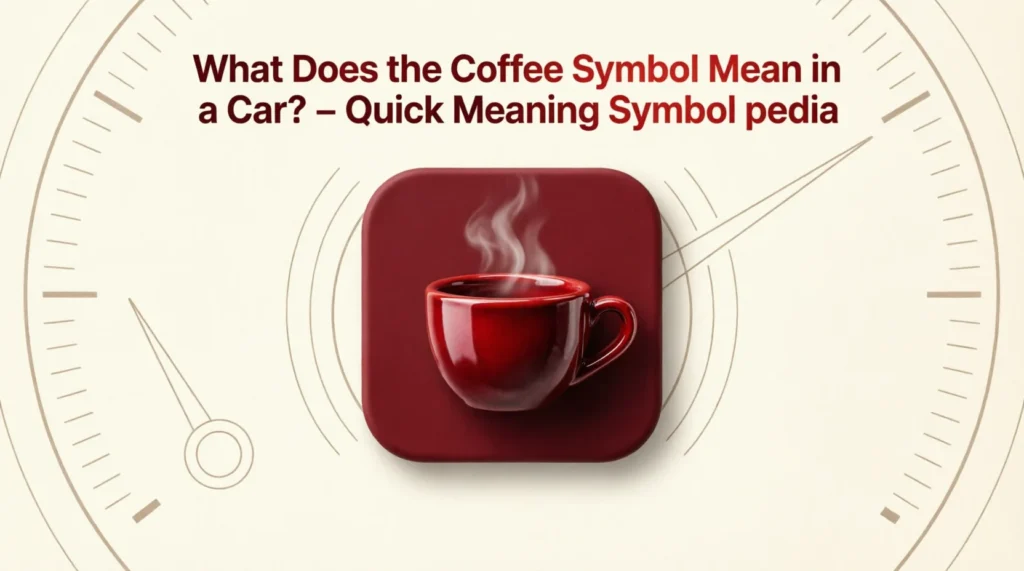
The coffee cup symbol in a car usually means “take a break” or “you may be tired.” It is generally connected with a driver attention or fatigue detection system.
In simple terms:
- ☕ Coffee cup icon: Possible driver fatigue or reduced attention
- 🛣️ Main purpose: Encourage the driver to take a rest
- 👀 What the car may monitor: Steering behavior, driving patterns, trip duration, and other signals
- ⚠️ Is it usually a mechanical fault? No
- 🅿️ What should you do? If you feel tired, safely pull over and rest
You might see messages such as:
“Take a break.”
“Consider taking a rest.”
“Driver attention low.”
The symbol does not necessarily mean your engine, transmission, brakes, or battery has a problem.
It is primarily a driver-safety reminder.
Why Does My Car Show a Coffee Cup?
Modern vehicles can monitor driving patterns and use that information to estimate whether the driver may be becoming fatigued.
For example, if the vehicle notices repeated steering corrections, unusual lane-position changes, or a long period of continuous driving, it may decide that a break would be sensible.
It cannot actually know how you feel.
The system is making an estimate based on available vehicle data.
Origin & Background of the Coffee Cup Dashboard Symbol
The coffee cup became a natural visual choice for communicating one simple idea: take a break and refresh yourself.
Coffee has long been culturally associated with waking up, taking a pause, and regaining concentration. That makes a cup an intuitive symbol for drivers who may have been traveling for a long time.
As driver-assistance technology developed, manufacturers began introducing systems designed to recognize possible driver fatigue or reduced attention.
These systems became particularly useful on highways and during long-distance journeys.
The icon itself isn’t necessarily identical across every vehicle. One manufacturer may use a steaming cup, another may show a cup alongside a message, while another may use a different attention-related symbol entirely.
That is why looking at your vehicle’s owner’s manual is important if you want the exact interpretation for your model.
How the Meaning Evolved
Years ago, dashboard symbols mostly told drivers about mechanical conditions.
Oil pressure, engine temperature, battery charging, brake problems, and similar warnings dominated the instrument cluster.
Modern dashboards have become much more interactive.
Today’s vehicles can communicate with drivers about safety, navigation, lane position, parking, attention, and fatigue.
The coffee cup is part of that broader shift.
It isn’t simply saying, “Here is a coffee symbol.”
It is effectively saying, “You’ve been driving for a while. Consider whether you need a break.”
Social Media Made Dashboard Symbols More Confusing
Dashboard-symbol questions frequently appear on social media because drivers suddenly notice an unfamiliar icon.
Someone might post a picture and ask:
“Does anyone know what this coffee cup means?”
Another person may answer:
“Your car thinks you’re tired.”
That answer is often directionally correct, but it can oversimplify the technology.
The exact trigger and behavior depend on the vehicle.
Real-Life Conversations About the Coffee Symbol
Sometimes the easiest way to understand a dashboard symbol is to see how people actually talk about it.
1. WhatsApp Conversation
Person A:
Why is there a coffee cup showing on my dashboard?
Person B:
It usually means the car thinks you should take a break.
Person A:
Seriously? I thought something was wrong with the car.
Person B:
No, it’s normally a fatigue or driver-attention reminder. If you’ve been driving for hours, I’d listen to it.
Person A:
Fair enough. I have been on the highway since early morning.
This is a good example of how a harmless-looking icon can be mistaken for a mechanical warning.
2. Instagram DM
Person A:
What does the coffee symbol mean in a car? 😭
Person B:
Your car basically said “go touch some grass and get some sleep.” 😂
Person A:
LOL. I’ve been driving for like four hours.
Person B:
Then it’s probably time for a proper break.
The humor is common online, but the underlying message is serious: fatigue can make driving dangerous.
3. TikTok Comments
Person A:
Why did my car suddenly show a coffee cup?
Person B:
Mine does that on long trips too.
Person C:
It’s a driver fatigue warning.
Person A:
So it isn’t an engine problem?
Person C:
Usually no. Check your manual for your exact model, though.
That last response is the safest because dashboard symbols aren’t completely universal.
4. Text Message
Person A:
My car keeps telling me to take a break.
Person B:
Is it showing the little cup?
Person A:
Yep.
Person B:
Then don’t ignore it. Pull over somewhere safe if you’re feeling tired.
Person A:
I actually am exhausted. Good timing.
This is where the symbol has real value. It can serve as a reminder at precisely the moment when a driver may be tempted to continue.
Emotional & Psychological Meaning of the Coffee Symbol
There is an interesting human side to this warning.
Drivers often convince themselves they are “fine” even when they are becoming tired.
You may think, I only have another hour to go.
Or:
I’ll rest when I get there.
The problem is that fatigue can affect concentration and reaction time before you fully recognize how tired you are.
A coffee cup warning can therefore act as a small psychological interruption.
It breaks the rhythm of a long journey.
Instead of thinking only about reaching the destination, you are prompted to ask:
“Am I actually alert enough to keep driving?”
That question matters more than the icon itself.
A Personal-Style Scenario
Imagine driving home late after a long day.
You’ve been on the road for several hours. You feel tired, but not dangerously tired. Then a small coffee cup appears.
At first, it may seem annoying.
But after pulling into a safe rest area, stretching your legs, drinking some water, and taking a proper break, you realize how mentally drained you actually were.
That’s exactly the kind of moment these systems are intended to encourage.
The technology isn’t judging you.
It is providing another reminder to pay attention to yourself.
Usage in Different Contexts
The coffee cup symbol has one primary automotive meaning, but people’s reactions to it vary depending on the situation.
Social Media
On social platforms, drivers often turn unfamiliar dashboard symbols into questions or jokes.
The coffee cup is particularly easy to joke about because coffee is associated with staying awake.
You may see comments such as:
“Car said I need caffeine.”
“Even my car knows I’m tired.”
“My dashboard is telling me to get coffee.”
These are humorous interpretations, but the actual purpose is usually related to driver attention or fatigue.
Friends and Relationships
A passenger may notice the symbol before the driver does.
A friend might say:
“Maybe we should stop for a few minutes.”
In a relationship, the warning can become a practical reminder to look after each other during a long trip.
Sometimes the passenger recognizes exhaustion that the driver is reluctant to admit.
Work and Professional Driving
For professional drivers, fatigue management is particularly important.
Long-distance driving, delivery work, transportation jobs, and business travel can involve extended periods behind the wheel.
A coffee symbol should never be treated as an inconvenience that must simply be dismissed.
If you are genuinely tired, the safer decision is to stop somewhere appropriate and rest.
Casual vs. Serious Tone
Casually, someone might call it:
- The coffee warning
- Coffee cup light
- Take-a-break symbol
- Tired-driver light
In a more technical context, you may hear terms such as:
- Driver drowsiness warning
- Driver attention alert
- Fatigue detection system
- Driver monitoring system
The wording changes, but the safety idea remains similar.
When NOT to Use or Interpret the Coffee Symbol
The coffee cup isn’t a universal symbol with exactly the same function in every car.
That means you shouldn’t automatically assume every cup-shaped icon means fatigue.
Don’t Assume It’s a Mechanical Warning
If your car displays a coffee cup, don’t immediately conclude that something is wrong with the engine.
Check the owner’s manual or your vehicle’s official documentation.
Don’t Ignore It If You’re Actually Tired
This is the most important point.
If you’re struggling to keep your eyes open, yawning constantly, losing concentration, drifting within your lane, or having trouble remembering the last few miles, don’t continue simply because you are close to home.
Stop somewhere safe.
Don’t Rely on Coffee Alone
Coffee can make you feel more awake, but drinking caffeine isn’t a substitute for adequate rest.
If you’re seriously sleepy, the responsible solution is to stop driving and recover.
Cultural Sensitivity
The coffee symbol is generally easy to understand across cultures because the cup has become strongly associated with taking a break.
However, not everyone drinks coffee.
The symbol should therefore be interpreted as a rest or attention reminder, rather than literally meaning that you need caffeine.
Common Misunderstandings About the Coffee Symbol
“My Car Has a Coffee Machine”
No.
A coffee cup icon usually isn’t telling you that your vehicle has a coffee-making function.
It is generally related to driver attention or fatigue.
“My Engine Is About to Fail”
Usually not.
The coffee cup is generally different from serious mechanical warning lights such as an oil-pressure warning, overheating warning, or brake warning.
Still, always check your specific owner’s manual.
“The Car Knows I’m Falling Asleep”
Not exactly.
Most systems don’t literally know that you’re sleepy.
They infer possible fatigue or reduced attention from patterns detected by the vehicle’s sensors and electronic systems.
“It Means I Must Stop Immediately”
Not necessarily.
The warning is usually a recommendation to consider taking a break.
However, if you personally feel sleepy or unsafe, you should stop as soon as it is safe and appropriate to do so.
“Every Car Uses the Coffee Cup for the Same Thing”
No.
Dashboard symbols vary between manufacturers, model years, markets, and equipment packages.
The owner’s manual is the final authority for your particular vehicle.
Coffee Symbol vs. Other Dashboard Warnings
| Symbol or Message | Common Meaning | What It Usually Suggests |
|---|---|---|
| ☕ Coffee cup | Driver fatigue/attention reminder | Consider taking a break |
| Engine-shaped light | Engine/emissions fault | Have the vehicle checked |
| Oil can | Low oil pressure or oil-related issue | Check the situation promptly |
| Battery symbol | Charging-system problem | Inspect the charging system |
| Thermometer | Engine temperature warning | Address overheating promptly |
| Brake symbol | Brake-system warning or parking brake | Check brakes/parking brake |
| Lane markings | Lane-departure assistance | Pay attention to lane position |
| Steering wheel | Steering/power steering-related message | Consult vehicle guidance |
| Seat belt symbol | Seat belt not fastened | Buckle up |
| Tire-pressure symbol | Low tire pressure/system issue | Check tire pressures |
Key Insight
The coffee cup stands apart from many traditional dashboard warnings because it is usually aimed less at the condition of the vehicle and more at the condition of the driver. That makes it a reminder rather than a conventional mechanical fault indicator.
How to Respond When Someone Mentions the Coffee Symbol
If someone sends you a message asking about the icon, your response can depend on your relationship.
Casual Replies
- “It usually means your car wants you to take a break.”
- “That’s probably the fatigue warning.”
- “Looks like your car thinks you need some rest.”
- “Check your manual to confirm for your model.”
Funny Replies
- “Even your car knows you need coffee. 😂”
- “Your dashboard just became your mom.”
- “Your car said: pull over, bestie. 😂”
- “The car has officially diagnosed Monday.”
Humor is fine when the situation is safe, but don’t let the joke distract from genuine fatigue.
Mature Replies
- “It generally indicates that you should consider taking a break.”
- “If you’ve been driving for several hours, stopping for some rest would be sensible.”
- “The exact meaning depends on your vehicle, so check the owner’s manual.”
Respectful Replies
- “That symbol commonly relates to driver attention or fatigue.”
- “I’d recommend checking your vehicle manual for the exact meaning.”
- “If you’re feeling tired, please stop somewhere safe before continuing.”
Regional & Cultural Usage
The visual meaning of the coffee cup is increasingly global, but attitudes toward driving breaks can differ.
Western Culture
In North America and Europe, coffee is strongly associated with mornings, work breaks, road trips, and staying alert.
Because of that cultural association, the symbol is usually easy to understand.
Long highway journeys also make fatigue warnings particularly relevant.
Asian Culture
In many Asian markets, long-distance driving and heavy traffic create different driving environments.
Coffee itself may not carry exactly the same cultural meaning everywhere.
Nevertheless, the dashboard symbol is generally interpreted through its automotive safety function rather than the beverage itself.
The owner’s manual remains the best source for the vehicle-specific definition.
Middle Eastern Culture
Long-distance travel can be common in areas separated by significant distances, making rest recommendations particularly practical.
At the same time, coffee has deep cultural significance in many Middle Eastern communities.
However, drivers should understand that the dashboard cup is normally a safety symbol, not a statement about any particular beverage or culture.
Global Internet Usage
Online, the coffee icon has become almost universally recognizable as:
“You’re tired. Take a break.”
Memes and short videos often make the meaning even more obvious, although they sometimes oversimplify how fatigue-detection systems actually work.
Gen Z vs. Millennials
Younger internet users may interpret the symbol humorously:
“Bro, even the car knows I’m cooked.”
Millennials might be more likely to describe it as a “coffee break warning” or “tiredness alert.”
Both expressions point toward the same basic idea.
The difference is mainly language and tone, not necessarily the underlying meaning.
Is the Coffee Symbol Safe for Kids?
Yes. The coffee cup dashboard symbol itself is not an inappropriate or dangerous symbol for children.
In fact, it can provide a useful opportunity to teach young passengers about road safety.
A child might ask:
“Why is the car showing a cup?”
You can explain:
“It means the driver may need a break.”
This can help children understand that safe driving isn’t only about following traffic signs. Being rested and alert also matters.
For children who are learning about cars, it’s also useful to explain that dashboard symbols aren’t identical in every vehicle.
FAQs About the Coffee Symbol in a Car
What does the coffee symbol mean in a car?
The coffee symbol usually indicates a driver fatigue or attention warning. It commonly recommends that the driver consider taking a break.
Is the coffee cup a serious warning?
It is generally a safety reminder rather than a mechanical emergency warning. However, if you’re genuinely tired, you should take the message seriously.
Why does my car think I’m tired?
Your vehicle may analyze driving patterns such as steering behavior, trip duration, lane-position changes, or other available signals to estimate possible driver fatigue.
Does the coffee symbol mean my car needs coffee?
No. The coffee cup usually refers to the driver’s need for a break, not a need to add anything to the vehicle.
Can I turn off the coffee cup warning?
That depends on the make, model, and driver-assistance system. Some vehicles allow certain alerts to be adjusted, while others may not. Check the owner’s manual before changing settings.
Does every car have a coffee cup symbol?
No. Not every vehicle has a driver-fatigue warning system, and manufacturers use different icons and messages.
Should I stop driving when I see the coffee symbol?
If you feel tired, yes—find a safe place to stop and rest. Even if you feel alert, treat the warning as a useful reminder to assess your condition before continuing.
Conclusion: What Does the Coffee Symbol Really Mean?
So, what does the coffee symbol mean in a car?
In most modern vehicles, that little cup is a friendly but important reminder connected with driver fatigue, attention, or the need to take a break.
It usually isn’t telling you that your engine is failing or that your vehicle needs coffee. Instead, the system is encouraging you to pause and think about one of the most important parts of safe driving: the person behind the wheel.
The exact technology varies from one vehicle to another. Some systems look at steering behavior and driving patterns, while more advanced systems may use additional driver-monitoring technology.
That’s why the owner’s manual should always be your final reference for a specific dashboard icon.
Still, the basic message is easy to remember:
☕ Coffee cup = consider taking a break.
And if you’re already feeling sleepy, don’t argue with the dashboard.
Pull over somewhere safe, rest, and continue your journey when you’re genuinely ready. Getting to your destination a little later is far better than arriving dangerously exhausted.
descover more post
What Does the Lock Symbol Mean on Snapchat Everything …
Ohm Symbol and Meaning Understanding Ω Its History and …
What Does the Clover Symbol Mean Luck Love Culture More …

Kavon is a passionate content creator and digital researcher who specializes in decoding symbols, meanings, and modern internet language. With a strong focus on clarity and authenticity, Kavon writes in a way that makes complex ideas simple, relatable, and useful for everyday readers.
Known for a hardworking mindset and attention to detail, Kavon is dedicated to creating content that genuinely helps people understand the deeper meanings behind words, signs, and online expressions. Every article is crafted with care, combining research, real-life insight, and a reader-first approach.
Through Symblpedia, Kavon aims to build a trusted space where curiosity meets clarity—helping users find answers that are not only accurate but also meaningful and easy to understa