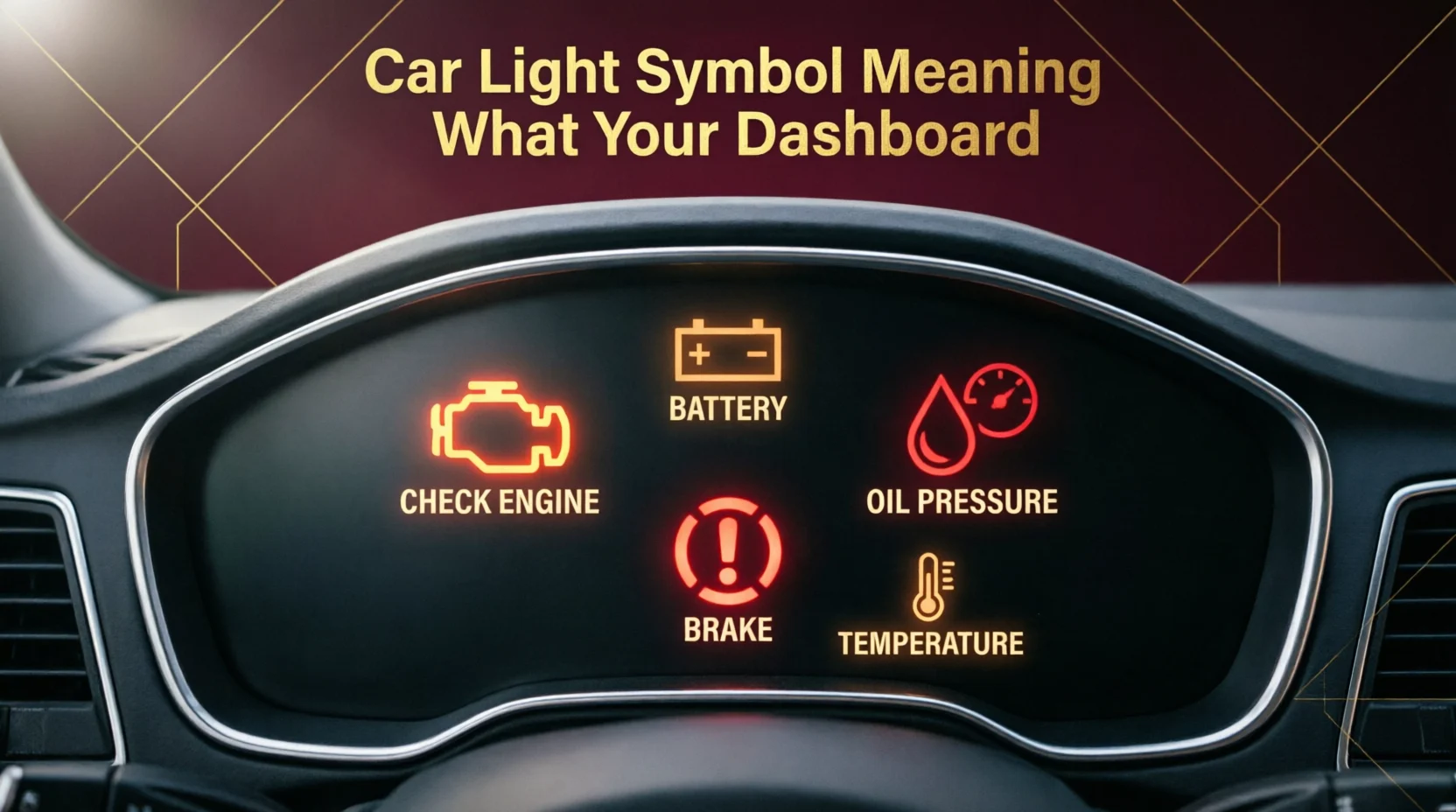
Seeing an unfamiliar light on your car dashboard can be surprisingly stressful. One moment you’re driving normally, and the next, a red symbol, yellow warning light, or green headlight icon appears in front of you.
The good news is that most dashboard symbols are designed to communicate a specific message quickly. Understanding the car light symbol meaning can help you decide whether you can keep driving, need to check something soon, or should stop immediately.
Dashboard lights are not all warnings. Some simply tell you that a system is active, such as your headlights, fog lights, or turn signals. Others indicate a possible mechanical or safety problem.
This guide explains common car dashboard light symbols in plain English, including what different colors mean, when a warning should concern you, and how to respond without panicking.
Car Light Symbol Meaning – Quick Meaning
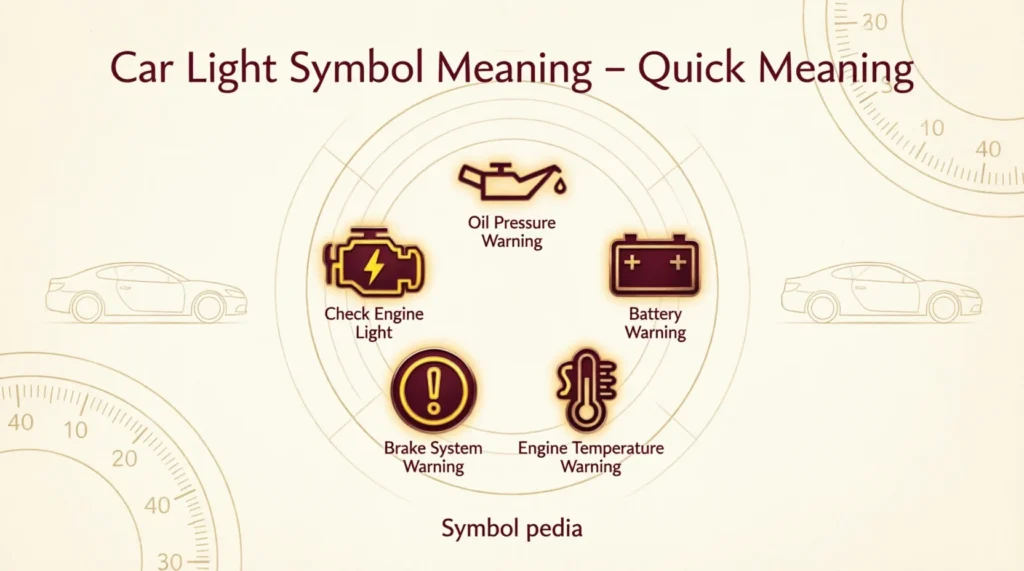
The car light symbol meaning depends on the shape, color, and behavior of the dashboard indicator.
As a general rule:
- Red lights usually indicate an urgent warning that deserves immediate attention.
- Yellow or amber lights generally mean caution, a detected fault, or a system that needs checking.
- Green lights usually show that a feature is operating.
- Blue lights commonly indicate high-beam headlights are switched on.
- Flashing lights can be more urgent than a symbol that remains steadily illuminated.
For example:
“The blue headlight symbol means my high beams are on.”
“The yellow engine light means the car has detected a problem.”
“The red oil symbol means I shouldn’t ignore it.”
Remember that exact meanings can vary slightly between manufacturers and models. Your owner’s manual remains the best source for a specific vehicle.
Origin & Background of Car Dashboard Symbols
Dashboard warning symbols developed because drivers needed information that could be understood quickly, regardless of language.
A driver may not speak the same language as the person who designed a vehicle, but a recognizable oil can, battery, tire-pressure symbol, or engine outline can communicate an idea visually.
Modern vehicle manufacturers increasingly rely on standardized symbols and conventions. International standards, including ISO 2575, have helped establish recognizable symbols for controls, indicators, and tell-tales used in road vehicles.
This standardization is especially useful in a world where cars are sold across different countries and drivers travel internationally.
Cultural habits also influence how people interpret dashboard warnings. Someone accustomed to older vehicles may immediately recognize a traditional oil-can symbol, while a younger driver who learned primarily through digital displays may be more familiar with text-based alerts.
Social media has changed things further.
Drivers frequently photograph an unfamiliar dashboard symbol and ask online, “What does this light mean?” A symbol that once required a trip to a mechanic can now be identified within minutes through a vehicle manual, owner’s forum, or automotive community.
However, online explanations should not replace the manufacturer’s instructions. A symbol can look similar across different vehicles while having slightly different meanings.
Real-Life Conversations About Dashboard Light Symbols
1. WhatsApp Conversation
Person A:
“Do you know what this yellow engine light means? It just came on.”
Person B:
“Is it flashing or staying on?”
Person A:
“It’s staying on.”
Person B:
“Check the manual first. If the car feels normal, you may be able to drive carefully, but get it checked soon.”
Person A:
“Okay, I was about to panic and call a tow truck.”
Sometimes the most useful first step is simply determining the color and whether the light is flashing.
2. Instagram DM
Person A:
“Why is there a little blue headlight symbol on my dashboard?”
Person B:
“That’s probably your high beams.”
Person A:
“Ohhh. I accidentally left them on.”
Person B:
“That’s why the car in front of you probably wasn’t very happy 😂”
A blue headlight indicator is generally informational rather than a sign of a mechanical failure.
3. TikTok Comments
Person A:
“My car has a red circle with an exclamation mark. What does it mean?”
Person B:
“It could be the brake warning light. Don’t assume it’s nothing.”
Person C:
“Check whether your parking brake is still engaged too.”
Person A:
“Yep, that was it. I completely forgot to release it.”
This illustrates why identifying the symbol isn’t always enough. You also need to consider what the vehicle is doing and what happened immediately before the light appeared.
4. Text Message
Person A:
“Dashboard says tire pressure low.”
Person B:
“Check all four tires when you get somewhere safe.”
Person A:
“I’ll do it tomorrow.”
Person B:
“Don’t wait if one tire looks noticeably low. A tire-pressure warning can be more than an inconvenience.”
Good dashboard awareness means knowing which warnings can wait and which ones deserve immediate attention.
Emotional & Psychological Meaning of Dashboard Warning Lights
Unlike internet slang, dashboard symbols don’t have an emotional meaning in the traditional sense. Their psychological effect comes from the way humans naturally respond to warning signals.
A sudden red light can trigger anxiety because red is widely associated with danger, stopping, and urgency.
Yellow or amber tends to feel less alarming, which is appropriate because these lights often indicate caution rather than an immediate emergency.
Green and blue indicators generally feel reassuring because they tell you that a particular function is active rather than reporting a fault.
I once heard a new driver describe the first appearance of a dashboard warning light as “the car suddenly talking to me in another language.” That description captures the problem perfectly. The symbol isn’t necessarily complicated; it’s unfamiliar.
Once you understand the visual language of your dashboard, the same light can feel much less intimidating.
The important psychological lesson is simple: don’t panic, but don’t dismiss warning lights either.
Take a moment to identify the symbol, check its color and behavior, and consult the vehicle’s manual when you’re unsure.
Usage in Different Contexts
Social Media
On social media, people often use phrases such as “What does this car symbol mean?” or “Dashboard warning light meaning?” when posting photographs of their instrument cluster.
These questions are usually practical rather than technical. Most people simply want to know whether they can continue driving.
Friends & Relationships
Friends often explain dashboard symbols to one another in casual language.
Someone might say, “That little red oil can isn’t good,” rather than giving a technical explanation about lubrication pressure.
These conversations are useful because everyday language can make complicated vehicle information easier to understand.
Work & Professional Settings
In professional driving environments, warning lights should be treated more seriously.
Drivers of company vehicles, taxis, delivery vehicles, buses, and commercial fleets may have specific procedures for reporting dashboard warnings.
Instead of casually asking a coworker what a symbol means, a professional driver may need to follow company safety rules and contact fleet management.
Casual vs. Serious Tone
A green headlight indicator can be discussed casually because it normally indicates an active feature.
A red brake, oil-pressure, or overheating warning deserves a much more serious response.
The same dashboard can therefore contain symbols with completely different levels of urgency.
When NOT to Ignore a Car Light Symbol
Not every dashboard light means “stop immediately,” but some should never be casually dismissed.
Avoid ignoring:
- A red oil-pressure warning
- A red brake-system warning
- A serious overheating warning
- A flashing engine warning light
- A warning accompanied by smoke, burning smells, severe vibration, or unusual noises
- Multiple warning lights appearing suddenly
- A warning accompanied by obvious changes in braking or steering
You should also avoid trying to diagnose a serious mechanical problem while the vehicle is moving.
If a warning indicates an immediate safety concern, pull over somewhere safe when possible and seek appropriate assistance.
Cultural differences can matter here too. In some places, drivers are accustomed to continuing to drive despite warning lights because they have learned to treat dashboard alerts as minor inconveniences.
That habit can be dangerous.
A dashboard warning is communication from the vehicle. Whether the problem is minor or serious should be determined rather than assumed.
Common Misunderstandings About Dashboard Lights
“Every dashboard light means something is broken.”
Not true.
Many green and blue indicators simply tell you that a particular feature is operating.
“Yellow means it’s safe to ignore.”
Not necessarily.
Amber usually indicates caution or a system that requires attention. It doesn’t automatically mean you can continue driving indefinitely.
“A red light always means the engine is damaged.”
No.
Red is generally used for high-priority warnings, but the actual problem depends on the symbol.
A red parking-brake indicator, for example, has a different meaning from a red oil-pressure warning.
“If the light disappears, the problem is fixed.”
Not always.
Some warnings can disappear temporarily when conditions change. A recurring warning still deserves investigation.
“The same symbol means exactly the same thing in every car.”
Not necessarily.
Manufacturers may use different graphics, descriptions, or warning strategies. Always check the manual for your specific model.
Car Dashboard Light Comparison Table
| Dashboard Light | Typical Color | General Meaning | What to Do |
|---|---|---|---|
| Engine/check engine | Yellow/Amber | Engine or emissions-related fault detected | Have it diagnosed |
| Oil pressure | Red | Possible low oil pressure | Stop safely and investigate urgently |
| Battery | Red | Charging system problem | Check promptly; seek assistance if needed |
| Brake | Red/Yellow | Brake system or parking brake warning | Check immediately |
| Tire pressure | Yellow | One or more tires may have low pressure | Check tire pressures |
| ABS | Yellow | Anti-lock braking system fault | Drive cautiously and have it checked |
| Airbag/SRS | Yellow/Red | Airbag restraint system fault | Arrange inspection |
| High beam | Blue | High-beam headlights active | Switch off when appropriate |
| Turn signal | Green | Turn indicator active | Normal operation |
| Fog light | Green/Amber | Fog lights active | Normal; switch off when unnecessary |
| Traction control | Yellow | Traction system active or fault detected | Check manual if it stays on |
| Temperature | Red | Engine may be overheating | Stop safely and allow appropriate cooling |
Key Insight
The color and symbol work together. Don’t judge a warning by color alone. A blue light may simply confirm high beams, while a red symbol can indicate a condition requiring immediate attention.
How to Respond When Someone Uses a Car Light Symbol
If someone sends you a photo of a dashboard light, your response should depend on the symbol.
Casual Replies
- “That looks like your tire-pressure warning.”
- “I think that’s the high-beam indicator.”
- “Check your owner’s manual to be sure.”
- “What color is the light?”
Funny Replies
- “Your car is trying to tell you something 😂”
- “That’s definitely not the ‘everything is perfect’ light.”
- “Time for the owner’s manual to become your best friend.”
Mature Replies
- “Check the exact symbol in your vehicle’s manual before continuing.”
- “If it’s red or flashing, I wouldn’t ignore it.”
- “If the car is behaving differently, get it checked as soon as possible.”
Respectful Replies
- “It may be the brake warning indicator, but I’d verify it for your exact model.”
- “Could you check whether the symbol is flashing or steady?”
- “If you’re unsure, it’s safer to have a professional inspect it.”
The best answer isn’t always the fastest answer. Accuracy matters more than confidence.
Regional & Cultural Usage of Car Dashboard Symbols
Western Culture
Drivers in North America and Europe generally encounter highly standardized automotive symbols, although individual manufacturers still use different displays and warning strategies.
Owner manuals, roadside assistance services, vehicle inspections, and automotive repair shops are common sources of guidance.
Asian Culture
Asian automotive markets include a wide range of manufacturers and vehicle technologies. Drivers may encounter dashboards with traditional symbols alongside increasingly sophisticated digital displays.
In countries where compact cars and motorcycles are especially common, dashboard literacy can vary considerably depending on driving experience.
Middle Eastern Culture
Extreme heat can make certain vehicle warnings especially important in some Middle Eastern driving environments.
Temperature-related warnings, tire-pressure changes, battery issues, and air-conditioning-related concerns may receive particular attention during very hot conditions.
However, the meaning of a symbol itself remains vehicle-specific rather than culturally defined.
Global Internet Usage
The internet has created a shared vocabulary around dashboard symbols.
A driver in Pakistan, the United States, the United Kingdom, or Japan can photograph a warning light and ask what it means using almost identical language.
This has made automotive knowledge more accessible, but it has also increased the risk of people relying on generic advice for a vehicle-specific problem.
Gen Z vs. Millennials
Younger drivers are often comfortable searching for a symbol visually or asking about it on social media.
Millennial and older drivers may be more likely to consult a physical owner’s manual, mechanic, or experienced driver.
Neither approach is automatically better. The important thing is finding accurate information quickly and responding appropriately.
Is It Safe for Kids?
Car dashboard symbols are generally safe for children to learn about because they are visual safety indicators rather than adult-oriented content.
Teaching older children what basic symbols mean can even improve road-safety awareness.
For example, children can learn that red generally deserves attention, green often indicates an active function, and blue commonly identifies high beams.
However, children should never be encouraged to operate vehicle controls or diagnose mechanical problems without adult supervision.
FAQs About Car Light Symbol Meaning
What does a red car light symbol mean?
A red dashboard symbol generally indicates a high-priority warning. Depending on the symbol, you may need to stop safely and address the issue immediately.
What does a yellow car light symbol mean?
A yellow or amber symbol usually indicates caution, a detected fault, or a system that needs attention. The exact response depends on the symbol.
What does a blue car light symbol mean?
A blue dashboard light commonly indicates that the high-beam headlights are switched on.
What does a green car light symbol mean?
Green indicators generally show that a vehicle function is active, such as a turn signal, headlights, or another operating system.
Can I drive with a warning light on?
It depends on the warning. Some indicators are informational, while others signal potentially serious problems. Check your owner’s manual and consider the vehicle’s behavior.
What does a flashing dashboard light mean?
A flashing warning can indicate a more urgent condition than a steady light. The exact meaning depends on the symbol and vehicle.
Where can I find the exact meaning of my car’s dashboard symbols?
Your vehicle’s owner’s manual is usually the most reliable source because it explains the symbols and warning procedures for your specific model.
Conclusion
Understanding car light symbol meaning doesn’t require you to become a mechanic. You simply need to recognize that your dashboard has its own visual language.
A green or blue indicator may simply tell you that a feature is active. A yellow light often means caution or that something needs checking. A red warning deserves greater urgency, especially when accompanied by unusual vehicle behavior.
The biggest mistake is not failing to recognize every symbol immediately. It’s ignoring a warning because you don’t understand it.
When an unfamiliar light appears, stay calm. Look at its color, identify the symbol, check whether it is flashing, and consult your owner’s manual. If the warning appears serious or the car behaves abnormally, prioritize safety over convenience.
Once you become familiar with these symbols, the dashboard stops looking like a collection of mysterious icons. It becomes what it was designed to be: a simple conversation between you and your vehicle.
descover more post
What Does the Heart Symbol Mean Meaning Emotions Colors …
What Does the Lock Symbol Mean on Snapchat Everything …
What Does the Swirl Symbol Mean A Complete Guide to Its …

Kavon is a passionate content creator and digital researcher who specializes in decoding symbols, meanings, and modern internet language. With a strong focus on clarity and authenticity, Kavon writes in a way that makes complex ideas simple, relatable, and useful for everyday readers.
Known for a hardworking mindset and attention to detail, Kavon is dedicated to creating content that genuinely helps people understand the deeper meanings behind words, signs, and online expressions. Every article is crafted with care, combining research, real-life insight, and a reader-first approach.
Through Symblpedia, Kavon aims to build a trusted space where curiosity meets clarity—helping users find answers that are not only accurate but also meaningful and easy to understa