You’ve seen it countless times—on your phone, laptop, TV remote, or even a coffee machine. That simple circle with a vertical line at the top feels so familiar that you probably never stopped to ask what it actually means.
Yet, every day, people search for the power button symbol meaning because it’s one of those symbols we use constantly without fully understanding. Is it just a design? A technical code? Or does it carry a deeper message?
The confusion usually comes from its abstract look. It doesn’t resemble anything obvious like a lightbulb or a switch. Still, it works across languages, cultures, and devices worldwide.
This article breaks it down in a clear, human way—so next time you press that button, you’ll know exactly what you’re interacting with and why it looks the way it does.
Power Button Symbol Meaning – Quick Meaning
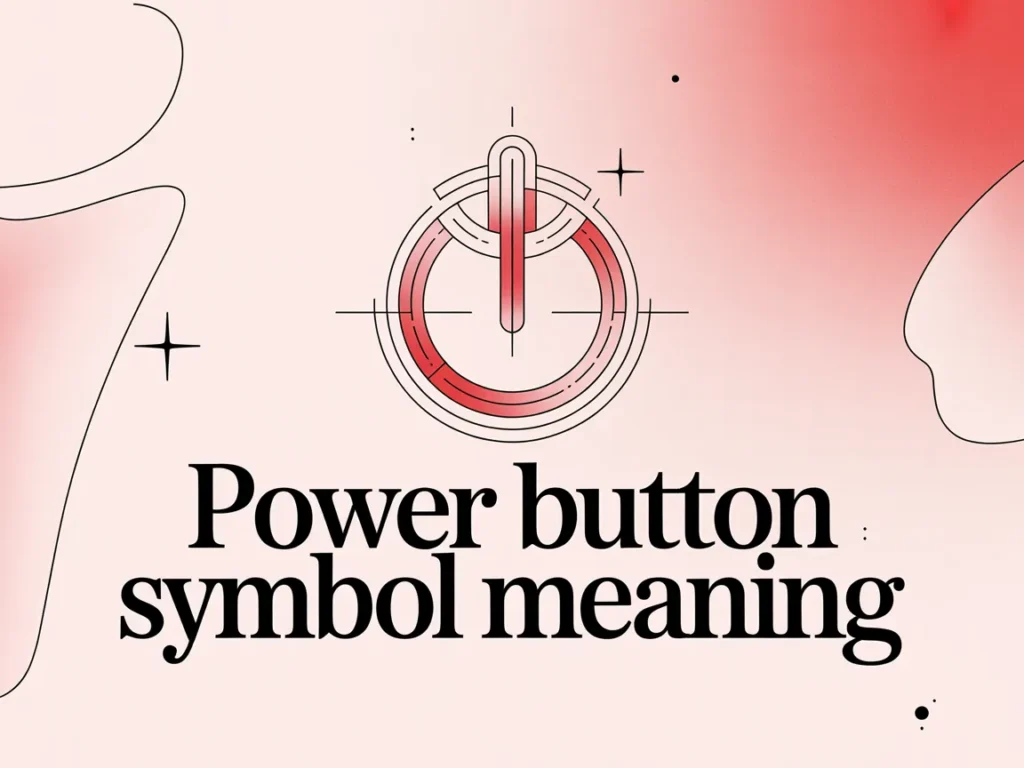
At its core, the power button symbol represents turning a device on or off.
More specifically:
- The circle (O) stands for “off”
- The line (|) stands for “on”
- Combined, they symbolize power control (on/off toggle)
In simple terms, it means:
“This is where you control whether the device is active or inactive.”
Quick Examples
- “Press the power button to start your laptop.”
- “Hold the symbol to shut down your phone.”
- “If it’s not working, try turning it off using the power icon.”
Origin & Background
The power button symbol didn’t come from modern app design or social media trends—it actually has a technical and historical origin rooted in engineering.
Back in the early days of electronics, engineers used the binary system, where:
- 1 = On
- 0 = Off
Over time, these numbers were stylized into visual symbols:
- A line (|) resembles “1”
- A circle (O) resembles “0”
Eventually, designers combined them into a single icon—what we now recognize as the universal power symbol.
This wasn’t random. It was formalized by the International Electrotechnical Commission (IEC) to create a consistent symbol that works globally, regardless of language.
Cultural Evolution
As technology spread, the symbol became more than just technical:
- It appeared on everything—from TVs to smartphones
- It became intuitive, even for non-English speakers
- It evolved into a universal visual language
Today, it’s so deeply embedded in daily life that even children recognize it before they can read.
Real-Life Conversations
WhatsApp Chat
Person A: My phone froze again 😩
Person B: Just hold the power button symbol and restart it
Person A: Ohhh that circle line thing? Got it
Instagram DMs
Person A: Why won’t my laptop turn on??
Person B: Did you actually press the power icon or just tap it?
Person A: Wait… you have to hold it?? 😭
TikTok Comments
User1: Bro I kept pressing random buttons for 10 mins
User2: Just hit the power symbol 😭
User3: It’s literally the universal “wake up” button
Text Message
Person A: My TV won’t respond
Person B: Try turning it off from the power symbol
Person A: Oh wow… that actually fixed it
Emotional & Psychological Meaning
At first glance, the power button symbol seems purely functional. But psychologically, it carries something deeper: control.
Pressing it gives you:
- Control over technology
- The ability to start something
- The authority to shut things down
In a world where so much feels overwhelming, even this small action creates a sense of immediate impact.
Why People Connect With It
- It represents instant response
- It signals beginning or ending
- It feels empowering in a subtle way
Personal Scenario
Imagine coming home after a long, exhausting day. You sit down, pick up your phone, and hold the power button to switch it off. That small act feels symbolic—like you’re temporarily disconnecting from the noise.
It’s not just a button anymore. It becomes a boundary.
Usage in Different Contexts
Social Media
On platforms, people sometimes refer to the symbol metaphorically:
- “I need a power button moment” (meaning: a break)
- “Hit reset on life”
It becomes a symbol of restarting mentally.
Friends & Relationships
Among friends:
- Used casually when talking about devices
- Sometimes used jokingly:
- “You need a reboot 😂”
Work / Professional Settings
In professional environments:
- Used literally in instructions
- Appears in manuals, presentations, and tech discussions
Tone here is direct and functional.
Casual vs Serious Tone
- Casual: “Just press the power button lol”
- Serious: “Hold the power button for 10 seconds to safely shut down the system”
Same symbol—different tone based on context.
When NOT to Use It
Even simple symbols can cause confusion in certain situations.
Avoid using or referencing it when:
- Giving unclear instructions (especially to non-tech users)
- Talking to elderly users unfamiliar with icons
- In urgent situations where clarity matters more than symbolism
Also, not every device uses the exact same design—so assumptions can lead to mistakes.
Common Misunderstandings
1. It’s Just a Design
Many people assume it’s decorative. In reality, it’s a carefully designed symbol with a technical foundation.
2. It Means Only “Turn On”
Some think it only turns devices on. Actually, it controls both on and off states.
3. All Power Buttons Work the Same
Not true. Some require:
- A single press
- A long press
- A double tap
The symbol stays the same, but the function can vary.
4. It’s Universal in Behavior
While the symbol is universal, device behavior isn’t. That’s where confusion often happens.
Comparison Table
| Expression / Symbol | Meaning | Usage Context |
|---|---|---|
| Power Button Symbol | Turn device on/off | Universal tech usage |
| Restart / Refresh Icon | Reload system or page | Software & apps |
| Sleep Mode Symbol | Temporarily pause device | Laptops, phones |
| Airplane Mode Icon | Disconnect networks | Mobile devices |
| Shutdown Option | Fully power off system | Operating systems |
Key Insight
The power button symbol stands out because it doesn’t just represent an action—it represents control over the entire system, making it more fundamental than other icons.
How to Respond When Someone Uses It
Casual Replies
- “Yeah just press it and restart”
- “That usually fixes everything 😂”
Funny Replies
- “The universal ‘have you tried turning it off and on?’ button 😆”
- “Ah yes, the magic circle-line of hope”
Mature Replies
- “Try holding the power button for a few seconds”
- “That should safely reset the system”
Respectful Replies
- “Look for the button with a circle and line symbol”
- “Press and hold it gently—it will turn off the device”
Regional & Cultural Usage
Western Culture
- Seen as basic tech literacy
- Widely understood across all age groups
Asian Culture
- Strong familiarity due to high tech adoption
- Often taught early in device usage
Middle Eastern Culture
- Common in urban areas
- Sometimes explained verbally rather than symbolically
Global Internet Usage
- Universally recognized symbol
- No language barrier
Generational Differences
- Gen Z: Instinctively understands it
- Millennials: Grew up learning it
- Older generations: May need explanation
Is It Safe for Kids?
Yes, the power button symbol is completely safe and appropriate for kids.
In fact, it’s often one of the first symbols children learn when interacting with devices. However, guidance is helpful so they understand:
- When to use it
- What happens when they press it
- Why not to randomly shut devices off
FAQs
1. What does the power button symbol actually mean?
It represents turning a device on or off, combining binary “1” (on) and “0” (off).
2. Why is it a circle with a line?
Because it visually merges the binary digits used in computing systems.
3. Is the symbol the same on all devices?
Mostly yes, but slight design variations exist.
4. Do all power buttons work the same way?
No. Some require holding, others just a tap.
5. Who created the power symbol?
It was standardized by international engineering organizations to ensure universal understanding.
6. Can it mean restart?
Not directly, but holding it often leads to restart options.
7. Why is it considered universal?
Because it doesn’t rely on language—just visual meaning.
Conclusion
The power button symbol is one of those rare designs that quietly shaped how we interact with the modern world. It’s simple, but not accidental. Behind that small circle and line is a blend of engineering logic, global standardization, and human-centered design.
What makes it powerful isn’t just what it does—it’s how effortlessly it communicates across cultures, languages, and generations.
Once you understand it, you start noticing how much thought goes into even the smallest details around you.
And the next time you press it, it won’t just feel like a routine action—it’ll feel intentional.
descover more post
Islam Symbol and Meaning A Clear Honest Guide to What It …
Buddhism Symbol and Meaning A Deep Human Guide to …
Trademark Symbol Meaning What ™ Really Stands For and …

Kavon is a passionate content creator and digital researcher who specializes in decoding symbols, meanings, and modern internet language. With a strong focus on clarity and authenticity, Kavon writes in a way that makes complex ideas simple, relatable, and useful for everyday readers.
Known for a hardworking mindset and attention to detail, Kavon is dedicated to creating content that genuinely helps people understand the deeper meanings behind words, signs, and online expressions. Every article is crafted with care, combining research, real-life insight, and a reader-first approach.
Through Symblpedia, Kavon aims to build a trusted space where curiosity meets clarity—helping users find answers that are not only accurate but also meaningful and easy to understa