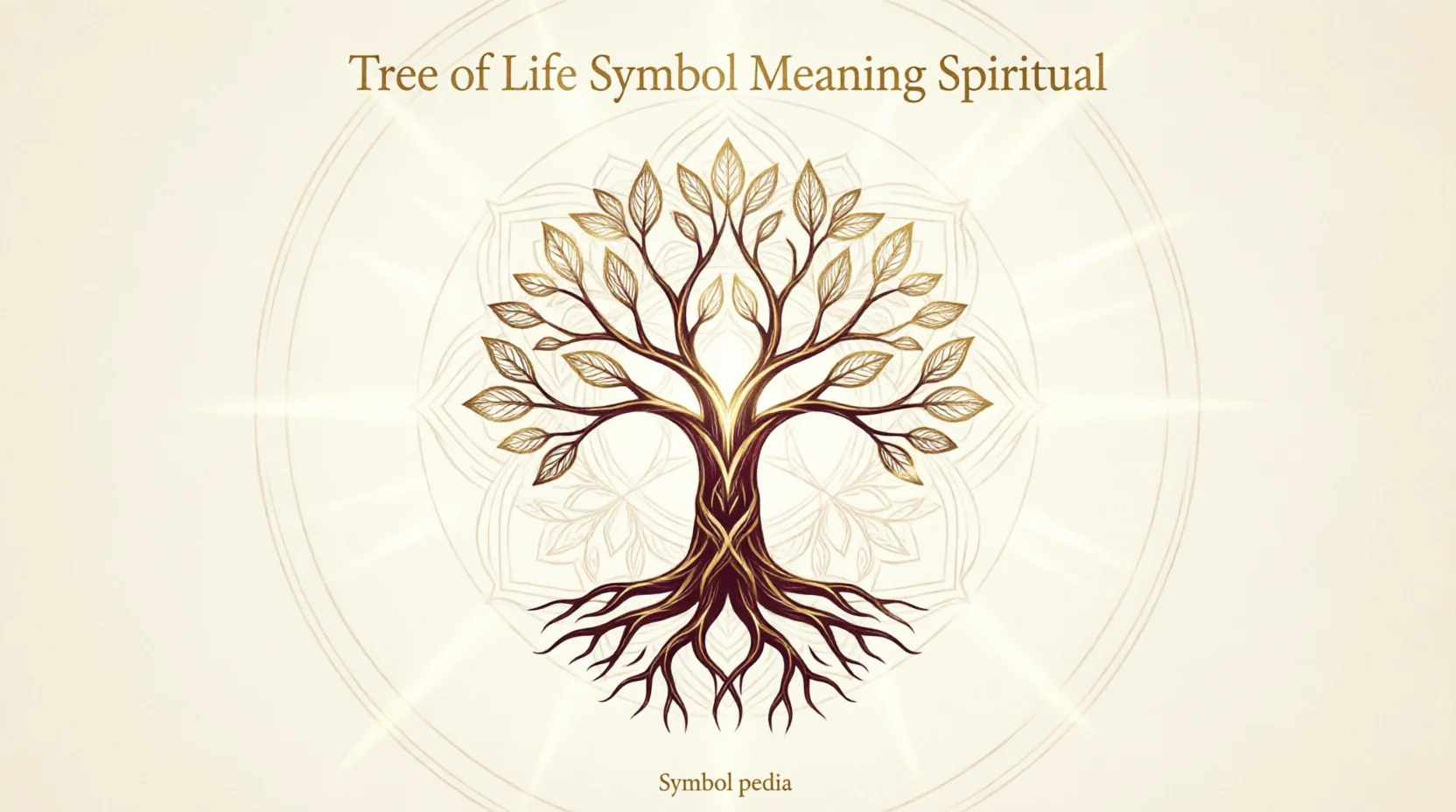
The tree of life symbol meaning is deeply connected with growth, connection, strength, wisdom, family, and the ongoing journey of life. You may have seen the symbol on jewelry, tattoos, home décor, spiritual artwork, clothing, or social media posts and wondered what it actually represents.
At first glance, the Tree of Life looks simple: roots below, a strong trunk in the middle, and branches reaching upward. But that simple image carries a surprisingly rich message. The roots can represent where we come from, the trunk can symbolize who we are today, and the branches can represent where life may take us.
That is why people are drawn to it during major life changes. Someone starting over after a difficult period may see the tree as a symbol of resilience. Someone celebrating their family may focus on its roots and branches. Another person may connect it with spiritual growth or a desire to remain grounded while moving forward.
There is no single meaning that applies to everyone. The Tree of Life appears in different cultures and traditions, sometimes with very different religious or philosophical interpretations.
Understanding those differences helps explain why this ancient-looking symbol remains so popular in modern life.
Tree of Life Symbol Meaning – Quick Meaning
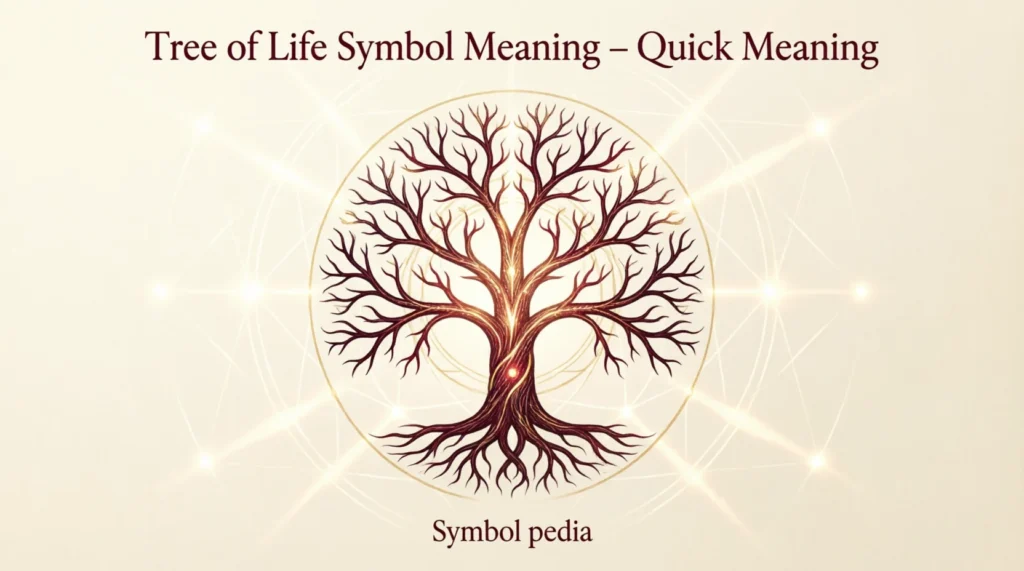
In its broadest sense, the Tree of Life symbolizes the interconnectedness of life and the balance between roots, growth, and possibility.
Common meanings include:
- Growth: Becoming wiser, stronger, and more mature over time.
- Strength: Remaining standing through difficult seasons.
- Family: Roots and branches can represent generations and relationships.
- Connection: The idea that people, nature, and life are interconnected.
- Wisdom: A growing tree can represent knowledge gained through experience.
- Grounding: Roots symbolize stability and staying connected to your values.
- Renewal: Trees lose leaves and grow again, making them symbols of new beginnings.
- Spiritual growth: The upward-reaching branches can represent a connection with something greater.
- Balance: The symbol brings together what is beneath us and what is above us.
You might hear someone explain their Tree of Life tattoo by saying:
“It reminds me how far I’ve come.”
Or:
“The roots represent my family.”
Another common interpretation is:
“I want to keep growing without forgetting where I came from.”
The important point is that the symbol’s meaning often becomes personal. Two people can wear nearly identical Tree of Life necklaces while attaching completely different stories to them.
Origin & Background of the Tree of Life
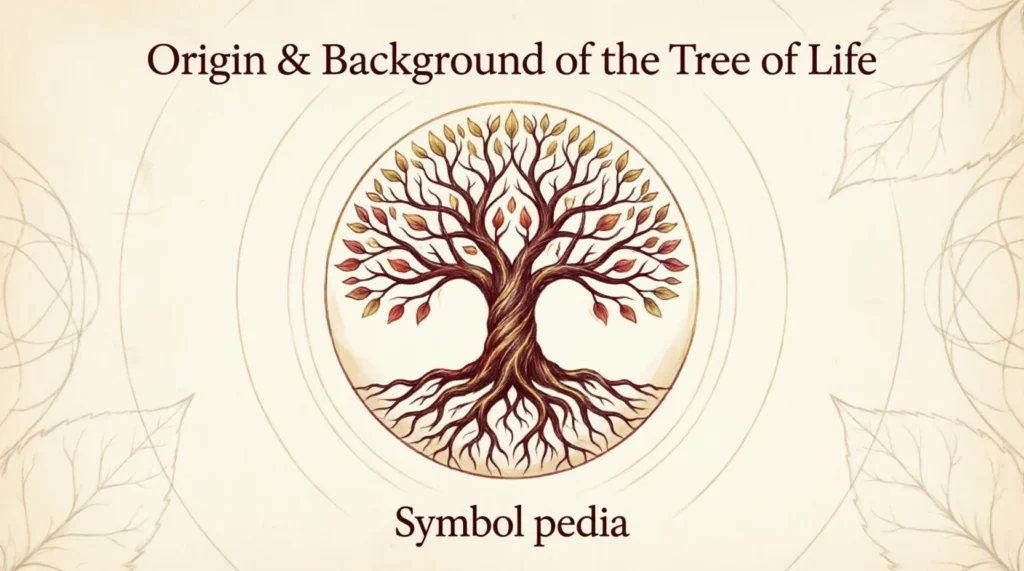
The Tree of Life is not limited to one culture or one historical tradition. Tree imagery appears across ancient religions, mythology, philosophy, and folklore.
One of the most famous examples appears in the Book of Genesis, where the Tree of Life is associated with the Garden of Eden. In that biblical setting, it is connected with life and immortality.
A different but related idea appears in Norse mythology through Yggdrasil, a great cosmic tree connecting different realms. Yggdrasil is not simply a family tree or decoration; it represents a vast structure connecting different parts of existence.
Ancient Mesopotamian art also contains important sacred tree imagery. In other traditions, sacred or cosmic trees symbolize the relationship between heaven, earth, nature, humanity, and the unseen world.
In South Asian traditions, trees have also carried powerful spiritual and philosophical associations. The Bodhi tree, for example, is strongly associated with the Buddha’s enlightenment. The broader image of a tree can therefore suggest wisdom, awakening, shelter, and spiritual transformation.
Jewish mystical traditions also use important tree imagery, particularly the Tree of Life in Kabbalah, although its structure and meaning are very different from the simplified tree designs commonly used in modern jewelry and tattoos.
Over time, these different traditions influenced art and popular culture. Today, the Tree of Life is often presented as a universal symbol rather than one belonging exclusively to a particular religion.
Social media has strengthened that modern interpretation. A beautifully illustrated tree with spreading branches and deep roots can communicate an emotional message without requiring a long explanation.
That visual simplicity is part of its appeal.
Real-Life Conversations About the Tree of Life Symbol
WhatsApp Conversation
Person A:
I finally decided what tattoo I want.
Person B:
Oh really? What is it?
Person A:
A Tree of Life. Roots underneath and branches going upward.
Person B:
That actually fits you.
Person A:
Yeah. The roots are my family, and the branches are everything I still want to become.
Person B:
Okay, that’s actually beautiful.
This conversation shows how the symbol can combine family, identity, and future goals in one image.
Instagram DM
Person A:
Your necklace is gorgeous. Does the tree mean something?
Person B:
Thank you! It does. I bought it after moving to a new city.
Person A:
Why a tree?
Person B:
I wanted something that reminded me to stay grounded while building a new life.
Person A:
I love that meaning.
Here, the Tree of Life represents stability during change.
TikTok Comments
Commenter 1:
Why does everyone use the Tree of Life?
Commenter 2:
For me, it’s about growth.
Commenter 3:
I see it as family. Roots = ancestors, branches = future generations.
Commenter 4:
I always thought it meant peace and balance.
The comments demonstrate something important: symbolic meanings can overlap without being identical.
Text Message
Person A:
Mom gave me a Tree of Life pendant today.
Person B:
That’s sweet. Why that symbol?
Person A:
She said the roots remind her of our family and the branches remind her that we’re all going to make our own paths.
Person B:
Keep that one forever.
Sometimes the meaning comes less from ancient symbolism and more from the person who gives the object to you.
Emotional & Psychological Meaning
The emotional power of the Tree of Life comes largely from its structure.
A tree grows slowly. You cannot force a mature tree to appear overnight. That makes it a natural metaphor for human development.
People often experience life in the same way. We go through difficult periods, learn from mistakes, build relationships, lose people, change direction, and gradually become different versions of ourselves.
The roots are particularly powerful psychologically.
They can represent family, childhood, memories, cultural heritage, personal values, or experiences that shaped us. Even when the visible part of a tree changes, its roots remain beneath the surface.
The branches offer another emotional message: growth does not have to mean forgetting your past.
Imagine someone who has spent years recovering from failure. They finally reach a point where they feel proud of themselves. A Tree of Life tattoo might express that journey better than words ever could.
The message might simply be: I survived, I grew, and I’m still becoming.
That is one reason the symbol feels comforting during transitions such as graduation, marriage, relocation, recovery from a difficult period, or the beginning of a new chapter.
Tree of Life Symbol Meaning in Different Contexts
On Social Media
On Instagram, Pinterest, TikTok, and other platforms, the Tree of Life is often used with captions about personal growth, healing, family, gratitude, or spirituality.
Someone might post a Tree of Life image after reaching an important personal milestone.
The meaning is usually emotional rather than strictly religious.
Among Friends and in Relationships
In friendships and relationships, the tree can symbolize a bond that becomes stronger with time.
Couples may interpret the roots as their shared foundation and the branches as the future they hope to build together.
Friends may use it to represent a long-lasting connection despite distance or changing circumstances.
In Work and Professional Settings
The symbol can appear in presentations, organizational diagrams, coaching materials, or personal-development settings.
However, its meaning should be explained rather than assumed.
For example, a company might use a tree diagram to represent the organization, with roots showing values, the trunk showing core operations, and branches representing different teams.
Casual vs. Serious Meaning
A Tree of Life image on a casual social-media post may simply mean “growth” or “good vibes.”
A tattoo, memorial gift, or religious artwork may carry a much more personal meaning.
Context matters.
When NOT to Use the Tree of Life Symbol
The Tree of Life is generally a positive and widely recognized symbol, but cultural sensitivity still matters.
Avoid presenting one interpretation as though it represents every culture or religion. Different traditions have their own sacred trees and theological meanings.
It is also wise to be careful when using a culturally specific design as a costume, joke, or commercial decoration without understanding its background.
For example, saying “the Tree of Life always means X” can be misleading because the symbol has appeared in multiple traditions with different interpretations.
If someone tells you that their Tree of Life jewelry has a specific religious or family meaning, respect their interpretation instead of correcting them based on a generic definition found online.
Common Misunderstandings About the Tree of Life
“It has only one meaning.”
It doesn’t. Growth, family, spirituality, wisdom, and connection are among the most common interpretations.
“It is only a religious symbol.”
Not necessarily. Many modern people use it in a personal, artistic, or philosophical sense.
“The roots always mean ancestors.”
Roots can represent ancestors and family, but they may also symbolize personal history, stability, identity, or values.
“The branches mean success.”
They can symbolize ambitions or future possibilities, but they may also represent relationships, choices, different life paths, or spiritual development.
“Every Tree of Life design has the same symbolism.”
Design details matter. Some versions emphasize roots, others emphasize branches, leaves, circles, fruit, birds, or geometric patterns.
Tree of Life vs. Similar Symbols
| Symbol | Main Meaning | How It Relates to the Tree of Life |
|---|---|---|
| Tree of Life | Growth, connection, family, life | Central symbol of interconnected existence |
| Family Tree | Ancestry and generations | Focuses more specifically on family lineage |
| Lotus | Renewal, spiritual growth, overcoming difficulty | Shares the idea of transformation |
| Infinity Symbol | Eternity and endlessness | Can overlap with the Tree of Life’s idea of continuity |
| Celtic Tree | Nature, balance, connection | Often emphasizes interconnectedness and natural cycles |
| Yggdrasil | Cosmic connection and existence | A specific Norse mythological world-tree |
| Bodhi Tree | Enlightenment and awakening | Strongly connected with Buddhist tradition |
| Dead Tree | Loss, endings, mortality | Can contrast with the living Tree of Life |
| Branch | Growth and direction | Represents one part of the Tree of Life |
| Roots | Foundation and origins | Represents the hidden foundation beneath growth |
Key Insight
The Tree of Life is best understood as a symbolic framework rather than a single fixed definition. Its roots, trunk, branches, and leaves allow people to tell different stories about where they came from, who they are, and where they are going.
How to Respond When Someone Uses the Tree of Life Symbol
If someone sends you a Tree of Life emoji-style image, tattoo photo, necklace picture, or social-media post, your response can depend on the relationship and context.
Casual Replies
- “That’s beautiful!”
- “I love the symbolism.”
- “The growth meaning really fits.”
- “That’s such a meaningful design.”
Funny Replies
- “Okay, but are you watering it regularly?”
- “Deep roots, apparently.”
- “So basically: stay grounded but keep growing?”
Mature Replies
- “I like how it represents both your past and your future.”
- “That’s a meaningful way to describe personal growth.”
- “The idea of staying grounded while changing really resonates.”
Respectful Replies
- “That’s beautiful. What does it mean to you personally?”
- “I’d love to hear the story behind your symbol.”
- “It seems like it has a special meaning for you.”
The last type of response is often the best. Instead of assuming what someone’s symbol means, invite them to explain it.
Regional & Cultural Usage
Western Culture
In Western popular culture, the Tree of Life is frequently associated with personal growth, family, spirituality, nature, and resilience.
It appears commonly in tattoos, jewelry, home décor, artwork, and inspirational content.
Asian Culture
Tree symbolism varies considerably across Asian cultures and religions.
Certain trees have specific Buddhist, Hindu, Jain, or local cultural associations. Therefore, a generic Tree of Life design should not automatically be treated as equivalent to every sacred-tree tradition.
In many contexts, however, themes such as wisdom, longevity, nature, and spiritual development may overlap.
Middle Eastern Culture
The broader image of a sacred or life-giving tree has a long history in the Middle East and surrounding regions.
The biblical Tree of Life is especially important within Jewish and Christian traditions. Islamic art and literature also contain rich references to trees and gardens, although these should not automatically be equated with the specific Tree of Life concept from another tradition.
Global Internet Usage
Online, the Tree of Life has become more universal.
A person may use it simply because they associate trees with healing, stability, nature, family, or personal development.
Social media often removes some of the historical complexity and turns the symbol into a broadly understandable message of growth and connection.
Gen Z vs. Millennials
Younger internet users may use the Tree of Life in a more personalized way, connecting it with healing, self-discovery, identity, mental strength, or aesthetic symbolism.
Millennials may be more likely to encounter it through tattoos, jewelry, family symbolism, spirituality, or personal-development communities.
These are tendencies rather than strict rules. People of any generation can attach almost any meaningful interpretation to the symbol.
Is the Tree of Life Symbol Safe for Kids?
Yes, the Tree of Life is generally a family-friendly and non-explicit symbol.
For children, it can be introduced as an image representing growth, nature, family, friendship, or learning.
The only important consideration is context. A specific Tree of Life design may have religious, cultural, or spiritual significance, so children can benefit from learning that symbols do not always have one universal meaning.
FAQs About Tree of Life Symbol Meaning
What does the Tree of Life symbol mean?
The Tree of Life commonly represents growth, strength, family, connection, wisdom, renewal, and the relationship between our roots and future possibilities.
What do the roots mean on the Tree of Life?
The roots often symbolize family, ancestry, personal history, values, stability, and the experiences that form a person’s foundation.
What do the branches represent?
Branches can symbolize growth, future possibilities, relationships, different life paths, dreams, and personal development.
Is the Tree of Life a religious symbol?
It can be. Several religions and cultures have important tree traditions, but modern Tree of Life designs are also widely used for personal, artistic, family, and philosophical reasons.
What does a Tree of Life tattoo mean?
A Tree of Life tattoo can represent resilience, personal growth, family, identity, spirituality, or a new chapter in life. Its exact meaning depends on the person wearing it.
What does the Tree of Life mean spiritually?
Spiritually, it may symbolize the connection between earthly life and higher awareness, personal transformation, balance, wisdom, and the continuing journey of existence.
Is the Tree of Life a good symbol for family?
Yes. Its roots and branches naturally lend themselves to the idea of generations, family connections, shared history, and future descendants.
Conclusion
The tree of life symbol meaning is powerful because it tells a story without needing many words.
Its roots remind us that our past matters. The trunk represents the person we have become. Its branches reach toward everything still possible, while its leaves remind us that life is constantly changing.
That combination makes the symbol deeply relatable.
For one person, it may represent family. For another, it may mark survival after a difficult chapter. Someone else may see spirituality, nature, wisdom, or simply the courage to keep growing.
And perhaps that is the most meaningful part of the Tree of Life: you do not have to choose between remembering where you came from and imagining where you are going.
You can be rooted and still grow.
You can honor your history without being trapped by it.
You can lose leaves and still bloom again.
Whether you see the Tree of Life on a necklace, tattoo, piece of artwork, or social-media post, its most enduring message is remarkably simple: life is connected, growth takes time, and where you come from can help shape where you are going.
descover more post
What Does the Clover Symbol Mean Luck Love Culture More …
Statistical Symbol for Mean What It Means How to Use It and …
What Does the Ribbon Symbol Mean Meaning History Colors …