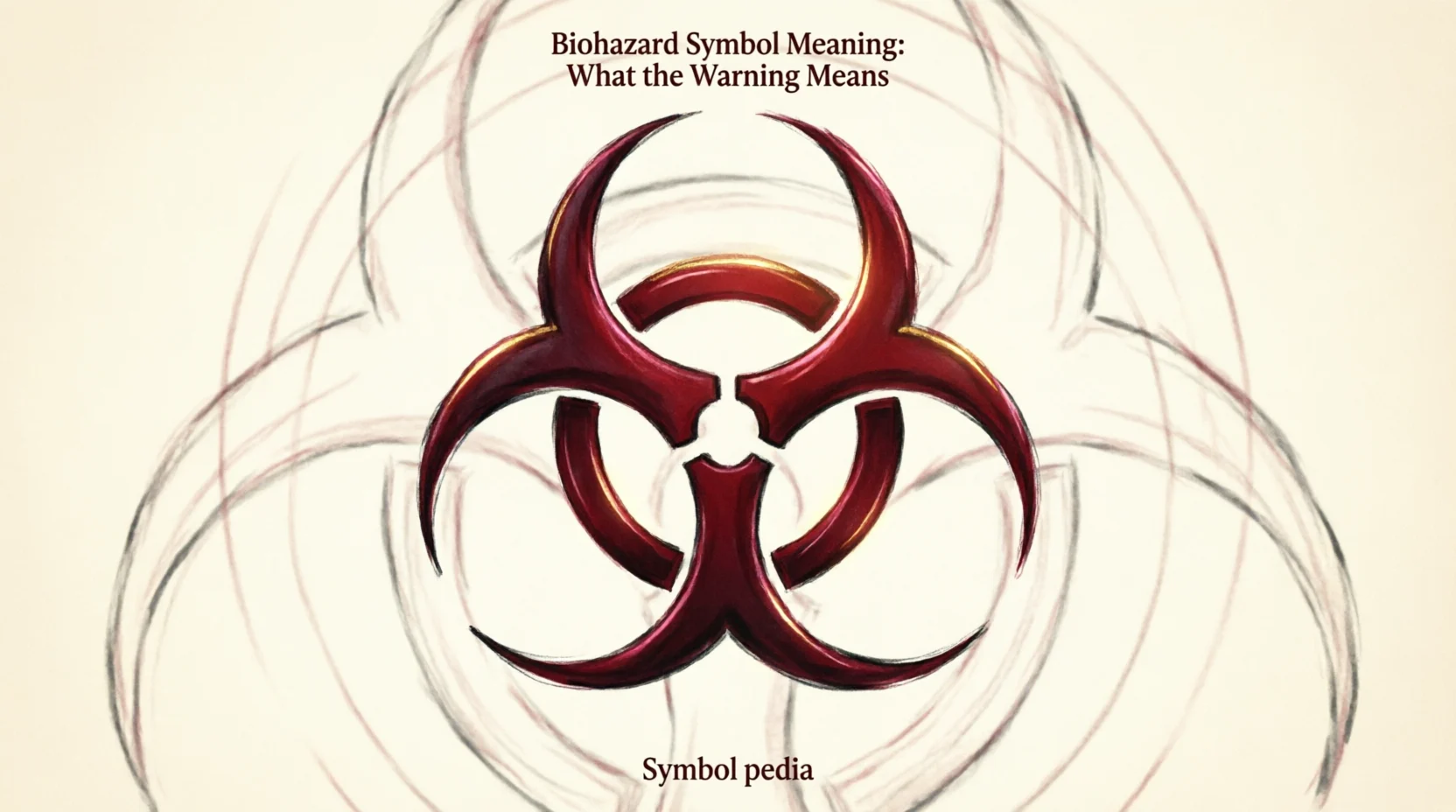
Seeing the ☣ biohazard symbol on a laboratory door, medical container, warning label, or fictional horror scene can immediately make you think, “Something dangerous is here.” But what exactly does the symbol mean, and where did it come from?
The biohazard symbol meaning is straightforward in its official use: it warns of the actual or potential presence of biological hazards that may cause illness, injury, or infection.
Unlike ancient symbols that developed through religion, mythology, or tradition, the biohazard symbol was deliberately designed in the 1960s. Its unusual shape was created to be memorable, recognizable, and culturally neutral rather than to represent an older hidden meaning.
Today, however, the symbol has developed meanings beyond laboratories. It appears in internet culture, gaming, tattoos, clothing, memes, horror imagery, and social media. That creates an interesting distinction: its official meaning is about biological danger, while its popular or symbolic meaning can suggest contamination, fear, rebellion, mystery, or something “dangerous.”
Understanding that difference helps prevent one of the most common mistakes people make with the symbol: assuming every appearance of ☣ is a literal warning.
Biohazard Symbol Meaning – Quick Meaning
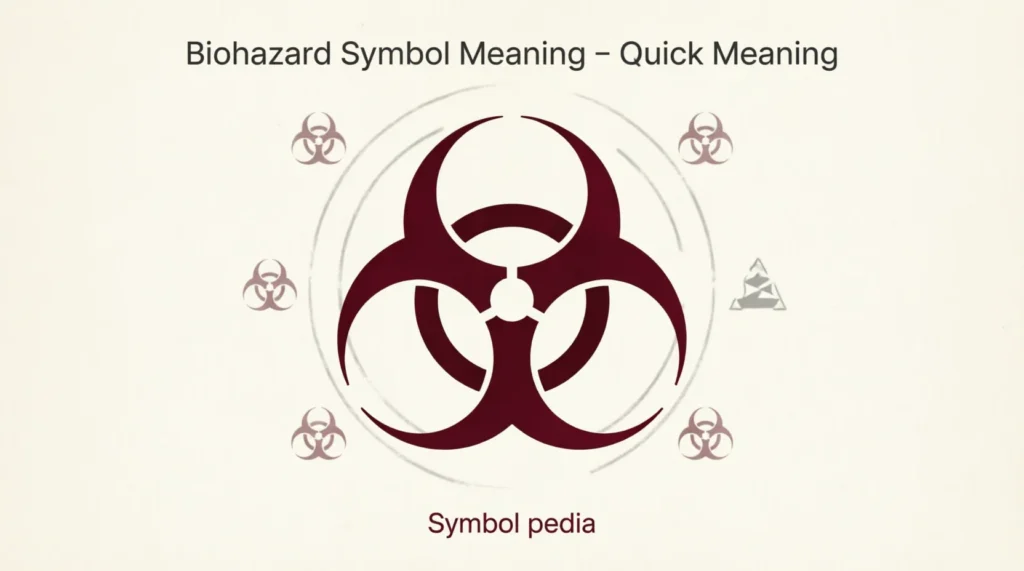
The biohazard symbol ☣ is a warning sign used to identify biological materials, areas, equipment, containers, or waste that present an actual or potential biological hazard.
In simple terms:
- ☣ = Biological hazard
- It can indicate potentially infectious or hazardous biological material.
- It is commonly associated with laboratories, hospitals, medical waste, research facilities, and contaminated materials.
- In popular culture, it can symbolize infection, contamination, danger, or something toxic.
- It is not the same as the radiation symbol ☢.
For example:
“The container has a ☣ label, so don’t handle it casually.”
“That game uses the ☣ symbol to represent an infection outbreak.”
“My friend put ☣ in her bio because she loves horror aesthetics.”
The first example uses the symbol in a safety-related sense. The other two use it figuratively or stylistically.
OSHA defines biological hazard labeling as a way to identify the actual or potential presence of hazardous biological agents and specifies the biohazard symbol for relevant warning tags.
Origin & Background of the Biohazard Symbol
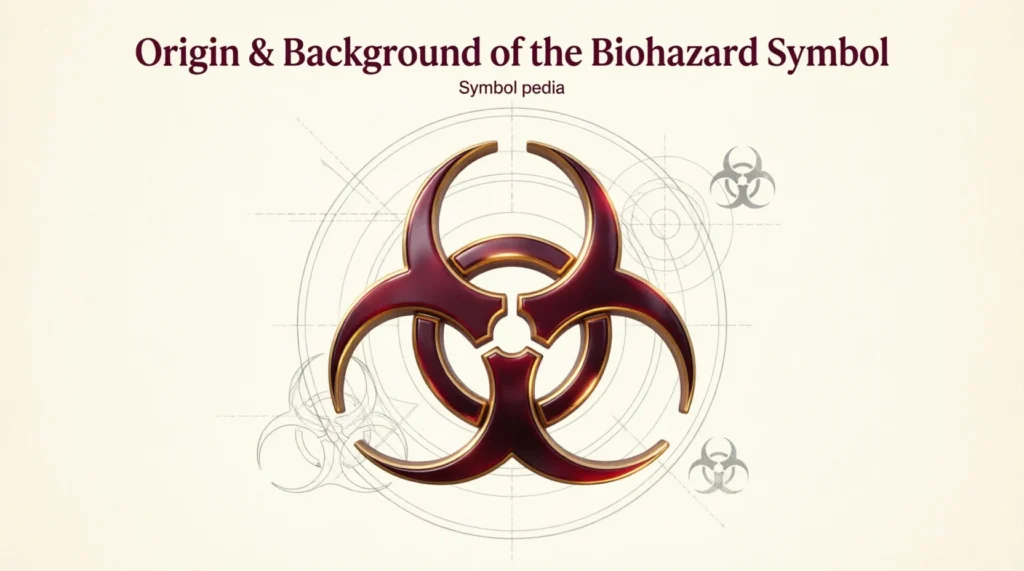
The history of the biohazard symbol is surprisingly modern.
The symbol was developed in 1966 by Charles Baldwin, an environmental health engineer working with Dow Chemical. The project emerged from a practical problem: laboratories needed a consistent way to warn people about biological hazards.
Before the symbol existed, different organizations used different warning signs. That inconsistency could become dangerous because a person familiar with one laboratory’s system might not understand another facility’s symbol.
Baldwin and his colleagues therefore approached the problem almost like a communication-design experiment.
They wanted a symbol that was:
- Visually striking
- Easy to recognize
- Easy to remember
- Difficult to confuse with another symbol
- Simple to reproduce
- Symmetrical from different viewing angles
- Acceptable across different cultural backgrounds
More than 40 designs were considered during the process. The eventual design was tested for both meaningfulness and memorability. Interestingly, the winning symbol was intentionally designed without an obvious pre-existing meaning.
That detail is important.
The designers did not want people to look at the shape and immediately think of a particular animal, religious symbol, letter, or familiar object. They wanted to create a new visual language that could be taught: this shape means biological danger.
The final design consists of three curved, overlapping forms surrounding a central circle. Its symmetry makes it recognizable even when viewed from different orientations.
The symbol was presented to the scientific community in 1967 in Science, in an article by Charles L. Baldwin and Robert S. Runkle discussing the development of a biological-hazard warning signal.
It subsequently became widely adopted by American health and safety organizations and eventually achieved international recognition. The Science History Institute notes that it was accepted as an ANSI standard in 1969 and later became an ISO global standard in 1986.
How the Meaning Evolved
Originally, the symbol had a very practical purpose: warn people about biological danger.
Over time, its strong visual identity made it useful outside scientific settings.
Movies began using it to represent mysterious contamination. Video games used it for infection zones, viruses, laboratories, and hazardous enemies. Clothing designers and artists adopted it because the shape immediately communicates danger.
On social media, someone might even use ☣ metaphorically to describe a person, situation, joke, or mood as “toxic” or “dangerous.”
That does not change the official definition. It simply demonstrates how symbols acquire additional cultural meanings through repeated everyday use.
Real-Life Conversations Using the Biohazard Symbol
A symbol can communicate different things depending on where it appears. Here are realistic examples.
1. WhatsApp
Person A:
“Why did you send me ☣?”
Person B:
“Because that leftovers container in your fridge is officially a biohazard 😂.”
Person A:
“Okay, fair. I’m throwing it away.”
Here, ☣ is being used humorously to mean extremely contaminated or disgusting, not as an official warning.
2. Instagram DM
Person A:
“Your new profile picture looks intense.”
Person B:
“I was going for a dangerous vibe. Added ☣ to my bio too.”
Person A:
“Yeah, definitely gives horror-movie energy.”
In this situation, the symbol is aesthetic. It represents danger, darkness, or an edgy personality.
3. TikTok Comments
Person A:
“That kitchen after the challenge ☣☣☣”
Person B:
“Literally looks like nobody has cleaned it since 2019 😭”
The symbol is being used as exaggeration. It communicates contamination or extreme messiness.
4. Text Messages
Person A:
“Don’t open that box.”
Person B:
“Why?”
Person A:
“☣ Seriously. It’s medical waste.”
Person B:
“Got it. I’m not touching it.”
This is different from the previous examples. Here, the symbol is being interpreted as a genuine safety warning.
Emotional & Psychological Meaning of the Biohazard Symbol
The official meaning of ☣ is technical, but people often respond to symbols emotionally.
Why?
Because visual warnings work faster than lengthy explanations.
A person does not need to read a paragraph about infectious material to feel that something requires caution. The unusual shape immediately creates a sense of risk, uncertainty, and distance.
That psychological effect is one reason the symbol works so well.
It Can Represent Fear
In horror films and games, ☣ often suggests an invisible threat.
You cannot necessarily see a virus or contaminant, which makes the symbol particularly effective. It tells you that something dangerous may exist even when the danger itself cannot be seen.
It Can Represent Contamination
People frequently use ☣ metaphorically for things they consider “contaminated,” messy, unhealthy, or toxic.
For example:
“My search history is a biohazard ☣.”
The person obviously isn’t claiming their phone contains infectious material. They’re using the symbol to exaggerate embarrassment.
It Can Represent Rebellion
Because the symbol is associated with danger, some people use it as an edgy visual statement.
It can suggest:
- “I’m dangerous.”
- “Stay away.”
- “Things are getting toxic.”
- “I like dark aesthetics.”
A Simple Personal-Style Scenario
Imagine noticing ☣ printed on a container in a hospital corridor. Even without knowing exactly what is inside, you instinctively give it more space.
That reaction illustrates why the symbol is powerful: you don’t need a long explanation before your brain recognizes that caution is appropriate.
Usage in Different Contexts
1. Social Media
On social platforms, ☣ can be literal or metaphorical.
People may use it in captions, usernames, bios, comments, memes, or artwork to suggest:
- Toxic energy
- Dark humor
- Contamination
- Horror
- Danger
- Rebellion
- Chaos
Context is everything.
A ☣ in a laboratory photograph is probably a safety reference. A ☣ next to a meme about someone’s terrible cooking is probably humor.
2. Friends & Relationships
Among friends, the symbol can become playful slang.
Someone might call an unbelievably messy room a “biohazard” or describe a disastrous date with ☣.
In relationships, however, calling someone’s behavior “biohazard” can sound harsher than intended. If you’re joking, the surrounding message should make that clear.
3. Work & Professional Settings
This is where you should take the symbol seriously.
In workplaces involving biological materials, medical waste, research samples, or infectious agents, ☣ is not simply an aesthetic symbol.
OSHA regulations specify biological-hazard signs and tags for situations involving actual or potential biological hazards.
For certain bloodborne-pathogen situations, OSHA also specifies biohazard labeling requirements for containers and other materials containing blood or potentially infectious materials.
So in a professional environment, never assume the symbol is decorative.
4. Casual vs. Serious Tone
Casual:
“Your refrigerator is ☣ 😂”
Meaning: It’s disgusting.
Serious:
“Do not open this container. ☣”
Meaning: There may be a genuine biological hazard.
The same symbol can therefore communicate completely different levels of seriousness.
When NOT to Use the Biohazard Symbol
The biohazard symbol deserves respect because it can represent a genuine safety warning.
Don’t Use It to Make Real Safety Warnings Into Jokes
If you’re labeling an actual hazardous container, use appropriate official procedures rather than creating a humorous label.
Don’t Assume Every ☣ Means Infection
Online, people often use the symbol aesthetically. Don’t panic simply because you see it on a shirt, profile, or video.
Avoid Creating False Warnings
Putting ☣ on an ordinary container could cause unnecessary concern, particularly in workplaces, schools, hospitals, or public spaces.
Consider Cultural and Situational Context
A symbol that feels funny in a meme can feel disturbing in a hospital or laboratory.
The setting determines how people interpret it.
Common Misunderstandings About the Biohazard Symbol
“It means radiation.”
No. The radiation warning symbol is ☢. The biohazard symbol is ☣.
“It always means someone is infected.”
Not necessarily.
It indicates a biological hazard or potential biological hazard in its official safety context. It does not automatically mean that a person is infected.
“The three shapes have an ancient meaning.”
The modern biohazard symbol was deliberately created in 1966. Its form was engineered for recognition and memorability rather than inherited from an ancient symbolic tradition.
“The symbol itself tells you exactly what danger exists.”
Not always.
A symbol warns you about the type of hazard, but additional information may be necessary to identify the specific biological agent, required precautions, or handling instructions.
“Every use online is a real warning.”
Definitely not.
Internet users frequently use ☣ figuratively to mean toxic, gross, chaotic, dangerous, or edgy.
Biohazard Symbol vs. Similar Symbols
| Symbol | Meaning | Common Context |
|---|---|---|
| ☣ | Biological hazard | Laboratories, medical waste, biological materials |
| ☢ | Radioactive/radiation hazard | Nuclear facilities, radiation equipment |
| ☠ | Poison/death | Toxic substances, skull imagery, warnings |
| ⚠ | General warning/caution | Roads, products, instructions |
| 🦠 | Microorganism/virus imagery | Social media, health discussions, biology |
| 🚫 | Prohibited/not allowed | Rules, restrictions, public signs |
| ☢ + ☣ | Multiple hazard concepts | Specialized scientific or fictional contexts |
| “Toxic” | Harmful or unhealthy, literal or figurative | Relationships, culture, chemicals, slang |
| “Danger” | General serious risk | Safety instructions and warnings |
| “Contaminated” | Polluted or carrying unwanted material | Medical, laboratory, environmental contexts |
Key Insight
☣ specifically points toward biological hazards, while symbols such as ☢ and ⚠ communicate different kinds of risk. Online, however, people often borrow these symbols for emotional or humorous meanings, so context matters more than the symbol alone.
How to Respond When Someone Uses the Biohazard Symbol
Your response depends entirely on what they mean.
Casual Replies
- “😂 What happened?”
- “That bad?”
- “Okay, I’m staying away.”
- “Biohazard is crazy 😂”
Funny Replies
- “Should I call the cleanup crew?”
- “Do I need protective equipment?”
- “That sounds medically concerning 😂”
- “Absolutely not. I’m evacuating.”
Mature Replies
- “What do you mean by the symbol?”
- “Are you using that literally or jokingly?”
- “Is there actually a safety concern?”
Respectful Replies
If someone uses it in a serious workplace or medical context, don’t joke immediately.
A simple:
“Understood. I’ll keep clear.”
is much more appropriate.
Regional & Cultural Usage
The official meaning of the biohazard symbol is broadly standardized, but informal interpretations can vary.
Western Culture
In the United States and other Western countries, ☣ is strongly associated with laboratories, medical hazards, infection, horror movies, and post-apocalyptic fiction.
It has also become familiar through video games and popular entertainment.
Asian Culture
In many Asian countries, the symbol is similarly recognizable as a biological warning, particularly in scientific and medical environments.
Online, younger users may also adopt it for memes, gaming, horror aesthetics, or exaggerated descriptions of something disgusting.
Middle Eastern Culture
The symbol generally retains its international safety meaning in professional contexts.
On social media, its interpretation may shift toward danger, contamination, horror, or dark humor depending on the surrounding language and cultural context.
Global Internet Usage
The internet has made ☣ almost language-independent.
A person does not need to speak English to recognize that the symbol suggests something hazardous.
That was actually part of the original design philosophy: the symbol needed to work across different cultural and linguistic backgrounds.
Gen Z vs. Millennials
Younger internet users may be more likely to use ☣ ironically.
For example:
“This group chat is a biohazard ☣.”
A Millennial might interpret the symbol more literally, especially if they encounter it in a workplace or safety-related context.
That isn’t a strict generational rule, though. Context and individual experience matter much more than age alone.
Is the Biohazard Symbol Safe for Kids?
The symbol itself isn’t dangerous. It is a visual warning sign.
For children, the important lesson is understanding that ☣ may indicate something they should not touch, open, or approach without adult or professional guidance.
When children encounter the symbol online, parents and teachers can also explain that people sometimes use it jokingly or aesthetically.
The safest rule is simple: treat it as a real warning when it appears on an actual container, room, workplace, or medical setting.
FAQs
What does the biohazard symbol mean?
The biohazard symbol ☣ warns of the actual or potential presence of hazardous biological agents or materials that may pose a health risk.
What does ☣ mean in texting?
In texting, ☣ can mean “biohazard,” but people often use it figuratively to mean something toxic, disgusting, dangerous, chaotic, or extreme.
Who created the biohazard symbol?
The modern biohazard symbol was developed in 1966 by Charles Baldwin, an environmental health engineer working with Dow Chemical.
Is the biohazard symbol the same as the radiation symbol?
No. ☣ means biological hazard, while ☢ is the radiation warning symbol.
Why does the biohazard symbol have three curved shapes?
Its distinctive symmetrical design was deliberately developed to be striking, recognizable, memorable, easy to reproduce, and usable across different orientations and cultural backgrounds.
Does the biohazard symbol mean someone has a virus?
No. The symbol indicates a biological hazard or potential biological hazard in an appropriate safety context. It does not automatically mean that a person is infected.
Why do people use ☣ on social media?
People use it to express ideas such as contamination, toxicity, horror, danger, dark humor, chaos, or an edgy aesthetic. In those situations, it is usually figurative rather than an official safety warning.
Conclusion
The biohazard symbol meaning is much more interesting than simply “danger.”
Officially, ☣ is a carefully designed warning symbol for biological hazards. It was created in the 1960s because scientists and safety professionals needed a recognizable way to communicate biological risk across laboratories and organizations. Its unusual design was intentionally developed to be memorable without relying on an older cultural meaning.
But language and symbolism rarely stay inside their original boundaries.
Today, ☣ can mean biological danger in a laboratory, contamination in a medical setting, or simply “this is toxic” in a group chat. A gamer might associate it with an outbreak, while someone on Instagram might use it purely for a dark aesthetic.
The most important thing is context.
When you see ☣ on an actual warning label, take it seriously. When you see it beside a meme or joke, look at the surrounding message before assuming there is a real hazard.
That small distinction is what turns symbol recognition into real communication understanding.
descover more post
Statistical Symbol for Mean What It Means How to Use It and …
What Does the Lock Symbol Mean on Snapchat Everything …
What Does the Nike Symbol Mean The Story Meaning Cultural …

Orvian is a passionate researcher and dedicated content creator focused on exploring the deeper meanings behind symbols, signs, and cultural interpretations. With a strong interest in symbolism and human psychology, Orvian simplifies complex ideas into clear, engaging, and easy-to-understand content for readers around the world.
Through consistent research and thoughtful writing, Orvian aims to provide accurate, insightful, and meaningful information that helps users connect with symbols on a deeper level—whether for personal growth, curiosity, or knowledge.
Known for a hardworking mindset and attention to detail, Orvian believes that every symbol carries a story, and every story deserves to be understood.