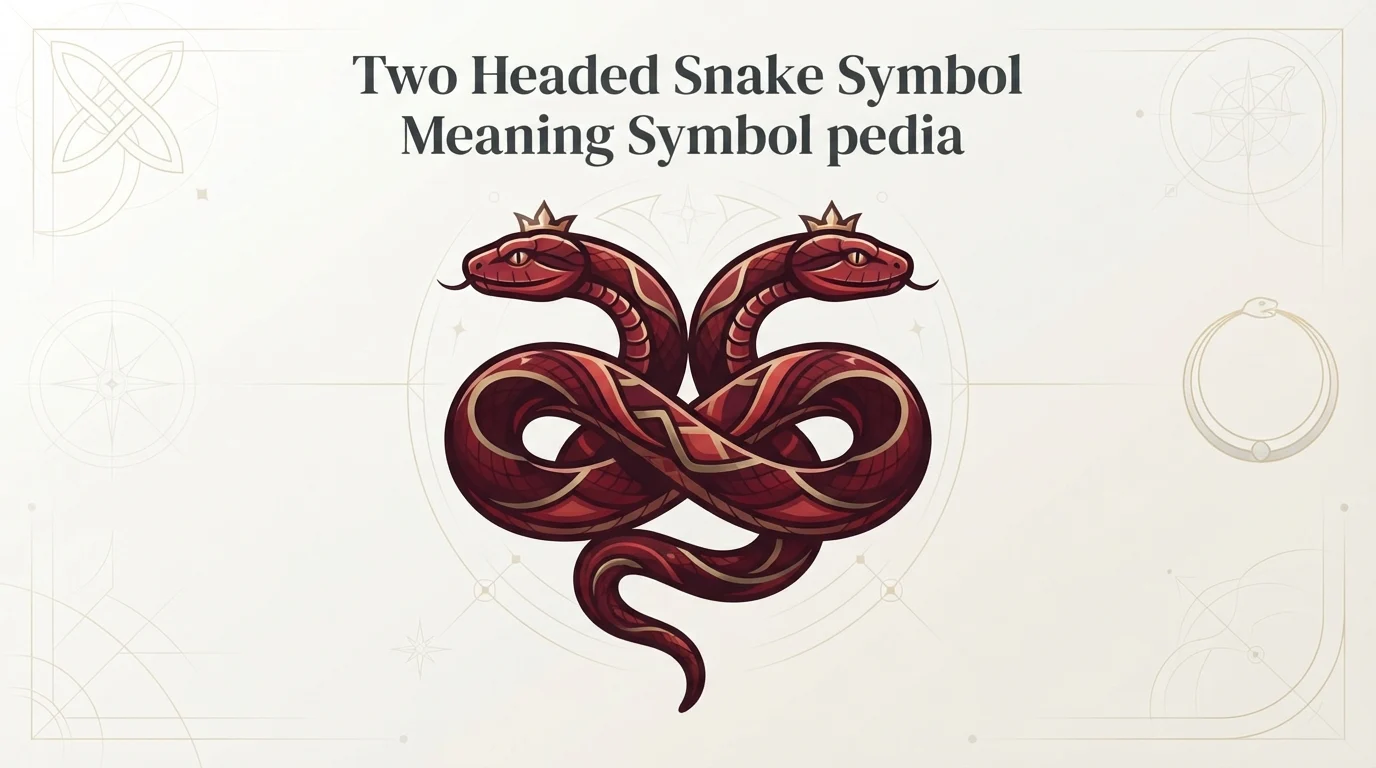
The two headed snake symbol meaning is often connected to duality, transformation, opposing forces, hidden wisdom, and the ability to see two sides of a situation. Depending on the culture, spiritual tradition, or personal experience, this unusual creature can represent balance, danger, renewal, or conflicting emotions.
A two-headed snake is more than an ordinary snake with an extra head. Its unusual appearance creates a powerful image of two directions, two perspectives, and two forces existing within one body.
People searching for the two headed snake symbol meaning may have seen it in a dream, tattoo design, ancient artwork, spiritual illustration, or online discussion. They often want to understand whether it represents good luck, a warning, personal transformation, or something deeper.
The interesting part is that a two-headed snake does not have one universal meaning. Its symbolism changes according to cultural history, religious beliefs, personal interpretation, and the situation in which it appears.
In this guide, we will explore its spiritual interpretations, ancient origins, psychological meaning, cultural significance, dream symbolism, tattoo meanings, and practical ways to understand this fascinating symbol.
1. Two Headed Snake Symbol Meaning – Quick Meaning
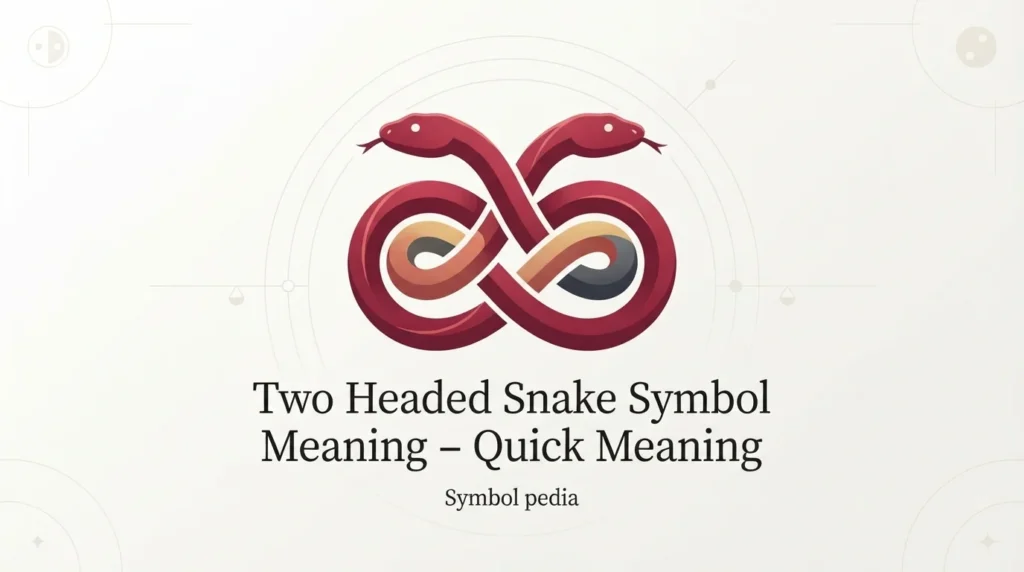
A two-headed snake is a symbolic creature representing two opposing or connected forces within one being.
It can suggest that someone is experiencing a choice, recognizing different perspectives, protecting themselves from uncertainty, or entering a period of personal change.
Common symbolic meanings
- Duality: Two different forces, personalities, or perspectives existing together.
- Transformation: Letting go of an old identity and moving toward a new beginning.
- Balance: Finding harmony between opposing emotions or responsibilities.
- Wisdom: Recognizing that situations can have more than one truth.
- Protection: Being aware of different directions and possible dangers.
- Conflict: Feeling emotionally divided or struggling between competing choices.
- Renewal: Moving through change and discovering a stronger sense of identity.
- Intuition: Paying attention to feelings, instincts, and overlooked possibilities.
For example, someone who feels torn between staying in a familiar relationship and beginning a new chapter might interpret a two-headed snake as a personal symbol of competing directions.
However, this is a personal interpretation rather than a fixed spiritual rule.
Simple examples
Someone might say:
“The two-headed snake represents my two different sides.”
Another person might explain:
“I see it as a symbol of transformation and balance.”
A tattoo enthusiast might describe it as:
“Two paths, one life, and the strength to choose.”
These examples demonstrate how the same image can express different personal meanings.
2. Origin and Background of the Two Headed Snake Symbol
The two-headed snake has a long history in mythology, traditional storytelling, and ancient art.
Its symbolism is especially interesting because different civilizations interpreted the creature in different ways. Some associated it with sacred power, renewal, and cosmic connections, while others viewed it as a frightening creature or an unusual omen.
Understanding these historical differences helps explain why the symbol still attracts attention today.
Ancient Mesoamerican symbolism
One of the most famous examples of a two-headed serpent comes from ancient Mexico.
The British Museum preserves a remarkable turquoise mosaic double-headed serpent associated with Mexica, commonly called Aztec, artistic and religious traditions.
The object dates to approximately the 15th or 16th century and was probably worn or carried during ceremonial occasions.
Its wooden structure is decorated with turquoise mosaic, shell, and other materials. Both ends display serpent heads, creating a striking image of a creature with two faces.
Historical context: British Museum double-headed serpent artwork. Double-headed serpent+1
In Mexica culture, serpents were associated with several important deities, including Quetzalcoatl, the Feathered Serpent.
Snake imagery could communicate ideas involving fertility, regeneration, sacred power, and connections between different parts of the natural world.
The serpent’s ability to shed its skin also made it a powerful image of renewal.
The two-headed serpent therefore cannot simply be described as a symbol of evil or bad luck. Its historical context includes sacred artistic and religious meanings.
The connection between heaven and earth
One interpretation of the ancient double-headed serpent connects it with the relationship between the earth and the sky.
The serpent represents an earthly creature, while the feathered imagery associated with Quetzalcoatl introduces a connection with birds and the heavens.
Together, these elements create a symbolic relationship between different realms of existence.
This makes the two-headed serpent especially interesting as a representation of duality.
Rather than suggesting that two forces must destroy one another, the image can communicate that different forces belong to a larger whole.
Maya and other Mesoamerican traditions
Serpent imagery also appears in Maya art and mythology.
However, historians caution against assuming that every two-headed serpent represented exactly the same idea across different Mesoamerican cultures.
Some images were connected with supernatural beings, sacred creatures, or complex cosmological ideas.
The meaning depended on the specific artwork, historical setting, and cultural tradition.
A double-headed serpent in a Maya context should not automatically be interpreted using the same explanation as a Mexica ceremonial object.
Historical comparison: Erenow+1
Greek mythology and the amphisbaena
Another important creature is the amphisbaena.
In classical mythology and later European bestiaries, the amphisbaena was described as a serpent with a head at each end of its body.
Its name is associated with movement in both directions.
Unlike the familiar image of a snake with two heads positioned beside one another, the traditional amphisbaena often has one head at the front and another near its tail.
Medieval descriptions presented it as a mysterious creature with unusual abilities.
Some stories associated it with the blood of Medusa, although these accounts belong to mythology rather than zoological history.
The creature became an interesting symbol of opposing directions, unusual movement, and the unsettling possibility of having no single forward path.
Historical source: Rochester Bestiary, approximately 1230. Kent History & Archaeology
How its meaning evolved
Over time, the two-headed snake became associated with different ideas in folklore, art, spirituality, and popular culture.
In some stories, it represented danger or unexpected misfortune.
In others, it suggested supernatural power, renewal, or the ability to move between different worlds.
Modern interpretations often focus on personal symbolism.
People may use the image to represent complicated relationships, emotional contradictions, spiritual transformation, or the experience of living with two different sides of their personality.
These modern interpretations are meaningful to individuals, but they should not be confused with established historical beliefs.
3. Emotional and Psychological Meaning
The psychological meaning of a two-headed snake often centers on the experience of having more than one feeling, desire, or direction at the same time.
People rarely experience life in simple categories.
Someone can love a person and still feel hurt by them. Someone can want independence while also fearing loneliness. Someone can feel excited about change and nervous about leaving familiar surroundings.
The two-headed snake provides a visual way to understand these complicated emotions.
Feeling pulled in two directions
Imagine someone who receives an opportunity to move to another country.
One part of them feels excited about a fresh beginning. Another part worries about leaving family, friends, and familiar routines.
The two-headed snake might become a personal symbol of that emotional experience.
It does not necessarily mean the person is confused or making a bad decision.
Instead, it can represent the reality that important decisions often involve competing values.
Accepting different sides of yourself
Another interpretation involves personal identity.
People sometimes feel pressure to behave differently depending on their surroundings.
Someone may be confident at work but quiet in unfamiliar social situations. Another person may be serious around family but playful with friends.
These differences do not automatically mean someone is dishonest.
They may simply reflect the different parts of a person’s personality.
A two-headed snake can represent the challenge of accepting those differences without feeling that one side must disappear.
The meaning of awareness
Because the creature has two heads, it can also suggest awareness of multiple perspectives.
Imagine a disagreement between two friends.
One friend believes they were ignored. The other believes they were simply busy.
A person who understands both perspectives may recognize that the disagreement involves different expectations rather than deliberate cruelty.
In this interpretation, the two-headed snake becomes a reminder to look beyond the first explanation.
A personal-style scenario
Imagine someone who has spent years working toward a particular career.
Eventually, they realize that the job no longer makes them happy.
They feel grateful for the experience but also want something different.
Rather than interpreting those feelings as failure, they begin to see them as two parts of a changing identity.
The two-headed snake becomes a meaningful image for that transition.
Psychological insight: Having conflicting feelings does not always mean something is wrong. Sometimes it means a person is recognizing important needs that deserve attention.
This is a reflective interpretation, not a psychological diagnosis or a scientifically established meaning of the symbol.
4. Spiritual Meaning of a Two Headed Snake
In spiritual symbolism, a two-headed snake is often interpreted through the ideas of duality, awareness, transformation, and the relationship between opposing forces.
Its meaning depends on the spiritual tradition and the individual’s beliefs.
Duality and balance
The most common modern spiritual interpretation involves duality.
Duality refers to the existence of two contrasting or complementary aspects.
Examples include:
- Light and darkness.
- Strength and vulnerability.
- Logic and intuition.
- Beginning and ending.
- Independence and connection.
- Action and reflection.
The two-headed snake can symbolize the need to recognize both sides without allowing either to dominate unnecessarily.
For someone exploring spirituality, it may encourage a more balanced understanding of personal experiences.
Transformation and renewal
Snakes are frequently connected with transformation because they shed their skin.
In Mexica art, serpent imagery carried important associations with renewal and regeneration.
This historical symbolism provides context for modern spiritual interpretations of snakes as creatures connected with change.
A two-headed snake may therefore represent transformation that involves more than one part of a person’s life.
For example, someone might change their career while also developing a new understanding of relationships and personal boundaries.
The image can represent a transition that affects several areas of identity simultaneously.
Historical context: Double-headed serpent
Protection and awareness
Some people interpret the two heads as a symbol of heightened awareness.
The creature appears capable of facing different directions, making it an appealing image for someone who values preparation and observation.
In personal spirituality, this might represent:
- Thinking before making a decision.
- Recognizing warning signs.
- Listening to intuition without ignoring evidence.
- Protecting emotional boundaries.
- Considering different possible outcomes.
There is no universal spiritual rule that a two-headed snake guarantees protection.
Its protective meaning is best understood as a personal association rather than a promise of supernatural safety.
Is it a good or bad omen?
There is no reliable universal answer.
Some folklore traditions associate two-headed serpents with fear, misfortune, or unsettling encounters.
Other traditions place serpent imagery within sacred, regenerative, or cosmological contexts.
The creature’s meaning changes according to the story and culture.
If you encounter the symbol in a dream, artwork, or meditation, it is more useful to consider your personal feelings and circumstances than to assume it predicts a specific event.
5. Two Headed Snake Meaning in Dreams
Dream interpretations are personal, and a two-headed snake does not have one scientifically established meaning.
Still, people often use dream symbolism to reflect on emotions and experiences they are trying to understand.
Dreaming of a peaceful two-headed snake
A calm snake may represent a situation involving two perspectives that are becoming easier to accept.
Perhaps you are learning to understand someone else’s point of view.
Or perhaps you are becoming more comfortable with different parts of your personality.
The peaceful appearance may reflect your emotional response rather than predict a future event.
Dreaming of an aggressive two-headed snake
An aggressive creature may bring attention to feelings of pressure, conflict, or uncertainty.
For example, you might be dealing with two responsibilities that seem impossible to manage simultaneously.
The dream could provide an opportunity to reflect on what is causing stress.
It does not automatically mean someone is secretly working against you.
Dreaming of two heads moving in different directions
This image naturally suggests competing directions.
You might be considering two career paths, feeling uncertain about a relationship, or struggling to decide what matters most.
A helpful question is:
“What are the two things I am trying to protect or achieve right now?”
That question can make the dream more useful as a personal reflection.
Dreaming of a two-headed snake changing its skin
Because snake shedding is associated with renewal in various symbolic traditions, this image may feel connected to personal change.
You might be leaving behind an outdated habit, relationship pattern, or way of thinking.
The dream can serve as a reminder that change often involves discomfort before it becomes familiar.
Remember, dreams are not dependable predictions of future events.
Their usefulness comes from the personal reflection they encourage.
6. Two Headed Snake Meaning in Tattoos
A two-headed snake tattoo can communicate a complicated personal message.
Unlike a simple snake design, the double-headed image naturally creates a sense of contrast.
Its meaning often depends on the tattoo’s placement, style, accompanying symbols, and the person’s own story.
Snake Tattoo Meanings + 52 Designs that take your breath aw
30 Cool Two Headed Snake Tattoo Ideas for Men
14
Duality and personal identity
Some people choose the design to represent two sides of their personality.
They may see themselves as both strong and sensitive, independent and connected, or cautious and adventurous.
The tattoo can remind them that these qualities can coexist.
Transformation
A two-headed snake tattoo may represent a major life change.
For example, someone might choose it after leaving a difficult period or discovering a new direction.
The snake’s association with renewal makes it a natural image for personal transformation.
Strength and independence
The design can also express resilience.
Its unusual appearance creates an impression of a creature that cannot easily be understood through ordinary expectations.
For some people, this makes it an appealing symbol of individuality.
A reminder of difficult choices
Other tattoo owners may use the image to represent a decision that changed their life.
The two heads might symbolize two possible paths, while the shared body represents the fact that both possibilities belong to one personal journey.
A tattoo’s meaning is ultimately determined by the person wearing it.
7. Usage in Different Contexts
The two-headed snake symbol appears in several modern settings.
Its interpretation changes depending on whether it is used in art, relationships, spiritual discussions, or professional communication.
Social media
On Instagram, Pinterest, TikTok, and other platforms, the symbol may appear in:
- Spiritual artwork.
- Tattoo inspiration.
- Mythology discussions.
- Fantasy illustrations.
- Personal transformation posts.
- Symbolism and dream interpretation videos.
A caption might say:
“The two-headed snake reminds me that growth means learning to understand both sides of myself.”
In this context, the meaning is usually personal and reflective.
Friends and relationships
In relationships, the symbol may represent two people who have different perspectives but share a connection.
It could also describe a relationship in which someone feels emotionally divided.
For example:
“I feel like the two-headed snake today. I want to stay, but I also need space.”
The image can communicate emotional complexity without requiring a long explanation.
However, it should not be used to label someone as manipulative or dishonest without considering the actual situation.
Work and professional settings
The symbol is less common in professional communication.
If someone uses it in a presentation about leadership, teamwork, or decision-making, they may be discussing competing priorities or the importance of considering different viewpoints.
For example:
“Our team needs to avoid thinking like a two-headed snake pulling in opposite directions.”
Here, the image is a metaphor for disagreement or a lack of coordination.
It is not a standard business expression, so unfamiliar audiences may need an explanation.
Casual versus serious meaning
In casual conversation, the symbol may be used humorously.
In serious discussions, it can represent emotional conflict, cultural symbolism, or personal transformation.
The tone depends on the surrounding conversation.
A tattoo caption and an academic discussion of ancient artwork should not automatically be interpreted in the same way.
8. When NOT to Use the Two Headed Snake Symbol
Although the symbol can be meaningful, some situations require care.
Avoid using it to stereotype cultures
The two-headed serpent appears in different cultural traditions.
It would be misleading to describe every Indigenous, Mesoamerican, or spiritual interpretation as identical.
When discussing historical artwork, identify the culture and context whenever possible.
Avoid treating it as a guaranteed omen
A two-headed snake does not reliably predict betrayal, death, financial success, or spiritual awakening.
Presenting it as a definite prediction can create unnecessary fear.
Avoid using it to accuse someone
Calling a person a two-headed snake may suggest that they are dishonest or have two faces.
That interpretation can be insulting.
If you are discussing an actual relationship problem, describe the behavior rather than relying on a symbolic label.
Be careful with sacred imagery
Some serpent designs come from religious or ceremonial traditions.
If you want to use a culturally specific design, take time to understand its background.
Appreciating historical symbolism is different from assuming that every sacred image is simply decorative.
Avoid unclear professional communication
In a formal workplace, the symbol may confuse people who are unfamiliar with its meaning.
Use direct language when discussing disagreements, responsibilities, or decision-making.
9. Common Misunderstandings
Misunderstanding 1: A two-headed snake always represents evil
This is incorrect.
Some folklore traditions portray unusual serpents as dangerous, but other historical contexts associate serpent imagery with sacred power, renewal, and cosmological ideas.
The meaning depends on the tradition.
Misunderstanding 2: It always means betrayal
The two heads can suggest opposing perspectives, but that does not automatically mean dishonesty.
A person can have different feelings or responsibilities without being deceptive.
Misunderstanding 3: It has one universal spiritual meaning
There is no single interpretation accepted across all cultures.
Modern spiritual meanings should be distinguished from documented historical beliefs.
Misunderstanding 4: Seeing one in a dream predicts something
Dreams are not reliable supernatural forecasts.
They may provide a useful opportunity to reflect on feelings, experiences, and concerns.
Misunderstanding 5: It is the same as an ordinary snake symbol
The two-headed design adds a specific visual element of duality.
While both images may connect with transformation or renewal, the double-headed form introduces the idea of two directions or perspectives within one creature.
Misunderstanding 6: Every two-headed snake in ancient art means the same thing
Historical images must be interpreted within their cultural setting.
Different civilizations used serpent imagery for different religious, artistic, and symbolic purposes.
10. Two Headed Snake Symbol Comparison Table
| Symbol | Common interpretation | Main difference |
|---|---|---|
| Two-headed snake | Duality, opposing directions, connected forces | Two heads share one body |
| Ordinary snake | Transformation, instinct, renewal | Focuses on the serpent itself |
| Ouroboros | Cycles, eternity, continuity | Snake forms a circle by biting its tail |
| Dragon | Power, protection, danger, wisdom | Often associated with supernatural strength |
| Feathered serpent | Sacred connections between earth and sky | Strongly associated with Mesoamerican religious traditions |
| Twin snakes | Partnership, contrast, balance | Often emphasizes two separate but connected figures |
| Phoenix | Renewal, rebirth, resilience | Transformation through destruction and return |
| Two-faced figure | Contrasting identities or deception | Often focuses on human character rather than serpent symbolism |
Key Insight
The two-headed snake is especially powerful as a symbol because it combines unity with difference. Both heads belong to the same creature, yet they can represent different directions, perspectives, or experiences. That makes it a useful image for reflecting on complicated choices and the coexistence of opposing feelings.
12. How to Respond When Someone Uses the Symbol
If someone shares a two-headed snake image, their intended meaning may not be obvious.
The best response depends on whether they are discussing a tattoo, mythology, a dream, or a personal experience.
Casual replies
- “That is such an interesting symbol.”
- “I like the idea of two perspectives in one design.”
- “The meaning behind it is really fascinating.”
- “It definitely makes you think.”
Funny replies
- “Two heads, twice the opinions.”
- “Imagine trying to decide where to go.”
- “One head says yes, the other says absolutely not.”
- “That snake needs a serious group chat.”
These responses work when the conversation is lighthearted.
Mature replies
- “I see how it could represent different sides of the same person.”
- “The symbolism of duality is really interesting.”
- “It makes sense as a reminder that life can involve conflicting emotions.”
- “I like how the design represents complexity without necessarily suggesting conflict.”
Respectful replies
If someone shares a personal interpretation, acknowledge their experience.
You could say:
- “That is a meaningful way to interpret it.”
- “I can understand why that symbol connects with your experience.”
- “Thank you for explaining what it means to you.”
- “I appreciate the personal meaning behind your design.”
You do not need to agree with every spiritual interpretation to respond respectfully.
13. Regional and Cultural Usage
The two-headed snake does not have the same meaning everywhere.
Its interpretation depends on historical traditions, religious beliefs, artistic context, and modern personal symbolism.
Western culture
In Western folklore and medieval European storytelling, unusual serpents sometimes appeared as frightening creatures or signs of danger.
The amphisbaena became an example of a mysterious animal with extraordinary characteristics.
Some American folklore also associated two-headed snakes with misfortune, deception, or unsettling events.
However, these negative interpretations are not universal.
Modern Western tattoo culture often uses the design to represent duality, resilience, or individuality.
Asian culture
Snake symbolism varies widely across Asian countries and religious traditions.
In some Hindu traditions, serpent imagery is associated with divine beings, protection, and spiritual power.
In Buddhist traditions, nāga figures can have important religious and mythological roles.
However, these traditions should not be treated as interchangeable.
A two-headed snake does not automatically have the same meaning as a nāga, and there is no universal Asian interpretation of the double-headed serpent.
The specific artwork and cultural context matter.
Middle Eastern culture
Serpent symbolism in Middle Eastern traditions also varies.
In some religious narratives, snakes appear in stories involving temptation, danger, or moral choices.
In other historical settings, serpent imagery may have different associations.
It is important not to assume that a two-headed snake has one fixed meaning throughout the Middle East.
Modern spiritual interpretations may differ considerably from traditional religious symbolism.
Global internet usage
On the internet, the two-headed snake often appears in discussions about:
- Tattoo meanings.
- Spiritual symbolism.
- Fantasy creatures.
- Personal transformation.
- Dream interpretation.
- Mythology.
- Artistic expression.
People may use the symbol to communicate an idea that would otherwise require a longer explanation.
For example, someone might post a two-headed snake illustration with the caption:
“Learning to accept both sides of myself.”
The image becomes a personal statement rather than a universally recognized message.
Gen Z versus Millennials
Generational differences are not strict rules, but online trends can influence how people interpret symbols.
Some younger internet users may encounter the two-headed snake through tattoo inspiration, fantasy artwork, or short-form spiritual content.
Others may approach it through mythology, literature, or historical art.
Both generations can use the symbol to discuss identity, transformation, and emotional complexity.
The important distinction is not age alone.
Personal experience and cultural familiarity often matter more than generation when interpreting a symbol.
14. Is the Two Headed Snake Symbol Safe for Kids?
The two-headed snake symbol is not inherently inappropriate for children.
Its suitability depends on the image, the explanation, and the child’s age.
A simple illustration can introduce interesting conversations about animals, mythology, imagination, and different cultural beliefs.
Parents and educators can explain that the creature is generally a mythological or artistic symbol rather than a common animal found in nature.
For younger children, avoid frightening interpretations involving curses, death, or supernatural threats.
Instead, focus on understandable ideas such as:
- Different perspectives.
- Making choices.
- Change and growth.
- Understanding emotions.
- Respecting cultural stories.
If the image includes violence, disturbing details, or mature themes, consider whether it is appropriate for the child’s developmental level.
The symbol itself does not determine whether the content is suitable.
15. Frequently Asked Questions
What does a two-headed snake symbolize spiritually?
A two-headed snake may symbolize duality, transformation, balance, awareness, or opposing forces. Its spiritual interpretation depends on the individual’s beliefs and cultural context.
Is a two-headed snake a good or bad symbol?
It can be interpreted positively or negatively. Some traditions associate it with sacred power and renewal, while certain folklore traditions connect it with danger or misfortune.
What does a two-headed snake mean in a dream?
It may represent conflicting emotions, difficult choices, or different perspectives. However, dreams do not have scientifically established universal meanings or reliable predictive powers.
What does a two-headed snake tattoo mean?
A two-headed snake tattoo can represent duality, personal transformation, independence, resilience, or two connected paths. Its meaning depends on the person’s intention and design.
Is a two-headed snake a real animal?
Two-headed snakes can occur naturally because of a developmental condition called polycephaly. However, the famous mythological double-headed serpent is a symbolic creature, not a separate common snake species.
What is the difference between a two-headed snake and an amphisbaena?
A two-headed snake generally describes a serpent with two heads. The traditional amphisbaena is a specific mythological creature often depicted with one head at each end of its body.
Does a two-headed snake mean betrayal?
Not necessarily. Although some folklore interpretations associate the creature with deception, its modern symbolism also includes duality, awareness, and transformation.
16. Conclusion
The two headed snake symbol meaning is fascinating because it brings together two different ideas: unity and contrast.
Its two heads can represent different directions, competing emotions, or opposing perspectives, while its shared body reminds us that those differences can still belong to one connected experience.
Throughout history, serpent imagery has carried many meanings.
In ancient Mesoamerican art, the serpent could participate in sacred imagery involving renewal, fertility, and connections between different realms. In European mythology and folklore, unusual serpents sometimes appeared as mysterious or frightening creatures.
Modern interpretations add another layer.
People may choose the two-headed snake as a tattoo, spiritual image, or personal symbol because it reflects the complicated nature of being human.
You can feel confident while still being uncertain. You can want change while appreciating what you already have. You can recognize another person’s perspective without abandoning your own.
That is what makes the symbol meaningful to so many people.
The most useful interpretation is not necessarily that two opposing forces must fight. It is that different sides of life can exist together, and understanding them may help you move forward with greater awareness.
Whether you encounter the two-headed snake in mythology, a dream, a tattoo, or a piece of artwork, take time to consider its context and the feelings it brings up.
A symbol becomes personally meaningful when it helps you understand something about your own experience.
discover more post
Hummingbird Moth Symbol Meaning Spiritual Hope 2026
Oriole Symbol Meaning Spiritual Messages 2026 – Symbl Pedia
Canary Symbol Meaning What This Small Bird 2026