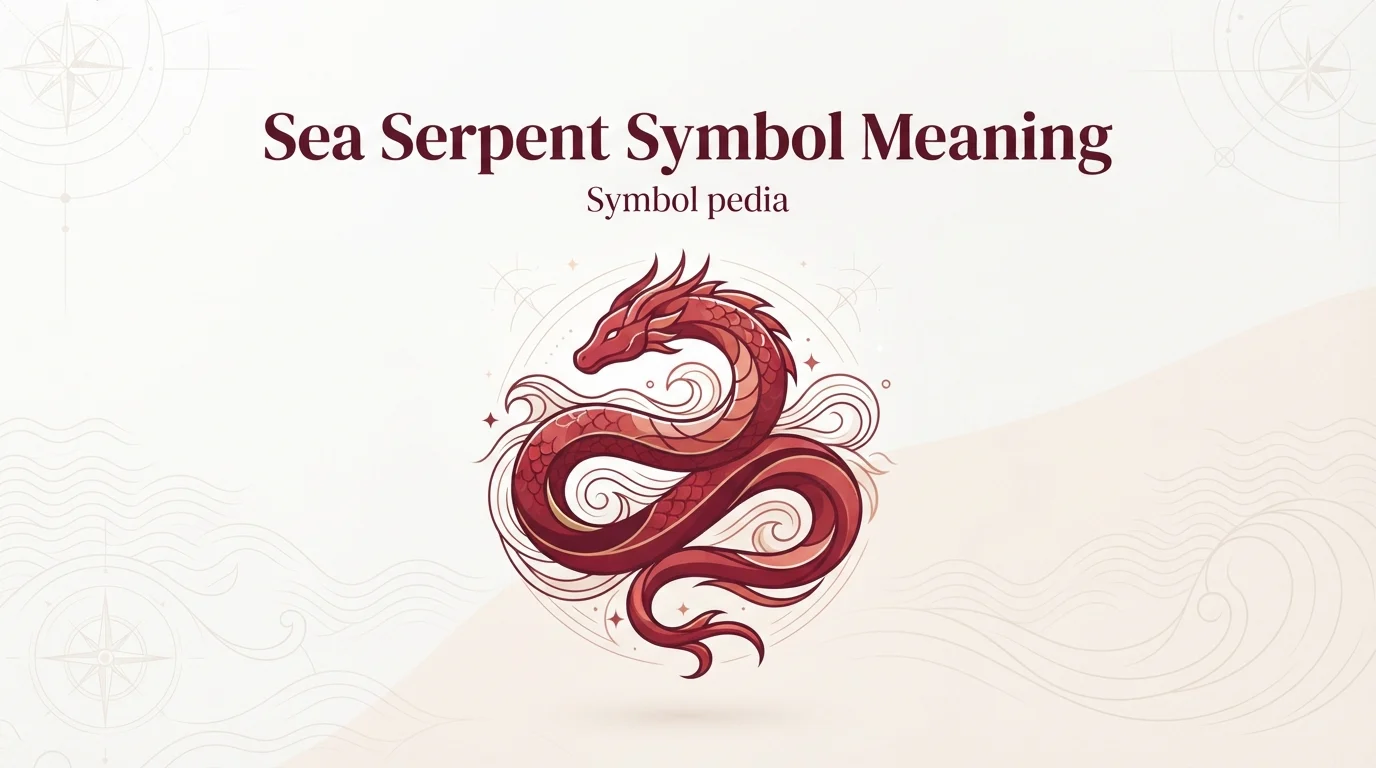
The sea serpent symbol meaning is often connected to mystery, transformation, wisdom, emotional depth, and the powerful forces hidden beneath the surface of life. This legendary creature appears in ancient stories, mythology, spiritual traditions, artwork, and modern symbolic interpretations.
Unlike ordinary snakes, sea serpents belong to the mysterious world of oceans, where darkness, movement, and uncertainty create a natural sense of wonder. Their symbolism often combines the serpent’s ability to shed its skin with the ocean’s association with emotions, intuition, and the unknown.
For some people, the sea serpent represents personal growth. For others, it symbolizes protection, hidden strength, spiritual awakening, or the courage to face difficult emotions.
People search for this symbol when they encounter it in dreams, tattoos, mythology, artwork, jewelry, or spiritual discussions. They may wonder whether it represents something positive, something dangerous, or a deeper message about their lives.
The truth is that the sea serpent does not have one universal meaning. Its interpretation depends on cultural background, personal experiences, artistic context, and the way the creature appears.
Understanding its different meanings can help you appreciate why this fascinating symbol has remained powerful throughout human storytelling.
2. Sea Serpent Symbol Meaning – Quick Meaning

The sea serpent commonly symbolizes mystery, transformation, emotional depth, hidden wisdom, and powerful natural forces.
Its meaning can change depending on whether it appears peacefully, aggressively, protectively, or mysteriously.
Common symbolic interpretations include:
- Transformation: The serpent’s ability to shed its skin represents renewal, personal growth, and leaving an outdated identity behind.
- Emotional depth: The ocean symbolizes feelings that are difficult to understand or express.
- Hidden wisdom: A sea serpent can represent knowledge that becomes available through patience and self-reflection.
- Protection: In certain stories and artistic interpretations, the creature guards sacred places, treasures, or boundaries.
- Power: Its enormous size and connection with the ocean represent strength that cannot easily be controlled.
- Mystery: Its association with unexplored waters reflects uncertainty, imagination, and the unknown.
Here are three simple examples of how people might interpret the symbol:
“The sea serpent reminds me that I can change without losing myself.”
“I see it as a symbol of strength hidden beneath a calm surface.”
“For me, the sea serpent represents the courage to explore what I don’t understand.”
These interpretations are symbolic rather than fixed definitions. The meaning becomes more personal when someone connects the creature with a particular experience or emotion.
3. Origin and Background of Sea Serpent Symbolism
Sea serpents have appeared in stories from different parts of the world for centuries.
Their symbolism developed through humanity’s relationship with oceans, rivers, storms, and mysterious creatures that people believed inhabited unfamiliar waters.
Because the sea was historically difficult to explore, it became a natural setting for stories about enormous creatures capable of controlling or threatening ships.
Ancient Mediterranean Traditions
In ancient Greek mythology, sea monsters were often associated with divine power, danger, and extraordinary challenges.
One famous example is Cetus, a sea monster connected with the story of Andromeda and Perseus.
Although Cetus is not simply a sea serpent in every depiction, it illustrates how ancient Mediterranean storytelling used enormous aquatic creatures to represent forces beyond human control.
The sea could provide food and transportation, but it could also destroy entire communities.
Consequently, sea monsters became powerful symbols of both wonder and danger.
Norse Mythology
Norse mythology contains one of the most recognizable serpent-like sea creatures: Jörmungandr, commonly called the Midgard Serpent.
According to the mythology, this enormous serpent surrounds the world and lives in the ocean.
Jörmungandr is associated with cosmic boundaries, immense power, and the relationship between order and destruction.
Its famous conflict with Thor also connects the creature with fate and the struggle against overwhelming forces.
In this tradition, the sea serpent is not merely an animal. It becomes part of a larger story about the structure and destiny of the world.
Asian Mythological Traditions
In Chinese mythology, dragons are strongly associated with water, rain, rivers, and oceanic power.
Although Chinese dragons are not identical to Western sea serpents, their symbolism offers an important comparison.
Water dragons can represent prosperity, authority, protection, and the natural forces that sustain life.
Japanese mythology also contains powerful aquatic beings and serpent-like creatures associated with water, spiritual transformation, and sacred places.
These traditions demonstrate that large water-dwelling creatures do not always represent evil or danger.
Their meaning may depend on their relationship with humanity, nature, and spiritual authority.
Cultural Influence and Modern Interpretations
Modern fantasy literature, films, games, tattoos, and digital artwork have expanded the sea serpent’s symbolic possibilities.
Today, someone might use a sea serpent image to express independence, emotional resilience, fascination with mythology, or appreciation for ocean life.
Social media has also encouraged people to explore symbols through personal spirituality and aesthetic identity.
However, modern interpretations should not automatically be treated as ancient beliefs.
A sea serpent tattoo representing emotional healing, for example, may reflect the wearer’s personal interpretation rather than a universally recognized historical tradition.
Understanding this distinction makes symbolic interpretation more accurate and respectful.
4. Real-Life Conversations
The following fictional conversations illustrate how people might discuss sea serpent symbolism in everyday digital communication.
Example 1: WhatsApp Conversation
Person A:
“I’ve been thinking about getting a sea serpent tattoo.”
Person B:
“That’s interesting. What does it mean to you?”
Person A:
“Honestly, transformation. I went through a difficult year, and I feel like I’m finally becoming myself again.”
Person B:
“Then it sounds like the perfect symbol for your journey.”
Here, the sea serpent represents personal growth and the ability to move forward after difficult experiences.
The meaning comes from the person’s emotional connection rather than a universal spiritual rule.
Example 2: Instagram DMs
Person A:
“Why do you always use sea serpent pictures?”
Person B:
“I love the mystery. It reminds me that not everything needs to be explained immediately.”
Person A:
“That’s actually a beautiful way to look at it.”
Person B:
“Sometimes the unknown is where the interesting things happen.”
In this conversation, the creature symbolizes curiosity, mystery, and acceptance of uncertainty.
Example 3: TikTok Comments
Person A:
“That sea serpent artwork looks terrifying.”
Person B:
“That’s the point! It’s supposed to represent the fear of facing your own emotions.”
Person A:
“Okay, now I understand why the ocean looks so dark in the background.”
Person B:
“Exactly. The darkness represents what we haven’t figured out yet.”
This example shows how artistic context can influence symbolic interpretation.
The creature’s threatening appearance does not necessarily mean the artwork is promoting evil.
Example 4: Text Messages Between Friends
Person A:
“I dreamed about a giant sea serpent last night.”
Person B:
“Was it attacking you?”
Person A:
“No, it was swimming beside me. I wasn’t even scared.”
Person B:
“Maybe it represents something powerful that you’re finally comfortable with.”
Person A:
“That actually makes sense. I’ve been learning to trust myself lately.”
Dream interpretations are personal and uncertain.
The conversation illustrates one possible reflection, not proof that a dream predicts the future or carries a specific supernatural message.
5. Emotional and Psychological Meaning
The sea serpent can be understood as a symbol of emotions that are powerful, complicated, and sometimes difficult to express.
The ocean provides a natural metaphor for the human emotional world.
Its surface may appear calm while strong currents move underneath.
Similarly, a person may seem confident while privately experiencing anxiety, grief, uncertainty, or personal change.
The sea serpent represents the possibility that these hidden feelings deserve attention rather than fear.
Transformation and Personal Growth
Serpents are frequently associated with transformation because they shed their skin.
This process creates a symbolic connection with changing habits, developing confidence, and moving beyond an old identity.
A sea serpent adds the ocean’s sense of depth to this interpretation.
It can represent transformation that happens gradually, often through experiences that other people cannot immediately see.
Someone recovering from a difficult relationship might connect with this symbolism because healing does not always happen in a straight line.
Emotional Strength
The creature’s enormous size can represent the strength required to face difficult situations.
However, strength does not always mean aggression.
Sometimes it means remaining calm during conflict, setting boundaries, or admitting that something has hurt you.
The sea serpent can symbolize the ability to acknowledge powerful emotions without allowing them to control every decision.
Hidden Wisdom
The ocean is often used in literature and art as a symbol of the unconscious mind.
A sea serpent emerging from deep water can therefore suggest an idea, feeling, or realization that has been hidden for a long time.
This interpretation encourages reflection.
It does not mean every mysterious experience contains a supernatural message.
Instead, it offers a meaningful way to think about the relationship between self-awareness and personal development.
A Personal-Style Scenario
Imagine someone who has spent years trying to please everyone around them.
They eventually recognize that constantly seeking approval has made it difficult to express their own needs.
After beginning to establish healthier boundaries, they discover an illustration of a sea serpent rising from dark water.
The image feels meaningful because it reflects their experience of finding confidence beneath years of uncertainty.
For that person, the sea serpent becomes a reminder of emotional independence.
The symbol matters because of the connection they make with their own life.
6. Sea Serpent Symbolism in Different Contexts
Social Media
On Instagram, Pinterest, TikTok, and other platforms, sea serpent imagery often appears in fantasy artwork, mythology discussions, tattoo designs, and spiritual content.
Its meaning may include mystery, power, creativity, independence, or transformation.
A person sharing sea serpent artwork might simply appreciate the design.
It is important not to assume that every image communicates a specific spiritual belief.
Friends and Relationships
In relationships, the sea serpent can represent emotional complexity, loyalty, protection, or the process of rebuilding trust.
Some people interpret its connection with deep water as a reminder that meaningful relationships require patience.
Others associate its strength with personal boundaries.
A sea serpent image can also represent the courage to explore emotions that are difficult to discuss.
Work and Professional Settings
Sea serpent symbolism is less common in formal professional communication.
However, it may appear in creative industries, branding, storytelling, game design, or personal artwork.
A company might use a mythical sea creature to communicate imagination, strength, or a connection with the ocean.
The interpretation depends on the organization’s identity and the surrounding visual design.
Casual Versus Serious Meaning
In casual settings, a sea serpent may simply represent a person’s interest in fantasy or mythology.
In serious personal contexts, it might symbolize emotional healing, spiritual reflection, or a meaningful life transition.
The same image can carry different meanings for different people.
Context is more important than assuming a single interpretation.
7. When NOT to Use Sea Serpent Symbolism
Although sea serpent imagery can be meaningful, there are situations where using it without understanding the context may create confusion.
Avoid Misrepresenting Cultural Traditions
Some aquatic creatures belong to specific religious, cultural, or mythological traditions.
Using them as generic decorations without understanding their background may unintentionally remove important cultural meaning.
Research the particular creature before presenting it as a sacred symbol.
Avoid Assuming Everyone Understands It
A sea serpent tattoo may communicate transformation to one person and fantasy interests to another.
Do not assume that friends, coworkers, or family members will interpret it the same way you do.
If the meaning is important, explain it.
Avoid Treating Symbolism as a Prediction
A sea serpent appearing in a dream does not establish that something dangerous or supernatural will happen.
Likewise, seeing a sea serpent illustration does not prove that the universe is sending a specific message.
Symbolic reflection can be useful without turning uncertain interpretations into facts.
Be Careful in Professional Communication
A mythical creature may be appropriate for a creative project but confusing in a formal presentation.
Consider your audience, industry, and purpose before using highly symbolic imagery.
8. Common Misunderstandings
Misunderstanding 1: Sea Serpents Always Represent Evil
Some stories portray sea serpents as dangerous monsters.
Others present aquatic serpents or dragons as powerful, protective, or spiritually significant beings.
Their meaning depends on the tradition and narrative.
Misunderstanding 2: Every Sea Serpent Has the Same Meaning
There is no universal dictionary that assigns one fixed interpretation to every sea serpent image.
A Norse mythological creature, a modern fantasy illustration, and a personal tattoo may communicate very different ideas.
Misunderstanding 3: Sea Serpent Dreams Predict the Future
Dreams can reflect personal experiences, emotions, memories, and imagination.
A sea serpent dream may inspire reflection, but it cannot reliably predict a specific event.
Misunderstanding 4: Sea Serpents and Dragons Are Identical
Some traditions portray dragons as serpent-like creatures.
However, dragons and sea serpents are not interchangeable in every mythology.
Their physical appearance, cultural roles, and symbolic meanings can differ.
Misunderstanding 5: Spiritual Meaning Is Always Historical Meaning
A modern person may interpret a sea serpent as a symbol of emotional healing.
That interpretation can be personally meaningful without being an established belief in an ancient culture.
Recognizing the difference helps avoid inaccurate historical claims.
9. Comparison Table
| Symbol or expression | Common symbolic meaning | Connection to sea serpent |
|---|---|---|
| Dragon | Power, wisdom, protection | Both can represent extraordinary strength and mythological mystery. |
| Snake | Transformation, renewal, instinct | Both share serpent imagery and associations with change. |
| Kraken | Oceanic danger, overwhelming power | Both represent mysterious forces hidden beneath the sea. |
| Phoenix | Rebirth, renewal, resilience | Both can symbolize transformation after difficult experiences. |
| Mermaid | Mystery, beauty, emotional connection | Both connect human imagination with the ocean. |
| Leviathan | Immense power, chaos, the unknown | Both can represent forces beyond human control. |
| Turtle | Patience, stability, longevity | Provides a contrasting symbol of calm, grounded strength. |
| Dove | Peace, gentleness, hope | Represents a softer contrast to the sea serpent’s powerful appearance. |
Key Insight
The sea serpent’s symbolism becomes clearer when compared with other mythical creatures. It shares transformation with snakes, power with dragons, and oceanic mystery with the kraken. However, its specific meaning depends on the story, culture, and personal interpretation rather than one universal definition.
11. How to Respond When Someone Uses Sea Serpent Symbolism
If someone shares a sea serpent image or explains its meaning, your response can depend on the conversation’s tone.
Casual Replies
- “That’s such an interesting symbol.”
- “I love the ocean connection.”
- “The design looks incredible.”
- “I can see why you chose it.”
Funny Replies
- “That serpent looks like it owns the entire ocean.”
- “Definitely not something I’d want to meet while swimming.”
- “The ocean just got a new boss.”
- “That creature needs its own mythology.”
Mature Replies
- “I like how the symbol connects strength with mystery.”
- “The transformation meaning is especially interesting.”
- “It seems like a powerful way to represent personal growth.”
- “The symbolism feels meaningful without being too obvious.”
Respectful Replies
- “What does the symbol mean to you personally?”
- “Is it connected to a particular mythology?”
- “I’d love to understand the cultural background.”
- “That’s a meaningful interpretation. Thanks for sharing it.”
The most thoughtful response is often a simple question.
Instead of deciding what the symbol means for someone else, give them the opportunity to explain their own connection.
12. Regional and Cultural Usage
Sea serpent symbolism differs across cultures because people have developed different relationships with oceans, mythology, religion, and storytelling.
Western Culture
Western sea serpent imagery frequently appears in mythology, fantasy, literature, and popular entertainment.
It may represent danger, mystery, extraordinary strength, or the struggle against powerful natural forces.
Norse mythology’s Jörmungandr is a particularly recognizable example.
However, Western interpretations are diverse, and not every sea serpent is portrayed as a villain.
Asian Culture
Asian traditions include many powerful water-associated dragons and serpent-like beings.
Chinese dragons are often associated with rain, rivers, prosperity, and authority.
Japanese traditions also contain aquatic mythological beings with distinctive cultural meanings.
These creatures should not automatically be described as identical to Western sea serpents.
Their symbolism needs to be understood within the specific tradition.
Middle Eastern Culture
Middle Eastern traditions contain important stories about serpents, dragons, and powerful creatures associated with religious or mythological narratives.
However, there is no single Middle Eastern interpretation of the sea serpent.
Meaning varies across historical periods, communities, and religious traditions.
It is better to investigate a specific story than to assign one broad spiritual meaning to an entire region.
Global Internet Usage
Online, sea serpent imagery is often used in fantasy art, gaming, tattoos, mythology discussions, and personal expression.
People may interpret it as a symbol of independence, emotional depth, transformation, or fascination with the unknown.
These modern meanings are often influenced by individual creativity rather than shared cultural rules.
Gen Z Versus Millennials
Generational differences are not absolute, but online habits can influence how people encounter symbolism.
Some younger internet users may discover sea serpent imagery through fantasy games, short-form videos, digital artwork, or aesthetic communities.
Some Millennials may encounter it through mythology books, films, tattoos, or older fantasy franchises.
Both generations can interpret the creature in similar ways.
The difference often comes from personal interests rather than age alone.
13. Is the Sea Serpent Symbol Safe for Kids?
Sea serpent symbolism is generally suitable for children when presented through age-appropriate stories, artwork, mythology, and creative activities.
The creature can introduce useful themes such as imagination, courage, transformation, and respect for nature.
However, some sea serpent stories include frightening imagery, violence, or intense themes.
Parents and educators should consider the child’s age and emotional sensitivity before introducing those stories.
It is also helpful to explain that mythical creatures belong to storytelling and cultural traditions.
Children can enjoy their symbolism without being taught that every mythical creature represents a real supernatural force.
14. Frequently Asked Questions
What does a sea serpent symbolize spiritually?
A sea serpent may symbolize transformation, emotional depth, hidden wisdom, strength, or mystery. Its spiritual meaning depends on personal beliefs and cultural context.
Is a sea serpent a good symbol?
A sea serpent can represent positive qualities such as resilience, protection, and personal growth. In other stories, it represents danger or overwhelming power. Its meaning depends on the context.
What does a sea serpent tattoo mean?
A sea serpent tattoo may represent transformation, independence, emotional strength, mystery, or a personal connection with mythology. The wearer’s intention determines its individual meaning.
What does seeing a sea serpent in a dream mean?
A sea serpent dream may inspire reflection about emotions, uncertainty, personal change, or hidden fears. Dream interpretation is subjective and does not reliably predict future events.
Is the sea serpent a symbol of transformation?
Yes, transformation is a common modern interpretation because serpents shed their skin. The ocean adds associations with emotional depth and unexplored experiences.
What is the difference between a sea serpent and a dragon?
A sea serpent is generally portrayed as a serpent-like aquatic creature. Dragons have broader mythological forms and roles. Some traditions connect them, but they are not identical everywhere.
Does a sea serpent represent protection?
It can. In stories and artistic interpretations, a sea serpent may guard a sacred place, treasure, or boundary. Protection is one possible meaning rather than a universal rule.
15. Conclusion
The sea serpent symbol meaning brings together mystery, transformation, emotional depth, and extraordinary power.
Its connection with the ocean makes it especially meaningful for people who want to explore the hidden parts of life.
In mythology, sea serpents can represent dangerous forces, cosmic boundaries, protection, or challenges that test human courage.
In modern symbolism, they may represent personal growth, emotional resilience, independence, or the willingness to face uncertainty.
The most important thing to remember is that a sea serpent does not have one fixed meaning for everyone.
Its interpretation depends on the cultural tradition, artistic setting, personal experience, and emotions connected with the image.
If you encounter a sea serpent in a dream, tattoo, story, or piece of artwork, consider what it represents to you.
Does it remind you of a difficult change, a hidden strength, a powerful emotion, or something you are still trying to understand?
That personal connection can make the symbol meaningful without requiring you to believe in a single universal interpretation.
Ultimately, the sea serpent reminds us that strength and mystery can exist together.
Sometimes the most meaningful growth happens beneath the surface, long before the outside world recognizes it.
discover more post
Water Strider Symbol Meaning Spiritual Significance 2026
Origin and Background of White Spider Symbolism 2026
White Butterfly Symbol Meaning Spiritual Signs 2026

Kavon is a passionate content creator and digital researcher who specializes in decoding symbols, meanings, and modern internet language. With a strong focus on clarity and authenticity, Kavon writes in a way that makes complex ideas simple, relatable, and useful for everyday readers.
Known for a hardworking mindset and attention to detail, Kavon is dedicated to creating content that genuinely helps people understand the deeper meanings behind words, signs, and online expressions. Every article is crafted with care, combining research, real-life insight, and a reader-first approach.
Through Symblpedia, Kavon aims to build a trusted space where curiosity meets clarity—helping users find answers that are not only accurate but also meaningful and easy to understa