Have you ever noticed a stick insect resting almost motionless on a branch and wondered whether its unusual appearance carries a deeper meaning? With its thin body, twig-like shape, and remarkable ability to blend into its surroundings, this small creature can inspire surprisingly powerful reflections about life.
The stick insect symbol meaning is commonly associated with patience, camouflage, adaptability, protection, and the wisdom of staying unnoticed when necessary. Because stick insects survive by blending into their environment and moving carefully, people often interpret them as symbols of quiet strength, self-preservation, and thoughtful action.
Some people also explore the spiritual meaning of a stick insect after encountering one unexpectedly, seeing one near their home, or repeatedly noticing images of the insect. They may wonder whether the experience represents a personal transition, a reminder to slow down, or an invitation to protect their peace.
However, it is important to distinguish cultural symbolism from established facts. There is no single universal spiritual meaning attached to a stick insect, and encountering one does not prove that the universe is sending a message.
Instead, the insect’s remarkable natural behavior provides a meaningful starting point for reflection.
In this guide, you will discover the stick insect’s spiritual symbolism, cultural interpretations, psychological significance, dream meanings, and practical lessons you can draw from this fascinating creature.
Stick Insect Symbol Meaning — Quick Meaning
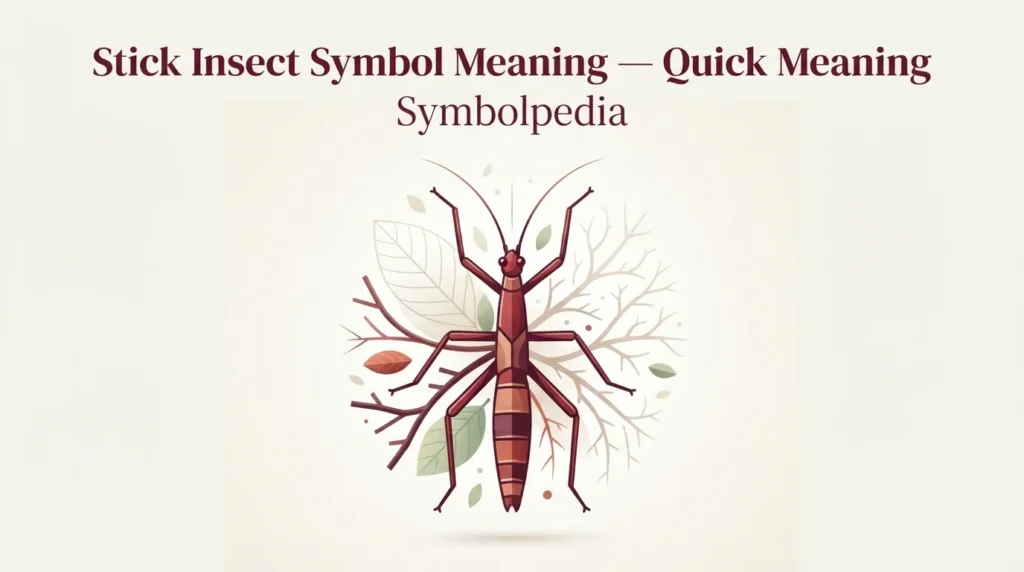
A stick insect commonly symbolizes patience, adaptability, camouflage, protection, resilience, and quiet observation.
Its appearance and behavior help explain why these meanings resonate with so many people.
Here are the main symbolic associations:
- Patience: The insect often remains still for long periods instead of rushing into action.
- Adaptability: Its body resembles a twig, helping it survive in particular environments.
- Protection: Camouflage allows it to avoid detection by many predators.
- Quiet strength: Its delicate appearance contrasts with its impressive survival strategies.
- Awareness: Its behavior encourages careful observation of the surrounding environment.
- Personal growth: Its life cycle, including molting, can inspire reflection on change and development.
- Boundaries: Its ability to remain inconspicuous can symbolize choosing privacy and protecting personal energy.
Consider these three interpretations:
“Be patient; the right moment will come.”
“You do not have to attract attention to have value.”
“Sometimes adapting is wiser than confronting everything directly.”
These are modern symbolic interpretations, not traditional quotations or messages scientifically attributed to the insect.
The central idea is that a stick insect can represent the value of knowing when to act, when to wait, and when to protect yourself.
Origin and Background of Stick Insect Symbolism
The natural history behind the symbolism
Stick insects belong to the order Phasmatodea. Many species have long, narrow bodies that resemble twigs or stems, making them difficult for predators to recognize.
This resemblance is an example of camouflage, an adaptation that improves survival in particular environments.
Some species also sway gently like vegetation moving in the wind. Others remain still for extended periods, relying on their appearance to avoid detection.
These behaviors provide a natural foundation for the symbolic associations people make with patience, concealment, and survival.
Cultural interpretations of insects
Insects have held different meanings in human societies throughout history. Depending on the species and cultural setting, they have represented transformation, persistence, danger, good fortune, or the relationship between humans and the natural world.
However, stick insects do not have one universally documented symbolic meaning across all cultures.
Their symbolism is often developed through personal observation, nature-inspired storytelling, spiritual reflection, and modern symbolic interpretation rather than a single ancient tradition.
For someone who values quiet living, a stick insect might represent the strength of remaining unnoticed. Another person might associate it with the need to become more adaptable during a difficult period.
Both interpretations can be personally meaningful without being universal cultural beliefs.
Stick insects in modern spiritual discussions
On social media, people frequently discuss the possible spiritual meanings of animals they encounter in everyday life.
A butterfly might be interpreted as transformation, while an owl may symbolize wisdom in some traditions. Stick insects are sometimes associated with similar themes of patience, awareness, camouflage, and personal change.
These interpretations can encourage people to pause and reflect on what is happening in their lives.
Still, an unexpected encounter is not proof of supernatural guidance. A stick insect may simply be resting on a plant or seeking shelter.
The value of the experience can come from what it helps you notice about your own circumstances.
Real-Life Conversations: How People Discuss Stick Insect Symbolism
The following fictional conversations illustrate how people might interpret a stick insect encounter in everyday life.
1. WhatsApp: Finding a Stick Insect at Home
Person A: “There was a stick insect on my balcony this morning. I’ve never seen one so close before.”
Person B: “That’s interesting! People sometimes associate them with patience and staying grounded.”
Person A: “Maybe I needed that reminder. I’ve been stressing about everything lately.”
Person B: “Then take it as a chance to slow down, even if it was just a little insect passing through.”
Meaning: The encounter becomes an opportunity for personal reflection rather than proof of a supernatural message.
2. Instagram DMs: A Period of Personal Change
Person A: “I posted that stick insect photo because it looked like a tiny branch.”
Person B: “It’s amazing how nature hides in plain sight.”
Person A: “Honestly, I’ve been keeping to myself recently. That idea really resonates with me.”
Person B: “Maybe you’re learning that being quiet doesn’t mean you’re standing still.”
Meaning: The stick insect becomes a metaphor for privacy, self-protection, and growth that other people may not immediately notice.
3. TikTok Comments: Understanding Its Spiritual Meaning
Person A: “What does it mean spiritually when you see a stick insect?”
Person B: “Some people interpret it as a symbol of patience, adaptability, or observation.”
Person C: “I see it as a reminder that you don’t always need to be the loudest person in the room.”
Person A: “I love that interpretation.”
Meaning: Different viewers find different personal lessons in the same creature. None of these interpretations needs to be treated as a universal rule.
4. Text Messages: Learning to Wait
Person A: “I really want to quit my job and start something new, but I’m scared.”
Person B: “Remember the stick insect we saw on our walk?”
Person A: “The one that looked exactly like a twig?”
Person B: “Yes. It made me think about how sometimes observing and preparing comes before taking action.”
Person A: “That’s actually helpful. Maybe I can make a plan before deciding.”
Meaning: The insect represents thoughtful preparation rather than impulsive action or indefinite avoidance.
Emotional and Psychological Meaning of a Stick Insect
The stick insect can inspire several psychological interpretations because its survival strategies reflect challenges people face in their own lives.
1. The need for patience
Modern life often encourages people to move quickly, respond immediately, and measure progress through visible achievements.
A stick insect offers a different image: an animal whose survival may depend on remaining still and avoiding unnecessary attention.
Symbolically, this can remind you that progress does not always need to be dramatic. Sometimes the most useful step is to wait, observe, and prepare.
2. The desire for privacy
Some people become quieter when they are overwhelmed, recovering from disappointment, or trying to understand their priorities.
The stick insect’s camouflage can serve as a metaphor for taking a step back without feeling obligated to explain every personal decision.
There is an important distinction, though. Healthy privacy can protect your well-being, while persistent isolation may leave you feeling disconnected. The symbolism is most useful when it encourages balance rather than avoidance.
3. Adaptability during change
A stick insect’s appearance helps it fit into its surroundings. This can inspire reflection on how people adapt to new workplaces, relationships, responsibilities, or unfamiliar environments.
Adaptability does not mean abandoning your values to please everyone. It means learning how to respond effectively while remaining connected to who you are.
4. Quiet confidence
Not every form of strength is visible.
A person may be rebuilding their confidence, learning a skill, recovering from a setback, or preparing for a major decision without telling everyone about it.
The stick insect can symbolize this quieter kind of development: meaningful work that happens before others notice the results.
A personal-style reflection
Imagine someone who has recently left a difficult relationship. They spend less time on social media, reconnect with friends, and begin rebuilding their routines.
One afternoon, they notice a stick insect on a plant near their window. They interpret its camouflage as a reminder that they are allowed to heal privately.
The insect has not objectively predicted their future. Yet the encounter gives them a useful way to understand their need for time, safety, and gradual change.
That is one of the most grounded ways to use symbolism: as a prompt for reflection, not as a substitute for evidence or personal judgment.
Stick Insect Symbolism in Different Contexts
Spiritual meaning
In modern spiritual interpretations, the stick insect is sometimes associated with patience, awareness, humility, and alignment with one’s surroundings.
Seeing one may prompt you to ask whether you are rushing a decision or overlooking details.
There is no established universal spiritual message attached to its appearance, so the interpretation is best treated as personal rather than absolute.
Symbolism in love and relationships
In relationships, the stick insect can symbolize patience, subtle affection, and the importance of respecting personal boundaries.
Its quiet presence may inspire reflection on whether a relationship allows both people to feel comfortable being themselves.
However, the insect does not reliably predict a soulmate, reunion, breakup, or another person’s hidden feelings.
Personal growth and life changes
Because stick insects molt as they grow, they can provide a metaphor for development and change.
A period of growth may involve leaving old habits behind, learning new skills, or accepting that your previous identity no longer fits your current circumstances.
The lesson is not that change must happen immediately. Instead, growth often requires preparation, time, and adjustment.
Work and professional life
The stick insect can symbolize strategic thinking, observation, and patience at work.
For example, someone entering a new role might benefit from learning the team’s routines before proposing major changes.
Quiet observation can be useful, but it should not prevent someone from speaking up when their contribution matters.
Casual versus serious interpretations
In a casual setting, a stick insect may simply be an unusual creature worth photographing.
In a reflective or spiritual setting, it may become a symbol of resilience or thoughtful timing.
Both perspectives are valid. You do not need to assign a deep meaning to every encounter with nature.
When NOT to Interpret a Stick Insect as a Sign
Symbolism can be helpful, but it becomes less useful when it creates unnecessary fear or replaces practical judgment.
1. Do not assume it predicts misfortune. There is no reliable evidence that encountering a stick insect predicts bad luck, betrayal, or danger.
2. Do not make major decisions based solely on an encounter. Career changes, relationship choices, and financial decisions deserve careful consideration of real circumstances.
3. Do not treat symbolism as a universal cultural rule. Interpretations differ among individuals and communities.
4. Do not ignore a practical explanation. A stick insect near your home may simply have landed on a plant or found a suitable place to rest.
5. Do not confuse patience with permanent inaction. Waiting can be wise when you need information, but delaying necessary action indefinitely is not always helpful.
A balanced approach allows personal meaning without turning an ordinary natural event into a source of pressure.
Common Misunderstandings About Stick Insect Symbolism
Misunderstanding 1: A stick insect always carries a spiritual message
Not everyone interprets animal encounters spiritually. Sometimes an insect is simply an insect.
You can appreciate its beauty and behavior without assigning it a deeper meaning.
Misunderstanding 2: Camouflage means hiding your true self
Camouflage is a survival strategy, not evidence that the insect represents dishonesty.
Symbolically, it can mean choosing privacy or knowing when to remain unobtrusive. It can also remind you that you deserve spaces where you feel safe expressing yourself openly.
Misunderstanding 3: Seeing a stick insect means you should avoid people
The symbolism of quietness does not require withdrawing from relationships.
A healthier interpretation is to respect your need for rest while maintaining supportive connections.
Misunderstanding 4: Stick insects symbolize weakness
Their thin bodies may appear fragile, but their survival strategies are highly specialized.
This contrast is one reason people associate them with quiet resilience rather than physical power.
Misunderstanding 5: Every culture gives the insect the same meaning
There is no single worldwide interpretation of stick insects. Modern spiritual meanings often reflect personal beliefs rather than a shared ancient tradition.
Understanding this distinction makes symbolic interpretation more respectful and accurate.
Comparison Table: Stick Insect and Related Animal Symbolism
| Symbol or animal | Common symbolic association | Connection to the stick insect |
|---|---|---|
| Stick insect | Patience, camouflage, adaptability | Represents quiet observation and strategic survival |
| Butterfly | Transformation and renewal | Both can inspire reflection on growth |
| Moth | Attraction, change, or mystery in some interpretations | Both may prompt reflection on unseen aspects of life |
| Chameleon | Adaptability and changing circumstances | Both are associated with blending into surroundings, although their biological strategies differ |
| Owl | Wisdom and observation in many traditions | Shares the theme of noticing what others overlook |
| Turtle | Patience and protection | Both can symbolize a slower, more deliberate approach |
| Ant | Cooperation and persistence | Emphasizes endurance, though ants are often associated with collective effort |
| Snake | Renewal or transformation in some cultures | Both can inspire reflections on growth and adaptation |
| Peacock | Visibility, beauty, and self-expression | Offers a contrast between blending in and standing out |
| Lion | Courage, leadership, and visible strength | Contrasts with the stick insect’s quieter survival strategy |
Key Insight
The stick insect stands out symbolically because it represents a different kind of strength from animals commonly associated with power or visibility. Its central lesson is not that you must always hide or remain silent, but that thoughtful observation, adaptability, and appropriate timing can be valuable forms of strength.
How to Respond When Someone Mentions Stick Insect Symbolism
If someone shares a stick insect encounter or asks about its meaning, your response can depend on how seriously they approach symbolism.
Casual replies
- “It’s amazing how well they blend into nature!”
- “I can definitely see why people associate them with patience.”
- “That little insect is surprisingly fascinating.”
Funny replies
- “Maybe it’s the original master of hide-and-seek!”
- “Proof that sometimes doing nothing is an impressive survival strategy.”
- “Nature’s tiny camouflage expert.”
Thoughtful replies
- “I like the idea that quiet progress can still be meaningful.”
- “Maybe it’s a useful reminder to observe before reacting.”
- “It makes me think about how adaptability and personal boundaries work together.”
Respectful replies
- “That interpretation sounds meaningful to you.”
- “Different people may see it differently, but I understand why that symbolism resonates.”
- “What did the encounter make you think about?”
The most helpful response is often one that respects the other person’s perspective without insisting that their interpretation must be true for everyone.
Regional and Cultural Usage of Stick Insect Symbolism
Stick insect symbolism varies because people interpret nature through their own traditions, experiences, and beliefs.
Western culture
In English-language spiritual and nature writing, stick insects are often associated with camouflage, patience, adaptability, and understated strength.
These associations largely follow from their observable behavior, rather than a single shared Western religious tradition.
Asian culture
Asia contains many different cultural, religious, and philosophical traditions. It would be inaccurate to claim that all Asian cultures assign one particular spiritual meaning to stick insects.
In some contemporary nature-inspired interpretations, their ability to blend into the environment may be used as a metaphor for patience or harmony with one’s surroundings. Such interpretations should not be mistaken for universal Asian beliefs.
Middle Eastern culture
The Middle East also encompasses diverse languages, religious traditions, and local customs.
There is no single established Middle Eastern spiritual meaning for encountering a stick insect. People may interpret it through personal beliefs, local experiences, or contemporary online symbolism.
A respectful explanation distinguishes individual interpretations from documented cultural traditions.
Global internet usage
Online discussions have made animal symbolism accessible to people around the world.
A photograph of a stick insect may inspire conversations about patience, privacy, resilience, and personal transformation, even among people who have never encountered one in nature.
Because social media spreads interpretations quickly, it is worth remembering that popularity does not necessarily establish historical or cultural authenticity.
Gen Z versus Millennials
Some younger internet users may describe a stick insect as a symbol of protecting their peace, staying low-key, or moving quietly toward personal goals.
Millennials may connect similar imagery with mindfulness, resilience, or personal development.
These are broad examples of contemporary language, not strict generational differences. Individual beliefs and experiences matter more than age alone.
Is Stick Insect Symbolism Safe for Kids?
Yes. Discussing stick insect symbolism can be a harmless and educational way to help children explore nature, creativity, and personal reflection.
Parents and teachers can explain how camouflage helps animals survive and then invite children to consider what patience or adaptability means in their own lives.
It is useful to distinguish scientific facts from imaginative interpretations. For example, camouflage is a real biological adaptation, while interpreting a stick insect as a sign of personal growth is a symbolic idea.
Children should also be taught to observe wildlife respectfully and avoid handling unfamiliar insects unnecessarily.
This approach encourages curiosity without creating fear or suggesting that ordinary animal encounters predict future events.
Frequently Asked Questions
1. What does a stick insect symbolize spiritually?
A stick insect is often interpreted as a symbol of patience, adaptability, protection, quiet strength, and observation. These are modern spiritual associations, not universal beliefs.
2. Is seeing a stick insect good luck?
Some people may view the encounter positively, associating it with resilience or thoughtful timing. However, there is no reliable evidence that seeing a stick insect predicts good or bad luck.
3. What does it mean when a stick insect visits your house?
It may simply have found its way indoors or landed on a nearby plant. Symbolically, you might use the encounter as a reminder to slow down, observe your surroundings, or protect your personal space.
4. What does a stick insect mean in love?
In a symbolic interpretation, it may represent patience, healthy boundaries, and quiet affection. It does not reliably predict a soulmate, reconciliation, or another person’s feelings.
5. What does a stick insect symbolize in dreams?
A stick insect in a dream might personally represent privacy, patience, adaptability, or a feeling of being overlooked. Dream interpretations are subjective and do not provide reliable predictions about the future.
6. Does a stick insect represent transformation?
It can symbolize transformation because stick insects molt as they grow. This biological process offers a natural metaphor for developing new skills, changing habits, and moving into a new phase of life.
7. What should I do if I keep seeing stick insects?
Consider whether the encounters are simply explained by your environment. If the symbolism interests you, reflect on whether patience, boundaries, or adaptability are relevant to your current circumstances. Repeated sightings do not establish a supernatural message.
Conclusion
The stick insect symbol meaning offers a thoughtful way to explore patience, adaptability, privacy, protection, and quiet resilience.
Its remarkable camouflage demonstrates how survival can depend on understanding the environment rather than constantly demanding attention. Its stillness can inspire patience, while its growth through molting provides a natural metaphor for change.
For some people, seeing a stick insect becomes a meaningful reminder to slow down, protect their boundaries, or trust a gradual process. Others may simply appreciate its unusual appearance and fascinating biology.
Neither perspective needs to be forced into a universal explanation.
The most useful lesson is that strength can take many forms. Sometimes it means speaking up and taking action. At other times, it means observing carefully, preparing quietly, and choosing the right moment to move forward.
If a stick insect catches your attention, let it inspire curiosity rather than fear. You can appreciate its natural beauty, explore its symbolism, and decide which lessons genuinely fit your life.
discover more post
What’s FT Mean in Text Real Meaning Examples 2026
What Is DD Mean in Text Real Meaning Examples 2026
What Does CDFU Mean in Text Real Meaning 2026

Orvian is a passionate researcher and dedicated content creator focused on exploring the deeper meanings behind symbols, signs, and cultural interpretations. With a strong interest in symbolism and human psychology, Orvian simplifies complex ideas into clear, engaging, and easy-to-understand content for readers around the world.
Through consistent research and thoughtful writing, Orvian aims to provide accurate, insightful, and meaningful information that helps users connect with symbols on a deeper level—whether for personal growth, curiosity, or knowledge.
Known for a hardworking mindset and attention to detail, Orvian believes that every symbol carries a story, and every story deserves to be understood.