A pheasant is more than a beautiful bird with colorful feathers and an elegant appearance. Across different traditions and personal belief systems, it can symbolize beauty, confidence, prosperity, renewal, and the courage to stand out.
If you have recently noticed a pheasant in your garden, seen one repeatedly in nature, encountered it in a dream, or discovered its image in artwork or a tattoo, you may be wondering whether it carries a deeper meaning.
The pheasant symbol meaning depends on the context in which the bird appears. Its striking plumage may inspire ideas about individuality and self-expression, while its connection to nature can evoke abundance, resilience, and grounded living.
However, there is no single universal interpretation of the pheasant. Its symbolism varies according to cultural traditions, personal experiences, and the setting in which it appears.
For some people, seeing a pheasant is simply a memorable wildlife encounter. For others, it becomes a meaningful reminder to appreciate beauty, trust their abilities, or pay closer attention to the opportunities around them.
In this guide, we will explore the spiritual symbolism of the pheasant, its cultural associations, its possible meanings in dreams and relationships, and how to interpret a personal encounter without losing sight of its natural significance.
Pheasant Symbol Meaning — Quick Meaning
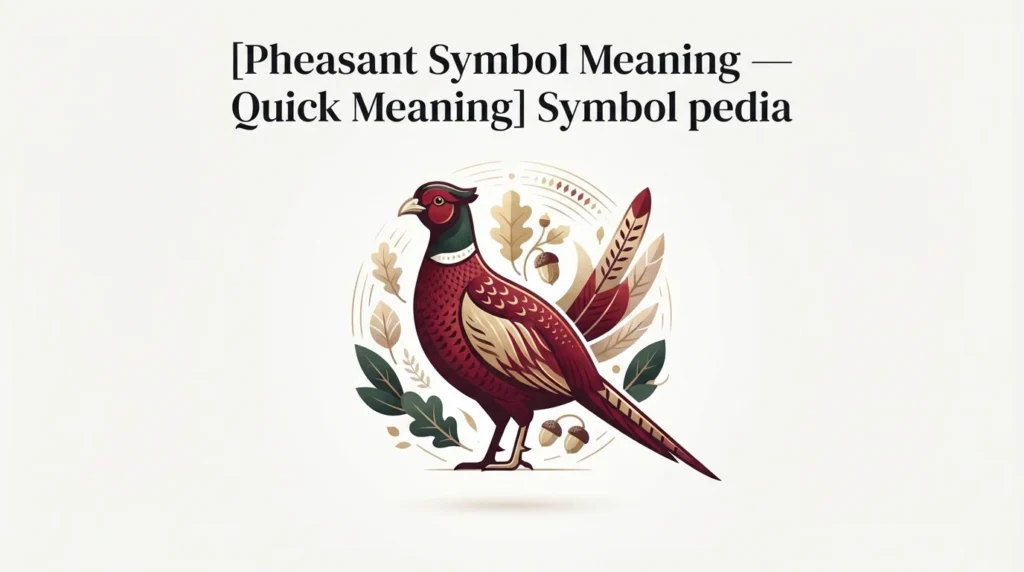
The pheasant commonly symbolizes beauty, confidence, abundance, individuality, and a connection with nature. These are interpretive associations rather than universally established meanings.
Its colorful feathers and distinctive behavior make it a natural source of inspiration for symbolic interpretations.
Here are some common associations:
- Beauty and elegance: Its patterned feathers represent visual richness and the appreciation of natural beauty.
- Confidence: Its striking appearance can serve as a reminder to express yourself without unnecessary fear.
- Prosperity and abundance: Its connection with fertile landscapes and traditional hunting imagery can evoke ideas of plenty and good fortune.
- Individuality: Its distinctive appearance may represent embracing the qualities that make you different.
- Resilience: Its ability to live in varied habitats can inspire reflections on adaptability and survival.
- Groundedness: Its close relationship with the earth can symbolize staying connected to practical realities.
- Awareness: Its alert behavior may encourage attentiveness to your surroundings.
For example, someone might describe the pheasant as “a reminder to embrace your uniqueness,” while another person might see it as “a symbol of abundance and natural beauty.”
Neither interpretation is an absolute rule. The meaning becomes more personal when you consider what the bird represents to you.
Origin and Background of Pheasant Symbolism
The pheasant in history
Pheasants belong to the family Phasianidae, which includes other birds such as partridges and chickens. Several pheasant species are native to Asia, and the common pheasant has a long history of association with human communities through hunting, farming, and ornamental birdkeeping.
Over centuries, their colorful feathers and impressive appearance made them prominent in decorative art, traditional clothing, and representations of the natural world.
The bird’s symbolism developed through these practical and artistic relationships. In some settings, it became associated with status, beauty, abundance, or the pleasures of the countryside.
These associations should not be confused with a single ancient belief shared by every culture. Pheasants appear in different traditions, but their meanings depend on the specific region, period, and artistic context.
Cultural influence
In Chinese decorative traditions, pheasant imagery can be associated with elegance, ornamental beauty, and auspicious themes. In particular historical contexts, pheasant designs appeared in clothing and artwork connected with status and official rank.
The precise meaning depends on the period and the form of representation. A pheasant in a traditional painting, for example, may carry different associations from a pheasant depicted in contemporary jewelry.
In parts of Europe, pheasants became familiar through hunting estates, country landscapes, and ornamental traditions. These associations helped connect the bird with rural life, seasonal abundance, and refinement.
Such imagery continues to influence how people interpret pheasants in art and popular culture.
How modern symbolism evolved
Today, people often approach animal symbolism through spirituality, personal reflection, nature observation, and social media.
A photograph of a pheasant might inspire a message about self-confidence. An illustration might represent prosperity, while a feather-inspired design could be chosen for its beauty.
Online discussions sometimes describe the pheasant as a spirit animal or a sign of good fortune. These interpretations can be meaningful within personal belief systems, but they are not universal facts or scientifically established messages.
The important distinction is between documented cultural associations and modern personal interpretations.
Real-Life Conversations: How People Discuss Pheasant Symbolism
The following fictional conversations illustrate how people might explore the meaning of a pheasant in everyday life.
1. WhatsApp: A Surprising Wildlife Encounter
Person A: “A pheasant walked right across my garden this morning. I’ve never seen one so close!”
Person B: “That’s amazing! Maybe it can be a reminder to slow down and appreciate nature.”
Person A: “I needed that, honestly. I’ve been rushing around all week.”
Person B: “Then enjoy the moment. Sometimes a simple encounter is enough to make your day better.”
Meaning: The pheasant becomes a personal symbol of mindfulness and appreciating the present moment. The meaning comes from the person’s circumstances rather than an objectively proven spiritual message.
2. Instagram DMs: Choosing a Tattoo
Person A: “I’m thinking about getting a pheasant tattoo. Do you think it has a meaning?”
Person B: “It can represent beauty, individuality, or confidence, depending on the design.”
Person A: “I like the idea of being comfortable standing out.”
Person B: “Then choose a design that reflects that feeling. The personal story matters most.”
Meaning: Here, the pheasant represents self-expression and individuality. Its visual appeal and the wearer’s personal values work together to shape the tattoo’s significance.
3. TikTok Comments: Understanding a Symbol
Person A: “Why do people say pheasants symbolize prosperity?”
Person B: “I think it’s connected to abundance and the bird’s association with rich countryside imagery.”
Person C: “That makes sense, although I always thought of them as symbols of beauty.”
Person A: “Maybe the meaning depends on the culture and the person.”
Meaning: This exchange shows why animal symbolism should not be reduced to one definition. Cultural history, visual characteristics, and individual interpretation can all influence meaning.
4. Text Messages: A Personal Reflection
Person A: “I saw a pheasant on my walk after a really difficult week.”
Person B: “Did it make you feel better?”
Person A: “Actually, yes. It reminded me that life can still surprise me in good ways.”
Person B: “That’s a lovely way to look at it.”
Meaning: The encounter becomes a symbol of hope and renewed appreciation. There is no need to assume the bird predicted something; its significance can come from the emotional moment itself.
Emotional and Psychological Meaning of the Pheasant
Animals can become powerful symbols because people connect what they observe in nature with their own emotions, experiences, and hopes.
The pheasant’s distinctive appearance and behavior offer several themes that can encourage personal reflection.
Beauty and self-acceptance
A male common pheasant often has colorful plumage, a patterned body, and a long tail. Its appearance makes it an appealing symbol of beauty and individuality.
On a personal level, this can encourage someone to appreciate their own qualities rather than constantly comparing themselves with others.
The message is not that everyone needs to attract attention. Instead, it can be a reminder that individuality does not have to be hidden to make other people comfortable.
Confidence and self-expression
The pheasant’s striking appearance can inspire a symbolic connection with confidence.
Someone who feels hesitant about sharing an idea, pursuing a creative project, or expressing an unpopular opinion might use the bird as a reminder to act with greater self-assurance.
Confidence, however, does not require constant visibility. Sometimes it means being comfortable with who you are, even when nobody is watching.
Abundance and gratitude
Pheasants are associated with fields, grasslands, woodland edges, and other natural environments. Their presence in a healthy landscape can evoke ideas of richness and natural abundance.
Symbolically, this can encourage gratitude for relationships, opportunities, resources, and everyday pleasures.
It should not be interpreted as a guarantee of financial success or future good fortune.
Resilience and adaptability
Pheasants forage for food, respond to threats, and navigate changing conditions in their habitats.
These characteristics can inspire people to think about flexibility and perseverance during difficult periods.
The symbolic lesson is straightforward: adaptability often matters more than having complete control over every circumstance.
A personal-style scenario
Imagine someone who has recently started a new job and feels uncomfortable being the least experienced person on the team.
During a weekend walk, they spot a pheasant moving through the grass. Its unusual coloring catches their attention, and they remember how distinctive the bird looks in its surroundings.
They later use that moment as a reminder that being different does not mean being out of place.
The bird has not delivered a measurable supernatural message. Instead, the encounter has given the person a useful image through which to understand their own situation.
That is one way symbolism can become emotionally meaningful without requiring a literal spiritual explanation.
Pheasant Symbolism in Different Contexts
Spiritual meaning
In modern spiritual interpretations, the pheasant may represent abundance, beauty, confidence, groundedness, or renewed awareness.
Some people regard a wildlife encounter as a personal sign to pay attention to their surroundings or reconsider their priorities.
These interpretations are matters of belief rather than universal spiritual rules.
If the bird appears during a meaningful period in your life, you can reflect on what it brings to mind without assuming that it predicts a particular outcome.
In dreams
Dream interpretations vary, and there is no scientific basis for assigning one fixed meaning to every animal that appears in a dream.
Nevertheless, a pheasant can serve as a useful symbol when exploring your own feelings.
- A colorful pheasant: You might associate it with creativity, confidence, or a desire for self-expression.
- A pheasant walking through a field: It may bring to mind peace, freedom, or a need to reconnect with nature.
- A pheasant running away: You might connect it with a missed opportunity or something you feel uncertain about pursuing.
- A pheasant appearing unexpectedly: It could represent surprise, curiosity, or an experience that has captured your attention.
These are reflective possibilities, not reliable predictions about the future.
In tattoos and artwork
Pheasant tattoos appeal to people who appreciate detailed feathers, natural imagery, and traditional bird designs.
Depending on the wearer’s intention, the design might represent individuality, prosperity, resilience, a connection with the countryside, or a cherished memory.
A realistic pheasant can emphasize natural beauty, while a stylized design may focus on cultural heritage or artistic expression.
The bird does not have to carry a spiritual meaning to be a meaningful tattoo.
In relationships
As a personal symbol, the pheasant can represent appreciating a person’s individuality and allowing them to express themselves.
Its beauty may inspire thoughts about attraction, admiration, and the importance of looking beyond superficial appearances.
However, the pheasant is not a universally recognized symbol of romantic love. A bird appearing near a couple does not prove that their relationship is destined for success.
At work and in professional life
The pheasant’s associations with confidence and distinction can be useful metaphors for professional development.
For example, someone preparing to present an idea may interpret the bird as a reminder to communicate clearly and recognize their own strengths.
In a professional setting, however, the pheasant is not a standard business symbol with a fixed meaning. Its relevance usually comes from the individual or the artwork in which it appears.
When Not to Interpret the Pheasant Symbol Too Literally
Animal symbolism can offer comfort and inspiration, but it is worth maintaining a balanced perspective.
First, avoid treating every sighting as a prediction. Pheasants may appear because suitable habitat, food, and shelter are available nearby.
Second, respect cultural differences. A pheasant depicted in a historical garment may carry a specific cultural meaning that differs from a contemporary spiritual interpretation.
Third, avoid assuming that a bird’s behavior reveals another person’s feelings. Seeing a pheasant after an argument does not establish whether someone will return, forgive you, or change their mind.
Finally, keep practical decisions grounded in evidence. A symbolic encounter can encourage reflection, but it should not replace careful thinking about finances, health, relationships, or work.
The most useful interpretation is one that adds perspective without creating fear or unrealistic expectations.
Common Misunderstandings About Pheasant Symbolism
1. Every pheasant sighting is a spiritual sign
Some people find spiritual significance in encounters with animals, but others see them as ordinary wildlife experiences.
Both perspectives can coexist. A sighting can be personally meaningful without proving that an external force arranged it.
2. The pheasant always means wealth
Abundance and prosperity are possible symbolic associations, but the bird does not universally represent money or guaranteed financial success.
In some settings, its primary significance may be beauty, hunting, rural traditions, or decorative art.
3. The pheasant symbolizes the same thing in every culture
Cultural meanings vary. Historical artwork, clothing, regional traditions, and contemporary spiritual beliefs should not be treated as interchangeable.
4. Only male pheasants have symbolic value
Male pheasants of many species are especially colorful, which makes them visually prominent in art and popular imagery.
However, female pheasants also contribute to the species’ natural story. Symbolism does not need to be limited to one sex or appearance.
5. A pheasant in a dream predicts the future
Dreams can be explored through personal associations and emotions, but a pheasant dream cannot reliably forecast a specific event.
It is more helpful to consider what the bird meant to you and how you felt during the dream.
Pheasant Symbolism Compared With Other Birds
The following table compares common symbolic associations. These are broad interpretive themes, not universal definitions shared by all cultures.
| Bird | Common symbolic associations | Difference from pheasant symbolism |
|---|---|---|
| Pheasant | Beauty, individuality, abundance | Often emphasizes distinctive appearance and natural richness |
| Peacock | Splendor, pride, display | More strongly associated in many modern interpretations with dramatic beauty and visibility |
| Dove | Peace, gentleness, reconciliation | Commonly connected with peace and, in some traditions, spiritual themes |
| Eagle | Strength, vision, leadership | Often represents power, perspective, and authority |
| Owl | Wisdom, mystery, knowledge | Frequently associated with observation and the unknown |
| Phoenix | Rebirth, renewal, transformation | Represents rising again after destruction in mythological traditions |
| Swan | Grace, devotion, elegance | Often linked with beauty, partnership, and transformation |
| Sparrow | Simplicity, community, resilience | Can symbolize everyday life, humility, or belonging |
Key Insight
The pheasant stands out because its appearance naturally lends itself to interpretations involving beauty, individuality, and abundance. Other birds have their own established cultural and mythological associations, so the most meaningful comparison depends on the tradition and context.
How to Respond When Someone Mentions Pheasant Symbolism
If someone tells you that they saw a pheasant or believes it carries a deeper meaning, you do not need to share the same spiritual beliefs to respond thoughtfully.
Casual responses
- “That’s a beautiful bird to come across.”
- “I can see why it caught your attention.”
- “Its feathers really are distinctive.”
- “That’s an interesting interpretation.”
Funny responses
- “Maybe it just wanted to show off its feathers!”
- “Nature certainly knows how to make an entrance.”
- “That’s one stylish bird.”
- “Perhaps it was on its way to a very important meeting.”
Mature responses
- “What did seeing it make you think about?”
- “I like how you’ve connected that experience with your life.”
- “Different cultures have some interesting interpretations of birds.”
- “It’s meaningful when an ordinary moment gives us a new perspective.”
Respectful responses
If the person has a strong spiritual connection with the bird, you can acknowledge their experience without making claims you cannot verify.
For example, “I’m glad the encounter brought you comfort” respects their feelings while leaving room for different beliefs.
Regional and Cultural Usage of Pheasant Symbolism
Western traditions
In parts of Europe and North America, pheasants are associated with country landscapes, game birds, hunting traditions, ornamental imagery, and rural life.
Their appearance may also inspire modern interpretations involving beauty and abundance.
These associations vary between communities and historical periods.
Asian traditions
Pheasants have an important place in some East Asian artistic and decorative traditions.
In historical Chinese visual culture, pheasant imagery could convey refinement, auspiciousness, or status in particular settings, including certain forms of official dress and decoration.
The specific interpretation depends on the artwork, period, and associated symbols.
Middle Eastern traditions
Pheasant symbolism is not uniform across the Middle East. Interpretations may depend on local wildlife traditions, literary references, artistic practices, and the individual’s beliefs.
It would be misleading to assign one spiritual meaning to the pheasant across all Middle Eastern cultures.
Global internet culture
Online communities frequently reinterpret animals as symbols of personal growth, spiritual awareness, or emotional experiences.
The pheasant can fit naturally into this trend because its colorful appearance offers an appealing image for posts about confidence, uniqueness, and abundance.
However, a popular online interpretation should not automatically be described as an ancient or universally accepted belief.
Generational differences
Younger and older people alike may appreciate animal symbolism, although they may encounter it through different channels.
Some younger users discover pheasant imagery through short-form videos, tattoo inspiration, or spiritual content. Others may associate the bird with wildlife photography, country traditions, or historical art.
There is no reliable rule that one generation interprets the pheasant differently from another. Personal interests and cultural backgrounds usually matter more.
Is Pheasant Symbolism Safe for Kids?
Yes. Learning about pheasant symbolism can be an enjoyable way for children to explore wildlife, art, cultural traditions, and personal reflection.
Parents and educators can explain that people sometimes attach meanings to animals because of their appearance, behavior, or place in a story.
It is also useful to distinguish between scientific facts about pheasants and beliefs about what they symbolize. Children can appreciate the bird’s beauty without feeling that a sighting predicts something good or bad.
If a child encounters a pheasant outdoors, encourage quiet observation from a respectful distance rather than attempting to chase, touch, or feed the bird.
Frequently Asked Questions
1. What does a pheasant symbolize spiritually?
In modern spiritual interpretations, a pheasant may symbolize beauty, abundance, individuality, confidence, or awareness. These meanings vary according to personal beliefs and cultural context.
2. Is seeing a pheasant a sign of good luck?
Some people interpret a pheasant sighting as a positive sign or a reminder to appreciate opportunities. However, there is no reliable evidence that seeing one predicts future luck.
3. What does a pheasant symbolize in a dream?
A pheasant in a dream may bring to mind beauty, confidence, freedom, or personal growth. The interpretation depends on the dreamer’s feelings and experiences rather than a fixed universal meaning.
4. What does a pheasant tattoo mean?
A pheasant tattoo can represent individuality, natural beauty, prosperity, resilience, or a personal connection with rural life. Its meaning depends on the design and the wearer’s intentions.
5. What does a pheasant feather symbolize?
A pheasant feather may represent beauty, uniqueness, creativity, or a connection with nature. In a specific cultural or historical setting, it may have a more particular meaning.
6. Is the pheasant a symbol of prosperity?
It can be interpreted that way, especially when connected with abundance, rich landscapes, or auspicious imagery. However, prosperity is only one possible association, not a universal definition.
7. What does it mean when a pheasant visits your garden?
Most likely, the bird has found suitable food, shelter, or habitat nearby. You may also choose to treat the encounter as a personal reminder to slow down and appreciate nature, without assuming it carries a supernatural message.
Conclusion
The pheasant symbol meaning brings together several appealing themes: beauty, individuality, abundance, confidence, resilience, and a connection with the natural world.
Its striking feathers can inspire self-expression, while its place in traditional artwork and rural landscapes offers additional cultural associations. For some people, seeing a pheasant becomes a memorable moment that encourages gratitude or a fresh perspective.
Still, the bird does not have one meaning that applies to every person or culture. Its symbolism depends on where it appears, the traditions surrounding it, and the feelings it brings to mind.
You can appreciate the pheasant as a beautiful wild bird, explore its historical significance, or use it as a personal symbol of confidence and growth.
Sometimes, the most meaningful part of an encounter is not whether it predicts something extraordinary. It is the way a simple moment in nature helps you notice something important about your own life.
discover more post
What Does OMR Mean in Text Real Meaning 2026
What Does Ads Mean in Text Real Meaning 2026 – Symbl Pedia
What Does WTVV Mean in Text Real Meaning 2026

Kavon is a passionate content creator and digital researcher who specializes in decoding symbols, meanings, and modern internet language. With a strong focus on clarity and authenticity, Kavon writes in a way that makes complex ideas simple, relatable, and useful for everyday readers.
Known for a hardworking mindset and attention to detail, Kavon is dedicated to creating content that genuinely helps people understand the deeper meanings behind words, signs, and online expressions. Every article is crafted with care, combining research, real-life insight, and a reader-first approach.
Through Symblpedia, Kavon aims to build a trusted space where curiosity meets clarity—helping users find answers that are not only accurate but also meaningful and easy to understa