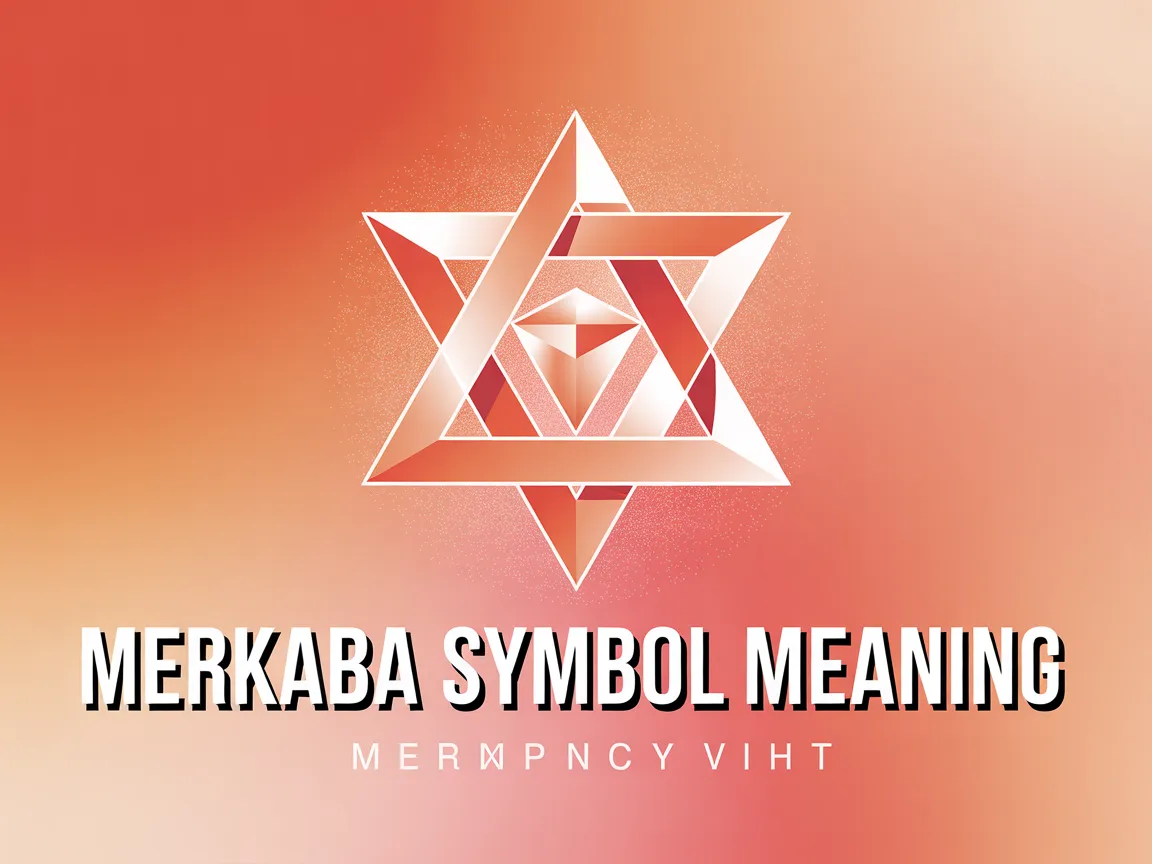
If you’ve ever come across a glowing star-like geometric shape in spiritual art or meditation spaces, chances are you’ve seen the Merkaba. At first glance, it looks like a complex 3D star—but for many people, it represents something much deeper.
The Merkaba symbol meaning often sparks curiosity because it sits at the intersection of spirituality, sacred geometry, and personal transformation. People search for it when they’re exploring meditation, energy healing, or simply trying to understand symbols that keep appearing in their lives.
But here’s the problem: most explanations online are either too abstract or overly mystical. That leaves beginners confused.
In this guide, we’ll break it down in a way that actually makes sense—what it means, where it comes from, and how people use it in real life today.
Merkaba Symbol Meaning – Quick Meaning
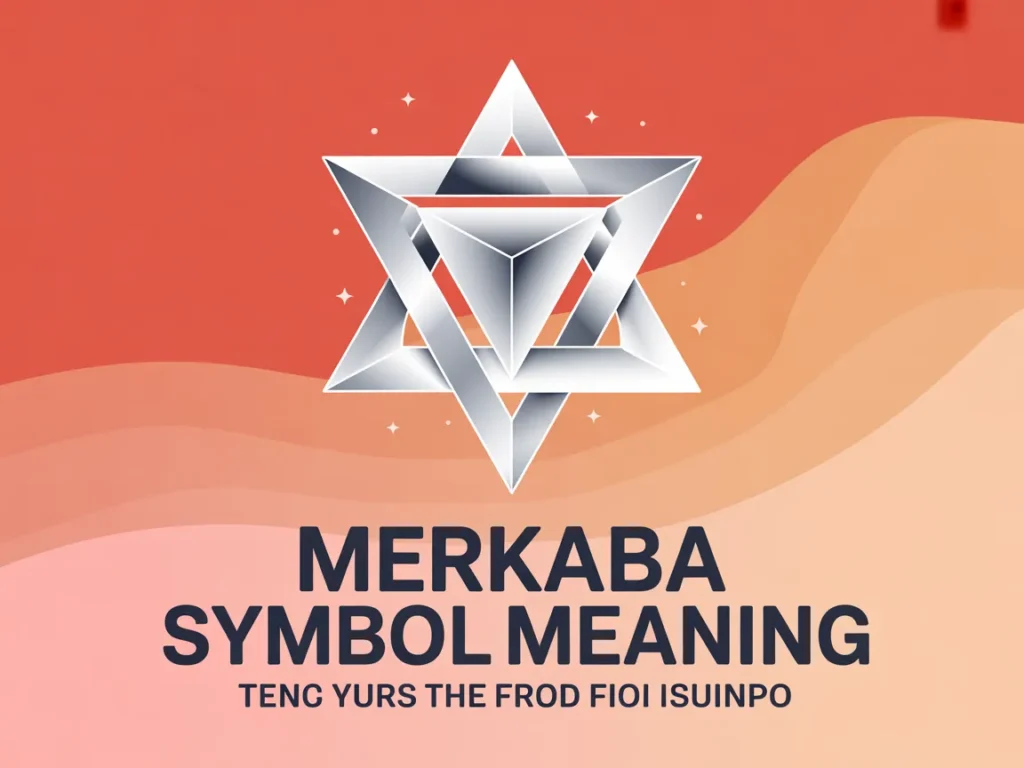
At its core, the Merkaba is a sacred geometric symbol made of two interlocking tetrahedrons (triangular pyramids) spinning in opposite directions.
Simple definition:
- A symbol of energy, balance, and spiritual protection
- Represents the connection between body, mind, and spirit
- Often linked to light, ascension, and higher consciousness
Many interpret the word itself as:
- Mer = Light
- Ka = Spirit
- Ba = Body
So, Merkaba can be understood as:
👉 “The light-body vehicle that connects spirit and body.”
Example usage:
“I’ve been meditating on the Merkaba lately—it helps me feel centered.”
“That tattoo is a Merkaba, it represents spiritual protection.”
“I don’t fully get it yet, but the Merkaba symbol feels powerful.”
Origin & Background
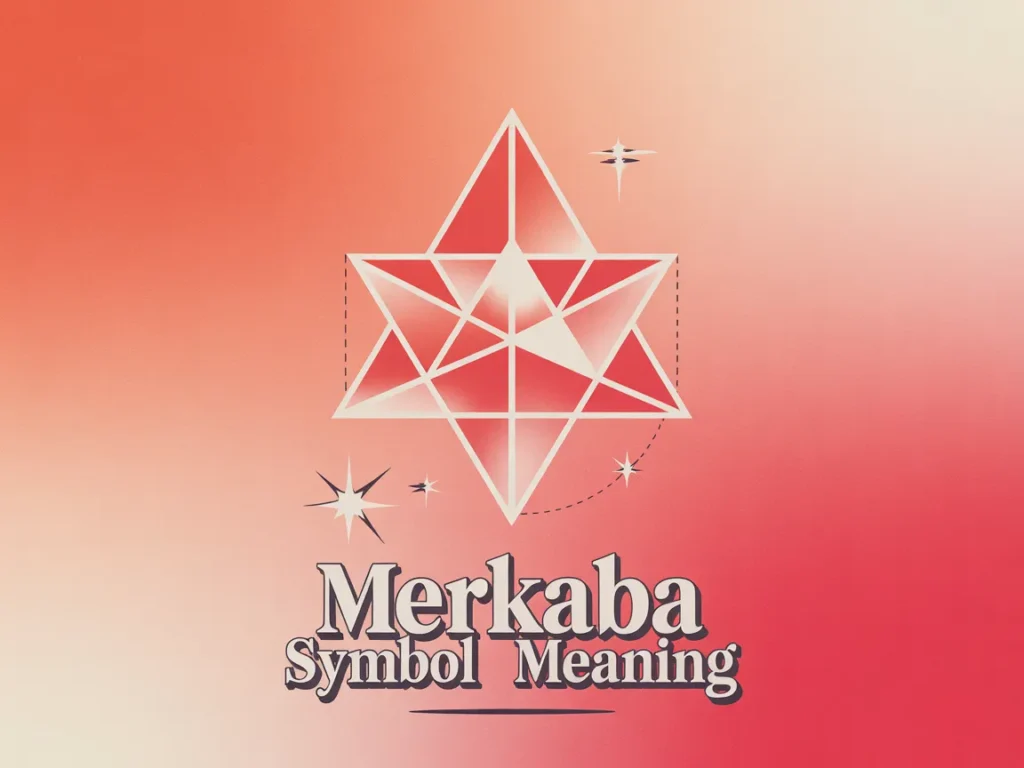
The Merkaba symbol isn’t new—it has deep roots in ancient traditions.
It’s commonly associated with:
- Ancient Egyptian spirituality
- Jewish mysticism (especially Merkavah traditions)
- Sacred geometry teachings across cultures
In ancient Egyptian belief systems, the Merkaba was thought to be a rotating field of light around the human body, used by advanced practitioners to travel between dimensions or states of consciousness.
In Jewish mysticism, particularly in early texts, “Merkavah” referred to a divine chariot—a vehicle of ascension and connection with higher realms.
Over time, these interpretations blended into what we see today: a symbol of spiritual activation and energetic alignment.
Modern Evolution
In recent decades, the Merkaba has gained popularity through:
- Meditation practices
- Yoga communities
- Energy healing circles
- Social media spirituality content
Platforms like TikTok and Instagram have amplified its visibility, often showing:
- Merkaba breathing techniques
- Visualizations of spinning light fields
- Symbolic tattoos and jewelry
Its meaning has evolved from ancient philosophy into a modern tool for self-awareness and inner balance.
Real-Life Conversations
WhatsApp Chat
Person A:
I keep seeing this star shape in meditation posts. What is it?
Person B:
That’s the Merkaba. It’s like a spiritual energy field.
Person A:
Oh wow… I thought it was just a design 😅
Instagram DMs
Person A:
Your necklace looks cool. What does it mean?
Person B:
It’s a Merkaba. It represents balance and protection.
Person A:
That’s actually deep. I need one now.
TikTok Comments
User1:
Why is everyone talking about Merkaba activation?
User2:
It’s about aligning your energy and consciousness.
User3:
Or just another trend? 😭
Text Message
Friend 1:
I feel so scattered lately.
Friend 2:
Try grounding yourself. I’ve been using Merkaba meditation—it helps a lot.
Emotional & Psychological Meaning
Beyond its spiritual roots, the Merkaba carries strong emotional symbolism.
It often represents:
- A desire for balance in chaos
- The need for inner protection
- A journey toward self-discovery
In today’s fast-paced world, people are constantly overwhelmed. Symbols like the Merkaba give them a visual anchor—something that reminds them to slow down and reconnect.
Why people use it
- To feel grounded
- To explore spirituality
- To create a sense of control in uncertain times
A personal-style scenario
Imagine someone dealing with stress, burnout, or emotional confusion. They come across the Merkaba during a late-night scroll.
At first, it’s just a shape.
But the more they learn, the more it becomes a symbol of stability—a reminder that even when life feels chaotic, balance is possible.
That emotional connection is what keeps people coming back to it.
Usage in Different Contexts
Social Media
- Shared in posts about spirituality, meditation, and healing
- Used as a visual symbol in reels and aesthetic content
Friends & Relationships
- Discussed when exploring deeper topics
- Sometimes gifted as jewelry for protection or meaning
Work / Professional Settings
- Rarely used directly
- Might appear subtly in design, wellness spaces, or personal accessories
Casual vs Serious Tone
- Casual: “That Merkaba design looks cool.”
- Serious: “The Merkaba represents alignment of my energy field.”
Tone depends heavily on the context and the person’s beliefs.
When NOT to Use It
While the Merkaba is generally positive, there are situations where using it may not be appropriate:
- Formal professional discussions (unless relevant to the topic)
- Mocking spiritual beliefs—it can be deeply meaningful to others
- Cultural or religious contexts where it may be misunderstood
- Overusing it as a trend without understanding its meaning
Respect matters, especially with symbols tied to belief systems.
Common Misunderstandings
1. It’s just a decorative shape
Not exactly. While it’s visually appealing, it holds deep symbolic meaning for many people.
2. It has only one meaning
The Merkaba is interpreted differently across cultures and individuals.
3. It’s “magic”
It’s better understood as a symbolic or meditative tool, not a literal supernatural object.
4. Everyone uses it the same way
Some use it spiritually, others aesthetically. Both are valid, but they’re not the same.
Comparison Table
| Expression / Symbol | Meaning | Tone | Use Case |
|---|---|---|---|
| Merkaba | Spiritual balance & energy field | Deep / symbolic | Meditation, self-growth |
| Mandala | Harmony & wholeness | Calm / artistic | Art, mindfulness |
| Yin-Yang | Duality & balance | Philosophical | Cultural, spiritual |
| Sacred Geometry | Universal patterns | Intellectual / spiritual | Study, design |
| Chaos Symbol | Disorder & unpredictability | Abstract | Philosophy, art |
Key Insight
While many symbols represent balance or energy, the Merkaba stands out because it combines geometry, motion, and consciousness into a single concept. It’s not just about harmony—it’s about transformation.
How to Respond When Someone Uses It
Casual Replies
- “That’s interesting, I’ve seen it around lately.”
- “It looks cool—what does it mean to you?”
Funny Replies
- “So it’s like WiFi for the soul? 😄”
- “Does it come with a user manual?”
Mature Replies
- “I respect the meaning behind that. It’s powerful.”
- “Sounds like a meaningful practice.”
Respectful Replies
- “Thanks for explaining, I didn’t know that.”
- “I appreciate the deeper perspective.”
Regional & Cultural Usage
Western Culture
- Popular in wellness, yoga, and self-help spaces
- Often tied to personal growth and mindfulness
Asian Culture
- Interpreted through the lens of balance and energy systems
- Sometimes connected to broader spiritual traditions
Middle Eastern Culture
- Less mainstream but gaining awareness through global content
- May be viewed cautiously depending on context
Global Internet Usage
- Widely shared as a spiritual aesthetic symbol
- Often simplified or misunderstood
Generational Differences
- Gen Z: Sees it as both aesthetic and spiritual
- Millennials: More likely to explore its deeper meaning
Is It Safe for Kids?
Yes, in general.
The Merkaba is not harmful—it’s simply a symbol. However, context matters.
If introduced to kids:
- Present it as a geometric shape with cultural meaning
- Avoid overwhelming spiritual interpretations
- Encourage curiosity, not belief pressure
FAQs
1. What does the Merkaba symbol represent?
It represents the connection between body, mind, and spirit, often seen as a field of energy and balance.
2. Is Merkaba religious?
Not strictly. It has roots in spiritual traditions but is widely used in non-religious contexts today.
3. Can anyone use the Merkaba symbol?
Yes. It’s open to interpretation and personal meaning.
4. What is Merkaba meditation?
A practice that uses breathing and visualization to imagine a spinning energy field around the body.
5. Why is Merkaba trending?
Social media has made spiritual symbols more visible and accessible.
6. Is it okay to wear Merkaba jewelry?
Yes, as long as you understand and respect its meaning.
7. Does Merkaba have scientific proof?
It’s more symbolic and spiritual than scientific.
Conclusion
The Merkaba isn’t just a geometric design—it’s a symbol that carries layers of meaning shaped by history, culture, and personal interpretation.
For some, it’s a meditation tool.
For others, it’s a reminder to stay balanced.
And for many, it’s simply something that feels right.
You don’t need to fully understand every detail to appreciate it. What matters is how it connects with you.
If it brings a sense of calm, curiosity, or clarity—that’s already meaningful.
descover more post
Expiry Date Symbol Meaning What It Really Says About Time …
Shield Symbol Meaning Why This Simple Icon Feels So …
Cancer Zodiac Symbol Meaning The Hidden Power Behind …