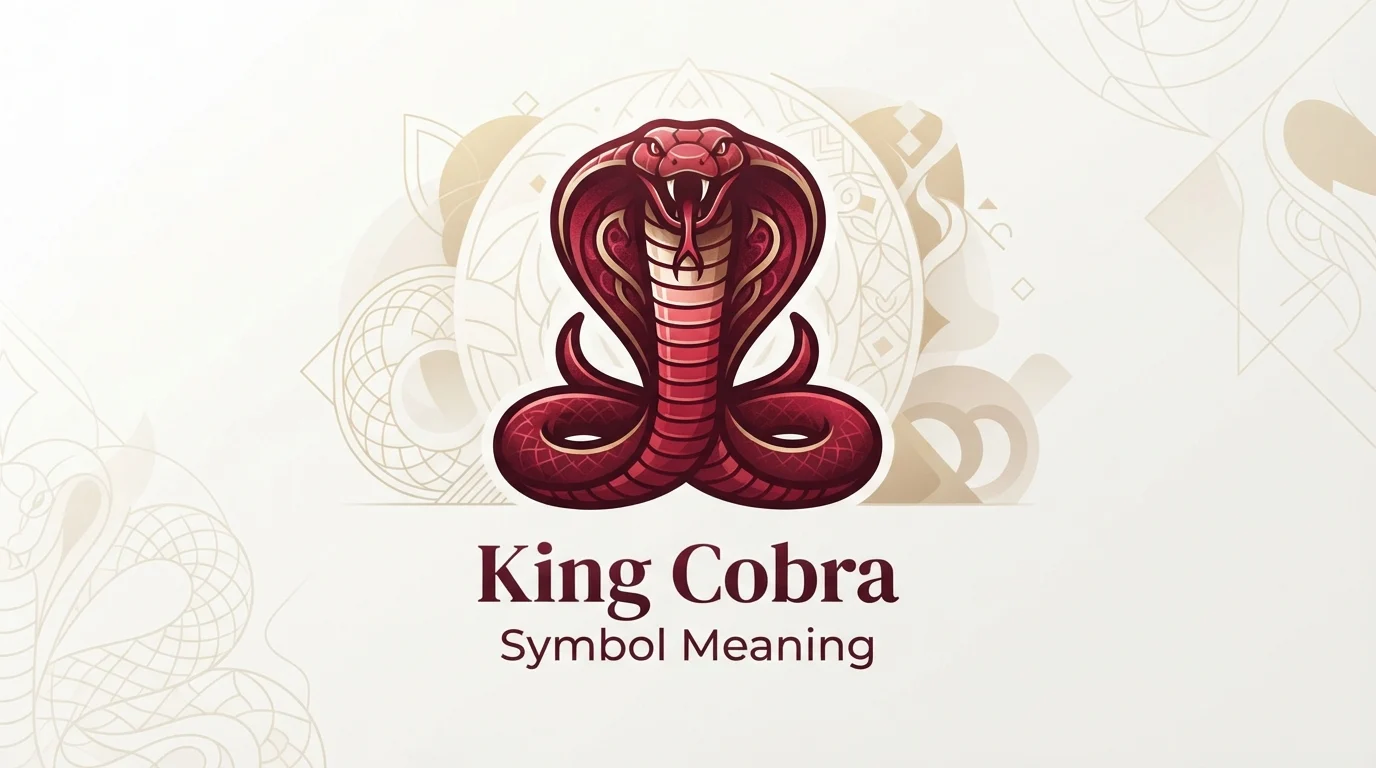
The King Cobra Symbol Meaning is often associated with power, protection, wisdom, transformation, and spiritual awareness. As one of the most recognizable and impressive snakes in the world, the king cobra has inspired fascination, fear, respect, and curiosity across different cultures.
Its symbolism is especially interesting because it represents two seemingly opposite qualities: danger and protection. A king cobra can remind people of the importance of strength, but it can also symbolize the wisdom of knowing when to remain calm and when to defend yourself.
People search for the king cobra’s spiritual meaning when they encounter it in dreams, artwork, tattoos, religious imagery, or personal experiences. Others want to understand what this powerful snake represents in mythology, spirituality, and modern symbolism.
The meaning depends heavily on the situation. A king cobra appearing in a dream may represent personal boundaries or an important change, while a king cobra tattoo might express confidence, independence, or respect for nature.
It is also important to understand that symbolic interpretations are not universal facts. Different traditions, individuals, and personal experiences give the king cobra different meanings.
In this guide, we will explore its symbolism, cultural background, emotional significance, real-life examples, and common interpretations so you can understand what this remarkable snake may represent.
2. King Cobra Symbol Meaning – Quick Meaning

The king cobra commonly symbolizes:
- Power: Confidence, authority, personal strength, and leadership.
- Protection: Defending yourself, maintaining boundaries, and guarding what matters.
- Wisdom: Awareness, patience, thoughtful decisions, and understanding.
- Transformation: Personal growth, change, and leaving an old identity behind.
- Spiritual awareness: Inner energy, consciousness, and reflection in certain traditions.
- Fearlessness: Facing challenges without allowing fear to control your decisions.
- Independence: Standing confidently on your own and trusting your judgment.
- Respect: Recognizing the strength of others and the importance of responsible behavior.
Simple symbolic examples
“The king cobra reminds me to stand up for myself.”
This expresses confidence, self-respect, and the ability to protect personal boundaries.
“I see the king cobra as a symbol of transformation.”
This suggests that someone is going through an important personal change.
“The king cobra represents power with responsibility.”
This connects strength with self-control rather than aggression.
The central idea is that the king cobra represents strength that becomes meaningful when combined with awareness and control.
3. Origin and Background of King Cobra Symbolism
The king cobra’s symbolism comes from a combination of its physical characteristics, human encounters with snakes, religious traditions, mythology, and modern interpretations.
Understanding these influences helps explain why this animal can represent both danger and spiritual protection.
The king cobra’s natural characteristics
The king cobra is a powerful venomous snake native to parts of South and Southeast Asia. Its impressive size, distinctive hood, defensive posture, and reputation as a formidable predator have contributed to its symbolic image.
When threatened, a king cobra can raise the front portion of its body and spread its hood. This behavior creates a striking visual impression of strength and readiness.
People naturally connect such characteristics with ideas like courage, authority, defense, and confidence.
However, the animal’s real behavior should not be confused with human personality. A snake does not consciously represent leadership or wisdom. Those meanings come from the way people interpret its appearance and behavior.
King cobra symbolism in Hindu traditions
Snakes hold important positions in Hindu mythology and religious imagery. Serpent beings known as Nāgas are associated with different divine, protective, and natural powers.
The meanings of Nāgas vary across traditions. They may be connected with water, sacred places, guardianship, supernatural power, and relationships between humans and the natural world.
For example, the Hindu deity Shiva is frequently depicted with a serpent around his neck. Vishnu is commonly represented resting on the serpent Shesha.
These images can communicate divine power, protection, cosmic order, and the relationship between spiritual authority and natural forces.
The king cobra is sometimes associated with these broader serpent traditions because of its recognizable hood and powerful appearance.
However, not every Nāga image specifically represents a king cobra. Sacred serpent symbolism includes many different snakes and supernatural beings. MDPI+2
Buddhist cultural influence
Serpents also appear in Buddhist traditions.
One well-known story describes the Nāga king Mucalinda sheltering the Buddha from a storm. The serpent’s protective hood becomes an image of shelter, devotion, and protection.
This story helps explain why serpent symbolism can communicate something very different from danger.
Instead of representing an enemy, the serpent becomes a protector of spiritual wisdom.
The broader lesson is that strength can serve a peaceful purpose. Power does not always need to threaten others; it can also protect something valuable. Sage Journals+1
King cobra symbolism in modern culture
Today, king cobras appear in tattoos, fantasy artwork, films, fashion, social media, and spiritual discussions.
Their striking appearance makes them popular symbols of confidence, mystery, resilience, and independence.
A person may choose a king cobra tattoo because they admire the snake’s strength or because it represents a difficult period they survived.
Others may simply appreciate its beauty and natural presence.
Modern symbolism is therefore a mixture of traditional cultural meanings and personal interpretation.
A king cobra does not have one fixed meaning that applies to everyone.
4. Real-Life Conversations: How People Interpret King Cobra Symbolism
King cobra symbolism often becomes meaningful when people connect it with personal experiences, emotions, or important decisions.
The following fictional conversations illustrate how people might discuss its meaning in everyday communication.
Example 1: WhatsApp – Personal Strength
Person A: I finally got that king cobra tattoo I told you about.
Person B: That’s awesome! What made you choose it?
Person A: I wanted something that reminds me not to let people walk over me anymore.
Person B: So it’s about confidence?
Person A: Exactly. Strength, but also knowing my worth.
Here, the king cobra represents self-respect, personal boundaries, and the courage to stand up for yourself.
Example 2: Instagram DM – Transformation
Person A: I keep seeing king cobra pictures everywhere lately.
Person B: Maybe your algorithm is obsessed with snakes 😂
Person A: Probably. But I like the symbolism. It reminds me of how much I’ve changed this year.
Person B: Honestly, that’s a pretty powerful way to look at it.
This conversation shows how people may connect the king cobra with personal growth.
The symbolism becomes meaningful because of the individual’s experience rather than because the snake predicts a specific event.
Example 3: TikTok Comments – Spiritual Curiosity
Person A: What does a king cobra symbolize spiritually?
Person B: I’ve seen people connect it with protection and wisdom.
Person A: Interesting. I always thought it just represented danger.
Person B: That’s part of it too. Different cultures and people interpret snakes differently.
This exchange highlights an important point: king cobra symbolism can include several meanings simultaneously.
Example 4: Text Messages – Emotional Boundaries
Person A: I think I’m finally learning to say no without feeling guilty.
Person B: That’s a big change for you.
Person A: I saw a king cobra illustration yesterday, and the caption was about protecting your energy.
Person B: I like that. Protect yourself without becoming cruel.
Person A: Exactly what I’m trying to do.
In this example, the king cobra represents emotional independence and the ability to maintain healthy boundaries.
These conversations demonstrate how symbolism can become a language for discussing feelings that are sometimes difficult to express directly.
5. Emotional and Psychological Meaning of the King Cobra
The king cobra’s emotional symbolism is especially powerful because it combines strength, vulnerability, danger, and self-control.
Its meaning often depends on what someone is experiencing in their personal life.
Confidence and self-respect
A king cobra can symbolize the confidence to recognize your own value.
People who have struggled with insecurity may interpret the snake as a reminder that they deserve respect.
For example, someone who has spent years avoiding confrontation might choose a king cobra image to represent their decision to become more assertive.
The message is not necessarily about becoming intimidating.
It is about learning that your voice matters.
Protection and personal boundaries
The king cobra’s defensive posture can inspire symbolism connected with protection.
In personal relationships, this may represent the ability to recognize unhealthy behavior and establish appropriate boundaries.
Someone might interpret the king cobra as a reminder to protect their emotional well-being without automatically treating others as enemies.
This distinction matters.
Healthy protection means understanding your limits. It does not mean controlling everyone around you.
Transformation and personal growth
Snakes are commonly associated with transformation because they shed their skin.
This natural process has inspired symbolic interpretations involving renewal, change, and the release of outdated habits.
The king cobra may represent a particularly powerful version of this idea.
A person who has overcome a difficult experience might see it as a symbol of their ability to rebuild themselves.
For example, imagine someone leaving an unhealthy relationship and learning to trust their own judgment again.
The king cobra could represent the strength they discovered during that process.
Wisdom and awareness
The king cobra can also symbolize awareness.
Its powerful appearance encourages people to think about the relationship between observation, patience, and action.
Sometimes the wisest response to a difficult situation is not immediate confrontation.
It may be stepping back, understanding what is happening, and making a thoughtful decision.
A personal-style scenario
Imagine a person preparing for an important career change.
They feel nervous because their previous workplace made them doubt their abilities.
While looking for inspiration, they discover artwork featuring a king cobra.
They interpret the image as a reminder to trust their experience, protect their confidence, and approach the next opportunity with courage.
The snake does not guarantee success.
Instead, its symbolic meaning helps the person express a commitment they have already made to themselves.
That is one of the most meaningful ways symbolism works: it gives a personal decision a memorable image.
6. King Cobra Symbolism in Different Contexts
Social media
On Instagram, TikTok, and Pinterest, king cobra images often appear alongside themes of confidence, discipline, mystery, and personal transformation.
A person might use a king cobra photograph as a profile picture because they admire its appearance or want to express a powerful personality.
Captions may focus on independence, self-respect, or resilience.
However, a snake image does not automatically reveal someone’s personality.
The meaning depends on the caption, context, and individual’s intention.
Friends and relationships
In friendships and romantic relationships, the king cobra can represent emotional boundaries and loyalty.
Someone might interpret it as a reminder to protect their peace while remaining respectful toward others.
It can also represent the courage to communicate honestly.
For example:
“I care about you, but I cannot keep accepting the same behavior.”
That statement reflects the protective side of the symbolism without suggesting hostility.
Work and professional settings
In professional environments, king cobra symbolism may be associated with leadership, confidence, focus, and authority.
A person might choose a king cobra logo for a business because its appearance communicates strength.
However, the symbol should fit the organization’s values.
A company focused on teamwork and accessibility might find a highly aggressive snake design less appropriate than a balanced, elegant illustration.
Casual versus serious meaning
In casual conversation, someone might use a king cobra emoji or image simply because it looks impressive.
In a serious discussion, the same image might represent survival, cultural identity, spiritual reflection, or personal growth.
Always consider the context before interpreting its meaning.
7. When NOT to Use King Cobra Symbolism
Although the king cobra can communicate strength and protection, it is not appropriate for every situation.
Avoid using it to intimidate others
Using a king cobra image to threaten someone can turn a symbol of confidence into a symbol of aggression.
If your goal is to establish a healthy boundary, direct and respectful communication is usually more effective.
Be careful with religious symbolism
Serpent imagery has significant meaning in several religious traditions.
Avoid treating sacred symbols as meaningless decorations or assuming that every religious community interprets them identically.
When using a Nāga image, understand that it may represent a sacred being rather than simply an ordinary snake.
Avoid making universal spiritual claims
It is misleading to tell someone that seeing a king cobra definitely means they will become wealthy, experience a spiritual awakening, or receive protection from danger.
Symbolism is interpretive.
A meaningful personal experience should not be presented as a guaranteed prediction.
Do not romanticize real snake encounters
King cobras are venomous wild animals.
Their symbolic association with courage should never encourage someone to approach, touch, capture, or provoke a real snake.
If you encounter one, keep your distance and contact trained wildlife professionals when necessary.
Respecting the animal is more important than creating a dramatic symbolic experience.
8. Common Misunderstandings About King Cobra Meaning
Misunderstanding 1: The king cobra always represents evil
Some people associate snakes with danger, temptation, or negative forces.
However, serpent symbolism also includes protection, wisdom, renewal, and sacred power.
The meaning depends on the cultural and personal context.
Misunderstanding 2: The king cobra always represents spiritual awakening
Spiritual interpretations are not universal.
Some people connect serpents with inner energy or consciousness, while others understand them primarily through mythology, nature, or personal symbolism.
Misunderstanding 3: A king cobra dream predicts the future
Dreams can reflect memories, emotions, concerns, and personal associations.
There is no reliable evidence that a king cobra dream automatically predicts a specific event.
Misunderstanding 4: King cobra symbolism and Nāga symbolism are identical
Nāgas are a broader category of serpent beings in South and Inner Asian religious traditions.
Although king cobras may be associated with Nāga imagery, not every Nāga specifically represents a king cobra.
Misunderstanding 5: Strength means aggression
The king cobra’s powerful appearance can inspire confidence.
But strength does not require threatening others.
In a positive symbolic interpretation, strength includes restraint, patience, and responsible action.
9. King Cobra Symbolism Comparison Table
| Symbol | Common interpretation | Main difference |
|---|---|---|
| King cobra | Power, protection, awareness | Combines strength with defensive symbolism |
| Ordinary snake | Transformation, mystery, renewal | Broader symbolism across different snake species |
| Eagle | Vision, freedom, leadership | Emphasizes perspective and independence |
| Lion | Courage, authority, confidence | Often associated with visible leadership |
| Dragon | Power, mystery, supernatural force | Cultural meanings vary greatly |
| Turtle | Patience, stability, protection | Emphasizes endurance and gradual progress |
| Butterfly | Change, renewal, personal growth | Focuses on transformation and emergence |
| Dove | Peace, gentleness, harmony | Emphasizes calm and peaceful relationships |
Key Insight
The king cobra’s distinctive symbolism comes from the combination of power, protection, and awareness. Unlike symbols that primarily emphasize peace or transformation, it often encourages people to think about how they use their strength and maintain their boundaries.
11. How to Respond When Someone Uses King Cobra Symbolism
If someone shares a king cobra tattoo, picture, dream, or spiritual interpretation, the best response depends on the conversation.
Casual replies
- “That is a powerful symbol.”
- “I like the confidence behind it.”
- “The design looks really interesting.”
- “What does the king cobra mean to you?”
Funny replies
- “That’s one serious profile picture!”
- “Confidence level: king cobra.”
- “Definitely not an ordinary snake.”
- “That design has main-character energy.”
Mature replies
- “I like how it combines strength with self-control.”
- “The symbolism feels connected to personal growth.”
- “It is interesting how the same animal can represent both danger and protection.”
Respectful replies
- “Does it have a cultural or personal meaning for you?”
- “I would love to understand what inspired your choice.”
- “That symbol has different meanings across traditions.”
The most thoughtful response is often a question.
Instead of assuming what the king cobra represents, ask the person why they chose it.
12. Regional and Cultural Usage
King cobra symbolism changes depending on cultural background, religious traditions, personal beliefs, and modern media.
Western cultures
In Western popular culture, snakes frequently appear in stories involving danger, temptation, transformation, mystery, and power.
King cobra imagery may be used in tattoos, fantasy artwork, films, and branding to communicate strength or intimidation.
However, Western interpretations are not uniform.
Some people admire snakes as fascinating wildlife, while others associate them with fear.
Asian cultures
In South and Southeast Asia, serpent symbolism has deep religious and cultural significance.
Hindu, Buddhist, and other regional traditions include different serpent beings and stories.
Nāgas may be connected with sacred water, guardianship, divine relationships, and spiritual power.
The specific interpretation depends on the tradition.
For example, Hindu and Buddhist serpent imagery may communicate protection or religious significance rather than simply danger. MDPI+2
Middle Eastern cultures
Snake symbolism in Middle Eastern traditions is diverse.
In some religious and literary contexts, snakes are associated with danger, temptation, wisdom, or transformation.
However, there is no single Middle Eastern interpretation of the king cobra.
The king cobra itself is not native to most of the Middle East, so its symbolism may come primarily through modern media, wildlife interest, or broader serpent imagery.
Global internet usage
Online, king cobra symbolism often becomes simplified.
A single image may be used to represent confidence, mystery, independence, or personal strength.
Social media captions sometimes present spiritual meanings as universal facts.
It is better to treat these interpretations as personal or cultural associations rather than guaranteed messages.
Gen Z versus Millennials
Generational differences are not absolute, but online communication can influence how people interpret symbols.
Some younger users may use king cobra imagery as an aesthetic expression of confidence, individuality, or personal identity.
Some Millennials may connect it with tattoo symbolism, resilience, or broader cultural references.
However, people within both generations have different interests.
The platform, personal experience, and context usually matter more than age alone.
13. Is the King Cobra Symbol Safe for Kids?
King cobra symbolism can be appropriate for children when it is explained in an age-appropriate way.
A child might understand the snake as a symbol of strength, respect for wildlife, or the importance of being careful around dangerous animals.
Parents and teachers should distinguish symbolic stories from real animal behavior.
A king cobra is venomous, and children should never approach or handle one.
It is also helpful to explain that different cultures have different beliefs about snakes.
Children can learn to appreciate cultural symbolism without assuming every spiritual interpretation is scientifically proven.
The most useful lesson is that powerful animals deserve respect rather than fear or careless admiration.
14. Frequently Asked Questions
1. What does the king cobra symbolize spiritually?
The king cobra may symbolize protection, wisdom, transformation, spiritual awareness, and personal strength. Its interpretation depends on the cultural tradition and the individual’s beliefs.
2. Is the king cobra a symbol of protection?
Yes, in some symbolic interpretations. Its defensive appearance can represent guardianship, personal boundaries, and the desire to protect something valuable.
3. What does a king cobra represent in Hinduism?
King cobras may be associated with broader Hindu serpent traditions involving Nāgas, sacred power, and divine imagery. However, not every Nāga specifically represents a king cobra.
4. What does a king cobra tattoo mean?
A king cobra tattoo may represent confidence, strength, independence, transformation, or survival. The meaning usually depends on the person’s personal experience and artistic choice.
5. What does dreaming about a king cobra mean?
A king cobra dream may reflect fear, personal boundaries, curiosity, or a significant emotional change. Dreams do not have one universal meaning and cannot reliably predict future events.
6. Does the king cobra symbolize wisdom?
It can. In symbolic interpretations, the king cobra may represent awareness, patience, thoughtful decisions, and the ability to recognize when action is necessary.
7. Is the king cobra a good or bad symbol?
Neither interpretation is universally correct. Some traditions and individuals associate serpents with danger, while others connect them with protection, sacred power, and renewal.
15. Conclusion
The King Cobra Symbol Meaning is much deeper than a simple association with danger.
This remarkable snake can represent power, protection, wisdom, transformation, independence, and spiritual reflection.
Its symbolism becomes especially meaningful when strength is understood alongside responsibility.
A king cobra may remind someone to establish healthy boundaries, trust their judgment, or move forward after a difficult experience.
In religious and cultural traditions, serpent imagery can carry meanings that go far beyond modern tattoo designs or social media captions.
The most important thing is to understand the context rather than assume that every king cobra represents the same message.
If you admire this animal, its symbolism can become a reminder to approach life with confidence, awareness, and respect.
True strength is not about making others afraid. It is about knowing your worth, protecting what matters, and having the wisdom to choose your actions carefully.
That is the most meaningful lesson the king cobra can represent.
discover more post
Wolf Spider Symbol Meaning Strength Independence 2026
Water Strider Symbol Meaning Spiritual Significance 2026
Origin and Background of White Spider Symbolism 2026

Kavon is a passionate content creator and digital researcher who specializes in decoding symbols, meanings, and modern internet language. With a strong focus on clarity and authenticity, Kavon writes in a way that makes complex ideas simple, relatable, and useful for everyday readers.
Known for a hardworking mindset and attention to detail, Kavon is dedicated to creating content that genuinely helps people understand the deeper meanings behind words, signs, and online expressions. Every article is crafted with care, combining research, real-life insight, and a reader-first approach.
Through Symblpedia, Kavon aims to build a trusted space where curiosity meets clarity—helping users find answers that are not only accurate but also meaningful and easy to understa