When people search for “islam symbol meaning,” they are often looking for one simple answer: What does the crescent and star actually mean in Islam?
The answer is a little more interesting than it first appears.
The crescent moon and star are widely recognized around the world as symbols associated with Islam and Muslim cultures. You may see them on flags, mosques, artwork, jewelry, books, social media profiles, and decorative designs.
However, there is an important distinction that is sometimes overlooked: the crescent and star are not an official symbol prescribed by the Quran or universally accepted as a religious symbol by Muslims.
Their association with Islam developed historically and culturally over many centuries. The crescent itself also has meanings connected with lunar calendars, including the Islamic calendar, while the star can represent different ideas depending on the culture and artistic tradition.
Understanding this difference helps clear up a common misconception. A symbol can become strongly associated with a religion without being a formal requirement of that religion.
So, what does the Islamic symbol mean today? What is its history? Why is the crescent important? And why do Muslims have different opinions about using it?
Let’s explore the meaning from historical, cultural, emotional, and modern perspectives.
Islam Symbol Meaning – Quick Meaning
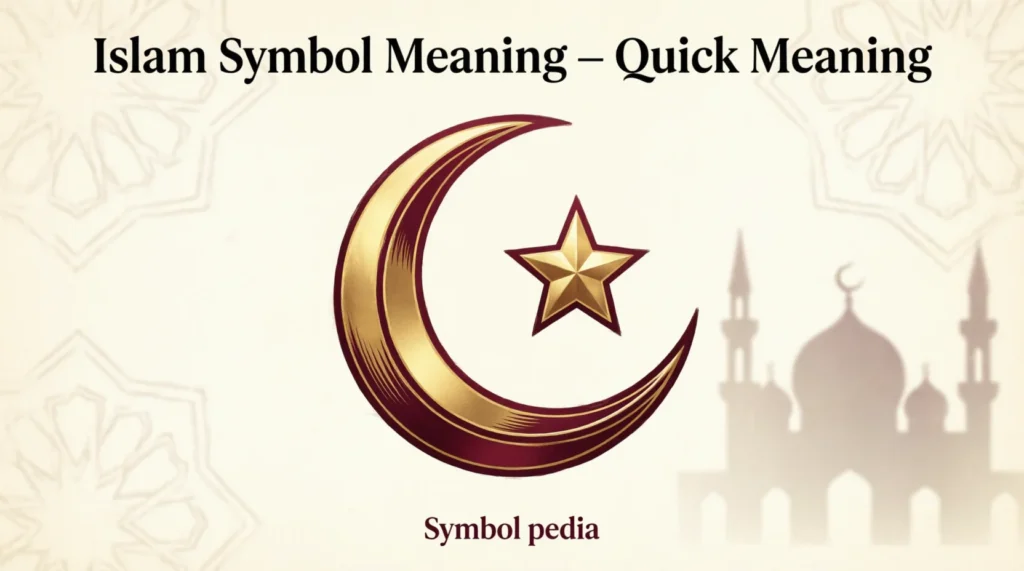
In everyday conversation, the phrase Islam symbol most commonly refers to the crescent and star.
The symbol is generally associated with:
- Islam and Muslim identity
- Muslim-majority cultures and communities
- The lunar calendar
- Islamic history and heritage
- Spiritual or cultural identity
- Mosques and Islamic-themed artwork
- Public recognition of Muslim communities
But there is no single universally official symbol of Islam.
The crescent moon has a particularly strong association with Islamic culture because the Islamic calendar is lunar. Important occasions such as Ramadan and Eid are determined according to lunar months.
A few simple examples show how people commonly understand the symbol:
“The crescent and star are often associated with Islam.”
“I saw an Islamic crescent on the mosque.”
“The crescent reminds me of Ramadan and Eid.”
These statements describe common cultural associations, rather than claiming that the symbol is a formal Islamic doctrine.
Origin & Background of the Islamic Symbol
One of the most important facts about the Islam symbol is that its history is more complicated than many modern illustrations suggest.
The crescent moon is much older than Islam. Crescent imagery appeared in several ancient civilizations and cultures long before the rise of Islam in the seventh century.
Similarly, stars have been used as symbols across countless cultures and religious traditions.
The crescent-and-star combination became particularly associated with the Ottoman Empire, whose political and cultural influence helped spread the imagery across regions where Islam was prominent.
Over time, the crescent and star became familiar to people around the world as a visual representation of Muslim societies.
That historical development is different from saying that Islam itself introduced the symbol.
The connection with the lunar calendar
The moon has an especially practical importance in Islamic life.
The Islamic calendar is based on lunar months. The beginning and ending of important months are connected to the appearance and observation of the new moon.
This is why moon imagery can feel deeply connected to Muslim life even when the crescent itself is not a required religious emblem.
Ramadan is a particularly strong example.
For many Muslims, seeing a crescent moon can immediately bring thoughts of fasting, prayer, family gatherings, generosity, reflection, and Eid celebrations.
The Ottoman influence
The crescent and star became increasingly recognizable through Ottoman visual culture and political symbolism.
As Ottoman influence expanded across parts of Europe, Asia, Africa, and the Middle East, the imagery became more widely familiar.
Later, various Muslim-majority countries incorporated crescent or crescent-and-star designs into their national flags and emblems.
This strengthened the public perception that the crescent and star represented Islam itself.
Yet national symbolism and religious doctrine are not necessarily the same thing.
Social media changed the symbol again
Today, the crescent has taken on an additional digital identity.
On Instagram, TikTok, WhatsApp, Facebook, and other platforms, people may use moon emojis, crescent designs, Islamic calligraphy, or crescent-and-star graphics to communicate Muslim identity, Ramadan greetings, spirituality, or cultural pride.
The meaning can therefore be personal as well as historical.
A simple crescent may mean something different to a practicing Muslim, a historian, an artist, or someone using it as part of a decorative design.
Real-Life Conversations
Symbols often become easier to understand when we see how people actually talk about them.
Here are a few realistic examples.
WhatsApp Conversation
Person A:
I saw a crescent and star on your status. Is that the Islam symbol?
Person B:
It’s commonly associated with Islam, yes. But I learned that it isn’t an official symbol from the Quran.
Person A:
Oh, I didn’t know that.
Person B:
Same. I mostly use it because it reminds me of Ramadan and Muslim culture.
This conversation shows the difference between cultural association and religious prescription.
Instagram DM
Person A:
What does the crescent in your bio mean?
Person B:
It represents my connection with Muslim culture and faith.
Person A:
Is the crescent mentioned in Islam as a symbol?
Person B:
Not as an official religious emblem. The moon is important because the Islamic calendar follows lunar months.
The important point is that the person is using the symbol as an expression of identity rather than claiming it is a mandatory religious sign.
TikTok Comments
Person A:
Why does everyone use the moon and star for Islam?
Person B:
It became historically associated with Muslim societies, especially through Ottoman imagery.
Person A:
So Muslims have to use it?
Person B:
No. Muslims don’t have to use a particular symbol to be Muslim.
This is one of the most useful distinctions to remember.
Text Message
Person A:
I’m making a Ramadan card. Can I put a crescent on it?
Person B:
Sure. It’s commonly connected with Ramadan and Muslim culture.
Person A:
I just don’t want to accidentally use something disrespectful.
Person B:
That’s thoughtful. Just keep the design respectful and avoid treating cultural imagery as if it were a religious requirement.
Emotional & Psychological Meaning
Symbols work because people attach memories and emotions to visual shapes.
For many people, the crescent can evoke feelings of belonging, faith, family, tradition, hope, peace, and spiritual reflection.
During Ramadan, for example, moon imagery may remind someone of evening meals with family, quiet prayers, waking for suhoor, or the anticipation of Eid.
That emotional connection can be powerful.
It also explains why symbols sometimes communicate things words cannot.
A person might place a crescent in a social media bio without writing “I am connected to Muslim culture.” The small image can communicate that feeling instantly.
From a communication perspective, this is one reason symbols remain so powerful in the digital age.
Imagine someone who grew up seeing the crescent during Ramadan every year. Years later, they see the same shape while living far away from home.
The image may suddenly bring back memories of family, familiar traditions, and childhood evenings.
The symbol is no longer simply a graphic.
It has become a personal emotional shortcut to memory and identity.
Usage in Different Contexts
1. Social Media
The crescent and star are frequently used in social media profiles, Ramadan posts, Eid greetings, Islamic-themed graphics, and educational content.
People may use 🌙 or related imagery simply to express a connection with Muslim culture.
Context matters because a moon emoji by itself does not necessarily indicate Islam.
2. Friends and Relationships
Among friends, the symbol may appear in birthday messages, Ramadan greetings, wedding invitations, profile descriptions, or conversations about faith and culture.
Someone might write:
“Ramadan Mubarak 🌙”
Here, the crescent helps create a visual connection with the occasion.
3. Work and Professional Settings
In professional environments, religious symbols should be treated respectfully.
A Muslim employee might use Islamic imagery in a personal profile or cultural event, while an organization might use a crescent in materials related to Ramadan or Eid.
However, businesses should avoid using religious imagery carelessly simply because it looks attractive.
4. Casual vs. Serious Tone
A crescent emoji can be casual.
A religious artwork featuring Arabic calligraphy, Quranic verses, or sacred imagery carries a much more serious context.
Understanding the difference is important.
A decorative moon on a social media post is not automatically equivalent to religious artwork.
When NOT to Use the Islam Symbol
Using a symbol respectfully is generally about context, intention, and cultural awareness.
Avoid using the crescent-and-star in ways that deliberately mock Islam or Muslims.
It is also better not to assume that every Muslim considers the symbol religiously important.
Different Muslims have different perspectives.
Some may happily use crescent imagery during Ramadan, while others may prefer not to associate the crescent and star with Islam because they do not consider it an authentic religious symbol.
Avoid treating it as a religious requirement
Saying something like “every Muslim must use this symbol” is misleading.
Islam does not require Muslims to display a crescent-and-star emblem.
Be careful with sacred content
If you combine a crescent with Quranic verses or other religious material, take extra care.
Sacred texts should never be used merely as decorative objects without considering their religious significance.
Common Misunderstandings About the Islam Symbol
Misunderstanding 1: “The Quran says the crescent is Islam’s official symbol.”
It does not establish a universal crescent-and-star emblem for Muslims.
Misunderstanding 2: “The crescent was created by Islam.”
Crescent imagery existed in cultures before Islam.
Misunderstanding 3: “Every Muslim identifies with the crescent.”
Not necessarily.
Muslims are a diverse global community, and attitudes toward symbols differ.
Misunderstanding 4: “The star has one fixed Islamic meaning.”
Not really.
The meaning of the star varies according to historical, national, artistic, and cultural context.
Misunderstanding 5: “A moon emoji always means Islam.”
No.
🌙 can mean nighttime, dreams, beauty, Ramadan, spirituality, or simply the moon.
The surrounding conversation determines its meaning.
Islam Symbol vs. Related Symbols and Expressions
| Symbol or Expression | Common Association | Is It an Official Universal Islamic Symbol? |
|---|---|---|
| Crescent and star | Islam, Muslim cultures, historical empires | No |
| Crescent moon 🌙 | Lunar calendar, Ramadan, Muslim culture, night | No |
| Star ⭐ | Guidance, national or cultural symbolism, general imagery | No |
| Arabic calligraphy | Islamic art, language, religious expression | No single universal symbol |
| Quranic verses | Islamic scripture and faith | Sacred text, not a logo |
| Mosque imagery | Muslim worship and community | Represents a place of worship |
| “Allah” in Arabic | God in Islamic theology | Religious expression, not a logo |
| Ramadan imagery | Fasting, worship, reflection, community | Cultural/religious imagery |
Key Insight
The most accurate way to understand the Islam symbol meaning is to separate association from doctrine. The crescent and star are widely recognized symbols of Muslim identity and culture, but Islam does not depend on a single official visual emblem.
How to Respond When Someone Uses the Islam Symbol
Your response depends on the situation.
Casual replies
- “Nice crescent!”
- “That reminds me of Ramadan.”
- “Beautiful design.”
- “I like the symbolism.”
Funny replies
If the relationship and context make humor appropriate:
- “The moon has entered the chat 🌙”
- “Definitely giving Ramadan vibes.”
- “That crescent is doing all the talking.”
Humor should never mock someone’s religion or beliefs.
Mature replies
- “I understand why people associate the crescent with Islam.”
- “It’s interesting how the symbol developed historically.”
- “I’ve always found the cultural history behind it fascinating.”
Respectful replies
If someone is discussing their faith:
- “Thanks for explaining what it means to you.”
- “I appreciate the cultural context.”
- “That helps me understand the symbol better.”
Sometimes the best response is simply to listen.
Regional & Cultural Usage
The meaning of the crescent can shift depending on where and how you encounter it.
Western Culture
In Western countries, the crescent-and-star is often immediately recognized as an Islamic or Muslim symbol.
It may appear in discussions about Ramadan, Muslim communities, mosques, Islamic organizations, or multicultural events.
However, people unfamiliar with Islamic history may assume it is an official religious emblem.
Asian Culture
Across parts of Asia, the crescent can have both religious and national associations.
Countries with large Muslim populations may use crescent imagery in national flags, architecture, educational materials, festivals, and public celebrations.
This can make the symbol feel like a familiar part of everyday culture rather than something limited to religious spaces.
Middle Eastern Culture
The Middle East contains enormous cultural and religious diversity, so there is no single attitude toward the crescent.
In some settings, it is a familiar visual reference to Islam and Muslim identity.
In others, people may emphasize that the crescent and star are historical or cultural symbols rather than an essential part of Islamic belief.
Global Internet Usage
Online, symbols move across cultural boundaries very quickly.
Someone may use 🌙 to mean Ramadan, while another person may use the same emoji simply to represent nighttime.
A crescent-and-star graphic is more strongly associated with Islam, but even that can be used in historical, artistic, national, or decorative contexts.
Gen Z vs. Millennials
Younger internet users often communicate through emojis, minimalist graphics, profile symbols, and visual shorthand.
A Gen Z user may place 🌙 in a bio or caption without explaining it.
Millennials may be more likely to use a crescent in a Ramadan greeting, religious post, or cultural context.
These are tendencies, not strict rules.
Individual background matters far more than age alone.
Is the Islam Symbol Safe for Kids?
The crescent-and-star itself is generally a non-harmful cultural and religious symbol.
Children may encounter it in books, flags, school activities, Ramadan decorations, social media, or conversations about world religions.
The most useful approach is to teach children what symbols mean rather than simply giving them a label.
For example, explain that the crescent and star are widely associated with Islam and Muslim cultures but are not a required symbol of the religion.
This encourages cultural understanding without turning a complicated history into an oversimplified rule.
FAQs About Islam Symbol Meaning
1. What is the main symbol associated with Islam?
The crescent and star are the symbols most commonly associated with Islam and Muslim cultures, although Islam does not have one universally official religious emblem.
2. What does the crescent moon mean in Islam?
The moon is important because the Islamic calendar follows lunar months. The crescent is therefore strongly connected with Muslim cultural and religious life, especially Ramadan and Eid.
3. Is the crescent and star an official symbol of Islam?
No. It is widely recognized as an Islamic or Muslim cultural symbol, but it is not an official universal symbol prescribed by Islamic scripture.
4. Did the crescent originate with Islam?
No. Crescent imagery existed in several ancient cultures before Islam. Its later association with Muslim societies developed through history, including Ottoman influence.
5. Why is the crescent associated with Ramadan?
Ramadan is based on the Islamic lunar calendar. The beginning and end of Ramadan are connected with lunar observation, making moon imagery particularly meaningful during the month.
6. Do all Muslims use the crescent and star?
No. Muslims have different cultural backgrounds and personal views about religious symbolism. Some use it, while others do not consider it an important Islamic symbol.
7. Does the moon emoji 🌙 always mean Islam?
No. The moon emoji can mean nighttime, dreams, beauty, spirituality, Ramadan, or many other things. Context determines its meaning.
Conclusion
The islam symbol meaning is best understood through both history and culture.
The crescent and star are now among the most recognizable visual associations with Islam and Muslim communities around the world. They appear in national symbols, artwork, Ramadan decorations, social media posts, and countless everyday designs.
But there is an important detail worth remembering: being widely associated with Islam does not make the crescent and star an official requirement of Islam.
The connection developed gradually through history, politics, culture, national identity, and the importance of lunar timekeeping in Muslim life.
For many people, the crescent is more than a shape. It can bring to mind Ramadan evenings, family traditions, prayer, Eid celebrations, community, or a personal connection to faith.
At the same time, respectful understanding means leaving room for different Muslim perspectives.
So if you see a crescent and star, think of it as a powerful cultural and historical symbol associated with Islam, rather than assuming it represents one fixed belief shared identically by every Muslim.
That small distinction makes the symbol—and the people who connect with it—much easier to understand.
descover more post
What Does the Swirl Symbol Mean A Complete Guide to Its …
What Does the Cadillac Symbol Mean History Hidden …
Sample Mean Symbol Statistics Meaning Formula Examples …