Seeing the small © symbol beside a name, photograph, website, book, or piece of artwork can make you wonder what it actually means.
So, what does the copyright symbol mean?
The copyright symbol © tells people that a creative work is claimed as copyrighted material. In simple terms, it signals that someone owns or controls copyright in that work and that others should not automatically assume they can copy, publish, sell, or distribute it without permission.
You may have seen it at the bottom of a website, on a photograph, inside a book, beneath a logo, or next to a creator’s name. Sometimes it appears almost invisible, while other times it is deliberately placed where everyone can see it.
Understanding the symbol is especially important online. A picture being publicly visible does not necessarily mean it is free to use. The same applies to articles, videos, illustrations, music, designs, and other original creative work.
Let’s break down what the symbol means, where it came from, how people use it today, and what you should do when you see it.
What Does the Copyright Symbol Mean?
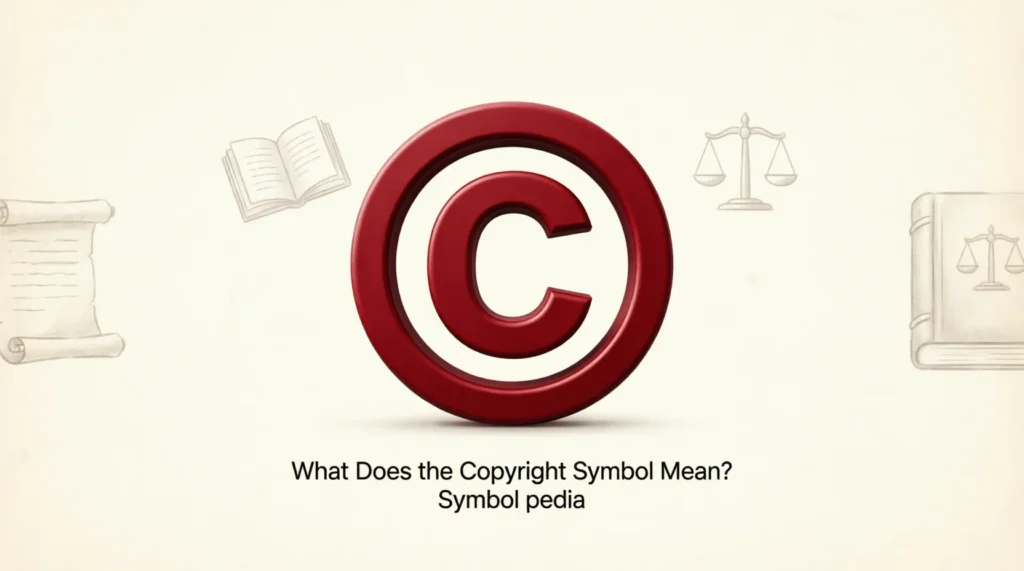
The copyright symbol (©) is a notice used to identify a work as protected by copyright.
The symbol itself looks like a C inside a circle.
For example:
- © 2026 Sarah Khan — indicates a copyright claim associated with Sarah Khan.
- © 2026 Example Publishing — indicates copyright associated with the publisher.
- © 2026 John Smith. All rights reserved. — communicates that the creator or rights holder reserves rights in the work.
In everyday language, seeing © is a reminder that the material belongs to someone or is subject to someone’s copyright rights.
You might encounter it in sentences such as:
“Please don’t repost this photo. © 2026 Maya.”
“© 2026 Green Valley Press”
“All website content © 2026.”
The important point is that © does not mean “do not look at this.” It means you should not assume you have permission to reproduce or exploit the work simply because you can access it.
What does © stand for?
The symbol © stands for copyright.
The letter C represents the word “copyright,” while the circle around it creates the familiar copyright mark.
It is commonly called the copyright symbol, copyright sign, or simply the copyright mark.
Origin & Background of the Copyright Symbol
Copyright itself is much older than the internet.
As printing technology developed, societies began creating legal systems to deal with the reproduction and distribution of books and other creative works. The underlying idea was relatively straightforward: creators needed a way to control how their original work was reproduced, while society also needed rules governing public access and eventual public use.
The modern copyright symbol developed much later.
The © symbol became particularly associated with copyright notices in the United States during the 20th century. Earlier copyright systems and laws did not always use exactly the same notice format.
The symbol became familiar because it offered an easy visual signal. Instead of writing a lengthy warning, a creator could place ©, a year, and the copyright holder’s name on the work.
For example:
© 1998 Michael Brown
was immediately recognizable as a copyright notice.
Copyright in the digital age
The internet dramatically changed how people think about copyright.
Before social media, copying a photograph or article often required physical reproduction. Today, a person can screenshot, download, copy, repost, remix, or redistribute material within seconds.
That convenience has made copyright awareness much more important.
A photograph posted publicly on Instagram, for example, may still belong to the photographer. An article published on a website may still be copyrighted even though anyone can read it.
The absence of a © symbol does not automatically mean a work is free to copy.
That distinction is one of the most common sources of confusion.
The influence of social media
Social platforms have also changed how copyright notices appear.
Creators sometimes add a copyright symbol directly to their images or videos. Others place their name, website, or watermark on the content.
This is partly legal awareness and partly social communication.
A creator might be saying, in effect:
“This is my original work. Please respect my ownership.”
The symbol therefore has both a legal and psychological function. It can identify rights while also discouraging casual copying.
Real-Life Conversations About the Copyright Symbol
The meaning of © becomes much easier to understand when you see how people actually discuss it.
WhatsApp Conversation
Person A:
Why did you put © 2026 under that picture?
Person B:
Because I took the photo myself.
Person A:
Does that mean nobody can share it?
Person B:
Not necessarily. It means I’m identifying it as my copyrighted work. I don’t want people assuming they can use it commercially without permission.
This is a realistic distinction: copyright ownership and permission to share are not always identical questions.
Instagram DM
Person A:
Can I use your artwork for my profile banner?
Person B:
Sure, if you credit me.
Person A:
I saw the © symbol and thought it meant I couldn’t use it at all.
Person B:
It means you shouldn’t assume you have permission. I’m giving you permission for this specific use.
Here, the creator voluntarily grants permission despite having copyright in the artwork.
TikTok Comments
Person A:
Why does this video have © 2026 in the caption?
Person B:
The creator is marking the content as theirs.
Person A:
So can someone still repost it?
Person B:
They might be able to share it through the platform’s built-in features, but downloading and re-uploading it somewhere else can raise different copyright issues.
The key lesson is that platform sharing features and copying content are not necessarily the same thing.
Text Message
Person A:
I’m making a school presentation. Can I use that image from your website?
Person B:
Ask me first and tell me how you’re going to use it.
Person A:
Got it. I noticed the © symbol and wasn’t sure.
Person B:
Good catch. It’s always better to check than assume.
That final idea is useful far beyond copyright: when ownership is unclear, ask before using someone else’s creative work.
Emotional & Psychological Meaning of the Copyright Symbol
At first glance, © seems purely legal.
But communication is rarely only about technical rules.
When creators place a copyright symbol on their work, they may also be expressing ownership, pride, protection, identity, and respect for creative effort.
Imagine spending twenty hours photographing a landscape, editing the images, writing captions, and building a portfolio. Seeing another account download the photograph and claim it as its own can feel deeply personal.
The copyright symbol becomes a quiet boundary.
It says:
“I created this, and that creative effort matters.”
This is particularly relevant to independent artists, photographers, writers, musicians, designers, and small businesses.
A personal-style example
I once came across a beautifully designed graphic being shared repeatedly online. People were praising it, but the original creator’s name had disappeared from most reposts.
That situation illustrates why copyright notices matter emotionally. The creator isn’t merely protecting a file. They are protecting the connection between themselves and something they created.
In modern digital communication, where content can travel faster than credit, that connection can be surprisingly easy to lose.
How the Copyright Symbol Is Used in Different Contexts
The meaning stays broadly the same, but its practical purpose can change depending on where you see it.
1. Social Media
Creators may place © in captions, profile descriptions, photographs, artwork, or videos.
For example:
© 2026 Alex Rivera | Original photography
It communicates that the content is not being offered as anonymous, ownerless material.
However, simply adding the symbol does not automatically settle every legal question about copying, licensing, or ownership.
2. Friends and Relationships
In casual conversations, people sometimes use © playfully.
A friend might write:
“© Emma’s terrible jokes, 2026.”
Here, the symbol is being used humorously rather than as a serious legal notice.
It can jokingly suggest:
“This idea belongs to me.”
3. Work and Professional Settings
Businesses commonly use copyright notices on:
- Websites
- Books
- Marketing materials
- Software
- Product photography
- Reports
- Training materials
- Original graphics
A professional notice can make ownership easier for visitors to identify.
4. Casual vs. Serious Tone
In a serious setting, © generally communicates ownership or copyright information.
In casual online conversation, however, people may use it as a joke.
For example:
“© My mom’s recipe, stolen from Grandma.”
The intended meaning is playful.
Context determines whether the symbol is functioning as a genuine copyright notice or simply as internet humor.
When NOT to Use the Copyright Symbol
Although the symbol is simple, it is worth using it thoughtfully.
Don’t use it to claim ownership of someone else’s work
Adding © Your Name to an image you downloaded does not make you the copyright owner.
Copyright isn’t created merely by typing the symbol beside your name.
Don’t assume every © notice means “no one can ever use this”
Copyright law can include exceptions and limitations, and different countries have different legal rules.
The symbol should not be treated as a universal replacement for understanding the specific rights involved.
Don’t use it to intimidate people unnecessarily
A copyright notice should communicate information, not become a vague threat.
If someone asks whether they can use your photograph, a clear answer about permission is often more helpful than simply saying, “It has © on it.”
Be culturally and legally aware
Copyright systems differ internationally.
What is permitted in one jurisdiction or context may not be treated exactly the same way elsewhere. Educational use, quotation, commentary, criticism, parody, and other situations can involve different rules.
When the stakes are high, legal advice from a qualified professional is more appropriate than relying on a symbol alone.
Common Misunderstandings About ©
Misunderstanding 1: “If there is no ©, it isn’t copyrighted.”
This is one of the biggest misconceptions.
In many copyright systems, copyright protection can arise automatically when an original work is created and fixed in an appropriate form.
The absence of a copyright symbol does not automatically make a work public domain.
Misunderstanding 2: “The symbol means I can’t even share the post.”
Not necessarily.
Some platforms provide built-in sharing functions, and specific circumstances can affect what use is permitted.
The important distinction is between using an authorized platform feature and copying or redistributing the underlying content independently.
Misunderstanding 3: “Putting © on something gives me ownership.”
No.
The symbol communicates a copyright claim; it doesn’t magically create ownership of material you did not create or otherwise acquire rights to.
Misunderstanding 4: “Copyright means nobody can ever use the work.”
Copyright generally gives rights holders control over certain uses, but copyright law also contains limitations, exceptions, and duration rules.
So copyright does not simply mean “zero use by anyone.”
Misunderstanding 5: “Copyright and trademark are the same.”
They are different.
Copyright generally concerns creative expression such as writing, photographs, artwork, music, and other protected works.
Trademark protection generally concerns identifiers associated with goods or services, such as names, logos, and brands.
Copyright Symbol vs. Similar Symbols and Expressions
| Symbol / Expression | Meaning | Common Use |
|---|---|---|
| © | Copyright | Books, websites, photographs, artwork |
| ® | Registered trademark | Registered brand names and marks |
| ™ | Trademark claim | Brand names or marks, often before registration |
| ℗ | Sound recording copyright | Music and sound recordings |
| All rights reserved | Rights are being reserved | Copyright notices and publishing |
| Public domain | Not protected by copyright in the relevant jurisdiction | Works free from copyright restrictions |
| Licensed | Permission has been granted under stated terms | Photos, software, media, creative content |
| CC | Creative Commons licensing system | Works offered under specified reuse conditions |
Key Insight
The © symbol is not interchangeable with ® or ™. If you’re trying to understand a symbol on a website or product, identifying the exact mark matters because each one communicates something different.
How to Respond When Someone Uses the Copyright Symbol
If someone sends you a message involving ©, your response depends on what they mean.
Casual replies
- “Got it!”
- “Thanks for clarifying.”
- “Understood—it’s your original work.”
- “Makes sense.”
Funny replies
- “Okay, copyright police 😄”
- “Message received, creator!”
- “Fine, I won’t steal your masterpiece 😂”
- “Your intellectual property is safe!”
Mature replies
- “Thanks for explaining. I’ll make sure I have permission before using it.”
- “Understood. I’ll credit you appropriately.”
- “I appreciate the clarification.”
- “I’ll respect your rights as the creator.”
Respectful replies
If you want to use someone’s content, the best response is direct:
“May I have permission to use this, and is there any credit you’d like me to include?”
That question is often much more useful than trying to interpret the symbol alone.
Regional & Cultural Usage of the Copyright Symbol
Copyright is an international concept, but people’s everyday understanding of the symbol can differ.
Western Culture
In the United States, Canada, the United Kingdom, and other Western countries, the symbol is widely recognized as a copyright notice.
People commonly encounter it on websites, books, photographs, software, and commercial content.
Asian Culture
Across Asian countries, the symbol is also widely used, particularly by publishers, businesses, photographers, designers, and digital creators.
However, practical understanding of copyright can vary between communities and generations.
Younger internet users may encounter copyright primarily through social media and content platforms rather than books or traditional publishing.
Middle Eastern Culture
The copyright symbol is increasingly visible across websites, business pages, publishing, photography, education, and digital media.
As online creative businesses grow, creators may use copyright notices to reinforce ownership and discourage unauthorized copying.
Global Internet Usage
Online, © has become a nearly universal visual shorthand.
Even when people speak different languages, the symbol itself is usually recognizable.
That makes it especially effective in global digital communication.
Gen Z vs. Millennials
Gen Z users may encounter copyright discussions through TikTok, Instagram, YouTube, gaming, memes, digital art, and creator culture.
Millennials may have encountered copyright through blogs, forums, websites, music downloads, photography, and early social media.
Both generations generally recognize ©, but the surrounding conversation has changed.
For younger creators, copyright can feel closely connected to digital identity and content ownership.
Is the Copyright Symbol Safe for Kids?
Yes. The copyright symbol itself is completely safe for children to learn and use.
In fact, teaching kids about copyright can encourage healthy digital habits.
Children should understand that:
- Someone created the picture they find online.
- A Google image isn’t automatically free to use.
- Copying someone’s artwork and claiming it as their own isn’t appropriate.
- Giving credit is important.
- Asking permission is a good habit.
For school projects, children should also learn that copyright rules can be nuanced. Teachers can help students understand when material can be quoted, referenced, linked, or used under applicable educational rules.
The goal isn’t to make children afraid of using online material.
It’s to teach them to respect creative work.
FAQs About the Copyright Symbol
What does the © symbol mean?
The © symbol indicates copyright. It is commonly used with a year and copyright holder’s name to identify a copyrighted work.
Does © mean I cannot use the content?
Not automatically. It means you should not assume that copying or reusing the content is permitted. Permission, licensing, exceptions, and applicable law can affect what use is allowed.
Does a work need the © symbol to be copyrighted?
No. Copyright protection can exist even when a work does not display the symbol, depending on the applicable law and circumstances.
What is the difference between © and ®?
© is associated with copyright, while ® indicates a registered trademark. They protect different types of intellectual property.
What does “© 2026” mean?
It is a copyright notice containing the year 2026. It is generally used to identify copyright information connected with a work.
Can I put © on my own work?
If you own copyright in an original work, you can generally use a copyright notice to identify it as your copyrighted material. The precise legal effect and notice requirements can vary by jurisdiction.
Is copyright the same as ownership?
Copyright generally refers to legal rights associated with an original creative work. Ownership of a physical object and ownership of copyright in that object are not necessarily the same thing.
For example, buying an original painting does not automatically mean you acquire every copyright right associated with the artwork.
Conclusion
So, what does the copyright symbol mean?
In simple terms, © is a copyright notice that identifies a work as being claimed as copyrighted material and can identify the person or organization associated with those rights.
You might see it beneath a photograph, inside a book, at the bottom of a website, next to an artist’s name, or in the caption of digital content.
But the most important lesson is not simply memorizing what the symbol looks like.
It’s understanding the idea behind it.
Behind that tiny C inside a circle may be someone’s photograph, years of writing, a carefully developed design, a business’s original content, or an artist’s personal expression.
The internet makes copying incredibly easy. Respecting the person behind the content is therefore more important than ever.
When you see ©, don’t panic and don’t automatically assume that every form of use is forbidden. Instead, treat it as a signal to pause, check the context, and understand who owns the work and what permissions may apply.
That small habit can make you a more thoughtful creator, reader, student, professional, and digital citizen.
descover more post
What Does the Infinity Symbol Mean in Apple Music Complete …
Aquarius Zodiac Symbol Meaning The Hidden Power Behind …
What Does the Swirl Symbol Mean A Complete Guide to Its …