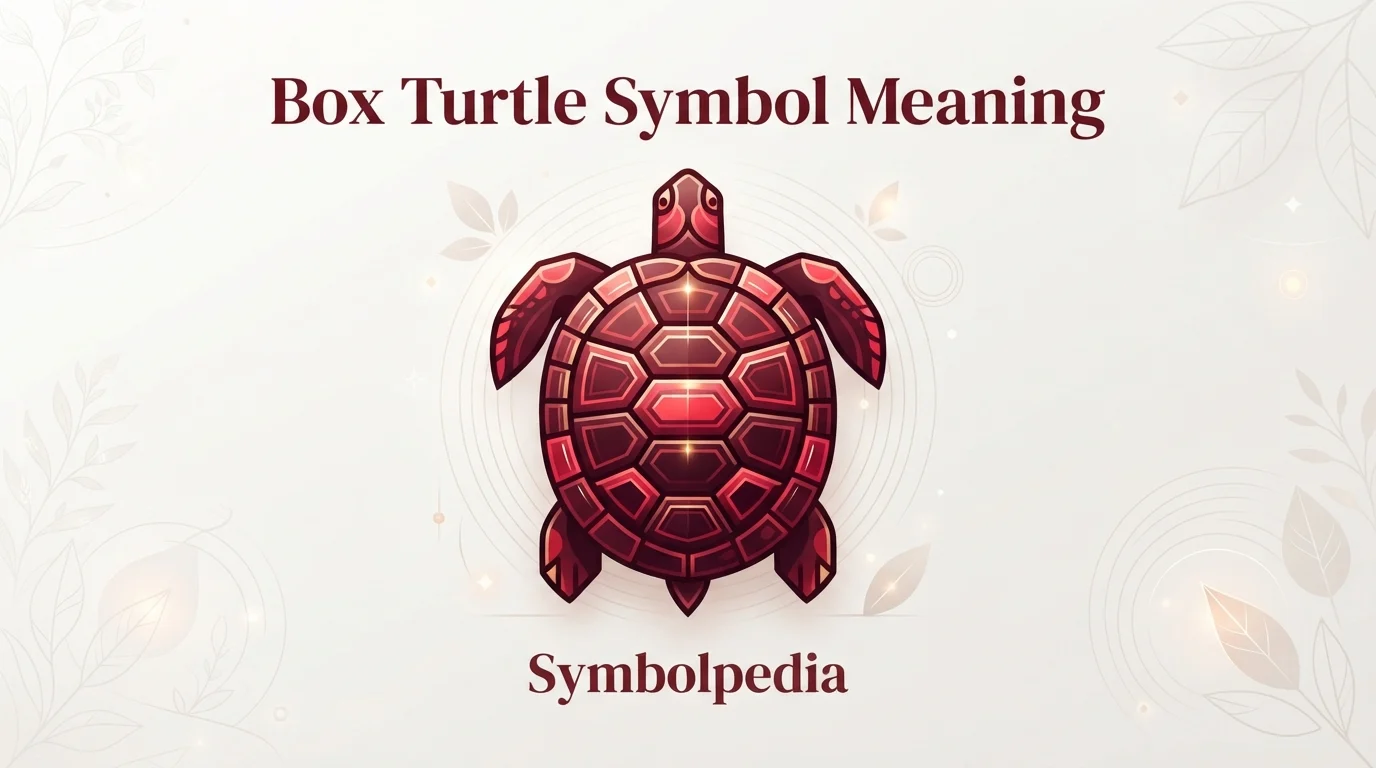
The box turtle symbol meaning is closely connected to protection, patience, wisdom, emotional boundaries, and the importance of moving through life at your own pace. This small turtle carries a powerful symbolic message: sometimes, the strongest thing you can do is protect your peace and trust your own journey.
Unlike animals that depend on speed or physical strength, a box turtle survives through patience, awareness, and its ability to retreat into its protective shell. These qualities make it an interesting symbol for people who value independence, emotional security, and personal growth.
If you have recently seen a box turtle in nature, dreamed about one, encountered it in artwork, or noticed it repeatedly in symbolic content, you might wonder whether it represents something meaningful.
People often search for box turtle symbolism because turtles have long been associated with wisdom, longevity, stability, and spiritual protection. However, the box turtle has its own distinctive characteristics that make its symbolism especially connected to boundaries, resilience, and quiet strength.
Its ability to close its shell completely also creates an important metaphor for emotional life. Just as the turtle protects itself when necessary, people sometimes need to step back from stressful situations, relationships, or overwhelming environments.
In this article, we will explore the box turtle’s symbolic meaning, cultural associations, emotional significance, spiritual interpretations, and everyday examples.
The goal is not to suggest that every box turtle encounter carries a supernatural message. Instead, its symbolism can offer a thoughtful way to understand personal experiences, emotional needs, and the importance of living with greater patience.
2. Box Turtle Symbol Meaning – Quick Meaning

The box turtle symbolizes protection, patience, emotional security, wisdom, resilience, and personal boundaries.
Its protective shell represents the ability to remain grounded while navigating difficult situations. Its slow movement reminds people that meaningful progress does not always happen quickly.
Main symbolic meanings
- Protection: Keeping yourself emotionally and physically safe.
- Patience: Understanding that progress takes time.
- Wisdom: Making thoughtful decisions instead of reacting impulsively.
- Resilience: Recovering from challenges without losing your identity.
- Boundaries: Knowing when to withdraw from situations that feel overwhelming.
- Stability: Building a secure foundation for your life.
- Independence: Trusting your own direction.
- Longevity: Appreciating consistency and long-term growth.
Simple examples
“The box turtle reminds me to protect my peace.”
“I saw a box turtle today, and it made me think about slowing down.”
“Maybe the box turtle represents my need for stronger boundaries.”
These examples show how box turtle symbolism can become a personal reflection rather than a fixed interpretation.
3. Origin and Background of Box Turtle Symbolism
Box turtles belong to the turtle family and are known for their distinctive hinged shells. This feature allows them to close their shells tightly when threatened.
Their physical behavior naturally inspires symbolic associations with protection, safety, and self-preservation.
Unlike animals that escape danger through speed, box turtles often rely on their protective structure and careful movement.
This creates a meaningful contrast between outward appearance and inner strength.
A box turtle may look vulnerable because it moves slowly, but its survival depends on strategies that are well suited to its environment.
That difference explains why people often associate it with quiet confidence and practical wisdom.
Turtle symbolism across cultures
Turtles appear in numerous cultural traditions, although their meanings differ depending on the region, historical period, and belief system.
In some Indigenous North American traditions, turtles are associated with creation stories, land, endurance, and the relationship between humans and the natural world.
Certain traditions describe the turtle as connected to the earth or to the foundation of the world.
These stories should not be treated as one universal Indigenous belief. Different nations and communities have their own teachings, histories, and interpretations.
In Chinese cultural symbolism, turtles have traditionally been associated with longevity, stability, wisdom, and good fortune.
The turtle’s long lifespan and protective shell contribute to these associations.
In Hindu traditions, the tortoise appears in the story of Kurma, an incarnation of Vishnu associated with supporting the cosmic churning of the ocean.
This story connects tortoise imagery with stability, support, and the relationship between the material and spiritual worlds.
However, these broader turtle traditions do not automatically establish a specific traditional meaning for the North American box turtle.
The box turtle’s symbolism is often a modern interpretation inspired by its distinctive behavior and physical characteristics.
How social media influenced its meaning
Social media has made animal symbolism more accessible.
People regularly encounter posts about animal encounters, spiritual signs, dreams, and personal transformation.
A box turtle appearing on someone’s walking path might become a symbol of patience or protection in a personal story.
Another person might associate it with emotional healing because the turtle reminds them of a period when they needed to establish healthier boundaries.
These interpretations are personal rather than universal.
The important distinction is that the box turtle’s biological characteristics provide a foundation for symbolism, while individual experiences shape the meaning people attach to it.
4. Real-Life Conversations
The following conversations are illustrative examples of how people might discuss box turtle symbolism in everyday communication.
They show how the animal can become a natural metaphor for emotional experiences without making the conversation feel overly spiritual or formal.
Example 1: WhatsApp conversation about patience
Person A:
“I found a little box turtle near the garden today.”
Person B:
“That’s adorable. Did you move it?”
Person A:
“No, I left it alone. It reminded me that I don’t have to rush everything.”
Person B:
“Honestly, that’s a good reminder. You’re always trying to do everything at once.”
Person A:
“Maybe I need some box turtle energy this week.”
Meaning: The box turtle represents patience, slowing down, and accepting that personal progress takes time.
Example 2: Instagram DM about emotional boundaries
Person A:
“I’ve been thinking about why I keep saying yes to things that stress me out.”
Person B:
“You need to protect your peace more.”
Person A:
“Exactly. I saw a box turtle yesterday, and its shell made me think about boundaries.”
Person B:
“That’s actually a beautiful comparison.”
Person A:
“Sometimes stepping back is healthier than explaining yourself a hundred times.”
Meaning: The turtle represents emotional protection and the ability to create distance from stressful situations.
Example 3: TikTok comments about personal growth
Person A:
“Why does everyone keep telling me to move faster in life?”
Person B:
“Because people forget that everyone has their own timeline.”
Person A:
“I feel like a box turtle trying to survive in a world full of racing cars.”
Person B:
“Slow doesn’t mean you’re losing. Keep going.”
Meaning: The box turtle symbolizes individuality, persistence, and resisting pressure to follow someone else’s timeline.
Example 4: Text messages about recovery
Person A:
“I’ve been really quiet lately. Just trying to figure things out.”
Person B:
“That’s okay. You don’t have to explain everything.”
Person A:
“I think I’m learning to protect my energy instead of forcing myself to be available.”
Person B:
“Sounds like you’re becoming a little box turtle.”
Person A:
“Honestly, yes. Taking my time and staying safe.”
Meaning: The turtle represents recovery, emotional boundaries, and the freedom to withdraw when necessary.
These conversations demonstrate how symbolic meanings can develop naturally through relationships and everyday experiences.
5. Emotional and Psychological Meaning
The box turtle’s emotional symbolism becomes especially meaningful when viewed through the lens of human behavior.
Its protective shell represents a natural form of defense.
People also develop emotional defenses when they experience rejection, stress, disappointment, or uncertainty.
However, emotional protection does not always mean avoiding relationships or refusing to communicate.
Healthy boundaries allow people to remain connected while recognizing their own limits.
Protection and emotional security
A box turtle may symbolize the desire to feel safe.
For someone recovering from a difficult relationship, the turtle can represent the importance of rebuilding trust and creating a secure emotional environment.
For someone experiencing workplace stress, it might represent the need to separate professional responsibilities from personal well-being.
The underlying message is simple: protecting yourself is not the same as giving up.
Patience and personal development
Box turtles move at a pace that reflects their natural behavior.
Symbolically, this can remind people that personal growth is not a competition.
Learning a new skill, rebuilding confidence, improving relationships, or changing habits often requires consistent effort over time.
A person who compares their progress with everyone else’s may feel frustrated even when they are making meaningful improvements.
The box turtle offers a different perspective.
Instead of asking, “Why am I not further ahead?” you can ask, “Am I moving in a direction that matters to me?”
Wisdom and thoughtful decisions
The turtle’s cautious behavior can represent the value of thinking before acting.
In emotional situations, people sometimes respond immediately because they feel pressured to defend themselves.
The box turtle offers a metaphor for creating space between an emotional reaction and a thoughtful response.
That space can help someone communicate more clearly, avoid unnecessary conflict, and make decisions they will feel comfortable with later.
A personal-style reflective scenario
Imagine someone who has recently started a new job.
They feel pressure to prove themselves, accept every responsibility, and respond immediately to every message.
After several weeks, they become exhausted.
During a weekend walk, they notice a box turtle moving slowly across a path.
The encounter reminds them that they do not need to answer every request immediately or demonstrate their value through constant availability.
They begin setting reasonable boundaries, organizing their workload, and allowing themselves time to rest.
In this scenario, the box turtle becomes a symbol of balance and self-respect.
The meaning comes from the person’s reflection, not from assuming the animal intentionally delivered a message.
6. Box Turtle Symbolism in Different Contexts
Social media
On Instagram, TikTok, Pinterest, and other platforms, box turtle symbolism may appear in nature photography, spiritual content, motivational posts, and personal reflections.
A turtle image can communicate patience, healing, emotional protection, or a reminder to slow down.
For example:
“Learning to move at my own pace.”
“Protecting my peace like a box turtle.”
“Small steps still count.”
These captions use turtle symbolism to communicate personal values.
The meaning depends on the surrounding image, caption, and conversation.
Friends and relationships
In friendships, the box turtle can represent emotional safety and the importance of respecting boundaries.
A friend who needs time alone is not necessarily rejecting the relationship.
They may simply need space to process emotions or recover from a stressful experience.
The turtle can also represent loyalty and consistency.
Healthy relationships often grow through dependable actions rather than dramatic promises.
Romantic relationships
In romantic symbolism, the box turtle may represent trust, stability, patience, and a desire for emotional security.
It can also suggest that a relationship should develop naturally rather than being forced.
For example, someone might use a turtle image to express that they prefer a slow, meaningful connection over a rushed relationship.
However, the symbol does not automatically mean marriage, a soulmate connection, or a guaranteed romantic future.
Those interpretations depend on personal beliefs and context.
Work and professional settings
The box turtle can represent steady work, thoughtful planning, and maintaining boundaries.
It may be useful as a personal reminder when dealing with deadlines, stressful projects, or demanding environments.
For example:
“I want to approach this project like a box turtle: carefully, consistently, and without unnecessary panic.”
In professional communication, the metaphor can be appropriate when the audience understands the intended meaning.
However, it is better to use direct language when discussing performance, deadlines, or serious workplace concerns.
Casual versus serious tone
Casual use:
“Box turtle mindset today. Slow, steady, and unbothered.”
Serious use:
“The box turtle reminds me that protecting my mental space is important.”
The casual version is playful.
The serious version communicates a deeper personal reflection.
Neither interpretation is automatically more meaningful than the other.
7. When NOT to Use Box Turtle Symbolism
Although box turtle symbolism is generally positive, there are situations where it may create confusion.
Avoid using it to dismiss someone’s feelings
If a friend is experiencing grief, anxiety, or a difficult personal situation, telling them to “be a box turtle” might sound dismissive.
They may need empathy rather than a symbolic explanation.
A more supportive response would be:
“Take the time you need. I’m here if you want to talk.”
Avoid assuming someone is emotionally closed
The turtle’s protective shell can represent boundaries.
However, using the symbol to describe someone as cold, distant, or unwilling to communicate may create unnecessary misunderstanding.
A person who needs privacy is not automatically emotionally unavailable.
Be careful with cultural interpretations
Turtle symbolism appears in different cultural and spiritual traditions.
It is important not to treat every tradition as interchangeable or claim that one interpretation represents all communities.
When discussing Indigenous stories, religious traditions, or cultural symbols, acknowledge their specific context.
Avoid using symbolism as medical advice
The box turtle may represent emotional healing in personal reflection.
However, it should not replace professional support when someone is experiencing serious mental health difficulties.
Symbolism can encourage reflection, but it cannot diagnose or treat a medical condition.
8. Common Misunderstandings
Misunderstanding 1: The box turtle always means protection
Protection is one of its most common symbolic associations.
However, it can also represent patience, stability, independence, wisdom, and long-term growth.
The meaning depends on the context.
Misunderstanding 2: Seeing a box turtle guarantees good luck
Some people interpret turtle encounters as positive signs.
Others simply enjoy seeing wildlife.
There is no universal evidence that encountering a box turtle predicts good fortune.
Its meaning can still be personally encouraging without being treated as a guaranteed prediction.
Misunderstanding 3: A turtle represents weakness because it moves slowly
Slow movement does not automatically mean weakness.
Box turtles have survival strategies that depend on their environment and physical characteristics.
Symbolically, this makes them useful reminders that strength can take many forms.
Misunderstanding 4: Protecting yourself means avoiding everyone
The turtle’s shell is a metaphor for boundaries, not necessarily isolation.
Healthy protection involves knowing when to rest, communicate, seek support, and maintain relationships.
Misunderstanding 5: Every turtle has exactly the same meaning
Different turtle species have different behaviors and physical characteristics.
Their symbolism may overlap, but box turtle symbolism often emphasizes its distinctive ability to close its shell and protect itself.
Personal experiences also influence how people interpret animals.
9. Comparison Table
The following table compares box turtle symbolism with related animal symbols and expressions.
| Symbol | Common meaning | Connection to the box turtle |
|---|---|---|
| Box turtle | Protection, patience, boundaries | Represents steady progress and emotional security |
| Sea turtle | Freedom, endurance, navigation | Shares resilience but emphasizes movement and journeys |
| Tortoise | Wisdom, longevity, stability | Strong connection through patience and long-term growth |
| Butterfly | Transformation, renewal | Represents change rather than primarily protection |
| Owl | Wisdom, observation, intuition | Shares thoughtful decision-making |
| Hedgehog | Defense, personal boundaries | Similar protective symbolism |
| Rabbit | Sensitivity, alertness, vulnerability | Contrasts with the turtle’s protective shell |
| Lion | Courage, leadership, confidence | Emphasizes outward strength rather than quiet protection |
| “Slow and steady” | Consistency and patience | Expresses the turtle’s gradual approach to progress |
| “Come out of your shell” | Become more open or social | Represents the opposite of withdrawing for protection |
Key Insight
The box turtle combines several qualities that are often treated separately: patience, protection, independence, and resilience. Its symbolism is especially useful when someone wants to understand how to remain strong without constantly rushing, fighting, or exposing themselves to unnecessary stress.
11. How to Respond When Someone Uses Box Turtle Symbolism
The best response depends on whether the person is being playful, emotional, reflective, or spiritual.
You do not need to share their interpretation to respond respectfully.
Casual replies
- “Honestly, I love that meaning.”
- “Slow and steady sounds pretty good to me.”
- “That’s a nice reminder to take things easier.”
- “Box turtle energy is definitely needed sometimes.”
Funny replies
- “My emotional support turtle has entered the chat.”
- “Currently operating at box turtle speed.”
- “Protecting my peace and my snacks.”
- “Slow progress, excellent shell.”
These responses work well when the conversation is lighthearted.
Mature replies
- “I think patience is something we all need more of.”
- “That’s a thoughtful way to look at personal boundaries.”
- “Sometimes taking a step back helps us make better decisions.”
- “I like the idea of moving forward without rushing.”
Respectful replies
- “That’s a meaningful interpretation.”
- “I can understand why you connect the turtle with protection.”
- “It’s interesting how animals can remind us of personal experiences.”
- “What does the box turtle symbolize for you personally?”
The last question is especially useful because it invites the person to explain their own interpretation instead of assuming you already know what they mean.
12. Regional and Cultural Usage
Box turtle symbolism does not have one universal meaning.
Its interpretation can vary depending on cultural traditions, personal experiences, religious beliefs, and the context in which the animal appears.
Western culture
In many contemporary Western settings, turtles are associated with patience, longevity, protection, and perseverance.
The box turtle’s protective shell makes it a natural symbol of emotional boundaries and self-preservation.
It may also appear in motivational content about personal growth and slow progress.
However, not everyone in Western cultures interprets animal encounters spiritually.
Some people simply appreciate turtles as interesting wildlife.
Asian cultural perspectives
In Chinese symbolism, turtles are commonly associated with longevity, stability, and wisdom.
These broader turtle associations may influence how people interpret box turtle imagery.
However, box turtles are not native to most Asian regions, and their specific symbolism should not automatically be treated as a traditional Asian belief.
In contemporary online conversations, people may combine traditional turtle imagery with personal interpretations of the box turtle.
Middle Eastern perspectives
In Middle Eastern communities, animal symbolism varies considerably according to local culture, religious background, family traditions, and individual beliefs.
There is no single universal Middle Eastern interpretation of the box turtle.
Some people may associate turtles with patience, protection, or nature.
Others may not attach any spiritual meaning to the animal.
It is better to approach the symbolism as a personal reflection rather than claiming that all Middle Eastern cultures share one interpretation.
Global internet usage
Online, box turtle symbolism often appears in conversations about mindfulness, emotional protection, healing, and personal development.
A turtle image may communicate a message without requiring a long explanation.
For example, someone might post a box turtle photograph with the caption:
“Learning that slow progress is still progress.”
The image becomes a visual expression of a personal value.
Gen Z versus Millennials
Generational differences are not absolute, but online communication styles can influence how animal symbolism is expressed.
Gen Z users may incorporate box turtle imagery into short captions, memes, aesthetic posts, or playful references to emotional boundaries.
Millennials may use the same symbolism in reflective posts about work-life balance, personal growth, or navigating stressful responsibilities.
Both generations can use the turtle as a metaphor for patience and self-protection.
The difference often comes from individual communication style rather than a fixed generational meaning.
13. Is Box Turtle Symbolism Safe for Kids?
Yes. Box turtle symbolism is generally suitable for children when explained in an age-appropriate way.
The animal can help introduce positive ideas such as patience, kindness toward wildlife, personal boundaries, and respect for nature.
For example, parents can explain:
“Just like a turtle has a shell to protect itself, people can have boundaries that help them feel safe.”
This creates an opportunity to discuss emotional awareness without making the subject frightening.
Children can also learn that wild turtles should be observed carefully rather than handled unnecessarily.
Box turtles are living animals, not toys or magical objects.
If a child encounters a wild box turtle, an adult should help them observe it from a safe distance and avoid disturbing its natural behavior.
The symbolic lesson can be positive while still encouraging responsible wildlife awareness.
14. FAQs
1. What does a box turtle symbolize spiritually?
A box turtle may symbolize protection, patience, wisdom, resilience, and emotional boundaries. Its interpretation depends on personal beliefs and the circumstances of the encounter.
2. Is seeing a box turtle good luck?
Some people consider seeing a box turtle a positive sign associated with patience and stability. However, there is no universal belief that every box turtle encounter predicts good luck.
3. What does a box turtle represent in dreams?
A box turtle in a dream may represent emotional protection, slow progress, stability, or the need for personal space. Dream interpretations are subjective and depend on the dreamer’s experiences.
4. What does a box turtle symbolize in love?
In romantic relationships, a box turtle may represent trust, patience, emotional security, and healthy boundaries. It can also symbolize allowing a relationship to develop naturally.
5. What does a box turtle symbolize in Native American traditions?
Turtle symbolism appears in different Indigenous North American traditions, including creation stories and teachings connected to the earth. However, beliefs differ among nations and communities, and the specific box turtle does not have one universal Indigenous meaning.
6. What does a baby box turtle symbolize?
A baby box turtle may represent new beginnings, vulnerability, personal growth, and the importance of protecting something that is still developing.
7. What does a box turtle crossing your path mean?
Symbolically, a box turtle crossing your path may remind you to slow down, remain patient, and trust your own direction. The meaning is personal rather than a guaranteed spiritual prediction.
15. Conclusion
The box turtle symbol meaning centers on protection, patience, wisdom, emotional boundaries, and the quiet strength that comes from moving through life with intention.
Its protective shell reminds us that creating boundaries is not a sign of weakness.
Its slow movement encourages us to recognize that meaningful progress does not always happen quickly.
And its ability to survive through careful adaptation offers a powerful reminder that strength can be quiet, steady, and deeply personal.
Whether you encounter a box turtle in nature, see one in a photograph, or use it as a symbol in your own life, its meaning can become an opportunity for reflection.
You might ask yourself whether you need more patience, stronger boundaries, greater emotional security, or simply permission to move at your own pace.
The most meaningful interpretation is the one that helps you understand your own experiences without forcing a message onto every encounter.
Sometimes, the box turtle’s greatest lesson is surprisingly simple:
You can protect your peace, trust your progress, and keep moving forward without rushing to become someone else.
discover more post
Oriole Symbol Meaning Spiritual Messages 2026 – Symbl Pedia
Lovebird Symbol Meaning Love Loyalty Romance 2026
Nightingale Symbol Meaning Hope Healing 2026 – Symbl Pedia

Kavon is a passionate content creator and digital researcher who specializes in decoding symbols, meanings, and modern internet language. With a strong focus on clarity and authenticity, Kavon writes in a way that makes complex ideas simple, relatable, and useful for everyday readers.
Known for a hardworking mindset and attention to detail, Kavon is dedicated to creating content that genuinely helps people understand the deeper meanings behind words, signs, and online expressions. Every article is crafted with care, combining research, real-life insight, and a reader-first approach.
Through Symblpedia, Kavon aims to build a trusted space where curiosity meets clarity—helping users find answers that are not only accurate but also meaningful and easy to understa