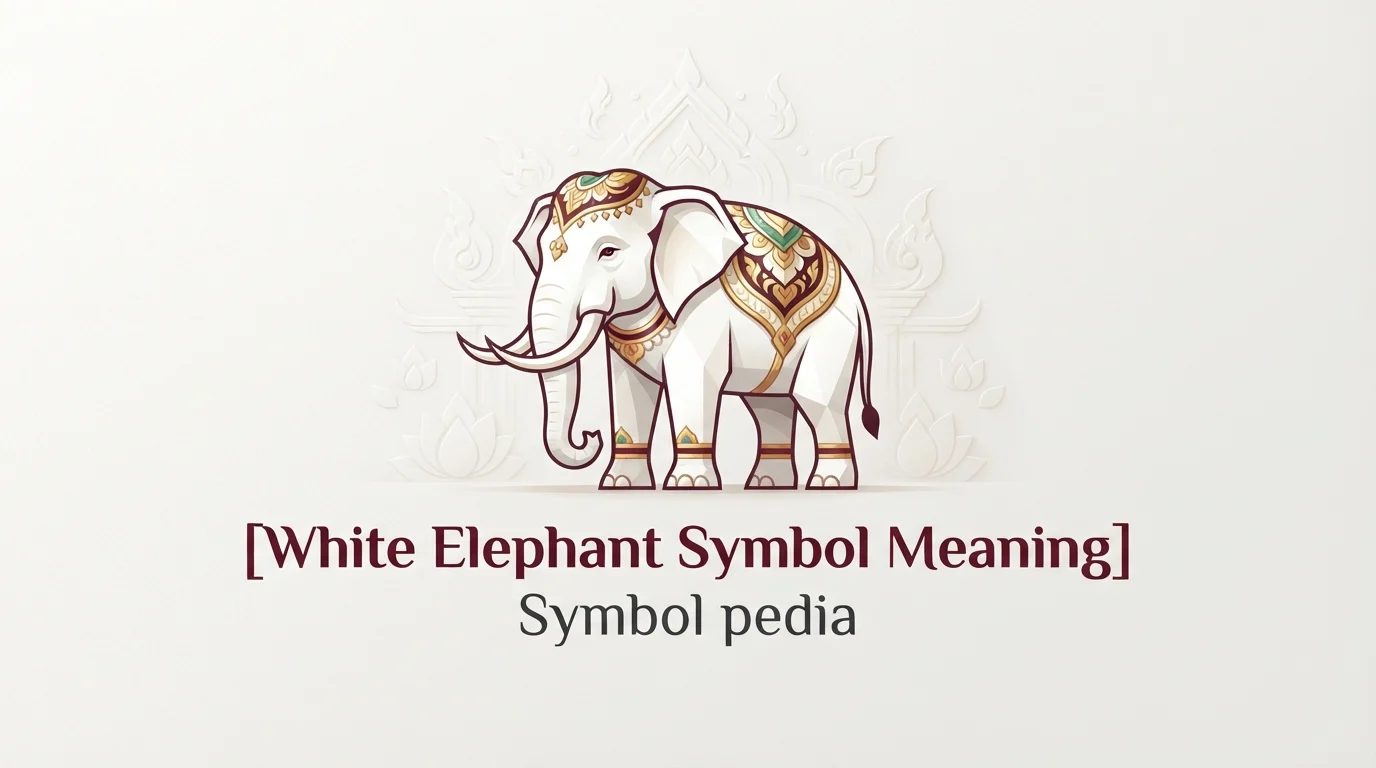
The white elephant symbol meaning is closely connected to wisdom, good fortune, spiritual importance, royal power, and responsibility. Across different cultures, the white elephant has been viewed as a remarkable animal associated with prosperity, purity, dignity, and sacred traditions. However, its meaning is not always positive. In everyday English, a white elephant can also represent something expensive, difficult to maintain, or more troublesome than useful.
This contrast makes the white elephant a fascinating symbol to explore. A white elephant appearing in a dream, a piece of artwork, a spiritual design, or a social media post may carry a different message depending on the context.
In several Asian religious and cultural traditions, white elephants have held a special place for centuries. They have been associated with Buddhist teachings, Hindu mythology, ancient kings, and ideas of spiritual greatness. In Western English, meanwhile, the expression has developed a more practical meaning, often describing an unwanted possession or costly responsibility.
Understanding these different interpretations helps you recognize what the white elephant represents in different situations. Whether you are researching its spiritual meaning, considering a tattoo, studying its cultural history, or simply curious about the phrase, this guide explains its symbolism in clear, everyday language.
White Elephant Symbol Meaning – Quick Meaning
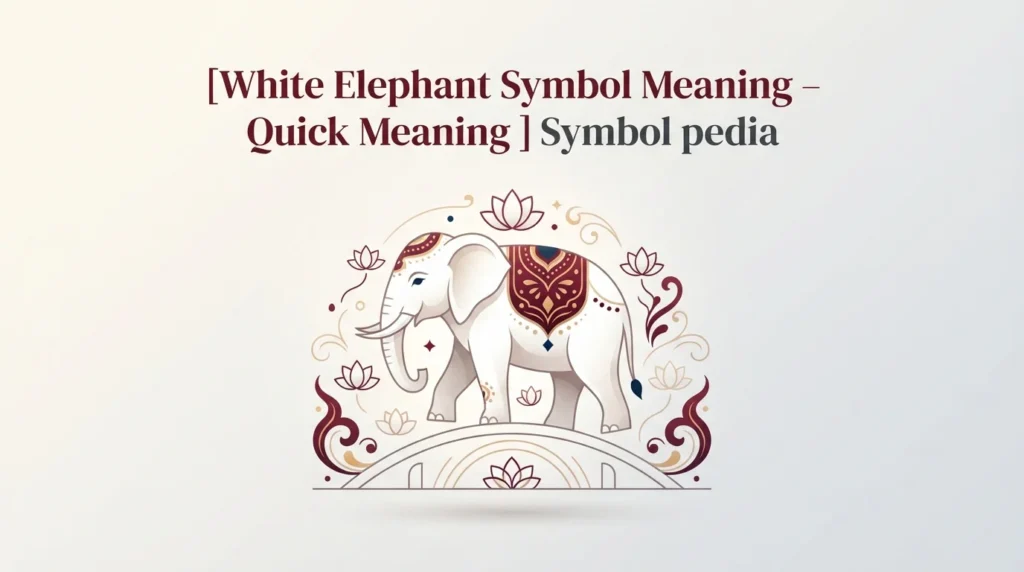
A white elephant generally symbolizes wisdom, good fortune, purity, prosperity, spiritual power, and royal dignity. Its meaning depends on the cultural tradition and the situation in which it appears.
Here are the most common interpretations:
- Good fortune: A white elephant may represent blessings, success, and positive opportunities.
- Wisdom: It can symbolize intelligence, patience, and thoughtful decision-making.
- Spiritual purity: In religious traditions, its pale appearance can be associated with sacredness and spiritual significance.
- Royal power: Historically, white elephants were associated with kingship, prestige, and authority in parts of Asia.
- Prosperity: The animal may represent abundance, status, and the hope for a prosperous future.
- Responsibility: In modern English, a white elephant can describe something valuable-looking that creates considerable expense or difficulty.
- Unwanted burden: The phrase can also refer to an object, project, or possession that is more trouble than it is worth.
For example:
- “The white elephant represents wisdom and good fortune in this artwork.”
- “Their new vacation house became a white elephant because the maintenance costs were enormous.”
- “She chose a white elephant design to represent peace, patience, and spiritual growth.”
The key is to look beyond the animal’s appearance and consider the message surrounding it.
Origin and Background of the White Elephant Symbol
Ancient Asian traditions
White elephants have been important in several Asian societies for centuries, particularly in parts of South and Southeast Asia. Their unusual appearance made them distinctive, while their association with rulers and religious traditions gave them a special cultural position.
In historical kingdoms, especially in regions that include present-day Thailand, Myanmar, and Laos, white elephants were sometimes regarded as extraordinary animals associated with royal legitimacy and prosperity. Possessing one could demonstrate a ruler’s prestige and was sometimes believed to reflect favorable fortune.
These animals were not simply decorative possessions. Their care could involve substantial resources, ceremonial attention, and special treatment. Their cultural significance helps explain why the white elephant developed such a powerful association with royalty and responsibility.
It is important to remember that white elephants are not a separate species. The term generally refers to elephants with unusually light pigmentation, often described as having pale or pinkish skin. Their appearance and cultural treatment have contributed to their symbolic importance.
The white elephant in Buddhism
In Buddhist tradition, the white elephant is particularly associated with the birth story of Siddhartha Gautama, who later became the Buddha.
According to a well-known Buddhist account, Queen Maya dreamed of a white elephant before giving birth to Siddhartha. In traditional interpretations, this dream is understood as an auspicious sign associated with the coming of an extraordinary spiritual figure.
The white elephant consequently became connected with purity, spiritual promise, wisdom, and the emergence of an important teacher.
This symbolism is especially meaningful because the elephant is also admired for its strength, steadiness, and intelligence. These qualities can serve as metaphors for a disciplined mind and a spiritual journey guided by patience rather than impulsiveness.
Interpretations differ across Buddhist communities, so the symbol should not be treated as having one identical meaning in every Buddhist tradition.
The white elephant in Hindu mythology
White elephants also have an important place in Hindu mythology.
One of the best-known examples is Airavata, the divine elephant associated with Indra, the king of the gods in Hindu tradition. Airavata is often depicted as a magnificent white elephant and is connected with divine authority, rain, clouds, and celestial power.
Through this association, the white elephant may represent strength, abundance, protection, and a connection between earthly life and the divine.
The animal’s presence in Hindu art and stories demonstrates how elephants can carry meanings beyond their physical strength. They may embody the power to protect, sustain life, and support a larger cosmic order.
How the modern expression developed
The English expression white elephant took on another meaning through historical traditions involving the costly care of these animals.
Because royal white elephants could be expensive to maintain and difficult to put to ordinary work, the expression gradually became associated with something prestigious but burdensome.
In modern English, a white elephant is often an expensive possession, building, or project that offers little practical benefit compared with its cost.
For example, a company might spend millions constructing an impressive office that employees rarely use. The building could eventually be described as a white elephant.
The phrase also appears in the popular holiday activity called a white elephant gift exchange, in which participants bring gifts and may exchange or steal one another’s selections according to the game’s rules.
These modern uses show how a symbol can preserve its historical identity while acquiring new meanings in everyday communication.
Real-Life Conversations: How People Use the White Elephant Symbol
The following examples illustrate how the expression and symbol might appear in ordinary conversations.
1. WhatsApp conversation about spiritual symbolism
Person A: I saw a white elephant in a painting at a Buddhist temple. Does it mean something special?
Person B: Yes, it’s associated with spiritual significance and good fortune in some Buddhist traditions.
Person A: That’s interesting. I thought it was just an artistic choice.
Person B: It might also be an artistic choice, but the cultural meaning makes it more meaningful.
Here, the white elephant represents religious significance, spiritual promise, and auspiciousness.
2. Instagram DM about a tattoo
Person A: I’m thinking about getting a white elephant tattoo. What do you think it symbolizes?
Person B: It can represent wisdom, patience, strength, and good fortune.
Person A: I like that. I want something that reminds me to stay calm during difficult times.
Person B: Then you could choose a design that emphasizes those personal values.
In this conversation, the symbol becomes a personal reminder of resilience and emotional growth rather than simply a decorative image.
3. TikTok comments about an expensive purchase
Person A: We finally opened the new community center, but hardly anyone visits it.
Person B: Sounds like a white elephant project.
Person C: Hopefully, they find a better way to use the space.
Person A: That’s the plan. We need more community events.
Here, the expression refers to an expensive project that has not delivered the expected practical benefits.
4. Text messages about a gift exchange
Person A: Are we doing the white elephant exchange at the office party again?
Person B: Yes! Bring a wrapped gift within the budget.
Person A: Last year, someone brought a singing fish.
Person B: And three people tried to steal it. That’s what made the game funny!
In this context, the phrase refers to a social gift-exchange game, usually designed to create laughter and friendly competition.
Emotional and Psychological Meaning of the White Elephant
Symbols often become meaningful because they connect an ordinary image with an emotion, belief, or personal experience.
The white elephant can represent several different emotional ideas, depending on how it is used.
Wisdom and emotional maturity
Elephants are widely admired for their strength, memory, and social intelligence. As a symbol, an elephant can remind people to approach difficult situations with patience and thoughtfulness.
A white elephant may add an association with purity or sacredness in traditions where the animal has religious significance.
For someone going through a challenging period, the image might represent the decision to respond calmly rather than react impulsively.
Hope and good fortune
In cultures where white elephants are considered auspicious, the symbol can communicate hope for success, prosperity, or a favorable change.
People may choose the image for artwork, jewelry, or personal decorations because it reflects their hopes for a new chapter in life.
However, a symbol of good fortune should be understood as a cultural or personal belief, not a guarantee that particular events will occur.
Responsibility and hidden burdens
The expression white elephant reveals a different psychological experience: the discomfort of owning something that demands more attention, time, or money than expected.
Imagine receiving a beautiful old house from a relative. At first, you feel grateful and excited. Later, you discover that the roof needs repairs, the plumbing is failing, and the property taxes are difficult to afford.
The house may become a white elephant. You appreciate its beauty and history, but the responsibility begins to outweigh the benefits.
This is why the expression can be emotionally powerful. It captures the difference between something that looks desirable and something that genuinely improves your life.
A personal-style scenario
Imagine someone who purchases an expensive piece of equipment because they believe it will help them start a business. Months later, the equipment sits unused while the payments continue.
They might eventually say, “I thought this would change everything, but it’s become a white elephant.”
The phrase communicates disappointment without requiring a long explanation. It expresses the realization that an attractive opportunity has turned into a burden.
Usage in Different Contexts
The meaning of a white elephant changes depending on the setting.
Social media
On Instagram, Pinterest, or other visual platforms, a white elephant image might appear in religious artwork, cultural illustrations, tattoo inspiration, or posts about good fortune.
In discussions about business or public spending, the phrase often describes an expensive project that fails to meet expectations.
Context is important: an image of a sacred animal and a caption criticizing an abandoned stadium are communicating different ideas.
Friends and relationships
Friends might use the expression humorously to describe an unwanted gift, an expensive hobby, or a possession that takes up too much space.
For example:
“Your third gaming console is becoming a white elephant. You never use it!”
In relationships, the phrase can also describe an obligation that has become emotionally or financially exhausting. However, applying it to a person can sound demeaning, so it is usually better to describe the specific situation rather than label someone a white elephant.
Work and professional settings
The expression is useful in discussions about investments, construction, technology, and business strategy.
Examples include:
- An office building that remains mostly empty.
- A software system that costs more to maintain than the value it provides.
- A public infrastructure project that receives little use.
- Equipment that is too expensive or impractical for its intended purpose.
In professional communication, the phrase can be memorable, but it may sound dismissive. In formal reports, alternatives such as underutilized asset, costly project with limited returns, or financially burdensome investment may be more precise.
Casual versus serious usage
In casual conversation, the expression often carries humor or mild frustration.
“My old boat is a white elephant. Every weekend, something else needs fixing.”
In serious discussions, it can criticize poor planning, wasteful spending, or an investment that has failed to produce meaningful benefits.
By contrast, when someone discusses the white elephant as a religious or cultural symbol, the focus may be reverence, spiritual significance, or historical tradition.
When NOT to Use the White Elephant Expression
Although the expression is widely understood in English, it is not suitable for every situation.
Avoid disrespecting religious imagery
In some Buddhist and Hindu contexts, the white elephant carries sacred or culturally significant associations. Avoid treating the animal as a joke about foolishness or waste when discussing its religious meaning.
A respectful explanation recognizes both the cultural importance of the symbol and the separate modern English expression.
Be careful when discussing personal gifts
Calling someone’s treasured possession a white elephant can hurt their feelings.
A gift might be financially impractical to you but emotionally valuable to the person who gave it. If you are discussing the situation with the owner, consider describing the maintenance costs or practical difficulties instead.
Avoid using it to criticize people
A white elephant normally describes an object, project, or responsibility. Applying it directly to a person can suggest that the person is useless, expensive, or unwanted.
That interpretation can sound insulting in a workplace or personal relationship.
Use precise language in formal writing
In financial, legal, and professional reports, the phrase may be too informal or vague.
If you mean that an asset costs more to operate than it generates in value, explain that directly. Clear language helps readers understand the actual problem.
Common Misunderstandings About the White Elephant
Several misconceptions can lead to confusion.
Misunderstanding 1: Every white elephant symbolizes good luck.
Not necessarily. Some cultural traditions associate the animal with auspiciousness, while the English expression often describes a costly burden.
Misunderstanding 2: A white elephant is a different species.
It is not a separate elephant species. The term generally refers to an elephant with unusually light pigmentation.
Misunderstanding 3: The phrase always has a negative meaning.
The negative meaning belongs mainly to its modern figurative use. In religious, cultural, and artistic settings, the animal may have positive or sacred associations.
Misunderstanding 4: White elephant gifts must be useless.
A white elephant gift exchange often includes humorous, unusual, inexpensive, or desirable gifts. The rules differ between groups, and the gifts are not necessarily worthless.
Misunderstanding 5: The symbol has exactly the same meaning throughout Asia.
Asian cultures are diverse. White elephant symbolism varies between religious traditions, countries, historical periods, and individual communities.
Misunderstanding 6: Seeing a white elephant in a dream predicts the future.
Some people interpret dreams symbolically or spiritually, but there is no reliable basis for claiming that a white elephant dream guarantees wealth, success, or a particular event.
White Elephant Symbol Meaning: Comparison Table
| Symbol or expression | Main meaning | How it differs |
|---|---|---|
| White elephant | Sacredness, good fortune, prestige, or a costly burden | Meaning depends strongly on cultural or linguistic context |
| Lucky elephant | Good luck, protection, and prosperity | Usually emphasizes positive fortune |
| Elephant symbol | Strength, wisdom, memory, and stability | Broader symbolism without necessarily emphasizing whiteness |
| Sacred animal | Religious or spiritual importance | Applies to many animals across different traditions |
| Albatross around one’s neck | A persistent burden or source of guilt | Emphasizes a problem that is difficult to escape |
| Money pit | Something that continually consumes money | Focuses on repeated financial expense |
| Millstone around one’s neck | A heavy responsibility or oppressive burden | Emphasizes emotional or practical weight |
| Valuable asset | Something that provides benefit or worth | Contrasts with the unhelpful or costly white elephant |
| Hidden gem | Something valuable that is not widely recognized | Emphasizes overlooked value rather than excessive cost |
Key Insight
The white elephant is unusual because it can symbolize both extraordinary value and unwanted expense. In cultural and spiritual settings, it may represent wisdom, prosperity, or sacred power. In everyday English, it often describes something whose costs outweigh its benefits. The surrounding context determines which interpretation makes sense.
How to Respond When Someone Uses the White Elephant Expression
Your response should reflect whether the person is discussing a cultural symbol, making a joke, or expressing frustration.
Casual replies
When a friend describes an expensive possession as a white elephant, you could say:
- “Sounds like it’s costing you more than you expected!”
- “Maybe it’s time to put it to better use.”
- “I can see why you’d call it that.”
Funny replies
If the conversation is lighthearted, try:
- “At least it looks impressive!”
- “Fancy on the outside, expensive on the inside.”
- “That thing needs its own bank account.”
Use humor only when the other person seems comfortable joking about the situation.
Mature replies
For a more thoughtful conversation, you might say:
- “It sounds like the maintenance costs are outweighing the benefits.”
- “Maybe there is a practical way to make better use of it.”
- “It might help to compare the cost of keeping it with the cost of letting it go.”
These responses acknowledge the problem without judging the person who made the original decision.
Respectful replies
If someone discusses the white elephant’s cultural or spiritual meaning, you could respond:
- “I didn’t know it had such an important cultural history.”
- “That’s an interesting connection to spiritual tradition.”
- “I appreciate you explaining what the symbol means in your culture.”
When the topic is religious or cultural, asking thoughtful questions is generally better than assuming that one interpretation applies to everyone.
Regional and Cultural Usage
Western culture
In the United States, the United Kingdom, and other English-speaking settings, white elephant is commonly used as a metaphor for an expensive possession, burdensome responsibility, or unsuccessful project.
The term is also familiar through white elephant gift exchanges, particularly during holiday gatherings and office parties.
Its traditional spiritual associations may be less familiar to some Western audiences, which can create confusion when the phrase appears in discussions of Asian religion or art.
Asian culture
White elephant symbolism has particular historical significance in several South and Southeast Asian traditions.
In Thailand, for example, white elephants have historically been associated with royal prestige and auspiciousness. In Buddhist contexts, the animal may carry religious significance connected with the Buddha’s birth narrative.
In Hindu traditions, Airavata provides another important association with divine authority.
However, it would be inaccurate to assume that every Asian community interprets the white elephant in the same way. Regional histories, religious practices, and local customs all influence its meaning.
Middle Eastern culture
The white elephant is not a single, universally established symbol across the Middle East.
Its interpretation may depend on whether someone encounters it through international English, Asian religious art, a business discussion, or a personal interest in animal symbolism.
In English-language professional settings, the phrase may be understood as describing a costly project or unwanted asset. In other contexts, the elephant may simply be an artistic or decorative image.
Avoid assigning one spiritual meaning to the entire region without considering the particular community or tradition.
Global internet usage
Online, the white elephant appears in discussions of tattoos, religious symbolism, gift exchanges, expensive purchases, and poorly planned projects.
A caption such as “This stadium became a white elephant” uses the figurative English expression. An illustration captioned “White elephant symbolism in Buddhist art” points toward a cultural or religious interpretation.
Images and short captions can remove important context, so it is worth reading the surrounding discussion before deciding what the symbol means.
Gen Z versus Millennials
Younger internet users may encounter the phrase through memes, short videos, gift exchanges, or discussions of expensive purchases. Millennials may recognize it through workplace conversations, holiday traditions, or discussions of public spending.
Neither generation has an entirely separate definition. The difference is more likely to involve the platform, the situation, and familiarity with cultural or historical background.
For both generations, context is more useful than age when interpreting the phrase.
Is the White Elephant Symbol Safe for Kids?
Yes. The white elephant symbol is generally appropriate for children, and learning about it can introduce useful ideas about animals, cultural traditions, religious stories, and figurative language.
Parents and educators can explain that the animal represents good fortune or wisdom in some traditions, while the expression white elephant can describe something expensive or difficult to maintain.
The white elephant gift-exchange game is also commonly used at family gatherings and school or community events, provided the gifts and rules are age-appropriate.
When discussing Buddhist or Hindu symbolism, present the traditions respectfully and explain that different communities may understand the symbol differently.
Children should also understand that symbolic interpretations are cultural beliefs or ways of expressing ideas, not guarantees about what will happen in the future.
Frequently Asked Questions
1. What does the white elephant symbol mean?
The white elephant can symbolize wisdom, purity, good fortune, prosperity, royal dignity, and spiritual importance. In modern English, it can also describe something expensive that is difficult to maintain or offers little practical value.
2. Is a white elephant a symbol of good luck?
In some Asian cultural and religious traditions, the white elephant is considered auspicious and is associated with prosperity or spiritual significance. However, it is not universally interpreted as a good-luck symbol.
3. What does a white elephant mean spiritually?
Spiritually, it may represent purity, wisdom, sacredness, patience, or spiritual promise. The interpretation depends on the religious tradition and the personal meaning someone attaches to the image.
4. What does a white elephant mean in Buddhism?
In a well-known Buddhist birth narrative, Queen Maya dreams of a white elephant before giving birth to Siddhartha Gautama. The story is traditionally associated with an auspicious event and spiritual significance.
5. What does it mean when someone calls something a white elephant?
It means that an object, possession, or project is expensive, difficult to maintain, or less useful than expected. For example, an enormous building that remains mostly empty might be called a white elephant.
6. What does a white elephant tattoo symbolize?
A white elephant tattoo may represent wisdom, patience, good fortune, strength, spirituality, or cultural appreciation. Its meaning depends on the design and the wearer’s intentions. Anyone choosing a religiously significant design should take time to understand its cultural background.
7. What does a white elephant mean in a dream?
Some people interpret a white elephant dream as a symbol of hope, wisdom, prosperity, or responsibility. However, dream symbolism is subjective, and there is no established evidence that such a dream predicts future events.
Conclusion
The white elephant symbol meaning reveals how one image can carry very different messages across cultures and everyday life. It can represent wisdom, purity, good fortune, royal dignity, and spiritual significance. In other situations, it describes an expensive possession or project that creates more problems than benefits.
Its cultural history adds depth to its meaning. Buddhist traditions connect the white elephant with an auspicious birth narrative, while Hindu mythology associates a divine elephant with Indra. Historical royal traditions in parts of Asia further connect the animal with prestige and prosperity.
In modern English, however, the expression often reminds us that something impressive is not always practical or worthwhile.
When you encounter a white elephant in art, conversation, a dream, or a social media post, consider the context before deciding what it represents. That simple habit will help you understand the symbol more accurately and appreciate the cultural stories and everyday experiences behind it.
discover more post
What’s FT Mean in Text Real Meaning Examples 2026
What Do NB Mean in Text Real Meaning Examples 2026
What Is DD Mean in Text Real Meaning Examples 2026

Orvian is a passionate researcher and dedicated content creator focused on exploring the deeper meanings behind symbols, signs, and cultural interpretations. With a strong interest in symbolism and human psychology, Orvian simplifies complex ideas into clear, engaging, and easy-to-understand content for readers around the world.
Through consistent research and thoughtful writing, Orvian aims to provide accurate, insightful, and meaningful information that helps users connect with symbols on a deeper level—whether for personal growth, curiosity, or knowledge.
Known for a hardworking mindset and attention to detail, Orvian believes that every symbol carries a story, and every story deserves to be understood.