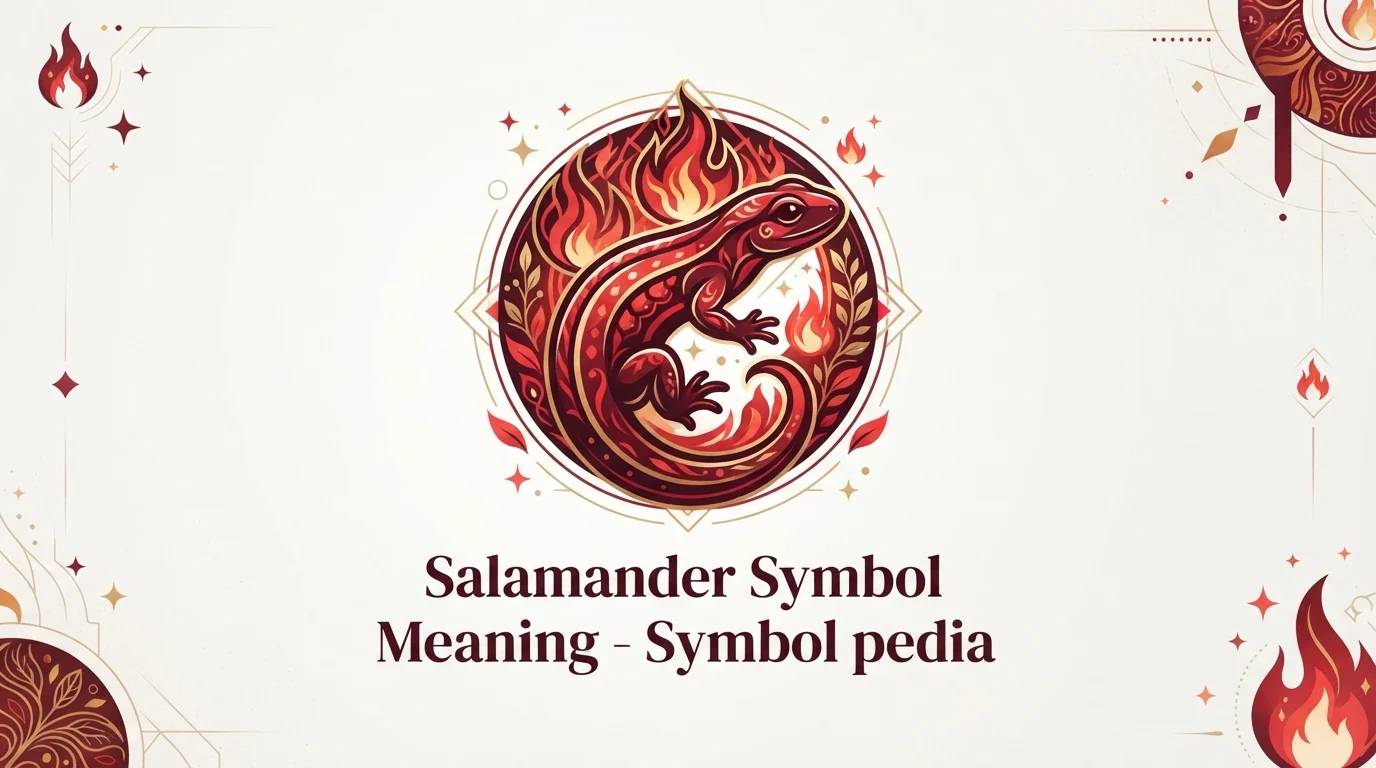
The salamander symbol meaning is often connected with transformation, resilience, protection, renewal, and the ability to survive difficult circumstances. This small amphibian has inspired fascinating stories, spiritual interpretations, and cultural traditions for centuries.
Although salamanders may look like ordinary woodland creatures, their unusual appearance and association with fire have made them powerful symbols in mythology and spiritual symbolism.
People often search for the salamander’s meaning after seeing one in a dream, encountering it in nature, noticing it in artwork, or considering it for a tattoo. Others are curious about what this creature represents emotionally and spiritually.
The interesting part is that salamander symbolism does not have one universal interpretation.
In some traditions, the salamander represents the mysterious power of fire. In modern spiritual interpretations, it can symbolize personal growth, emotional healing, adaptability, and courage during challenging times.
Understanding its meaning requires looking beyond the animal itself.
A salamander can represent the ability to remain steady when life becomes unpredictable, the courage to begin again, and the quiet strength required to move through difficult experiences.
This guide explores the salamander’s spiritual meaning, cultural background, psychological symbolism, dream interpretations, tattoo meanings, and everyday associations.
Whether you encountered a salamander unexpectedly or simply feel drawn to its symbolism, understanding these interpretations can help you discover what the creature represents to you personally.
2. Salamander Symbol Meaning – Quick Meaning

The salamander symbol meaning generally represents transformation, resilience, protection, renewal, and adaptability.
Its symbolism is influenced by ancient mythology, folklore, natural characteristics, and modern spiritual interpretations.
Here are its most common symbolic associations:
- Transformation: Moving through change and becoming a stronger version of yourself.
- Resilience: Finding strength during difficult experiences.
- Protection: Symbolizing safety, courage, and the ability to withstand challenges.
- Renewal: Representing fresh beginnings and personal growth.
- Adaptability: Learning to adjust when circumstances change.
- Fire symbolism: Connecting with passion, energy, purification, and transformation.
- Emotional healing: Encouraging recovery after painful experiences.
- Inner strength: Recognizing the power of quiet determination.
For example:
“Seeing a salamander reminds me that I can survive difficult changes.”
“The salamander represents my ability to start over.”
“I chose a salamander tattoo because it symbolizes resilience.”
The meaning depends on the situation, the cultural background, and the personal feelings associated with the animal.
3. Origin and Background of Salamander Symbolism
Ancient Greek and Roman Associations
Salamanders have appeared in European folklore and classical traditions for centuries.
Ancient writers sometimes described salamanders as mysterious creatures associated with fire. Their cool, moist bodies and secretive behavior contributed to the belief that they possessed unusual relationships with flames.
These observations eventually became part of mythology.
The salamander developed a reputation as a creature capable of surviving fire, even though real salamanders cannot withstand flames.
This distinction is important.
The symbolic salamander represents an imaginative understanding of survival, while the actual animal is vulnerable to heat, fire, and environmental damage.
Medieval European Folklore
During the medieval period, salamanders became particularly associated with alchemy, magical traditions, and elemental symbolism.
Alchemists frequently used animals and natural elements to represent spiritual or philosophical processes.
The salamander became an especially interesting symbol because of its connection with fire.
Fire could represent destruction, purification, energy, or the transformation of one substance into another.
Consequently, the salamander was sometimes interpreted as a creature capable of enduring purification and emerging from difficult circumstances.
Its image appeared in artistic traditions, heraldry, and symbolic illustrations.
In some European heraldic traditions, salamanders were depicted surrounded by flames, reinforcing their association with courage and endurance.
Salamander and Elemental Fire
In European occult traditions, the salamander became associated with the element of fire.
This association was popularized in Renaissance and later esoteric writings.
Within elemental symbolism, fire often represents:
- Passion and motivation.
- Creative energy.
- Destruction of outdated patterns.
- Spiritual purification.
- Courage and determination.
The salamander therefore became a symbolic representation of the mysterious forces connected with fire.
This does not mean that every salamander carries a spiritual message.
Rather, its historical associations have influenced how people interpret the animal today.
Modern Spiritual Interpretations
Modern spiritual interpretations often emphasize the salamander’s connection with personal transformation.
People may view it as a reminder to remain strong during periods of uncertainty.
Others associate it with emotional healing, independence, or the ability to adapt to unfamiliar situations.
Social media has also contributed to the popularity of animal symbolism.
Salamander illustrations, tattoos, spiritual posts, and nature photography frequently encourage people to explore the creature’s deeper meaning.
However, modern interpretations should not be confused with ancient beliefs.
The idea that a salamander universally represents a specific spiritual message is a contemporary interpretation rather than an established fact.
4. Real-Life Conversations
The following fictional conversations demonstrate how people might discuss salamander symbolism in everyday communication.
Example 1: WhatsApp Conversation
Person A:
“I finally decided to leave my old job. I saw a salamander near my house yesterday, and it made me think about starting fresh.”
Person B:
“That’s actually a beautiful symbol for a new beginning. Maybe it reminded you that change doesn’t have to be scary.”
Person A:
“Exactly. I’m nervous, but I feel ready.”
Here, the salamander represents transformation and the courage to move forward.
Example 2: Instagram Direct Messages
Person A:
“Why did you choose a salamander for your tattoo?”
Person B:
“Because I went through a really difficult year, and I wanted something that reminded me I could rebuild myself.”
Person A:
“That makes the tattoo much more meaningful.”
Person B:
“Yeah. It represents surviving something without letting it define me.”
In this conversation, the salamander symbolizes resilience and emotional recovery.
Example 3: TikTok Comments
Person A:
“I keep seeing salamander videos. What do they symbolize?”
Person B:
“People often associate them with transformation and fire symbolism.”
Person A:
“So basically becoming stronger after difficult experiences?”
Person B:
“That’s one common interpretation, especially in modern spiritual symbolism.”
This example shows how animal symbolism is often explained through short, accessible conversations online.
Example 4: Text Messages
Person A:
“I found a salamander while walking through the garden today.”
Person B:
“That’s cool! They’re fascinating little animals.”
Person A:
“I looked up their symbolism, and apparently they can represent adaptability.”
Person B:
“That actually fits your situation pretty well. You’ve handled so many changes recently.”
The salamander becomes a meaningful reminder of personal strength without requiring a supernatural explanation.
5. Emotional and Psychological Meaning
The salamander’s emotional symbolism is closely connected with the human experience of change.
People often become interested in symbolic animals during periods when their lives feel uncertain.
A new relationship, a difficult breakup, a career change, or a personal challenge can encourage someone to search for an image that expresses what they are experiencing.
The salamander offers several useful psychological associations.
Resilience During Difficult Times
Resilience means being able to respond to challenges, recover, and continue moving forward.
The salamander’s symbolic connection with survival makes it a meaningful representation of this quality.
Someone recovering from disappointment might connect with the animal because it represents the possibility of rebuilding.
The message is not that hardship automatically makes someone stronger.
Instead, the symbolism can encourage people to recognize the strength they develop through difficult experiences.
Transformation and Personal Growth
Transformation is another central meaning.
A salamander may symbolize the transition from an old chapter into a new one.
This could involve changing habits, developing confidence, learning healthier boundaries, or discovering a different direction in life.
Its symbolism encourages the idea that personal identity can evolve.
You do not have to remain the person you were during your most difficult period.
Emotional Healing
The salamander can also represent emotional recovery.
For someone who has experienced disappointment, the animal may symbolize the ability to continue living meaningfully without allowing past experiences to control every future decision.
Its meaning can be especially comforting when someone is learning to trust themselves again.
A Personal-Style Scenario
Imagine someone who has spent years feeling uncomfortable about expressing their opinions.
After gradually developing confidence, they begin setting boundaries and speaking honestly.
One day, they encounter a salamander while exploring a nature trail.
They decide to interpret the encounter as a personal reminder of adaptability and growth.
The animal does not need to possess supernatural powers for the experience to become meaningful.
Its symbolism simply gives the person a memorable way to recognize their progress.
That is one of the most valuable aspects of personal symbolism: it can help people connect abstract emotions with something they can see and remember.
6. Salamander Symbolism in Different Contexts
Social Media
On Instagram, TikTok, Pinterest, and other platforms, salamanders may appear in spiritual artwork, tattoo designs, nature photography, and motivational content.
Their symbolism often emphasizes:
- Personal transformation.
- Strength during adversity.
- Spiritual growth.
- Connection with nature.
- Fire and creative energy.
However, the meaning depends on the creator.
A salamander illustration in a fantasy video may simply represent a magical creature.
A salamander in a personal-growth post may represent emotional resilience.
Context determines interpretation.
Friends and Relationships
In relationships, salamander symbolism can represent adaptability and the ability to grow together.
A couple might choose matching salamander tattoos to represent surviving difficult experiences.
Someone might also use the animal as a reminder that relationships require patience and flexibility.
The symbolism can encourage a healthy understanding of change.
However, resilience should not mean tolerating disrespect or remaining in an unhealthy relationship.
Sometimes personal transformation involves recognizing when it is time to leave.
Work and Professional Settings
In professional environments, salamander symbolism may represent adaptability, determination, and learning through experience.
Someone beginning a new career might connect with the creature as a reminder to remain open to change.
Its symbolism can also be useful in creative projects involving leadership, personal development, or environmental awareness.
However, salamander symbolism is not a standard professional communication term.
It would generally be inappropriate to assume that a colleague understands its spiritual meaning without explanation.
Casual Versus Serious Meaning
In casual conversations, a salamander might simply represent an interesting animal.
In serious discussions, it may carry deeper associations with recovery, transformation, or personal identity.
A person sharing a salamander tattoo could be expressing something emotionally significant.
The best interpretation comes from listening rather than assuming.
7. When NOT to Use Salamander Symbolism
Although salamander symbolism can be meaningful, it is not appropriate for every situation.
Avoid Assuming Everyone Shares the Same Beliefs
Different cultures and individuals interpret animals differently.
Someone may appreciate salamanders as wildlife without believing they carry spiritual messages.
Respect their perspective.
Avoid Using Symbolism to Explain Serious Problems
A salamander may inspire resilience, but it cannot replace practical action.
If someone is dealing with financial difficulties, relationship problems, or emotional distress, encouraging them to focus only on symbolic meanings may be unhelpful.
Real support matters more than symbolic reassurance.
Be Careful in Professional Communication
A salamander tattoo or illustration may be appropriate in creative industries.
However, discussing its spiritual meaning in a formal business setting may confuse people who are unfamiliar with the symbolism.
Explain the meaning when necessary.
Avoid Treating Wildlife as a Spiritual Prop
Real salamanders are living animals with environmental needs.
They should not be handled unnecessarily, removed from their habitats, or exposed to dangerous conditions because someone believes an encounter carries a message.
Respecting the animal is more important than interpreting it.
8. Common Misunderstandings
Misunderstanding 1: Salamanders Actually Survive Fire
This is one of the most famous misconceptions.
Real salamanders cannot safely survive flames.
Their association with fire comes from historical folklore and symbolic traditions.
The myth should not be confused with biological reality.
Misunderstanding 2: Every Salamander Encounter Is a Spiritual Sign
Some people interpret unexpected animal encounters spiritually.
Others see them as ordinary experiences.
Neither interpretation needs to be universal.
A salamander appearing in your garden may simply mean that your garden provides a suitable habitat.
Misunderstanding 3: Salamander Symbolism Always Means Transformation
Transformation is a common interpretation, but it is not the only one.
Depending on the tradition, salamanders may symbolize fire, protection, endurance, creativity, or mystery.
Personal experiences also influence meaning.
Misunderstanding 4: Salamanders and Lizards Are the Same
Salamanders are amphibians.
Lizards are reptiles.
Although they can look similar, they belong to different animal groups and have different biological characteristics.
Their symbolic meanings may overlap, but their natural histories are distinct.
Misunderstanding 5: Salamander Symbolism Is Always Positive
Salamanders can represent powerful change, but change is not always comfortable.
Their association with fire may also symbolize destruction, uncertainty, or the need to release something outdated.
The meaning depends on the situation.
9. Salamander Symbol Meaning Compared With Related Symbols
| Symbol | Common meaning | Connection with salamander |
|---|---|---|
| Phoenix | Rebirth and renewal | Both may symbolize transformation after difficulty. |
| Dragon | Power, strength, and protection | Both can appear in fire-related mythology. |
| Butterfly | Growth and transformation | Both represent changing through different stages. |
| Snake | Renewal, wisdom, and transformation | Both may symbolize personal change. |
| Turtle | Patience, stability, and protection | Both can represent resilience, but emphasize different qualities. |
| Fire | Passion, energy, and purification | Fire is closely connected with salamander folklore. |
| Water | Emotion, healing, and adaptability | Water reflects the salamander’s natural habitat and amphibious life. |
| Phoenix symbolism | Starting again after destruction | Salamander symbolism can similarly represent endurance and renewal. |
Key Insight
The salamander’s distinctive symbolism comes from the combination of its natural identity as an amphibian and its historical association with fire. While the phoenix emphasizes dramatic rebirth, the salamander often represents quiet endurance, adaptability, and the ability to continue through challenging circumstances.
11. How to Respond When Someone Uses Salamander Symbolism
If someone shares a salamander image, tattoo, or spiritual interpretation, your response should reflect the context.
Casual Replies
- “That’s an interesting symbol.”
- “I like the meaning behind it.”
- “Salamanders are fascinating animals.”
- “That’s a cool connection with transformation.”
Funny Replies
- “Tiny creature, surprisingly big symbolism.”
- “Apparently this little amphibian has a whole mythology.”
- “Nature really knows how to create interesting characters.”
- “That’s a lot of meaning for such a small animal.”
Mature Replies
- “I like how you connected it with personal growth.”
- “That sounds like a meaningful reminder of what you’ve overcome.”
- “It’s interesting how animals can represent different experiences.”
- “The symbolism makes sense when you explain your personal connection.”
Respectful Replies
- “What does the salamander represent to you?”
- “I would love to hear why you chose that symbol.”
- “Does it have a personal meaning or a cultural connection?”
- “That’s a thoughtful interpretation.”
Asking about someone’s personal meaning is often more helpful than assuming you already understand it.
12. Regional and Cultural Usage
Western Culture
In Western European traditions, salamanders are particularly associated with fire mythology, medieval folklore, and elemental symbolism.
The fire salamander became an important figure in historical stories about unusual creatures.
Modern Western interpretations frequently emphasize resilience, transformation, and personal growth.
However, these interpretations vary between spiritual communities, artists, and individuals.
Asian Culture
Salamanders do not have one uniform symbolic meaning across Asian cultures.
Different countries have distinct folklore, religious traditions, and relationships with amphibians.
In some contexts, salamanders may simply represent wildlife, ecological diversity, or artistic inspiration.
It would be inaccurate to claim that all Asian cultures interpret salamanders as symbols of luck, protection, or spiritual transformation.
Specific cultural interpretations should be understood within their individual traditions.
Middle Eastern Culture
In Middle Eastern contexts, salamander symbolism may appear through contemporary artwork, nature-related discussions, or interpretations influenced by European mythology.
However, there is no single universal Middle Eastern salamander meaning.
The animal’s significance depends on the particular community, religious perspective, and cultural setting.
When discussing salamander symbolism in this region, it is better to avoid assigning religious meaning without reliable cultural context.
Global Internet Usage
Online, salamanders frequently appear in discussions about:
- Spiritual animal symbolism.
- Tattoos.
- Fantasy creatures.
- Environmental awareness.
- Personal transformation.
- Mythology and folklore.
Internet users often combine traditional symbolism with personal experiences.
This creates a wide range of interpretations.
Gen Z Versus Millennials
Generational differences are not absolute, but online communication can influence how people discuss symbolism.
Some younger users may encounter salamanders through aesthetic content, tattoo inspiration, fantasy media, or short spiritual videos.
Some millennials may connect the animal with personal-growth themes, mythology, or nature-related interests.
However, individual preferences matter more than age.
A person’s cultural background, interests, and experiences usually provide better clues to their interpretation than their generation alone.
13. Is the Salamander Symbol Safe for Kids?
Yes, salamander symbolism is generally appropriate for children when explained in an age-appropriate way.
The animal can introduce useful ideas about nature, resilience, and environmental responsibility.
Parents and teachers can explain that salamanders are amphibians and that different cultures have developed stories about them.
Children may also enjoy drawing salamanders, learning about their habitats, or exploring their life cycles.
However, adults should distinguish mythology from science.
For example, children should understand that salamanders cannot survive in fire, despite the traditional folklore connecting them with flames.
Real salamanders should also be treated carefully.
Children should not handle wild salamanders unnecessarily because their skin is sensitive and some species have defensive chemicals.
The safest approach is to appreciate them through observation, books, illustrations, and responsible nature education.
14. Frequently Asked Questions
What does a salamander symbolize spiritually?
A salamander commonly symbolizes transformation, resilience, protection, adaptability, and renewal in modern spiritual interpretations.
Its historical connection with fire also contributes to meanings involving passion and purification.
Is a salamander a symbol of good luck?
Some people interpret salamanders positively because they associate them with protection, courage, and personal growth.
However, salamanders are not universally recognized as lucky animals.
Their meaning depends on cultural traditions and personal beliefs.
What does seeing a salamander mean?
Seeing a salamander may inspire thoughts about change, resilience, or connection with nature.
Some people interpret the encounter spiritually, while others simply appreciate the animal.
There is no scientifically established universal message associated with seeing one.
What does a salamander tattoo mean?
A salamander tattoo may represent resilience, transformation, independence, courage, or a meaningful personal experience.
Its specific meaning depends on the person wearing it and the design.
Why is the salamander associated with fire?
European folklore historically portrayed salamanders as creatures capable of surviving flames.
This association developed into symbolic connections with elemental fire, courage, purification, and transformation.
Real salamanders cannot safely survive fire.
What does a salamander represent in dreams?
A salamander in a dream may reflect personal associations with change, emotional recovery, or resilience.
However, dream interpretation is subjective.
The dreamer’s emotions and circumstances are more useful for understanding the experience than a fixed symbolic definition.
What is the difference between salamander and phoenix symbolism?
A phoenix commonly represents rebirth after destruction.
A salamander often represents resilience, adaptability, and transformation, especially through its historical connection with fire.
Both can symbolize renewal, but their mythological backgrounds are different.
15. Conclusion
The salamander symbol meaning offers a fascinating connection between nature, mythology, emotional resilience, and personal transformation.
Historically, salamanders became associated with fire, mystery, and the extraordinary ability to endure difficult conditions.
Modern interpretations often build on these associations, presenting the salamander as a symbol of courage, adaptability, renewal, and inner strength.
For some people, the salamander represents surviving a difficult chapter.
For others, it symbolizes the freedom to change, the courage to begin again, or a deeper appreciation of the natural world.
Its meaning can also be simple.
Sometimes an animal becomes meaningful because it reminds us of something we already understand about ourselves.
The most important thing is to approach salamander symbolism with curiosity rather than treating it as a universal spiritual rule.
Learn about its history, appreciate its natural characteristics, and consider what its symbolism means within your own experiences.
A salamander may be small, but its place in mythology and modern symbolism reminds us that meaningful ideas can come from unexpected places.
Ultimately, the salamander represents the possibility of adapting, growing, and moving forward without losing your connection to who you are.
discover more post
Honeybee Symbol Meaning Love Hard Work Loyalty 2026
Tanager Symbol Meaning What This Colorful 2026
Blue Dragonfly Symbol Meaning Spiritual Messages 2026

Kavon is a passionate content creator and digital researcher who specializes in decoding symbols, meanings, and modern internet language. With a strong focus on clarity and authenticity, Kavon writes in a way that makes complex ideas simple, relatable, and useful for everyday readers.
Known for a hardworking mindset and attention to detail, Kavon is dedicated to creating content that genuinely helps people understand the deeper meanings behind words, signs, and online expressions. Every article is crafted with care, combining research, real-life insight, and a reader-first approach.
Through Symblpedia, Kavon aims to build a trusted space where curiosity meets clarity—helping users find answers that are not only accurate but also meaningful and easy to understa