Have you ever received a text containing just “><” and wondered what the person was trying to say?
You are not alone. Unlike abbreviations such as “LOL” or “BRB,” >< is a visual text symbol whose meaning changes depending on the conversation. It can express frustration, embarrassment, awkwardness, emotional overload, excitement, or a playful reaction.
The interesting part is that there is no single official definition of “><” in texting. The person’s age, online community, relationship with you, and the message surrounding it can all change how you should interpret it.
For example, someone might reply “>< I can’t believe I did that” to show embarrassment. Another person might use “><” after something annoying happens. In anime-inspired or emoticon-heavy online communities, it can also represent tightly shut or squeezed eyes.
So, if you are searching for “what does >< mean in text,” the safest answer is: it is usually a facial or emotional text expression used to show a strong reaction, often frustration, embarrassment, awkwardness, or being overwhelmed.
Let’s look at how this unusual little symbol actually works in everyday communication.
What Does >< Mean in Text? – Quick Meaning
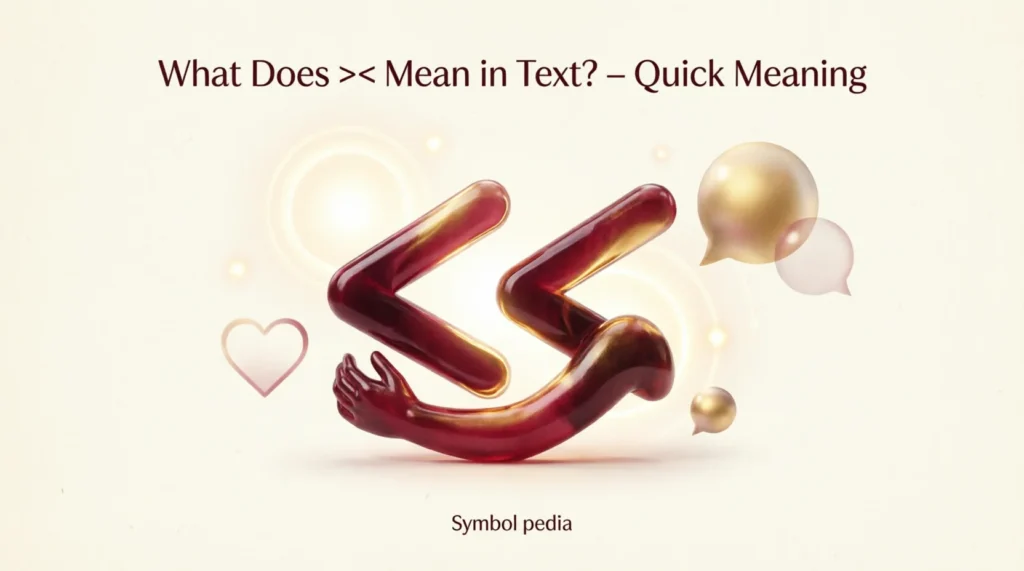
>< usually represents an emotional facial expression rather than a traditional abbreviation.
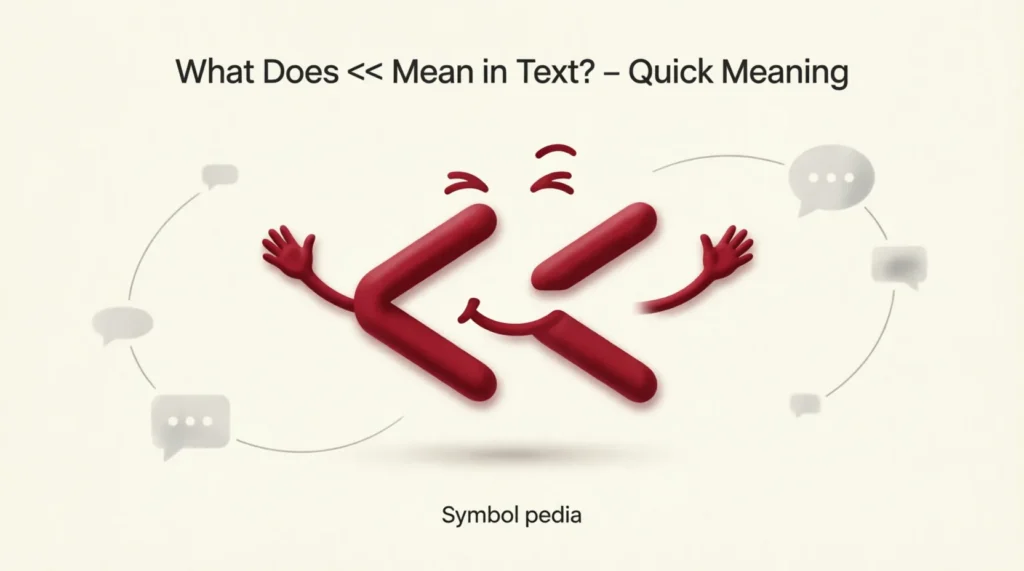
Depending on context, it can suggest:
- Frustration: “Ugh, >< this is so annoying.”
- Embarrassment: “>< I can’t believe I said that.”
- Awkwardness: “>< That was embarrassing.”
- Overwhelmed feelings: “I have so much work ><”
- Playful emotional reaction: “Stoppp ><”
- Tightly squeezed or closed eyes: A visual emoticon-style interpretation.
Think of >< as a tiny picture rather than a word.
The two symbols can resemble tightly squeezed eyes, especially when used in communities where text-based facial expressions are common.
Simple examples
“>< I messed up again.”
“Stop teasing me ><”
“This homework is killing me ><”
In all three examples, the basic emotional message is stronger than the literal symbols themselves.
Where Did >< Come From?
The meaning of >< is connected to the broader history of text-based emoticons.
Before modern emojis became standard on phones and social platforms, internet users often created facial expressions from ordinary keyboard characters. Classic examples include 🙂 for a smile, 🙁 for sadness, and XD for laughing.
As online communication developed, users became more creative with punctuation and symbols. Expressions such as ><, ^_^, T_T, -_-, and >_< became recognizable in certain online communities.
The exact history of “><” is difficult to reduce to one inventor or one official starting point. It developed organically through internet culture, gaming communities, forums, fandom spaces, messaging, and other forms of informal digital communication.
The related expression “>_<” is particularly recognizable as a squeezed-eye or distressed facial expression. People sometimes shorten, modify, or reverse these symbols depending on their typing habits.
Influence of anime and internet culture
Asian internet culture, especially Japanese-inspired emoticon styles, helped popularize expressive keyboard faces among international online communities.
Expressions such as T_T for crying or ^_^ for happiness showed users that punctuation could communicate emotion without using words.
That cultural influence eventually spread through forums, gaming, social media, fan communities, and messaging platforms.
Today, however, you should not assume that everyone uses >< in exactly the same way.
How >< Is Used in Modern Social Media
Modern texting is highly visual.
People often use emojis, punctuation, GIFs, reaction images, capitalization, and repeated letters to communicate emotional details that would normally come from facial expressions or voice.
That is where >< fits.
Someone may type:
“Nooo ><”
The symbols are not really adding factual information. They are adding emotional texture.
Without them, “Nooo” could sound neutral. With ><, the message feels more like an exaggerated facial reaction.
This is one reason unusual text symbols survive even when emojis are widely available. They can create a particular online personality or nostalgic internet style.
Real-Life Conversations Using ><
The easiest way to understand this expression is to see it in realistic conversations.
1. WhatsApp Conversation – Embarrassment
Person A:
Did you really send that message to your teacher?
Person B:
YES >< I thought I was texting my friend.
Person A:
Oh no 😭
Person B:
I wanted to disappear after that.
Here, >< communicates embarrassment and emotional discomfort.
2. Instagram DM – Playful Reaction
Person A:
I saw your old dance video 😂
Person B:
Delete it right now ><
Person A:
Absolutely not.
Person B:
You’re actually evil ><
In this situation, the symbol is playful rather than genuinely angry.
The surrounding words make that clear.
3. TikTok Comments – Frustration
Person A:
Why does this recipe always fail for me?
Person B:
Same >< I followed every step.
Person C:
Mine came out perfect somehow 😭
Here, >< expresses frustration or mild exasperation.
4. Text Message – Feeling Overwhelmed
Person A:
Are you ready for tomorrow’s exam?
Person B:
Not even close ><
Person A:
How much do you have left?
Person B:
Basically the entire syllabus.
The symbol adds emotional emphasis to the statement. It makes “not even close” sound more expressive and stressed.
The Emotional & Psychological Meaning of ><
Small symbols can carry surprisingly large emotional meanings.
When someone types ><, they may be trying to communicate something that ordinary words don’t capture perfectly.
For example, saying:
“I’m embarrassed.”
is direct and serious.
But:
“I can’t believe I did that ><”
feels lighter, more spontaneous, and more emotionally expressive.
That difference matters in digital communication.
Why people use it
People often use >< because it:
- Softens a potentially serious statement
- Shows emotional intensity
- Makes a message more playful
- Communicates embarrassment without explaining it
- Mimics a facial expression
- Adds personality to short messages
In my experience with informal English, people often rely on these tiny visual cues when they want their message to sound emotionally alive rather than flat.
For example, “Stop” can sound annoyed.
“Stoppp ><” can sound playful or embarrassed.
The punctuation and visual expression change the emotional reading.
What it reveals about modern communication
Digital communication removes many signals we normally depend on.
When speaking face-to-face, you can see someone’s smile, raised eyebrows, nervous expression, or embarrassed reaction.
Text removes those signals.
Symbols such as >< help put some of that emotion back into the conversation.
Using >< in Different Contexts
Social Media
On TikTok, Instagram, Discord, gaming chats, and informal social platforms, >< can feel natural when used by people who already understand emoticon-style communication.
It works especially well in playful or emotional conversations.
Friends and Relationships
Among close friends, >< may communicate embarrassment, teasing, affection, annoyance, or exaggerated frustration.
For example:
“You’re so annoying ><”
may actually be affectionate depending on the relationship.
The same sentence between strangers could sound genuinely hostile.
Work and Professional Settings
Be careful here.
Although >< may be understandable in casual workplaces, it is generally better avoided in formal emails, business proposals, professional complaints, or communication with someone you do not know well.
Instead of:
“I missed the deadline ><”
a professional message should simply explain the situation clearly.
Casual vs. Serious Tone
The surrounding message matters enormously.
“I forgot my passport ><”
Usually suggests frustration or panic.
“I forgot my passport.”
Sounds more neutral and potentially serious.
“STOP ><”
Could be playful or genuinely irritated.
That is why punctuation and context should always be considered together.
When NOT to Use ><
There are situations where this symbol can create more confusion than personality.
Formal communication
Avoid it in formal applications, official correspondence, academic writing, and most professional emails.
Serious situations
If someone is discussing grief, illness, an emergency, a major conflict, or another sensitive subject, an unclear emoticon can appear dismissive.
With people unfamiliar with internet slang
Older relatives, teachers, clients, or colleagues may simply wonder what the symbols mean.
Cross-cultural conversations
Not every online community interprets keyboard expressions in the same way.
If clarity matters, ordinary words are safer.
Common Misunderstandings About ><
“>< always means anger.”
Not necessarily.
It can express frustration, but it can also indicate embarrassment, awkwardness, excitement, playful discomfort, or a squeezed-eye reaction.
“>< is an abbreviation.”
Usually, no.
It is better understood as a text emoticon or symbolic expression than an acronym.
It does not stand for a standard phrase such as “laughing out loud.”
“Everyone understands it the same way.”
Definitely not.
Internet expressions are highly community-dependent.
Someone who regularly uses emoticons may immediately recognize ><, while another person may see it as nothing more than two mathematical symbols.
“It literally means greater-than and less-than.”
Technically, the individual characters > and < are mathematical comparison symbols.
But when placed together as >< in a chat, they can function visually rather than mathematically.
The context tells you which interpretation makes sense.
>< Compared With Similar Expressions
| Expression | Common Meaning | Typical Tone |
|---|---|---|
| >< | Frustration, embarrassment, awkwardness, squeezed-eye reaction | Playful/emotional |
| >_< | Strong frustration, embarrassment, discomfort | Expressive |
| T_T | Crying or sadness | Emotional |
| XD | Laughing or amusement | Playful |
| -_- | Annoyance, disbelief, unimpressed reaction | Dry |
| ^_^ | Happiness or friendliness | Warm |
| 😭 | Crying, extreme laughter, emotional reaction | Modern/casual |
| 😖 | Distress, frustration, discomfort | Clearer |
| ugh | Annoyance or frustration | Casual |
| OMG | Surprise or shock | Casual |
Key Insight
The biggest difference is that >< is ambiguous. Emojis such as 😖 have a more standardized visual meaning, while keyboard expressions depend much more heavily on the user’s personal style and online community.
How to Respond When Someone Uses ><
Your response should depend on the emotion behind it.
Casual replies
- “Haha, what happened?”
- “You okay? 😂”
- “I knew you were going to react like that.”
- “Why are you making that face? 😭”
Funny replies
- “Not the >< face again 😂”
- “Someone is emotionally defeated.”
- “I can literally hear the frustration.”
- “Okay, okay, I’ll stop 😭”
Mature replies
If the context seems genuinely frustrating:
- “What happened?”
- “That sounds frustrating.”
- “Want to talk about it?”
- “I understand. Take your time.”
Respectful replies
If you’re unsure what they mean, simply ask:
“What do you mean by >< here?”
That may sound basic, but it is often the smartest response. Guessing someone’s emotional meaning can easily create an unnecessary misunderstanding.
Regional and Cultural Usage
Western Culture
In Western online spaces, >< is usually understood by people familiar with emoticons, gaming, fandoms, or older internet culture.
However, it is less universal than mainstream emojis.
Younger users may understand the emotional intent without regularly using the symbol themselves.
Asian Culture
Text-based facial expressions have a particularly rich history across several Asian online communities.
Different countries and platforms have developed their own preferred combinations of characters, so >< may feel more familiar in some communities than in others.
It is still important not to assume that every Asian texter uses or interprets it identically.
Middle Eastern Culture
In Middle Eastern online communication, users commonly mix English, Arabic, emojis, transliterated Arabic, and internet slang.
The meaning of >< is generally determined by the immediate conversational context rather than by a single regional definition.
A close friend may understand it as playful embarrassment, while someone unfamiliar with internet emoticons may not recognize it at all.
Global Internet Usage
Gaming, anime, fandom, Discord, social media, and international messaging have blurred many traditional language boundaries.
As a result, expressions that originated or became popular within particular internet communities can now appear worldwide.
Still, familiarity does not equal universal meaning.
Gen Z vs. Millennials
Generational differences can be noticeable.
Millennials who spent years on forums, MSN-style messaging, gaming communities, and early social media may recognize older keyboard emoticons immediately.
Some Gen Z users may prefer emojis, reaction images, or newer slang instead.
That does not mean Gen Z cannot understand ><. It simply means the expression may feel more niche or stylistic to some users.
Is >< Safe for Kids?
Yes, >< itself is generally harmless. It is simply a text-based emotional expression.
The important issue is context.
Children and teenagers may encounter it in gaming chats, social media, fandom communities, or private messages. Parents should focus less on the symbol itself and more on the surrounding conversation, the people involved, and whether the interaction is appropriate.
A child asking what >< means is not, by itself, a warning sign.
FAQs About >< in Text
What does >< mean in texting?
>< is usually a text emoticon expressing frustration, embarrassment, awkwardness, or an intense emotional reaction. Its exact meaning depends on context.
Is >< an emoji?
No. It is better described as a keyboard-based emoticon or text expression made from punctuation symbols.
Does >< mean angry?
Sometimes, but not always. It can show frustration or irritation, but it may also represent embarrassment, awkwardness, playful discomfort, or emotional overwhelm.
What does >_< mean in texting?
>_< commonly represents tightly squeezed eyes and can express frustration, embarrassment, pain, or discomfort. It is closely related to ><.
Is >< flirting?
Not inherently. Someone might use it during playful or flirty conversation, but >< does not automatically mean flirting. The surrounding words and relationship matter.
Is >< rude?
Usually not. It is generally informal and expressive rather than rude. However, using it during a serious conversation could make your message seem dismissive or immature.
Should I use >< in a professional message?
Generally, no. In professional communication, clear language is safer because not everyone interprets informal emoticons in the same way.
Final Thoughts
So, what does >< mean in text?
Most commonly, it is a visual emotional reaction. Depending on the conversation, it can communicate frustration, embarrassment, awkwardness, playful annoyance, or the feeling of squeezing your eyes shut.
The important lesson is not to treat >< like a word with one fixed definition.
Digital communication is flexible. A tiny pair of symbols can change meaning depending on who sends it, what happened immediately before it, and how close the two people are.
If your friend says “Stop teasing me ><”, they may be laughing while typing it. If someone says “I can’t deal with this ><”, they may genuinely be frustrated.
When you’re unsure, read the whole conversation rather than interpreting the symbols alone.
That is the real secret to understanding internet language: context often speaks louder than the characters themselves.
descover more post
What Does the Heart Symbol Mean Meaning Emotions Colors …
What Does the Lock Symbol Mean on Snapchat Everything …
What Does the Swirl Symbol Mean A Complete Guide to Its …

Orvian is a passionate researcher and dedicated content creator focused on exploring the deeper meanings behind symbols, signs, and cultural interpretations. With a strong interest in symbolism and human psychology, Orvian simplifies complex ideas into clear, engaging, and easy-to-understand content for readers around the world.
Through consistent research and thoughtful writing, Orvian aims to provide accurate, insightful, and meaningful information that helps users connect with symbols on a deeper level—whether for personal growth, curiosity, or knowledge.
Known for a hardworking mindset and attention to detail, Orvian believes that every symbol carries a story, and every story deserves to be understood.